
- What is a pain and suffering journal and why does it matter in Irvine personal injury cases?
- How can a pain journal be used as evidence in California courts?
- What should you track in your pain and suffering journal each day?
- Where can you find an Irvine personal injury lawyer pain journal template you can use today?
- How often should you write, and how do you build consistent habits?
- How do you use a pain journal in a California personal injury claim?
- What deadlines apply in California, and how does a journal help you meet them?
- Will keeping a pain journal affect your privacy and medical records?
- What will insurance adjusters and defense lawyers look for in your journal?
- What common mistakes should you avoid when keeping an injury diary?
- How do California juries think about pain and suffering damages?
- Should you use a notebook or a secure app for your pain journal?
- Should you share your pain journal with your doctors and therapists?
- Why does local context in Irvine, CA matter for your documentation?
- Who is GoSuits and how can our approach support your injury claim?
- References and resources
What is a pain and suffering journal and why does it matter in Irvine personal injury cases?
A pain and suffering journal, also known as an injury diary or car accident pain diary, is a structured record of your symptoms, pain levels, daily limitations, and treatment progress after an injury. In California civil cases, your non economic damages such as pain, suffering, inconvenience, emotional distress, and loss of enjoyment of life are real categories of compensation that may be considered by a jury when liability and causation are proven. California’s standard jury instruction confirms that there is no fixed formula for noneconomic damages and that jurors use their judgment to decide a reasonable amount based on the evidence presented [1]. A clear, consistent diary helps turn day to day experiences into admissible proof or useful testimony, supporting the narrative of how the injury changed your life.
You might hear this called a pain and suffering journal, injury claim documentation, daily symptom tracker, or injury diary template. Regardless of the label, its goal is the same. It captures concrete details that are easy to forget months later when you are in negotiations or testifying under oath. For local relevance, our Irvine personal injury lawyer pain journal template below gives you a practical, case ready format you can start using today.
Motor vehicle crashes remain a leading source of serious injuries nationwide. Public health data shows the widespread impact of crash injuries on individuals and communities, with substantial medical and economic costs each year [9]. These numbers highlight why accurate injury documentation matters for California personal injury claim evaluation and settlement talks.
How can a pain journal be used as evidence in California courts?
Whether and how your journal can be used in court depends on the purpose for which it is offered and on the rules of evidence. There are multiple pathways for a lawyer to use your entries.
- Refreshing your recollection: If your memory needs a prompt at deposition or trial, you may review your diary to refresh your recollection. California Evidence Code section 771 governs writings used to refresh memory [5]. In federal court, Federal Rule of Evidence 612 addresses the same concept [6].
- Recorded recollection: If you cannot recall even after reviewing, a contemporaneous entry may be read into evidence as a recorded recollection if the statutory elements are met. California Evidence Code section 1237 covers this hearsay exception [4].
- State of mind or physical condition: Statements describing then existing physical sensations or symptoms may be admissible under California Evidence Code sections 1250 through 1252 and the analogous Federal Rule of Evidence 803, subdivision 3, when offered for that limited purpose [2] [3].
- Probative versus prejudicial balance: Even relevant entries may be limited or excluded if their probative value is substantially outweighed by risks like undue prejudice, undue consumption of time, or confusion. California Evidence Code section 352 provides this balancing test [11].
These pathways are fact specific. A diary kept close in time to the events, using neutral language, consistent scales, and objective anchors such as medication doses, work absences, and medical appointments is more likely to be persuasive for settlement and to withstand evidentiary scrutiny if the case goes to trial [1]. Good documentation helps your attorney decide whether to use the entries to refresh your memory, as a recorded recollection, or as circumstantial evidence of symptoms.
What should you track in your pain and suffering journal each day?
Think of your diary as a daily symptom tracker and medical appointment log rolled into one. The best entries are clear, brief, and consistent across time.
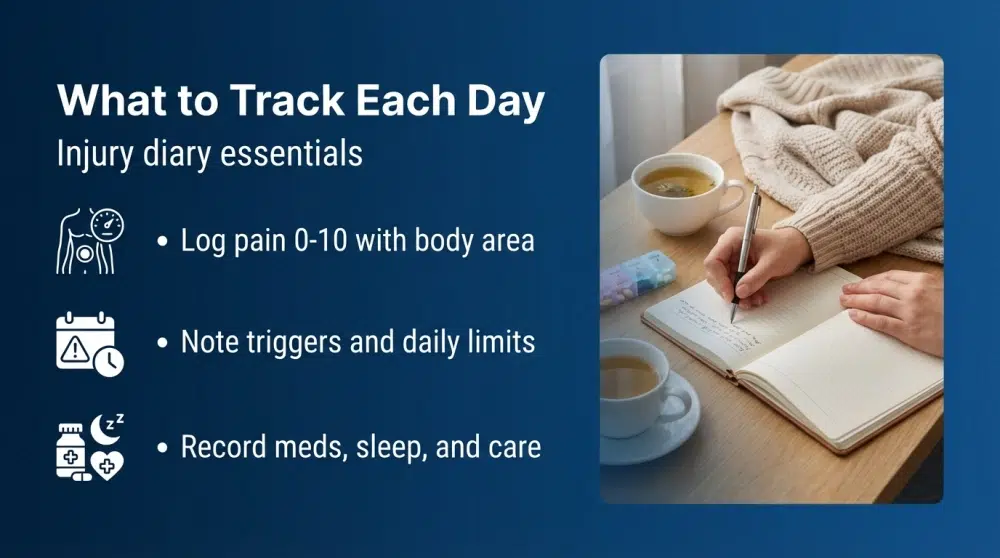
- Date and time: Note the date and, when relevant, the time of significant symptom spikes or events.
- Pain level: Use a 0 to 10 scale with anchors. For example, 0 no pain, 3 mild distraction, 7 unable to do normal chores, 9 cannot sleep.
- Location and type of pain: Neck, lower back, left knee, headaches, tingling, burning, stabbing.
- Symptoms that are not pain: Dizziness, nausea, light sensitivity, brain fog, anxiety.
- Triggers and activities: Driving more than 20 minutes, sitting at a desk, climbing stairs, lifting groceries, loud environments, bright lights.
- Functional impact: Missed work, limited childcare, inability to exercise, difficulty bathing or dressing, reduced social activities.
- Sleep quality: Time to fall asleep, awakenings, total hours slept, nightmares.
- Medication and treatments: Name and dose, time taken, side effects, relief level. Include injections, physical therapy, chiropractic, counseling.
- Medical appointments: Provider, purpose, key recommendations or referrals. Maintain a separate medical appointment log for quick reference.
- Adaptive devices: Braces, canes, TENS unit, ergonomic equipment, ice or heat use.
- Objective anchors: Photos of swelling, screenshots of step counts or heart rate from devices, work absence notes, therapy home exercise frequency.
When you are being evaluated for noneconomic damages, jurors and claims professionals consider how symptoms limit daily life rather than just the presence of pain. California’s jury instruction on pain and suffering emphasizes that the task is to decide a reasonable amount based on the evidence of human experience and the impact on the plaintiff’s life, not on a formula [1]. Your diary turns intangible impact into an ordered, credible story.
Where can you find an Irvine personal injury lawyer pain journal template you can use today?
Use the practical template below. You can copy this table into a document or spreadsheet. Keep one line per day, adding additional lines for any major episodes. This injury diary template is designed to be simple, consistent, and easy for your attorney and treating providers to understand.

Daily Pain and Symptoms Journal Template
| Date | Pain level 0 to 10 | Body area | Symptoms | Triggers or activities | Medication or treatment, dose, time | Work school impact | Sleep quality | Notes |
|---|---|---|---|---|---|---|---|---|
| MM DD YYYY | 7 | Neck, left shoulder | Headache, stiffness | Computer work 45 minutes | Ibuprofen 400 mg at 2 pm, ice at 4 pm | Left early, missed meeting | 5 hours, woke twice | PT tomorrow, no lifting today |
Medical Appointment Log
| Date | Provider and specialty | Purpose | Findings | Plan and referrals | Next appointment |
|---|---|---|---|---|---|
| MM DD YYYY | Dr. Smith, Orthopedics | Follow up MRI results | Partial rotator cuff tear | PT twice weekly, consider injection | MM DD YYYY |
How do you tailor the template for a car accident pain diary versus other injuries?
For a car crash, add rows for driving tolerance and seat belt pressure areas. For premises incidents, add walking tolerance and balance entries. For traumatic brain injury symptoms, add screen sensitivity, memory lapses, and overstimulation notes. Keep the structure, adjust the symptom fields to reflect your condition.
How often should you write, and how do you build consistent habits?
Short entries every day are better than long entries once a week. Consistency builds credibility. Choose a fixed time, like after dinner, set a calendar reminder, and keep your journal in one place. If you forget a day, do not backfill. Simply make the next entry and note any major missed events. If you use a secure app, enable time stamps to document when entries are created and updated, which can help if questions arise about timing [6].
- Keep it factual: Avoid speculation and sarcasm. Use neutral words, measure, and record.
- Use consistent scales: Keep the same 0 to 10 pain scale and functional descriptors for the entire case.
- Anchor your statements: Tie symptoms to observable facts, for example distance walked, hours slept, tasks missed.
- Attach objective proof: Photos, work notes, therapy handouts, device screenshots, and receipts can reinforce entries.
How do you use a pain journal in a California personal injury claim?
In a typical California personal injury claim, the diary can support each phase.
- Medical care: Bring a summary to appointments so providers can address ongoing symptoms and adjust treatment. Accurate symptom tracking can make medical records more complete, which matters when the doctor later writes a report reflecting your course of treatment.
- Insurance claim: When a demand is prepared, excerpts from consistent entries can help explain noneconomic harm in plain language, aligned with medical records and employment documentation. California law recognizes pain and suffering as compensable when supported by evidence [1] [14] [15].
- Discovery: Your diary may be discoverable. If your physical condition is in controversy, portions of the medical privacy privilege may be waived for relevant information under California Evidence Code section 996 [12]. Your attorney will advise how to respond to requests while protecting sensitive information consistent with the law.
- Deposition and trial: The diary can help you testify with specific dates and examples, and it can be used to refresh your recollection under Evidence Code section 771 or Federal Rule of Evidence 612 when appropriate [5] [6].
Many people wonder whether they should work with accident lawyers early or wait until they complete medical care. Early guidance helps your documentation align with the proof needed for liability, causation, and damages, but the choice is always yours. Your diary is useful whether you begin on day one or start a few weeks into recovery.
When negotiations begin, your lawyer may pair select entries with medical notes, employment records, and your own photographs to tell a clear, credible story. The goal is to reach a fair resolution grounded in evidence. California practice emphasizes reasoned evaluation rather than any mechanical multiplier for noneconomic damages [1].

What deadlines apply in California, and how does a journal help you meet them?
California generally provides two years to file a lawsuit for personal injury under Code of Civil Procedure section 335.1, counted from the date of injury, subject to tolling and exceptions [7]. If your claim is against a public entity, California’s Government Claims Act typically requires that a written claim be presented within six months for personal injury and property damage claims, with additional rules for claim rejection and suit deadlines under Government Code section 911.2 and related provisions [8].
A journal supports meeting these deadlines by anchoring the timeline. It helps you and your lawyer pinpoint the onset of symptoms, dates of diagnosis, and the pace of healing or aggravation, which may intersect with discovery rules or tolling arguments. It also helps with preparing for early case conferences and disclosures in federal court if your case involves diversity or federal questions, where Rule 26 of the Federal Rules of Civil Procedure governs initial disclosures and the scope of discovery [10].
Will keeping a pain journal affect your privacy and medical records?
In California, placing your physical or mental condition at issue can create a patient litigant exception to physician patient privilege for relevant information under Evidence Code section 996 [12]. A pain journal itself is not a medical chart, but entries you share with providers may be noted in medical records. If portions of the diary are produced, a protective order can sometimes be negotiated to limit dissemination. Your attorney will weigh how to use excerpts effectively while respecting privacy and privilege rules. When in doubt, keep the diary factual, avoid unnecessary sensitive details, and discuss any concerns with your legal team.
What will insurance adjusters and defense lawyers look for in your journal?
A balanced diary tends to be credible. Here are common review points from a defense perspective.
- Consistency over time: Are pain levels and activity limits consistent with the diagnosis and treatment notes, or do they fluctuate without explanation
- Objective anchors: Are entries tied to appointments, imaging, therapy attendance, work records, and activities of daily living
- Overstatement: Are scales used realistically, reserving 9 or 10 for truly severe days
- Gaps in entries: Are there long periods with no entries, especially just before evaluations
- Clarity and neutrality: Is the tone factual rather than argumentative
These are the same markers your attorney will use to strengthen your case. Thoughtful entries, aligned with medical documentation, make it easier to explain daily limitations in negotiations or at trial.
What common mistakes should you avoid when keeping an injury diary?

- Backfilling: Writing multiple days of entries at once creates time stamp inconsistencies and can reduce credibility.
- Vague descriptions: Saying hurt a lot without specifics is not helpful. Use the 0 to 10 scale, identify the body area, and tie symptoms to activities.
- Copy paste repetition: Identical entries every day look artificial. Real symptoms vary. Use short, specific examples each day.
- Exaggeration: Save high scores for the worst days. Consistent moderate entries with occasional spikes reflect typical recovery patterns.
- Leaving out treatment: Always record medication doses, therapy sessions, home exercises, and side effects.
- Ignoring sleep and mood: Sleep disruption and emotional strain are part of noneconomic harm and belong in the journal when relevant [1].
How do California juries think about pain and suffering damages?
California juries receive a clear instruction that noneconomic damages like pain, suffering, inconvenience, mental suffering, emotional distress, and loss of enjoyment of life have no fixed standard and that jurors must use their judgment to decide a reasonable amount based on the evidence and common sense [1]. Legal reference materials also explain that noneconomic damages compensate for intangible harms connected to the injury [14] [15]. In practice, jurors often look for a coherent narrative supported by medical evidence, objective anchors, and consistent daily impact. A well maintained pain and suffering journal can support your testimony and give the jury a trustworthy timeline of how the injury affected your life in Irvine, CA.
Should you use a notebook or a secure app for your pain journal?
Both can work. Use whichever you will maintain daily.
- Paper journal: Easy to start, portable, and avoids technology issues. Photograph pages regularly to back up.
- Digital journal: Time stamps and metadata can help show when entries were made. If your case is in federal court, electronic information can be subject to preservation rules and discovery requests. Federal Rule of Civil Procedure 26 outlines disclosure duties and Rule 37 addresses spoliation of electronically stored information, so talk with your attorney about preservation if litigation is anticipated [10].
- Hybrid: Keep a paper daily chart and log medical appointments in a spreadsheet for easy sharing.
Whatever you choose, save your file or notebook in a secure location. Do not post diary content on social media. Keep your entries factual, consistent, and private unless your attorney asks you to share selected portions for medical or claim purposes.
Should you share your pain journal with your doctors and therapists?
Yes, but with care. Bringing a concise summary can help your provider address patterns, adjust medications, and order additional testing. When you share entries, remember that providers may reflect your statements in the medical record, which can later be reviewed in your claim. California’s patient litigant exception allows discovery of relevant medical information once your condition is in controversy, so your legal team will guide what to share and when [12]. For most patients, sharing a one page weekly summary highlights the most important data points without overwhelming the chart.
Why does local context in Irvine, CA matter for your documentation?
Irvine cases typically proceed in Orange County Superior Court. Local rules, department procedures, and case management preferences can affect how evidence is exchanged and presented. Knowing filing systems and local practices helps your legal team decide how to package your pain journal for settlement conferences, mediations, and trial settings [13]. In addition, the medical providers you see in and around Irvine often have standard workflows for records and billing. Attaching your medical appointment log to record requests can make it easier to obtain complete treatment histories from local clinics and hospitals.
When your lawyer prepares a settlement brief or pretrial documents, your organized diary reduces the time needed to build a clear chronology. That saves effort, avoids confusion, and helps the decision makers focus on the facts that matter most. Many clients in Irvine find it helpful to combine the daily pain journal with a simple spreadsheet listing dates, providers, procedures, and cost codes for quick reference.
As negotiations begin, Irvine accident lawyers may highlight a few representative entries that align with key medical notes to show the day to day impact of injuries. This focused approach helps adjusters and mediators understand how symptoms limit work, family care, and community activities without overwhelming them with too much detail at once.

Who is GoSuits and how can our approach support your injury claim?
We built this guide and the template because a clear, factual journal can make a meaningful difference in a civil injury case. If you are considering legal help for a California personal injury claim, a short conversation can clarify how your documentation fits with liability, causation, and damages, and how to prepare for negotiations or trial.
- Where we practice: We serve clients across California from Orange County, including Irvine, and handle select matters in additional jurisdictions as appropriate.
- Technology driven process: GoSuits uses exclusive proprietary software designed to organize evidence, analyze timelines, and prepare case materials efficiently. It is built to drive faster, better results while maintaining rigorous quality controls.
- Human representation: Although we use technology to expedite case preparation, every client has a designated attorney. We do not route clients through case managers. You have direct, unfettered access to your attorney.
- Trial readiness: Our team has substantial trial experience, which benefits settlement leverage and courtroom presentation when a fair resolution requires filing suit.
- Past results: You can review a selection of our work at prior cases. Past outcomes do not predict future results, and every case is unique.
- Who we are: Meet our attorneys and learn more about us.
- Practice areas: We handle injury claims including collisions, premises liability, product liability, catastrophic injury, and wrongful death. Explore our practice areas.
- Experience: We bring 30 years of combined experience to evaluating evidence, preparing cases for mediation and trial, and presenting your story clearly.
If you want help getting started with the template, or you need guidance on organizing your records, accident lawyers in Irvine can explain how to use daily entries, medical appointment logs, and supporting documentation to present a clear, credible claim.
References and resources
- Judicial Council of California Civil Jury Instructions CACI 3905A Noneconomic Damage in Personal Injury – California Courts
- California Evidence Code sections 1250 to 1252 Then Existing State of Mind or Physical Sensation – California Legislative Information
- Federal Rule of Evidence 803 Hearsay Exceptions – Cornell Law School Legal Information Institute
- California Evidence Code section 1237 Past Recollection Recorded – California Legislative Information
- California Evidence Code section 771 Writings Used to Refresh Memory – California Legislative Information
- Federal Rule of Evidence 612 Writing Used to Refresh a Witness – Cornell Law School Legal Information Institute
- California Code of Civil Procedure section 335.1 Two Year Statute of Limitations for Personal Injury – California Legislative Information
- California Government Code section 911.2 Claim Presentation Deadlines – California Legislative Information
- United States Road Traffic Safety and Injury Data – Centers for Disease Control and Prevention
- Federal Rule of Civil Procedure 26 Duty to Disclose and Discovery – Cornell Law School Legal Information Institute
- California Evidence Code section 352 Exclusion of Evidence on Grounds of Prejudice or Confusion – California Legislative Information
- California Evidence Code section 996 Patient Litigant Exception – California Legislative Information
- Superior Court of California, County of Orange Home Page – Orange County Superior Court
- Damages Overview, Including Non-Economic Damages – Cornell Law School Legal Information Institute
- Pain and Suffering Definition – Dictionary.Law.com