<?xml encoding=”UTF-8″>
- What makes left turn motorcycle crashes common at Irvine intersections?
- Who has the right of way in a left turn motorcycle crash under California Vehicle Code section 21801?
- How does comparative negligence work in California for left turn motorcycle collisions?
- What evidence helps prove or dispute fault in an Irvine left turn motorcycle crash?
- How do police reports and DMV reporting rules affect your claim?
- How do lane splitting and unprotected left turns interact under California law?
- What injuries and damages are recoverable in civil cases after a motorcycle crash?
- What deadlines apply to Irvine motorcycle crash claims and lawsuits?
- What local steps should you take right after a left turn crash in Irvine?
- How do courts and juries evaluate credibility and crash reconstruction in intersection cases?
- Do helmets and riding gear affect liability or damages in California?
- When should you seek legal help after an Irvine left turn motorcycle crash?
- How can GoSuits help with an Irvine left turn motorcycle crash claim?
- References and Resources
What makes left turn motorcycle crashes common at Irvine intersections?
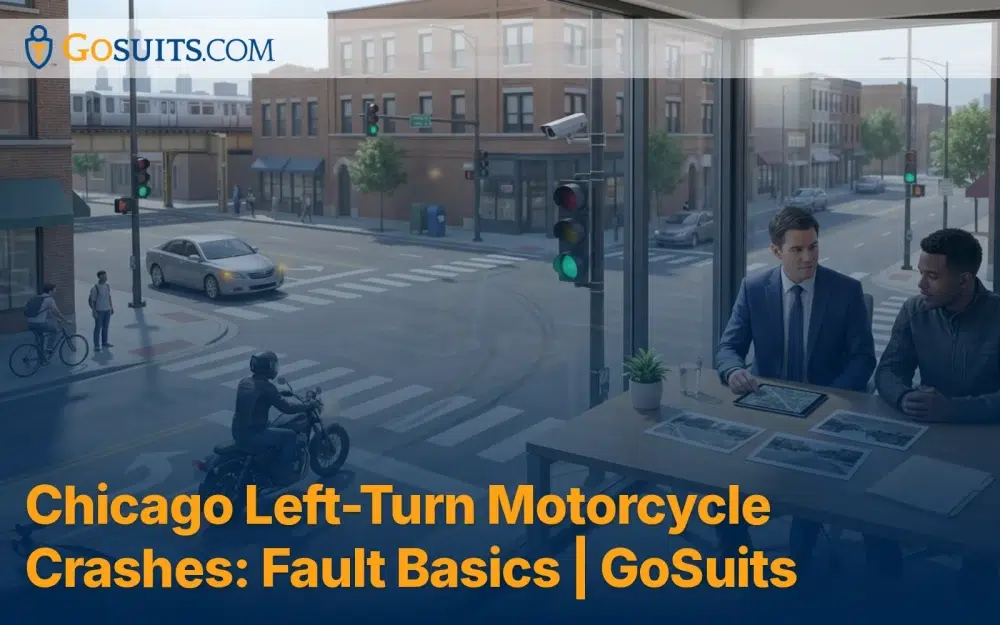
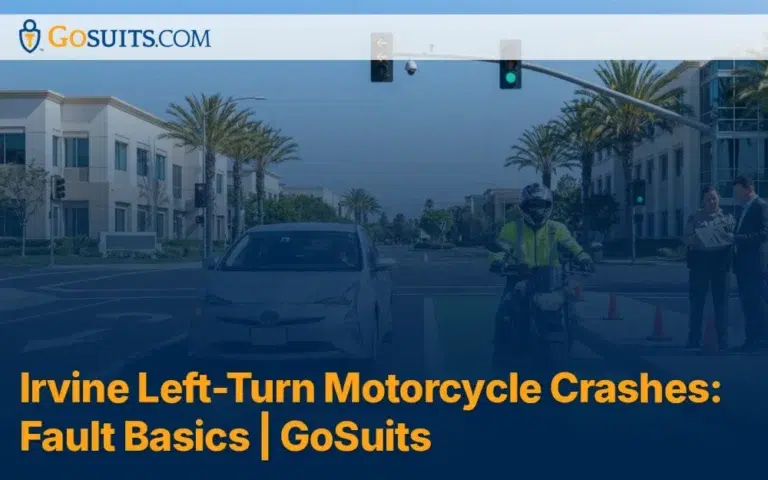
Left turn collisions involving motorcycles often occur where traffic movements converge and drivers make quick judgments. In Irvine, CA, wide arterial roads, multi lane intersections, and heavy commuter patterns create conditions where a driver turning left may misjudge a motorcyclist’s speed or fail to detect the bike entirely. Visibility challenges, A pillar’s and windshield glare in the afternoon, and visual search patterns that favor larger vehicles all contribute to risk. National safety agencies note that motorcyclists face a higher fatality risk per mile traveled than occupants in passenger vehicles, which heightens the consequences when a left turning vehicle violates the motorcycle’s path of travel [12].
Intersections are recognized by federal and state safety programs as complex environments that require careful control and driver attention. Engineering guidance highlights the role of signal timing, protected and permitted left turn phases, and sight distance at approaches. Intersection safety remains a priority because conflicts between opposing movements happen within short time windows, making accurate gap selection crucial for both turning drivers and through riders [13]. In practical terms, this means a rider traveling straight through the intersection is vulnerable if a left turning driver proceeds without a safe gap or fails to yield the right of way as required by California law [1].
When you are evaluating what happened in a specific crash in Irvine, the focus often falls on three questions. Did the left turning driver yield as required? Was the motorcyclist visible and traveling at a reasonable speed? Were there traffic controls, such as a protected left arrow, or only a circular green permissive phase? The answers guide civil liability analysis and insurance fault decisions, which in California are grounded in statutes, case law, and comparative negligence principles [1] [14].
For context when you are searching for legal support, many people begin with Irvine motorcycle accident lawyers to help guide early decisions on evidence preservation, medical documentation, and communication with insurers. The right legal team can coordinate collision reconstruction and witness interviews while you focus on recovery.
Who has the right of way in a left turn motorcycle crash under California Vehicle Code section 21801?
California Vehicle Code section 21801 sets the baseline rule for left turns and U turns. A driver intending to turn left or make a U turn must yield the right of way to all vehicles approaching from the opposite direction that are close enough to be an immediate hazard, and must continue yielding until the turn can be made with reasonable safety [1]. Applied to a motorcycle traveling straight through an intersection, the statute usually places the duty on the left turning driver to wait for a safe gap.
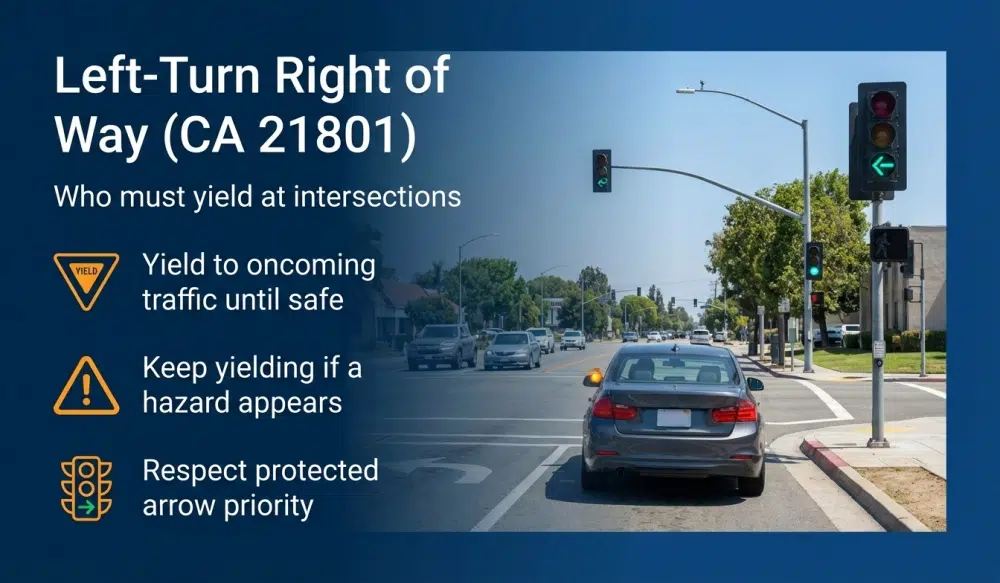
Key points about right of way under section 21801 include the following.
- Through travel priority. A motorcyclist proceeding straight has priority when the left turning driver faces only a permissive turn phase or a circular green without a protected arrow, subject to speed and hazard conditions [1].
- Ongoing duty to yield. Even after starting the turn, the turning driver must continue to yield if an immediate hazard develops during the maneuver. The duty does not end once the front wheels enter the intersection [1].
- Protected arrows. A protected left turn arrow can change who has the right of way, since conflicting traffic is stopped by a red indication. If the motorcyclist runs a conflicting signal or enters late against a red, that can affect liability.
- Negligence per se. A statutory violation can support a negligence per se theory if the plaintiff proves the defendant violated the statute, proximately caused the injury, and the plaintiff belonged to the class the statute intended to protect. California recognizes negligence per se principles in Evidence Code section 669 [5].
Right of way does not answer every dispute. If a motorcyclist was speeding, lane splitting unsafely, or failed to use lights at night, a jury may allocate fault between both parties under California’s comparative negligence doctrine [2] [14].
How does comparative negligence work in California for left turn motorcycle collisions?
California follows pure comparative negligence. That means each party is responsible for their percentage of fault, and a plaintiff’s damages are reduced by their share of responsibility rather than being barred entirely. The California Supreme Court adopted this rule in Li v. Yellow Cab Co., which reshaped how juries apportion fault in traffic cases [14]. In practice, a jury might find a left turning driver primarily at fault for violating the duty to yield, but still assign a percentage to the rider if the evidence shows excessive speed, abrupt lane changes, or insufficient lighting.
California civil jury instructions describe the basic negligence framework. To recover, a plaintiff must show the defendant owed a duty of care, the defendant breached that duty, the breach caused harm, and damages resulted. The CACI instructions provide a plain language summary of these elements that courts routinely use in trial [6]. When a traffic safety statute is violated, negligence per se can ease the proof on the breach element if the other conditions of Evidence Code section 669 are met [5].
Comparative negligence is fact specific. Examples that can shift some percentage of fault to a rider include entering on a late yellow that turns red mid intersection, traveling significantly above the posted speed, or riding without required lighting at night. On the defense side, a driver may argue the motorcyclist created an immediate hazard by sudden acceleration or unsafe lane splitting near the intersection. The final allocation is for the jury or fact finder, guided by the statutes and instructions [1] [6] [14].
What evidence helps prove or dispute fault in an Irvine left turn motorcycle crash?
A strong civil case relies on timely, reliable evidence from the scene and the days that follow. Consider compiling the following materials whenever possible.
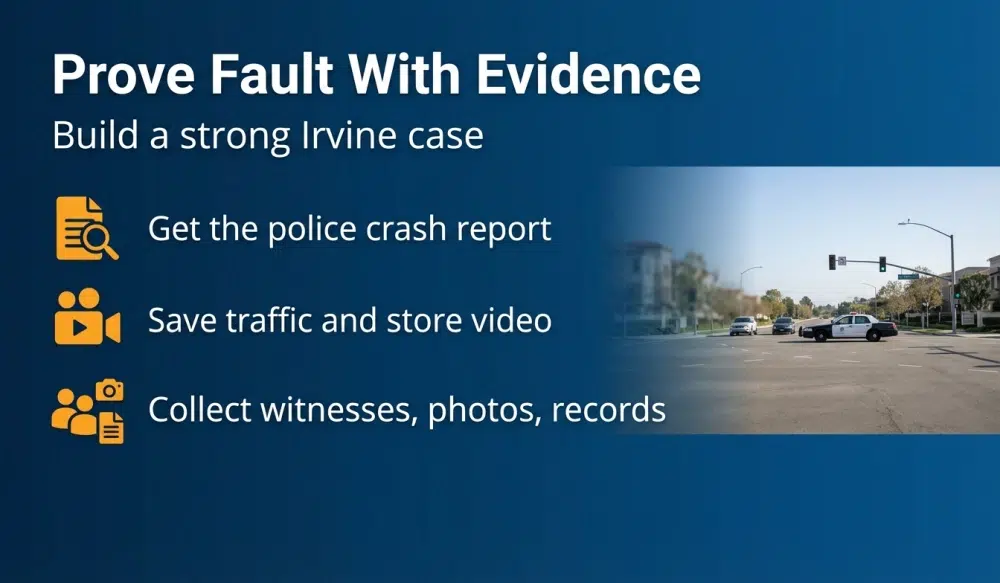
- Traffic collision report. Obtain the report from the investigating agency such as the California Highway Patrol or the local department. The report documents parties, diagrams, statements, and any listed violations. Although not itself conclusive, it often guides early insurance decisions and can shape settlement value [10].
- Witness statements and contact information. Independent witnesses can help resolve disputes over speed, signals, and who entered first. Secure names and phone numbers at the scene if you are able.
- Intersection video and nearby cameras. Many Irvine intersections and adjacent businesses use cameras. Prompt preservation letters can prevent routine overwriting of footage.
- Vehicle and motorcycle inspections. Downloads of airbag control modules from cars, lighting filament analysis, and damage pattern assessments can be used in reconstruction.
- Scene measurements and mapping. Skid marks, yaw marks, gouges, point of rest, and sight lines can be documented through photographs, drones, and laser mapping. These measurements support analysis of speed, perception reaction time, and available gaps.
- Medical records and imaging. Emergency department records, CT scans, and follow up care notes tie injuries to crash forces and timing.
- Cell phone records. If distraction is suspected, call and data logs may be requested in litigation and, when appropriate, by subpoena.
- Prior complaints or signal timing. Records showing recent signal timing changes, construction, or visibility complaints may be obtained through public records requests where applicable.
A clear, methodical approach to evidence can reduce disputes and anchor a settlement discussion. The sooner you engage a process to preserve time sensitive data, the more complete your proof will be.
How do police reports and DMV reporting rules affect your claim?
Traffic collision reports document observations of the investigating officer, including diagrams, statements, and any cited violations. In Irvine, reports may be prepared by the Irvine Police Department or by CHP depending on the roadway. To request the report, follow the agency’s procedures. The CHP provides a public facing portal describing how to obtain collision reports, which can include incidents investigated within city limits on state routes [10].
Separate from the police report, California law requires drivers to report a crash to the DMV within 10 days when there is injury, death, or property damage of 1000 dollars or more by submitting the SR 1 form. This reporting requirement applies regardless of fault or whether a police report was prepared. The DMV explains the SR 1 process and circumstances that trigger it [9]. Failing to comply can lead to licensing consequences, so it is important to track this deadline even while medical treatment and insurance calls are unfolding.
While a police report can influence insurer decisions, it is not the final word in civil court. Liability is decided by legal standards and the evidence presented to the fact finder, which includes testimony, physical evidence, and sometimes expert reconstruction. Be cautious about assuming the report alone will determine the outcome.
How do lane splitting and unprotected left turns interact under California law?
Lane splitting is defined in California law as driving a motorcycle between rows of stopped or moving vehicles in the same lane, including on divided and undivided streets and highways. Section 21658.1 recognizes lane splitting, and the CHP provides public safety guidance on prudent speeds and following distance in traffic queues [2] [3]. Lane splitting can appear in left turn crash disputes when the rider approaches an intersection between lanes and a left turning driver initiates a turn across the rider’s path.
Key considerations in this scenario include visibility and speed. If the rider is lane splitting at a prudent speed relative to surrounding traffic and the driver fails to make a reasonably safe left turn, the analysis often points to a breach of the driver’s duty to yield under section 21801. If the rider is lane splitting at a speed that is not prudent for conditions or weaving near the intersection approach, comparative fault may be argued by the defense. The case will turn on facts such as closing speed, traffic density, and sight lines [1] [2] [3].
Courts and juries view lane splitting through the lens of reasonableness. There is no blanket rule that lane splitting automatically causes or prevents liability. Photographs, video, and reconstruction analysis help show how the movements unfolded and whether each party acted as a reasonably careful person would in similar circumstances [6].
What injuries and damages are recoverable in civil cases after a motorcycle crash?
Motorcycle collisions can cause a wide range of injuries, from fractures and ligament tears to traumatic brain and spinal injuries. National materials explain that motorcyclists face a higher risk per mile traveled compared with occupants of passenger vehicles. NHTSA notes that per vehicle miles traveled, motorcyclists are significantly more likely to be killed in a traffic crash than passenger vehicle occupants [12]. Helmets play a critical role. Public health research shows motorcycle helmets reduce the risk of head injury and death in substantial percentages, which has long informed California’s universal helmet requirement [4].
In a civil case, compensable damages can include medical expenses, lost income, reduced earning capacity, property damage, and non economic harm such as pain, suffering, and loss of enjoyment of life. When a crash results in a fatality, certain heirs may bring a wrongful death action and the decedent’s personal representative may bring a survival claim, subject to California statutes [8]. The specific categories and proofs depend on the facts and the medical record.
For riders and families facing a serious outcome, the path from emergency care to recovery can be long. Organizing billing records, health insurance liens, and provider communications helps manage the process and support your claim for damages.
What deadlines apply to Irvine motorcycle crash claims and lawsuits?
California generally provides two years from the date of injury to file a civil action for personal injury under Code of Civil Procedure section 335.1. There are shorter deadlines for claims against public entities and potential exceptions depending on the facts. Missing a deadline can bar the claim, so calendar the applicable dates early and track them as you seek medical treatment and evaluate liability [7].
In addition to court filing deadlines, there are administrative timelines to consider. Injured parties must submit the DMV SR 1 within 10 days if the crash meets the injury or property damage thresholds. Insurance policies may require prompt notice and cooperation. Gathering records early reduces the risk of delays when it is time to file [9].
What local steps should you take right after a left turn crash in Irvine?
Your health and safety come first, so call 911 and request medical evaluation. If you can safely do so, gather the following at the scene.
- Photographs and video. Capture vehicle positions, damage, debris fields, skid marks, signal heads, and any obstructions such as parked vehicles or vegetation.
- Driver and witness information. Get the other driver’s insurance details, license plate, and contact information for witnesses.
- Report number. Ask which agency will prepare the traffic collision report and note the incident or report number. You can later request a copy through the agency. CHP outlines a standard process for collision report requests [10].
- Medical documentation. Keep all discharge paperwork, imaging results, and follow up referrals. These records help connect injuries to the incident.
In the days after the crash, file the DMV SR 1 if required, notify your insurance company, and consider contacting a qualified legal team. You can also send preservation letters to nearby businesses requesting any available intersection footage be saved. The California Office of Traffic Safety publishes statewide research and county level rankings that can help contextualize risk factors when discussing your claim with insurers [11].
If the Irvine Police Department investigated, you may request an Irvine Police Department report following its public records and collision report procedures. If CHP investigated, use its report request process. Keep copies of everything you submit and receive for your records [10].
How do courts and juries evaluate credibility and crash reconstruction in intersection cases?
Courts permit lay and expert testimony to help the jury understand how the collision occurred. In left turn motorcycle collisions, reconstruction can address speed estimates, timing of signal phases, sight distance, and whether the turn could be made safely. Photogrammetry and event data from involved vehicles can supplement witness accounts. Jurors assess whether each party acted as a reasonably careful person would under the same circumstances using the negligence standards described in the CACI instructions [6].
Physical evidence can be decisive. For example, crush profiles, final rest positions, and scrape patterns can indicate where the impact occurred within the intersection box. Signal timing logs, if available, can show whether an approach faced a red, green, or yellow at the moment of entry. The more objective evidence you preserve, the less the case turns on contested recollections alone.
California’s pure comparative negligence system means a case is not all or nothing. Even if jurors believe the motorcyclist could have been more cautious, they may still assign the majority of fault to a left turning driver who violated section 21801. Both plaintiffs and defendants should be prepared with clear explanations and demonstratives that show timing, spacing, and decision points [1] [14].
Do helmets and riding gear affect liability or damages in California?
California requires all motorcycle riders and passengers to wear a helmet that meets federal standards. Vehicle Code section 27803 sets this requirement, and public health data show that helmets reduce head injury risk and death risk in measurable amounts [4]. In civil cases, defendants sometimes argue that failing to wear a helmet contributed to the extent of head injuries. Courts analyze such arguments under comparative negligence principles and causation. If a helmet would have mitigated specific injuries, a jury may consider that when allocating fault and damages, though plaintiffs will respond that the primary harm flowed from the left turning driver’s violation of section 21801 [1].
Beyond helmets, armored jackets, abrasion resistant pants, gloves, and boots can reduce orthopedic and soft tissue injury severity. While gear is not a legal requirement other than a compliant helmet, documentation of gear use can sometimes counter defense claims about foreseeability and mitigation.
National summaries explain the protective effect of helmets in percentages that reflect years of research. These summaries also reinforce that motorcyclists face an elevated risk per mile traveled, which is one reason California maintains a universal helmet law [4] [12].
When should you seek legal help after an Irvine left turn motorcycle crash?
After you address immediate medical needs, it is sensible to speak with a knowledgeable legal team as soon as possible. Early consultation helps with evidence preservation, strategy on recorded statements, claim valuation, and meeting statutory deadlines. California’s two year statute for injury claims will arrive sooner than expected if you are focused on treatment and time away from work. Prompt guidance can also help you manage health insurance subrogation and medical liens in a way that supports your recovery [7].
Insurers may move quickly to assign fault percentages, especially in left turn scenarios. A legal team can frame the section 21801 duty, gather intersection timing records, and coordinate scene inspections before conditions change. These steps are difficult to replicate months later, and missing a key video or witness can change the outcome. If a public entity may be involved, shorter claim timelines make early action even more important.
If you are unsure where to start, many people in Irvine begin by contacting Irvine motorcycle accident lawyers for a free consultation to discuss the facts, the likely legal standards, and immediate next steps. The goal is to protect your rights while you focus on healing, not to escalate conflict without purpose.
How can GoSuits help with an Irvine left turn motorcycle crash claim?
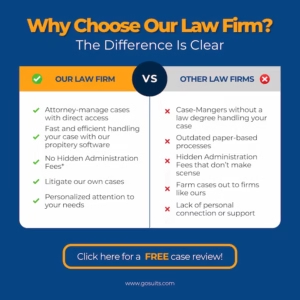
GoSuits represents people in civil injury matters arising from traffic collisions, including intersection and left turn motorcycle crashes in Irvine and across California. A free consultation can clarify liability under section 21801, the role of comparative negligence, and what evidence to gather in the next few days. Our practice spans California courts, and we regularly handle cases throughout Orange County and Southern California.
- Technology driven case management. We use exclusive proprietary software to accelerate evidence collection, medical record retrieval, and damage modeling. This approach helps reduce delays and brings greater transparency to your case timeline.
- Attorney access and client service. Although we leverage technology to expedite work, every client has a designated attorney and direct access. We do not route clients through case managers. You will be able to reach your lawyer to discuss strategy, settlement posture, and trial readiness.
- Proven results and trial readiness. Our team has secured meaningful outcomes for clients in a wide range of injury cases. See a selection of our prior cases. Trial experience matters because insurers evaluate risk based on how a case will present to a jury.
- Breadth of practice areas. In addition to motorcycle crash litigation, we handle car collisions, truck collisions, wrongful death, brain injury, product liability, and other personal injury matters. Explore our practice areas for details.
- Team and background. Learn more about our attorneys and our approach on the about us page.
With more than 30 years of combined experience, our attorneys build cases from the ground up using scene inspections, video preservation, and expert reconstruction when needed. We prepare every case with trial in mind, which supports strong negotiation and credible presentation to a jury when required. If you have questions after a left turn motorcycle crash in Irvine, we are ready to discuss your options and next steps.
References and Resources
- California Vehicle Code section 21801 Left turns and U turns yielding rules – California Legislative Information
- California Vehicle Code section 21658.1 Lane splitting definition – California Legislative Information
- Lane Splitting Safety – California Highway Patrol
- California Vehicle Code section 27803 Motorcycle helmet requirement – California Legislative Information
- Evidence Code section 669 Negligence per se – California Legislative Information
- CACI No. 400 Negligence Essential Factual Elements – Judicial Council of California
- Code of Civil Procedure section 335.1 Two year statute for injury – California Legislative Information
- Code of Civil Procedure section 377.60 Wrongful death actions – California Legislative Information
- SR 1 Reporting a Traffic Accident – California DMV
- Traffic Collision Reports – California Highway Patrol
- Crash Rankings and Research – California Office of Traffic Safety
- Motorcycles Road Safety Overview – National Highway Traffic Safety Administration
- Intersection Safety Proven Safety Countermeasures – Federal Highway Administration
- Li v. Yellow Cab Co. of California 13 Cal.3d 804 – CourtListener