<?xml encoding=”UTF-8″>
- What counts as a hit and run in Irvine CA?
- What immediate steps should you take at the scene to protect your claim?
- How do you report a hit and run to Irvine Police and the California DMV?
- What evidence should you gather and how do you document it?
- How does uninsured motorist coverage help after a hit and run in California?
- What deadlines and statutes of limitations apply to California hit and run claims?
- How do criminal and civil cases interact after a hit and run?
- Can you recover medical bills lost income and pain and suffering in California?
- How do you identify the fleeing driver and what if they are never found?
- What mistakes should you avoid after a hit and run in Irvine?
- How can a lawyer help you build and present your civil claim?
- Why choose GoSuits for an Irvine hit and run claim?
- References and resources
What counts as a hit and run in Irvine CA?
If a driver causes a crash and does not stop to exchange information or render reasonable aid, California law treats that as a hit and run. When people are injured or a life is lost, leaving the scene violates California Vehicle Code section 20001, which requires drivers to stop, provide identifying and insurance information, and offer reasonable assistance such as calling for medical help if needed [1]. When only property is damaged, section 20002 imposes similar duties to stop, locate the property owner or leave written notice and report the collision to law enforcement upon request [2].
These duties apply whether you were driving, riding a bike, or operating a scooter. They also apply to crashes in parking lots and private property open to the public. Even if you believe the other person caused the collision, you should stay at the scene and follow the law, because failure to stop can create separate criminal exposure and complicate a civil claim for compensation [1][2].
Nationally, hit and run crashes are a persistent safety problem. Federal traffic safety researchers found that thousands of people die each year in hit and run incidents and a large share of those killed are people walking or biking [6]. While every case is unique, the civil roadmap below explains how you can protect your claim and your health after a hit and run in Irvine.
What immediate steps should you take at the scene to protect your claim?
Your safety comes first. If you can safely move to the shoulder or a nearby parking area, do so. Use hazard lights and, if available, place reflective triangles. Call 911 for urgent injuries. Even in minor collisions, request an officer to document the scene and start a report. A prompt record supports causation and damages if the other driver is later identified or if you need to use uninsured motorist coverage [1][2].
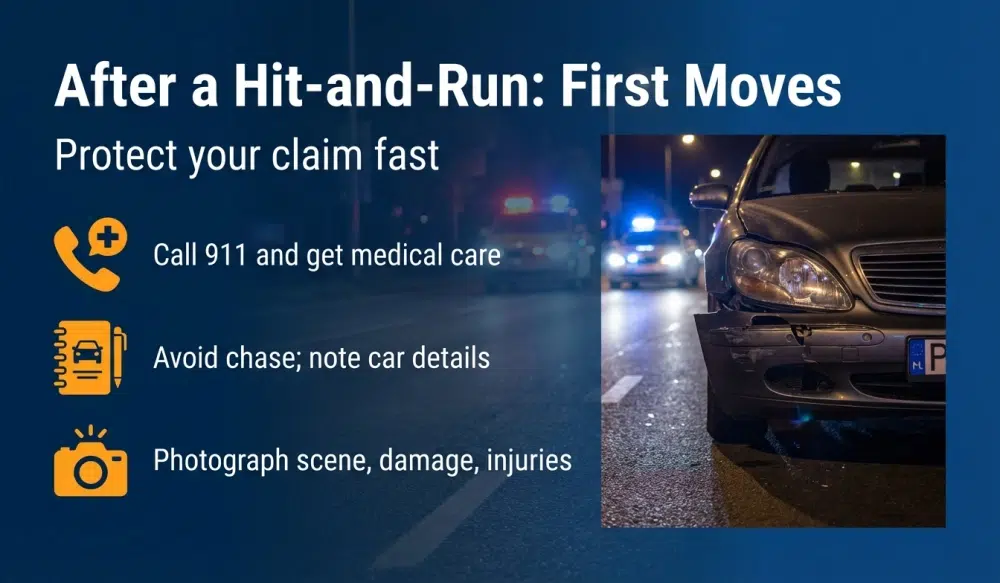
- Check for injuries and call 911 Seek medical help for anyone hurt. Adrenaline can hide pain. Early evaluation creates a medical record that links injuries to the crash.
- Do not chase the fleeing driver Pursuits increase risk and may be used against you. Focus on collecting details that investigators can use later.
- Capture identifiers Note the make, model, color, and any partial plate. Observe unique features such as decals, body damage, racks, or aftermarket lights.
- Secure witness information Ask bystanders for names, phone numbers, and whether they captured video or photos. Independent witnesses can be decisive.
- Photograph the scene Take wide shots and closeups of damage, debris, skid marks, fluid trails, and the surrounding area. Photograph your injuries if visible.
- Preserve dash cam and phone data Save copies of dash cam files and back them up to the cloud. Document the file names and timestamps.
After you leave the scene, schedule a same day or next day medical appointment even if you feel okay. Many injuries are delayed onset. Seeking care early helps you recover and creates documentation that insurers expect to see when assessing a claim.
When people search for guidance, they often compare options among car accident lawyers. Use that research to understand timelines, insurance rules, and evidence preservation standards. It can make your conversations with insurers and treating providers more productive.
How do you report a hit and run to Irvine Police and the California DMV?
File a police report as soon as possible. If officers did not respond to the scene and the incident qualifies for online reporting, you can use the Irvine Police Department’s online reporting portal for certain non emergency collisions [9]. If injuries were involved, call the non emergency number or visit the station so an officer can take a report and arrange photographs.
In addition, California requires you to submit a DMV SR 1 accident report within 10 days if anyone was injured or killed or if property damage exceeds 1000 dollars, regardless of who was at fault or whether law enforcement took a report [3]. Keep a copy for your records. If you have the other vehicle’s plate or VIN from a witness or photo, include it on the SR 1.
- When should you call police Call immediately for injury crashes. For minor property damage where the driver fled, report promptly online or in person so the incident is recorded [9].
- Why file DMV SR 1 The SR 1 is required by state law and helps the DMV track crashes. Filing on time avoids administrative issues and creates a dated record that can support your insurance claim [3].
- How to obtain the report number Ask the officer or the desk clerk for your report or incident number. You will need it for insurance and for any follow up with investigators.
Local crash patterns can help explain why documentation matters. The California Office of Traffic Safety publishes city collision rankings with categories including hit and run. These data give context for how often these collisions occur in a community and underscore the benefits of early reporting and evidence preservation [10].

What evidence should you gather and how do you document it?
Think of evidence in layers: scene, vehicle, injuries, and investigative leads. You do not need to collect everything on day one. Start a checklist and build it over the first two weeks.
- Scene evidence Photos of the roadway, lighting, traffic signals, skid marks, debris field, and any obstructions. Document weather and visibility. Save 911 call logs or screenshots if your phone app shows the call time.
- Vehicle evidence Photos of damage from multiple angles, closeups of paint transfer, and alignment or tire issues. Obtain repair estimates and parts lists. Keep all invoices.
- Injury evidence Emergency department records, primary care notes, imaging results, physical therapy plans, and pain journals. A simple daily log of symptoms and limitations helps quantify non economic harm.
- Witness and third party footage Ask nearby businesses for exterior camera footage. Many systems overwrite within days. Provide the date, time window, and your contact information. If available, request that Irvine Police check automated license plate recognition tools and traffic cameras that may aid identification in an investigation [9].
- Insurance correspondence Keep every letter and email from insurers. Photograph envelopes that show postmark dates. Note each claim number and adjuster.
For your records, create a simple evidence folder with subfolders for photos, medical, estimates, correspondence, and forms. Name files with dates, for example, 2026 01 28 ER discharge. Back up to cloud storage. If you later retain counsel, this organization saves time and can reduce disputes over missing documentation.
How does uninsured motorist coverage help after a hit and run in California?
When a driver flees and cannot be identified, California law allows you to pursue a civil claim through your own uninsured motorist coverage, commonly called UM. State law requires insurers to offer UM coverage with liability policies and you accept or decline in writing. Many people carry UM even if they are not sure about the limits [8].
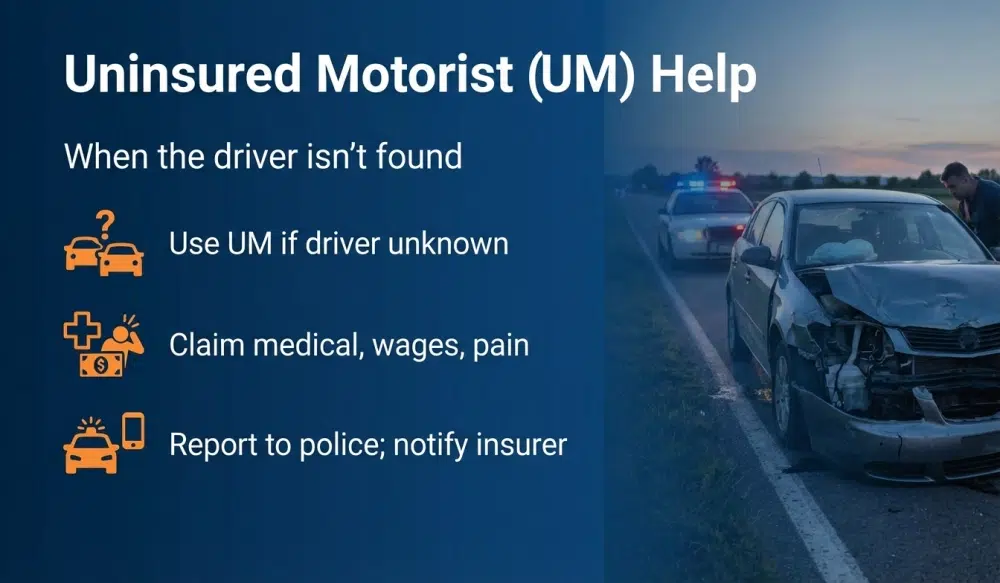
- What does UM pay UM may cover medical bills, lost income, and non economic damages up to your UM policy limits, subject to policy terms. Some policies include medical payments coverage that pays regardless of fault.
- What proof is required Insurers typically require prompt notice, proof that a hit and run occurred, evidence of contact between vehicles in many policies, and documentation of injuries and losses. A police report and timely DMV SR 1 support the claim [3].
- What if the driver is found If the driver is identified and insured, you may pursue the liability insurer. If their limits are too low, underinsured motorist coverage may help depending on your policy and California law [7][8].
UM claims can be complex because the process resembles a claim against another driver while you are technically making a first party claim to your own insurer. The evaluation still turns on liability, causation, and damages. Insurers look for consistent medical care, clear mechanism of injury, and reasonable treatment plans. Keep dialogue professional and focused on documentation.
What deadlines and statutes of limitations apply to California hit and run claims?
For personal injury claims in California, the general statute of limitations is two years from the date of the collision [4]. For damaged property such as your vehicle, the time to sue is generally three years [4]. If a public entity may be partly responsible, for example due to a dangerous roadway condition, you must file a government claim within six months before you can sue, with limited exceptions [5][14].
- Two year injury deadline File suit within two years for bodily injury claims, or your claim can be barred [4].
- Government claim within six months Claims against a city, county, or state entity generally require a written claim within six months of the incident [5][14].
- Doe defendants to preserve claims If you do not know the identity of the other driver when you file suit, California procedure allows naming Doe defendants and amending when the identity is discovered, subject to rules on diligence and relation back [13].
Diary these deadlines early. Calendar two reminders for each deadline, with the first reminder about 60 days out. If you are pursuing a UM claim, also check your policy for notice provisions and any contractual arbitration deadlines. These are separate from court statutes and can be enforced by the insurer [7][8].
How do criminal and civil cases interact after a hit and run?
A hit and run can result in a criminal investigation and charges under California Vehicle Code 20001 or 20002. A criminal case focuses on punishment and deterrence, while a civil case focuses on making you whole financially. You can generally pursue a civil claim even if no criminal charges are filed or if the criminal case does not result in a conviction [1][2].
- Restitution orders in criminal court If the fleeing driver is convicted, the court must order restitution to victims for economic losses like medical bills and lost wages. Restitution is separate from insurance claims and civil damages and may not cover non economic harm [12].
- Use of police records Police reports and investigative materials can inform your civil claim. Some materials may be discoverable after the case progresses or through a records request, subject to exemptions and privacy laws.
- Punitive damages in civil court In addition to compensatory damages, California law allows punitive damages when a defendant acted with malice, oppression, or fraud. Fleeing the scene, combined with other aggravating facts such as intoxication or extreme recklessness, can sometimes support a punitive damages claim under Civil Code 3294 [11].
Can you recover medical bills lost income and pain and suffering in California?
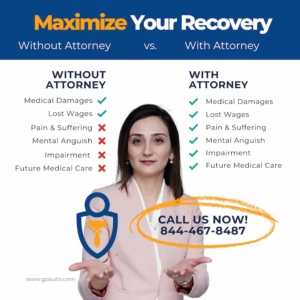
Compensatory damages are designed to make you whole. In a civil claim, you can seek economic damages such as medical expenses, future medical care, lost wages, and loss of earning capacity. You can also seek non economic damages for pain, suffering, and loss of enjoyment of life, supported by your medical records and daily impact documentation.
- Medical costs Emergency treatment, imaging, specialist visits, physical therapy, medications, and medical devices. Keep itemized bills and explanation of benefits to show billed versus paid amounts.
- Income losses Pay stubs, employer letters confirming days missed, and tax returns. For self employed individuals, gather invoices, bank statements, and a simple summary of projects lost or delayed.
- Non economic harm Pain journals, statements from family or coworkers, and photographs of visible injuries can help describe the human impact.
- Comparative fault and reduction California follows pure comparative negligence, which means your award is reduced by your percentage of fault if any, but you can still recover even if you were partly at fault. This rule comes from California Supreme Court precedent and applies in motor vehicle cases [15].
Insurance adjusters evaluate damages systematically. They look for consistent treatment, reasonable gaps in care, and objective findings when available. If you disagree with an adjuster’s assessment, provide the missing documentation or clarify assumptions in writing, and keep correspondence professional.
How do you identify the fleeing driver and what if they are never found?
Many hit and run drivers are identified weeks or months later through a combination of witness tips, body shops noticing matching damage, license plate readers, and camera footage. You can assist investigators by providing any partial plate, photos, and the precise time and location. If the driver is identified and insured, your claim proceeds like any other third party liability claim. If not identified, your UM claim becomes the primary path [9][8].
- Follow up with investigators Check in respectfully with the assigned officer for updates. Provide any new information, such as a witness who came forward or a business that found saved footage.
- Request nearby footage quickly Many systems overwrite within days. Ask businesses to preserve footage from 15 minutes before to 30 minutes after the crash window.
- Check your neighborhood and route Doorbell cameras and dash cams on delivery vehicles may have captured the car. Place a brief notice on community boards with the time window and location.
- Proceed under UM when needed If the driver is not identified, provide your insurer with proof of a hit and run, the police report number, photos, medical records, and estimates. Clarify that you are proceeding under the UM provision of your policy [7][8].
What mistakes should you avoid after a hit and run in Irvine?
- Waiting to seek medical care Delays make it harder to link injuries to the crash and can slow your recovery. Try to be evaluated within 24 to 72 hours.
- Missing the DMV SR 1 deadline File the SR 1 within 10 days when required. Keep a copy and proof of submission [3].
- Giving recorded statements prematurely Provide basic facts but avoid speculative statements before you have gathered your records and spoken with your support team.
- Overlooking public entity deadlines If roadway design or maintenance may be involved, calendar the six month government claim requirement while you investigate [5][14].
- Discarding damaged parts Save broken parts and tires until the claim resolves. Physical evidence of impact can be useful if liability is disputed.
- Posting about the crash on social media Public posts can be misinterpreted. Share updates privately and assume insurers may review your content.
If you feel overwhelmed, that is normal. Crash recovery is both medical and administrative. Helpful checklists, patient portals, and a simple claim diary can reduce stress while you focus on treatment and daily life.
How can a lawyer help you build and present your civil claim?
A lawyer can coordinate evidence, track deadlines, and present a clear liability and damages picture to insurers or a court. Choosing Irvine car accident lawyers gives you local familiarity with Orange County venues, health systems, and the documentation expectations common to carriers serving this region.
- Evidence development Counsel can request and organize medical records, obtain sworn statements when needed, and consult with treating providers to explain causation and prognosis.
- Insurance navigation A lawyer can communicate with multiple adjusters, reconcile medical billing issues, and prepare a settlement package that fairly represents your losses.
- Liability analysis Even if the other driver fled, counsel can analyze roadway design, lighting, and signal timing for potential contributory factors and preserve public entity claims where appropriate [14].
- UM arbitration and litigation If your UM carrier disputes value or liability, counsel can prepare for arbitration or suit within the contractual and statutory timelines [7][8].
For many families, partnering with Irvine car accident lawyers helps shift the administrative burden so you can focus on medical recovery and daily responsibilities. Ask about communication practices, case milestones, and how your team will present your story with records and credible timelines.
Why choose GoSuits for an Irvine hit and run claim?
We help people in Irvine and throughout California after serious vehicle crashes, including hit and run. A free consultation can clarify timelines, required forms like the California SR 1, and the evidence that strengthens a UM or liability claim. We welcome questions about treatment coordination, wage documentation, and how to approach insurers with confidence and care.
- Where we practice We serve clients across California, including Orange County and Irvine.
- Technology driven approach Our exclusive proprietary software organizes medical records, estimates, and correspondence in a secure case graph so issues surface faster and negotiations move with clarity.
- Leadership in innovation We adopt secure automation and data tools that reduce delays while keeping you informed at every step.
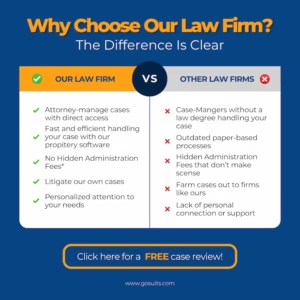
- Attorney access Although we use technology to expedite each case, every client has a designated attorney. We do not route cases through case managers. You can reach your attorney directly for updates and strategy discussions.
- Past results See a selection of outcomes on our page for prior cases. Results depend on facts and law and are not predictive of future outcomes.
- Trial readiness We have taken cases to verdict when fair offers did not materialize. Trial experience can shape investigation, expert selection, and negotiation posture from day one.
- Practice areas We handle personal injury cases including vehicle collisions, pedestrian and bicycle injuries, premises liability, and wrongful death. Explore our practice areas.
- Team and background Learn more about about us and meet our attorneys. We bring more than 30 years of combined experience to complex injury claims.
If you were injured in a hit and run in Irvine, we can help you report to police, complete the DMV SR 1, secure medical documentation, and pursue all available insurance benefits, including UM coverage when appropriate. We are ready to discuss timelines and next steps at your pace and on your schedule.
References and resources
- California Vehicle Code section 20001 Duty in injury or fatal collisions – California Legislature
- California Vehicle Code section 20002 Duty in property damage collisions – California Legislature
- Accident Reporting and SR 1 requirement – California DMV
- Code of Civil Procedure section 335.1 Two year statute for injury – California Legislature
- Government Code section 911.2 Six month claim requirement – California Legislature
- Traffic Safety Facts Hit and Run Crashes – NHTSA
- Understanding Automobile Insurance Claims – California Department of Insurance
- Insurance Code section 11580.2 Uninsured motorist coverage – California Legislature
- Online Police Reporting – City of Irvine Police Department
- Collision Ranking Results and City Profiles – California Office of Traffic Safety
- Civil Code section 3294 Punitive damages standard – California Legislature
- Penal Code section 1202.4 Victim restitution – California Legislature
- Code of Civil Procedure section 474 Doe defendants – California Legislature
- Claims Against the Government overview – California Courts
- Li v. Yellow Cab Co. of California, 13 Cal.3d 804 – CourtListener