- What is a T-bone collision and why do they happen in Irvine intersections?
- How does California assign fault in a T-bone accident under comparative negligence?
- What right of way and signal laws often decide intersection accident fault in California?
- Which evidence helps prove who had the green light or right of way in Irvine?
- How do insurance companies evaluate side impact liability and what defenses arise?
- What if both drivers share blame in an Irvine side impact crash?
- How do you preserve time sensitive evidence after a T-bone crash in Irvine?
- What damages can you claim and what defenses can reduce recovery?
- How long do you have to file a claim after an Irvine T-bone collision?
- How do right turn on red and left turn rules affect side impact fault at Irvine intersections?
- What steps should you take at the scene and soon after to support your claim?
- How can a lawyer build a case using negligence per se in a T-bone collision?
- Why choose GoSuits if you were hurt in an Irvine T-bone accident?
- References and resources
What is a T-bone collision and why do they happen in Irvine intersections?
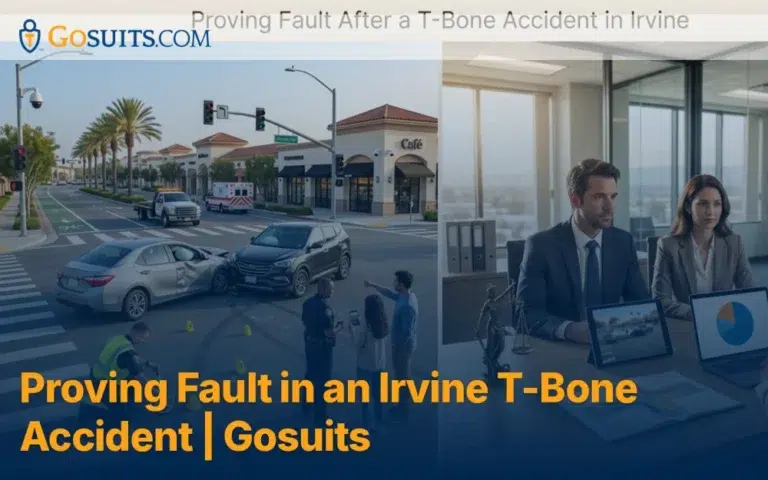
A T-bone collision, also referred to as a side impact crash, happens when the front of one vehicle collides with the side of another, often occurring at intersections. These incidents commonly stem from disputes over right of way, red light or stop sign violations, unsafe left turns across oncoming traffic, or speeding under California’s basic speed law [5] . Due to the fact that the struck vehicle’s side panels provide less protection during a crash, side impact collisions can result in serious injuries even at moderate speeds.
Intersections are complex scenarios where multiple decision points converge. National roadway safety statistics reveal that a considerable proportion of serious accidents occur at intersections, due to conflicts in movement, visual constraints, and disregard for traffic control devices [10] . Localized collision patterns in California are monitored by the Office of Traffic Safety, which publishes comparative scorecards to help us understand city and county trends for planning and prevention [11] . While each crash is unique, many side-impact collisions in Irvine arise from one driver ignoring their legal right of way while another is legally moving through the intersection.
How does California assign fault in a T-bone accident under comparative negligence?
California follows comparative negligence, which means a judge or jury can assign each party a percentage of fault and adjust compensation accordingly. The California Supreme Court’s decision in Li v. Yellow Cab replaced the old all-or-nothing contributory negligence rule with comparative negligence, allowing recovery even if the injured person is partly at fault, reduced by that percentage [1]. In a T-bone crash, a finder of fact might allocate percentages for actions like running a red light, turning left into oncoming traffic, or entering from a stop sign without yielding.
After an Irvine side impact collision, determining fault isn’t always straightforward. Factors like signal phases, turn movements, speeds and perception-reaction times can play a role in determining who is responsible. If the other driver claims you were speeding, it doesn’t mean your recovery will be impossible. However, if speed was a factor in the crash according to California’s basic speed law [5] , your compensation might be reduced. Given the complexity of these cases, many people prefer to seek trusted legal guidance rather than handle negotiations alone.
What right of way and signal laws often decide intersection accident fault in California?
An essential aspect of the California Vehicle Code that plays a significant role in determining fault in a side-impact (T-bone) collision is its extensive provisions. These legal guidelines are frequently applied when handling signal, stop sign, and left turn rule violations. Some of the most commonly utilized laws in these situations are:
- Red signals: Drivers facing a steady circular red must stop before entering the intersection and remain stopped until an indication to proceed is shown [2].
- Left turns: A left turning driver must yield to oncoming traffic that is close enough to be a hazard and must complete the turn only when it can be done with reasonable safety [3].
- Stop signs: A driver approaching a stop sign must stop and yield the right of way to traffic approaching so closely as to constitute an immediate hazard [4].
- Basic speed law: No person may drive at a speed greater than is reasonable or prudent for conditions, having due regard for weather, visibility, traffic, and the surface and width of the roadway [5].
In California, if a driver violates one of these safety statutes and that violation significantly contributes to causing an accident, the state’s negligence per se doctrine allows a jury to consider this violation as evidence of negligence, based on certain conditions outlined in the Judicial Council’s civil jury instructions [9]. This framework is often crucial in determining liability in intersection crashes resulting from side impacts.
Which evidence helps prove who had the green light or right of way in Irvine?
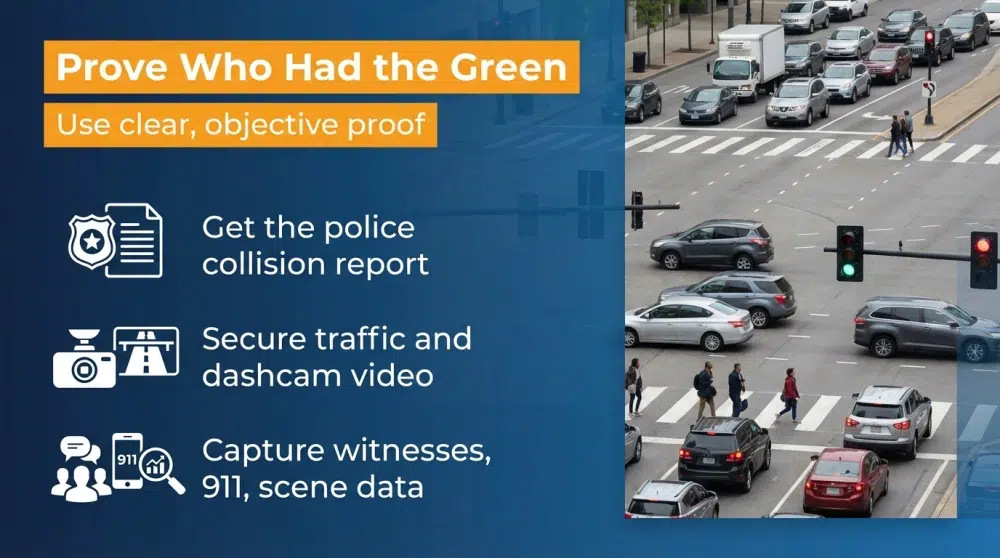
Side impact disputes frequently center around questions such as “who had the green light?” or “who was turning?”, and more often than not, “who should have yielded?” Resolving these cases largely depends on gathering strong evidence. Therefore, it is crucial to gather everything you can while memories are still fresh. Here are some key areas that can aid in proving what actually occurred:
Can an Irvine Police Department traffic collision report help?
Yes. If injuries or deaths occur, California requires a report to the police or California Highway Patrol within 24 hours [6]. The responding agency typically documents the scene, identifies parties and witnesses, notes apparent violations, and may include diagrams. You can request records through the Irvine Police Department’s Records Unit, subject to eligibility and availability rules [15]. While police reports are not binding on civil liability and may include opinions, insurers and courts often consider them as part of the overall evidence picture.
How do we get traffic camera or intersection video in Orange County?
Traffic or intersection cameras may capture signal phases, vehicle positions, and movement paths. Because video can be overwritten quickly, prompt preservation is crucial. Attorneys often send preservation letters and, if necessary, use subpoenas duces tecum to request footage from public or private custodians [15] [15] [15]. In civil cases, California’s subpoena statute provides a mechanism to demand production of documents and electronically stored information from nonparties, including video files when properly identified and within the custodian’s control [15]. Municipal agencies may also maintain records pursuant to local retention schedules and state law, so early action often makes the difference between obtaining vital video and finding it no longer exists.
Will dashcam and telematics be admissible?
Dashcam video, GPS data, and vehicle telematics often provide objective timing, speed, and location data. California law requires that evidence be relevant and properly authenticated before admission. Relevance means the evidence has any tendency in reason to prove or disprove a disputed fact [13]. Authentication generally requires producing sufficient proof that the item is what the proponent claims it is, which can be done through testimony of a witness with knowledge or technical foundation for digital data [14]. With proper foundation, such media frequently play a central role in proving or disproving right of way or signal compliance.
Do witnesses and 911 calls matter?
Witness statements can corroborate the color of the signal, turning movements, and whether a vehicle rolled a stop. Identifying independent witnesses early helps avoid fading memory. Audio from 911 calls can establish contemporaneous observations and timing markers. Like other evidence, these materials must be authenticated and relevant to be admitted [13] [14].
How do scene measurements and vehicle damage prove angle and speed?
Photographs, skid or yaw marks, and crush profiles on vehicle doors and bumpers help map angles of impact and pre-impact paths. Intersection geometry, signal timing charts, and lane striping add context. Combining these artifacts with data from onboard systems or nearby cameras can clarify which driver entered first, who had the green, and whether either driver’s speed was unreasonable for conditions under California’s speed rule [5]. The more contemporaneous and complete the record, the more persuasive the reconstruction.

How do insurance companies evaluate side impact liability and what defenses arise?
Insurers analyze T-bone crashes by reviewing traffic control device compliance, turn movements, pre-impact speeds, point of impact, and comparative statements. They will often argue:
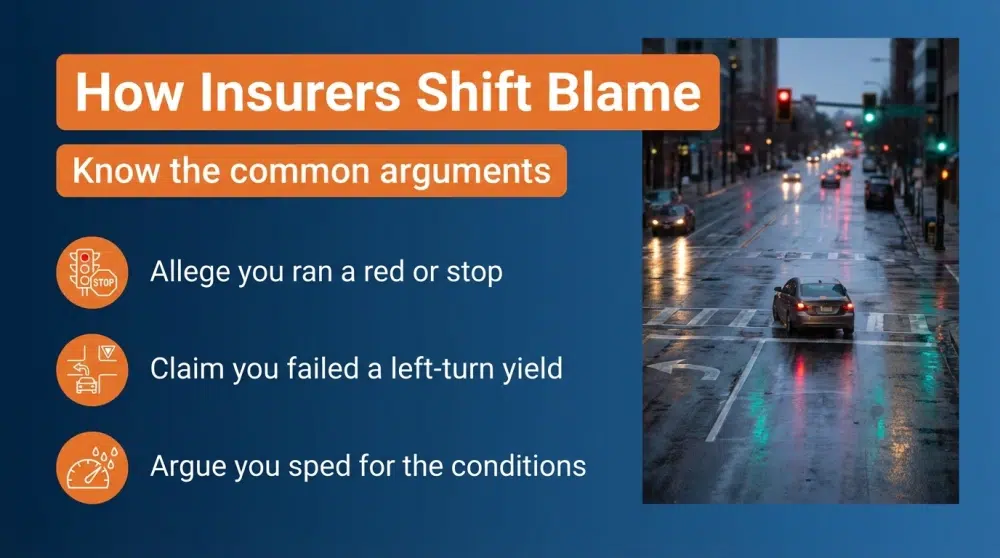
- You entered against the signal: A claimed red light entry or rolling a stop can lead to heavy fault assignment if credible evidence supports it [2] [4].
- You failed to yield while turning left: If you initiated a left turn without sufficient gap to oncoming traffic, they may contend you violated the left turn rule [3].
- You were traveling too fast for conditions: Even if within the posted limit, the basic speed law can apply when conditions call for slower speeds [5].
Adjusters may press for recorded statements early. Be cautious with any statement that speculates about signal phases or speeds. Presenting organized, verified evidence tends to be more persuasive than recollections alone. Many people consult car accident lawyers to help gather and present the strongest materials rather than navigating claim traps alone.
What if both drivers share blame in an Irvine side impact crash?
Comparative negligence means both drivers can be partially at fault with recovery reduced by one’s own percentage of responsibility. For example, if a left turning driver misjudged a gap and an oncoming driver entered the intersection late in a yellow phase at an imprudent speed, a trier of fact could split fault based on the weight of the evidence. California’s high court expressly recognizes that fault can be apportioned to reflect real world responsibility rather than a zero sum rule [1].
If you receive a low offer because the insurer claims you share fault, the question is whether their allocation matches the evidence and California law. Objective video, signal timing charts, tire mark analysis, and accurate witness statements can shift percentages materially. When in doubt, discuss options with Irvine car accident lawyers who regularly assess how right of way laws and comparative negligence interact in side impact disputes.
How do you preserve time sensitive evidence after a T-bone crash in Irvine?
Some of the most persuasive evidence disappears quickly. Consider these immediate steps:
- Request the police report: Identify the report number, agency, and request procedures promptly [15].
- Send preservation notices: Quickly notify potential video custodians such as nearby businesses, transit agencies, or property managers that footage may be relevant. Follow up with formal subpoenas if needed under California procedure [15].
- Secure your own data: Preserve your dashcam card, phone photos, and telematics without alteration. Create a read only copy for review to protect original metadata [14].
- Document the scene: Photograph vehicle rest positions, debris fields, marks, and sight lines as soon as it is safe to do so. Return promptly for daytime and nighttime lighting comparisons.
Organized and authenticated evidence makes your position clearer to insurers and, if necessary, a jury. Solid preservation habits today often pay off months later when negotiations hinge on a few minutes of video or a sequence of still images [13] [14].
What damages can you claim and what defenses can reduce recovery?
California civil cases typically allow recovery for both economic losses such as medical bills and wage loss, and noneconomic harms such as pain and inconvenience. However, any comparative negligence finding reduces the recovery by your percentage of fault [1]. Common defense themes in side impact collisions include arguing that injuries are inconsistent with the described impact angle or that prior conditions are responsible for ongoing symptoms. These issues are highly fact specific, and careful documentation of medical care, functional limits, and impact mechanics can address many of them.
How long do you have to file a claim after an Irvine T-bone collision?
California generally allows two years to file a personal injury lawsuit arising out of a motor vehicle collision [7]. If a public entity may be liable, such as for signal timing or a dangerous condition of public property, you usually must present a government claim within six months before filing suit [8]. Because exceptions can apply and timing is strict, it is wise to mark your calendar and act quickly so that important evidence is not lost while deadlines approach.
How do right turn on red and left turn rules affect side impact fault at Irvine intersections?
Right turns on red are allowed in California after a complete stop when the movement can be made safely and is not prohibited by signs. A driver turning right on red must yield to cross traffic and pedestrians lawfully in the intersection, and may proceed only when safe to do so [2]. If a right turning driver fails to stop or yield and strikes a vehicle lawfully proceeding on a green, that violation can weigh heavily in fault allocation.
Left turns require yielding to oncoming traffic close enough to constitute a hazard until the movement can be made with reasonable safety [3]. Many T-bone collisions happen when a left turning driver misjudges the speed or proximity of oncoming traffic, or attempts to “beat” a yellow. Where evidence shows a failure to yield, negligence per se may apply subject to the conditions in the jury instructions [9].
What steps should you take at the scene and soon after to support your claim?
Safety comes first. Call 911, seek medical care, and move vehicles out of travel lanes if safe. Then, to protect your civil claim, consider these steps:
- Call law enforcement: A timely report helps document factors like apparent violations, witness names, and diagrams [6].
- Gather information: Exchange identification and insurance, note license plates, and capture photos of vehicle positions, damage, signals, and visibility obstructions.
- Identify cameras: Look for nearby store cameras or traffic cameras. Note addresses and quickly send preservation requests if you can act the same day [15].
- Avoid speculation: Provide facts, not guesses, about speed or signal phases.
- Follow medical guidance: Consistent treatment and documentation help connect injuries to the crash.
If questions arise about statements to adjusters or how to obtain records, many people find it helpful to speak with car accident lawyers before giving recorded statements. Clear, accurate records tend to lead to fairer evaluations.
How can a lawyer build a case using negligence per se in a T-bone collision?
Negligence per se allows a jury to consider a statutory safety violation as evidence of negligence. In side impact cases, common statutes include running a steady red [2], failing to yield during a left turn [3], or entering from a stop without yielding [4]. California’s civil jury instruction on negligence per se explains that if the defendant violated a statute designed to prevent the type of harm suffered, and that violation was a substantial factor in causing the harm, the jury may find negligence based on that violation unless the defendant proves a legally sufficient excuse [9].
Building such a case usually involves collecting reliable proof of the violation. That could mean securing intersection video, the traffic collision report, event data recorder downloads, or testimony authenticating dashcam footage. Evidence must be relevant and authenticated under California’s Evidence Code to be admitted [13] [14]. Robust preparation on these points often increases settlement leverage and improves clarity at trial.

Why choose GoSuits if you were hurt in an Irvine T-bone accident?
When a T-bone crash turns life upside down, having a dedicated legal team focused on civil motor vehicle cases can make a meaningful difference.
- Aligned with your case needs: We help people in personal injury matters including intersection crashes, side impacts, rear end collisions, pedestrian and bicycle injuries, trucking collisions, and wrongful death in California, Texas, and Illinois.
- Technology driven case building: GoSuits uses exclusive proprietary software that accelerates records gathering, video preservation, and analytics to surface the most important facts sooner.
- Designated attorneys, not case managers: Although we leverage technology for speed, every client has direct, unfettered access to a designated attorney who leads the case strategy and communication.
- Proven courtroom readiness: Trial experience matters when insurers weigh risk. Our litigators prepare from day one with the evidence and instructions that juries actually use.
- Past results: See representative outcomes in our prior cases. Results vary based on facts and law.
- Leadership in innovation: Our software guided approach integrates subpoena workflows, evidence authentication checklists, and jury instruction mapping to present clear liability stories faster.
- Decades of combined service: With 30 years of combined experience across negotiation, discovery, and trial, we focus on building strong records that hold up under scrutiny.
- Start a conversation: A free consultation can clarify rights, timelines, and next steps, including obtaining reports from the Irvine Police Department and requesting intersection video before it is overwritten.
- Learn more: Meet our attorneys, read about about us, and review our practice areas.
If you are comparing options after a T-bone crash, Irvine car accident lawyers who understand California’s comparative negligence framework and right of way statutes can organize the evidence to present your strongest case.
References and resources
- Li v. Yellow Cab Co. of California 13 Cal. 3d 804 1975 – CourtListener
- California Vehicle Code section 21453 Red Signals – California Legislature
- California Vehicle Code section 21801 Left Turns and U Turns – California Legislature
- California Vehicle Code section 21802 Stop Signs – California Legislature
- California Vehicle Code section 22350 Basic Speed Law – California Legislature
- California Vehicle Code section 20008 Accident Reporting – California Legislature
- California Code of Civil Procedure section 335.1 Two Year Limitations – California Legislature
- California Government Code section 911.2 Claims Presentation Deadline – California Legislature
- California Civil Jury Instructions CACI Negligence Per Se – Judicial Council of California
- Intersection Safety Overview and Statistics – Federal Highway Administration
- Crash Rankings and Score Card – California Office of Traffic Safety
- California Evidence Code section 210 Relevance – California Legislature
- California Evidence Code section 1400 Authentication – California Legislature
- California Code of Civil Procedure section 1985 Subpoena Duces Tecum – California Legislature
- Irvine Police Department Records and Information – City of Irvine