- What are the most common mistakes people make after an injury in Irvine?
- Why is delaying medical care risky and how soon should you see a doctor?
- Should you give a recorded statement to an insurance adjuster?
- How do you document medical treatment and expenses in California?
- Do you need to report a crash to the Irvine Police Department or the DMV?
- What is the California statute of limitations for personal injury and what exceptions apply?
- How does comparative negligence work in California and how can your actions affect your claim?
- What social media mistakes can hurt your case and how should you manage online activity?
- How should you preserve evidence after an accident in Irvine?
- What should you know about property damage and rental cars in Orange County?
- What should you say and not say to avoid admitting fault?
- How do medical liens, health insurance, and subrogation affect a California injury claim?
- When should you consider hiring a lawyer in Irvine and what should you look for?
- How does GoSuits support injury clients in Irvine and throughout California?
- References and resources
What are the most common mistakes people make after an injury in Irvine?
If you were hurt in Irvine, you are not alone in wondering what to do next. Each step you take can help or hurt a future civil claim. Based on California law and consumer protection guidance, here are frequent mistakes we see after car crashes, falls, and other incidents in Orange County.
- Waiting to get medical care. Gaps in treatment can be used to argue your injuries were minor or unrelated. Early documentation ties your condition to the incident and protects your health.
- Giving recorded statements to opposing insurers. The at fault carrier may ask to record you quickly. You are not required under California law to provide a recorded statement to an opposing insurer, and what you say can be used against you later [7] [8].
- Missing reporting rules. Certain collisions must be reported to law enforcement within 24 hours and to the DMV within 10 days in California, and missing these steps can complicate claims [5] [6].
- Posting on social media. Photos, videos, and comments can be discovered and used to challenge your account of pain, limitations, or damages under California discovery rules [12].
- Admitting fault too quickly. California uses comparative negligence, so even partial fault reduces compensation. Off hand statements can be misinterpreted as admissions [9] [10].
- Not preserving evidence. Vehicles, defective products, surveillance videos, dashcams, and smartphone data can disappear fast. Loss of evidence can harm your case and may trigger adverse inferences by a jury [11].
- Letting the statute of limitations lapse. California has a general two year deadline to file personal injury lawsuits, with shorter deadlines for claims against public entities and special rules for minors [1] [2] [3] [4].
- Failing to track bills and lost income. You will need organized proof of economic losses. Sloppy records can lower any settlement offer.
- Underestimating comparative fault issues. What you say to police, adjusters, or online can be cited to shift blame and reduce recovery under California law [9] [10].
Early guidance helps you avoid these pitfalls. Many people start by talking with car accident lawyers to understand timelines, evidence needs, and insurance rules before speaking with the other side.
Why is delaying medical care risky and how soon should you see a doctor?
After a collision or fall, adrenaline can mask pain. Soft tissue injuries and concussions often evolve over hours or days. Delaying evaluation can worsen outcomes and create gaps in the record that insurers point to as proof that you were not seriously hurt. California traffic safety data show thousands of people are injured in traffic crashes each year, and immediate treatment supports both recovery and documentation [14].
- Go to the emergency department or urgent care the same day if you have head trauma, neck or back pain, numbness, weakness, chest pain, shortness of breath, severe headaches, or visual changes.
- Tell clinicians about all symptoms and how the injury occurred. Mechanism of injury helps clinicians decide on imaging and follow up.
- Follow the treatment plan and attend all referrals such as physical therapy or specialists. Missed appointments are commonly cited to discount claims.
- Request your medical records. California law gives you the right to inspect and obtain copies of your health records, often within specific time frames and for reasonable costs [15].
Create a personal health timeline that lists dates of care, providers, diagnoses, prescriptions, and time off work. This log will make demand packages stronger and reduce back and forth with insurers.
Should you give a recorded statement to an insurance adjuster?
It is common for the opposing insurer to call within days and ask to record a statement. You generally are not required to give a recorded statement to the other driver’s carrier. Insurers must follow California Fair Claims Settlement Practices Regulations, which set standards for prompt and fair handling of claims [7]. The California Department of Insurance also publishes consumer guidance on auto claims that explains what insurers may ask and what claimants should prepare, such as photos, police report numbers, and medical documentation [8].
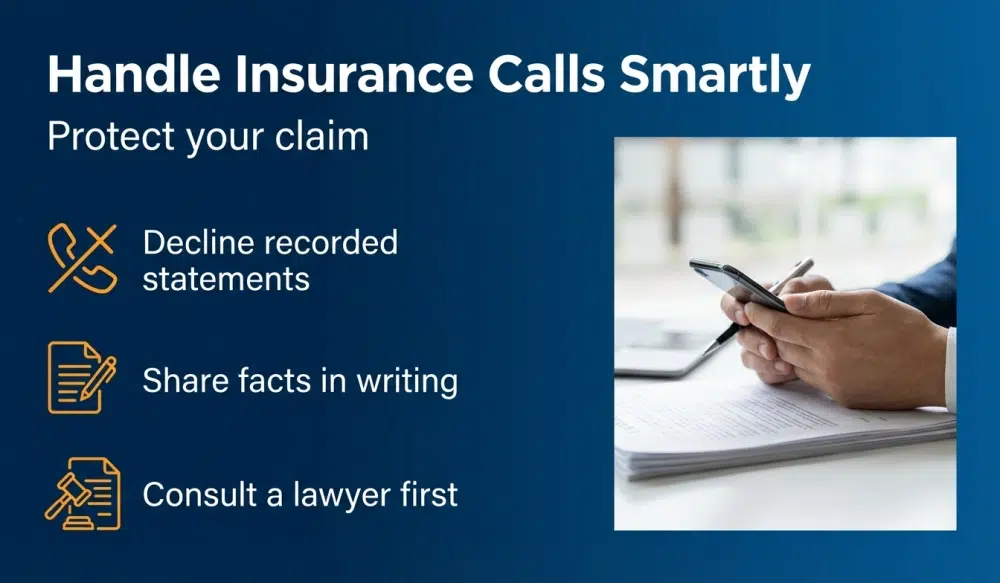
Common risks of recorded statements include incomplete answers early in your recovery, leading questions that elicit damaging admissions, off the cuff estimates of speed or distances, and minimizing symptoms that later worsen. Politely decline a recorded statement to the adverse insurer until you have had time to get medical care and understand your rights. If you choose to give any statement, consider doing so with guidance and in writing.
People who are recovering from serious collisions often decide to speak with accident lawyers in Irvine before engaging with insurers so that communications are accurate and focused on the facts.
How do you document medical treatment and expenses in California?
Well organized documentation is the backbone of a strong claim. California law allows broad discovery of relevant evidence in civil cases, including electronic records, so create a system now that you can maintain through recovery [12].
- Medical records. Request complete records from each provider, including clinic notes, imaging reports, test results, and discharge summaries. Keep copies of referrals and treatment plans. California Health and Safety Code recognizes your right to obtain these records [15].
- Bills and Explanation of Benefits. Keep every bill, receipt, and insurance EOB. Track copays, deductibles, and out of pocket costs.
- Medication and supplies. Save receipts for prescriptions, braces, bandages, and medical equipment.
- Lost income. Maintain pay stubs, W 2s, and employer letters confirming time missed and any reduced duties.
- Daily impact journal. Brief entries about pain, sleep, hobbies, childcare, and work limitations can show non economic harm over time.
- Photos and video. Document visible injuries from day one and at key milestones. Date stamp images when possible.
This organization makes it easier for car accident lawyers to assemble a demand package that accurately reflects both economic and human losses.
Do you need to report a crash to the Irvine Police Department or the DMV?
California has specific reporting rules that may apply to your collision. Complying with them helps protect your claim and creates an official record of the event.
- Law enforcement report within 24 hours. If an accident involves injuries or death, the driver of a vehicle must report the collision to the police department or the California Highway Patrol within 24 hours [5]. In Irvine, that means you can contact the Irvine Police Department for assistance and report numbers [13].
- DMV SR 1 within 10 days. You must submit a DMV SR 1 report if anyone was injured or killed or if property damage appears to exceed the DMV threshold. This report is mandatory even if law enforcement responded and even if the other party is at fault [6].
Keep a copy or screenshot of any online submissions, and write down the incident number. When in doubt, ask the responding officer or the Irvine Police Department front desk how to obtain a copy of the collision report for your records [13].
What is the California statute of limitations for personal injury and what exceptions apply?
Deadlines are a critical part of any California civil claim. If you miss the filing deadline, courts generally must dismiss your case regardless of the facts. Key timelines include:
- Two year general deadline. Most personal injury claims must be filed within two years from the date of injury [1].
- Claims against government entities. You must present a written claim directly to the public entity within six months for personal injury. If the claim is rejected, you generally have six months to file in court [2] [3].
- Minors. The statute is tolled for minors in many cases, meaning the clock may not start until the minor turns 18, subject to exceptions [4].
There are other exceptions for latent injuries or delayed discovery in narrow circumstances. Because deadlines vary by claim type and defendant, many injured people in Orange County speak with Irvine car accident lawyers early so there is time to investigate and file properly.

How does comparative negligence work in California and how can your actions affect your claim?
California follows pure comparative negligence. If a jury finds you partially at fault, your recovery is reduced by your percentage of fault. For example, if damages are 100 thousand dollars and you are 25 percent responsible, you can recover 75 thousand dollars. This rule comes from the California Supreme Court decision that replaced older all or nothing rules and is incorporated into standard California jury instructions [9] [10].
Your decisions after the incident can influence fault arguments:
- Statements at the scene. Avoid speculating about speed, distance, or cause. Provide facts needed for safety and reporting.
- Seat belts and helmets. Use of safety equipment can factor into comparative fault arguments depending on the claim.
- Following medical advice. Large gaps in care or not following restrictions can be framed as failing to mitigate damages.
- Preserving evidence. Losing key evidence can harm credibility and allow a jury to draw negative conclusions [11].
Balanced presentation of facts, supported by records and photos, helps reduce unfair blame shifting and aligns with California civil jury instructions on comparative fault [10].
What social media mistakes can hurt your case and how should you manage online activity?
Courts in California allow discovery of relevant social media content if it is proportional to the needs of the case. This includes photos, videos, comments, and location data, even if your profile is set to private. The California Code of Civil Procedure describes the broad scope of discovery in civil actions, and judges can order production of electronically stored information where appropriate [12].
- Avoid posting about the accident. Do not discuss fault, injuries, or negotiations online.
- Do not delete existing content. Deleting material after you anticipate a claim can be characterized as improper suppression of evidence and may lead to sanctions or adverse inferences [11] [12].
- Adjust privacy settings. Limit who can tag you or view your content, but remember that privacy settings are not a shield from lawful discovery.
- Ask friends and family not to post about you. Well meaning posts can be taken out of context.
Cautious online behavior helps you avoid giving the defense material that undermines your claims about pain, limitations, or daily activities.
How should you preserve evidence after an accident in Irvine?
Evidence can disappear quickly. Taking simple steps early strengthens your claim and prevents disputes about what happened.
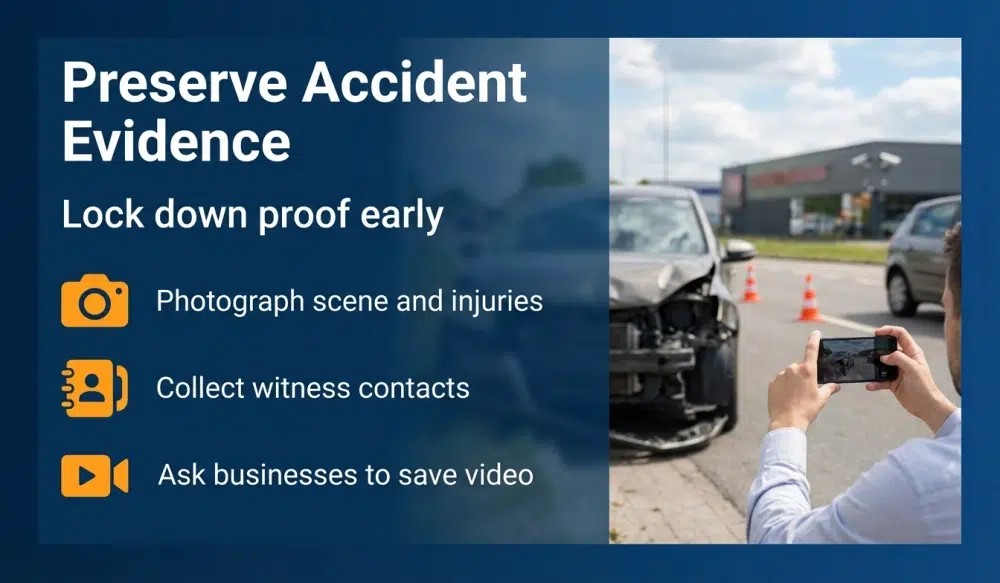
- Photographs and video. Capture vehicle positions, skid marks, road and weather conditions, traffic control devices, debris fields, and all visible injuries. Date your photos.
- Contact information. Obtain names, phone numbers, and addresses of witnesses. Ask local businesses if they have surveillance footage. Request that they retain it.
- Vehicle preservation. If a defect or serious impact is suspected, do not authorize disposal or repair without documenting the damage. Give written notice to the other side if you plan to move or inspect a vehicle so they cannot later claim surprise.
- Product preservation. In product related injuries, keep the product and packaging in a safe place. Document serial numbers and condition.
- Medical documentation. Photograph bruising and swelling over time. Save braces, casts, slings, and broken eyeglasses.
California jury instructions recognize that jurors may consider whether a party willfully suppressed evidence in evaluating the facts, which makes careful preservation important for both plaintiffs and defendants [11].
What should you know about property damage and rental cars in Orange County?
Property damage claims often move faster than injury claims. Still, there are pitfalls to avoid.
- Choose the repair shop. In California you generally have the right to select your repair shop. You do not have to use a preferred shop if you prefer another.
- Estimates and supplements. Initial estimates often miss hidden damage. Ask the shop to submit supplements to the insurer as needed and keep copies.
- Rental coverage. Coordinate with your insurer and the at fault carrier to determine rental eligibility and daily limits. Confirm the rate and class in writing.
- Diminished value. California law may allow diminished value claims in some circumstances, but proof can be complex. Professional appraisals and repair records are helpful.
Save towing invoices, storage bills, and all communications. Organized records support reimbursement and keep you in control of repairs.
What should you say and not say to avoid admitting fault?
In the moments after a collision or fall, emotions run high. Keep communication focused on safety and facts.
- Call 911 when needed. Request medical help for anyone who may be injured.
- Exchange information. Share names, contact details, driver’s license, registration, and insurance details when applicable.
- Describe facts, not opinions. Provide objective information to police about what you saw and heard. Avoid speculating about speed or who had the right of way.
- Do not apologize or admit fault. Say you want to cooperate and that you will provide information after you have had medical care.
- Request the report number. Ask responding officers how to obtain a copy of the report for your records in Irvine [13].
Later, be careful with adjusters. If you are unsure how to answer, it is reasonable to say you prefer to respond in writing. Many people choose to work with car accident lawyers in Irvine to streamline communications and reduce misunderstandings.
How do medical liens, health insurance, and subrogation affect a California injury claim?
Medical billing after an injury can be complicated. Understanding who paid and what must be repaid helps you avoid surprises at settlement.
- Private health insurance. Your insurer may pay bills and later assert a contractual right to reimbursement from your settlement. Request an itemized lien or subrogation statement and verify only related, paid claims are included.
- Medical payments coverage. If your auto policy includes Med Pay, it may pay early bills regardless of fault. Some policies have reimbursement provisions that must be reviewed carefully.
- Provider liens. Some providers treat on a lien basis and get paid from the settlement. Get any lien terms in writing and confirm that all charges are reasonable and necessary.
- Public programs. Programs like Medi Cal have statutory lien rights with specific procedures. Accurate accounting and timely resolution are important to close out a claim.
Track all payers, amounts billed, payments made, and any write offs. Organized lien resolution can increase your net recovery and speed final disbursement.
When should you consider hiring a lawyer in Irvine and what should you look for?
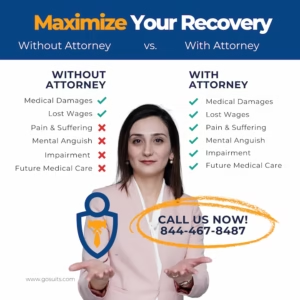
Significant injuries, disputed fault, government defendants, commercial vehicles, or multiple parties are signals to seek legal help. California deadlines can be short, and evidence goes stale quickly. Look for a team that communicates clearly, litigates in Orange County courts, and is prepared to take a case to trial if needed.
Many injured people start with a free consultation to understand options, evidence strategy, and timelines. They look for a firm that uses modern tools to gather records and build persuasive presentations without losing the personal attention of a designated attorney. People often compare experience, trial readiness, technology capabilities, and client access, along with reviews and published case results.
Injury victims frequently speak with accident lawyers to evaluate liability, damages, and insurance coverage and to avoid early missteps that can reduce a claim’s value.
How does GoSuits support injury clients in Irvine and throughout California?
We wrote this guide for people searching for Irvine personal injury lawyer mistakes after injury because the choices you make in the first days can influence your health, finances, and future civil claim. Our team represents clients across California, including Irvine and Orange County, in injury matters involving vehicles, unsafe property conditions, defective products, and catastrophic harm.
- Technology driven case building. GoSuits uses exclusive proprietary software that organizes evidence, tracks medical records, and models damages timelines so we can move from intake to action with speed and clarity.
- Designated attorneys for every client. Although we harness advanced technology to expedite each case, we do not use case managers. Every client has unfettered access to their attorney for strategy discussions and updates.
- Trial experience. Our attorneys prepare every matter as if it will go to trial, which supports better negotiations and positions cases to be heard if a fair resolution is not reached.
- Proven results. You can review a selection of outcomes on our page for prior cases. Results depend on facts and law in each case.
- Leadership in innovation. We continue to refine our litigation toolkit, including data forward investigation, streamlined discovery workflows, and visual storytelling for mediation and trial.
- Breadth of practice areas. We handle personal injury, motor vehicle collisions, premises liability, product liability, construction site incidents, and wrongful death. See our full practice areas.
- Who we are. Learn more about about us and meet our attorneys, who bring 30 years of combined experience to investigations, settlement negotiations, and trials.
If you want to talk about your situation, a free consultation can help you understand next steps and how a focused approach can avoid the most common mistakes after an injury in Irvine. We are ready to help you preserve evidence, manage communications, and stay on top of critical California deadlines.
Which practice areas are most relevant to this topic?
For collisions on the 405, Jeffrey Road, or Culver Drive, many people speak first with car accident lawyers to understand comparative negligence, medical documentation, and insurance communications. In other incidents such as falls or product related injuries, Irvine personal injury lawyers help investigate property conditions, product preservation, and notice requirements while you focus on recovery.
What local steps should you take in Irvine during the first 48 hours?
- Get medical care. Visit an emergency department, urgent care, or your primary care provider for evaluation and documentation.
- Report the collision when required. For injury crashes, contact the Irvine Police Department and request the report number [5] [13].
- Complete a DMV SR 1 if applicable. File within 10 days when the criteria are met [6].
- Preserve evidence. Photograph the scene and injuries, gather witness contacts, and secure damaged property.
- Be cautious with insurance calls. Consider delaying any recorded statement to the adverse carrier until you have organized facts and records [7] [8].
What statistics highlight the scope of injury risks in California and Orange County?
California Office of Traffic Safety data show continuing challenges on state roads, including serious and fatal crashes involving speed, impairment, and vulnerable road users. Local planning in Irvine and countywide enforcement focus on these risks year round [14]. Understanding these trends can inform your own decisions about documentation, prompt care, and follow up.
What should defendants and insurers know about California discovery and evidence rules?
California civil discovery is broad but guided by relevance and proportionality. Parties should anticipate early preservation of electronic records, including emails, logs, telematics, surveillance video, and social media, and should cooperate in reasonable discovery to narrow disputes. Courts may instruct jurors that they may consider whether a party willfully suppressed evidence and may impose sanctions for discovery misuse [11] [12].
What are common mistakes specific to pedestrian, bicycle, and motorcycle incidents?
- Not documenting visibility and lighting. For early morning or evening incidents, photograph lighting, shadows, and reflective clothing or gear.
- Helmet and safety gear records. Keep and photograph damaged helmets and gear. Do not discard them.
- Route and timing. Save navigation app histories or bike computer data to show your path, speed range, and timing.
- Vehicle black box data. Prompt letters from counsel can help preserve event data recorders in vehicles where speed and braking are disputed.
How can you avoid mistakes when dealing with multiple insurers and coverage types?
Many collisions involve several coverages such as liability, uninsured motorist, Med Pay, and health insurance. Keep a single claim log with each claim number, adjuster name, and a summary of what documents were sent and when. Confirm key points in writing. If a defendant is a government entity, calendar the six month claim deadline immediately and save proof of mailing or online submission [2] [3].
What should you do if you cannot work after an injury?
- Obtain a work status note. Ask your provider to document restricted duties or time off and the duration.
- Track income loss. Keep pay stubs, tax forms, and employer letters confirming missed hours and lost bonuses or commissions.
- Consider accommodations. Document offers and attempts at modified duty. This documentation helps show reasonable efforts to mitigate losses.
How do you avoid common pitfalls in medical follow up?
- Keep all follow ups. Missed visits can be used to argue that you recovered quickly.
- Update your physician. Report new or worsening symptoms promptly so they are recorded in your chart.
- Collect imaging and test results. Save CDs or links to portals for MRI and CT studies for easy sharing with consultants or experts.

What negotiation mistakes do claimants make with insurers?
- Sending a demand too early. If you have not reached maximum medical improvement, it can be hard to value future care and limitations.
- Undervaluing non economic harm. Journals, witness statements, and provider notes help explain how injuries affect daily life.
- Ignoring comparative fault arguments. Address disputed facts head on with photos, maps, and consistent narratives that align with jury instructions on fault apportionment [10].
How do you stay organized without getting overwhelmed?
- Create a single master file. Keep a digital folder with subfolders for medical records, bills, wage loss, photos, and correspondence.
- Use a claim log. Record every call and email with adjusters, including date, time, and what was discussed.
- Back up your files. Store copies in a secure cloud service or an external drive for redundancy.
References and resources
- Cal. Code Civ. Proc. § 335.1 Statute of limitations for personal injury – California Legislative Information
- Cal. Gov. Code § 911.2 Claim presentation to public entities – California Legislative Information
- Cal. Gov. Code § 945.6 Time to commence actions after claim rejection – California Legislative Information
- Cal. Code Civ. Proc. § 352 Tolling for minors and others – California Legislative Information
- Cal. Veh. Code § 20008 Accident report to law enforcement within 24 hours – California Legislative Information
- SR 1 Report of Traffic Accident Occurring in California – California DMV
- Fair Claims Settlement Practices Regulations overview – California Department of Insurance
- Auto Insurance Claims Consumer Guide – California Department of Insurance
- Li v. Yellow Cab Co. of California – CourtListener
- CACI No. 405 Comparative Fault of Plaintiff – Judicial Council of California
- CACI No. 204 Willful Suppression of Evidence – Judicial Council of California
- Cal. Code Civ. Proc. § 2017.010 Scope of discovery – California Legislative Information
- Irvine Police Department – City of Irvine
- Collision Data and Statistics – California Office of Traffic Safety
- Cal. Health & Safety Code § 123110 Patient access to health records – California Legislative Information