- What makes evidence the deciding factor in a Chicago motorcycle crash claim?
- What immediate steps should you take at the scene in Chicago?
- Which photos and videos help most and how do you capture them safely?
- How do you secure dashcam, GoPro and traffic camera footage in Chicago?
- How do you get the police crash report and why does it matter?
- How do witness statements strengthen your claim?
- Which medical records and bills matter and how do you get them?
- How should you preserve your motorcycle, gear and damaged property?
- What digital preservation steps prevent spoliation?
- Which Illinois motorcycle laws often shape liability in Chicago?
- How do insurance claims use your evidence and how should you communicate?
- What are the time limits in Illinois and what exceptions apply?
- How does comparative negligence work in Illinois and how can evidence push back?
- What special steps apply if a city vehicle or employee is involved?
- What is the complete Chicago motorcycle crash evidence checklist?
- How do courts decide if your photos, videos and records are admissible?
- Who is GoSuits and how do we support riders in Chicago, Illinois?
- References and resources
What makes evidence the deciding factor in a Chicago motorcycle crash claim?
In a motorcycle crash case, the side with the clearest, most credible evidence usually shapes the outcome. Under Illinois law, liability and damages must be proven by a preponderance of the evidence, which means more likely than not. Your documents, photos, videos, testimony, and physical items tell the story of what happened, who is at fault, and what losses you suffered. Strong evidence is also your best defense if an insurer argues that you were partly at fault under Illinois comparative negligence rules [3].
National research underscores why a careful, documented approach matters. Per federal safety data, motorcyclists face a much higher risk on the road, and per miles traveled, riders were many times more likely to die and several times more likely to be injured than passenger car occupants in recent annual statistics [7]. Because risk and impact are high, building a reliable record from day one is essential.
We encourage you to consult with a Chicago motorcycle accident lawyers as early as possible. Prompt legal help can coordinate preservation letters, secure video before it is overwritten, and guide you through medical documentation and insurance communications.
What immediate steps should you take at the scene in Chicago?
Your safety comes first. If you can do so safely, move out of traffic and call 911. In Illinois, injury or fatal crashes must be reported to law enforcement, and officers will prepare a report in qualifying circumstances [10].
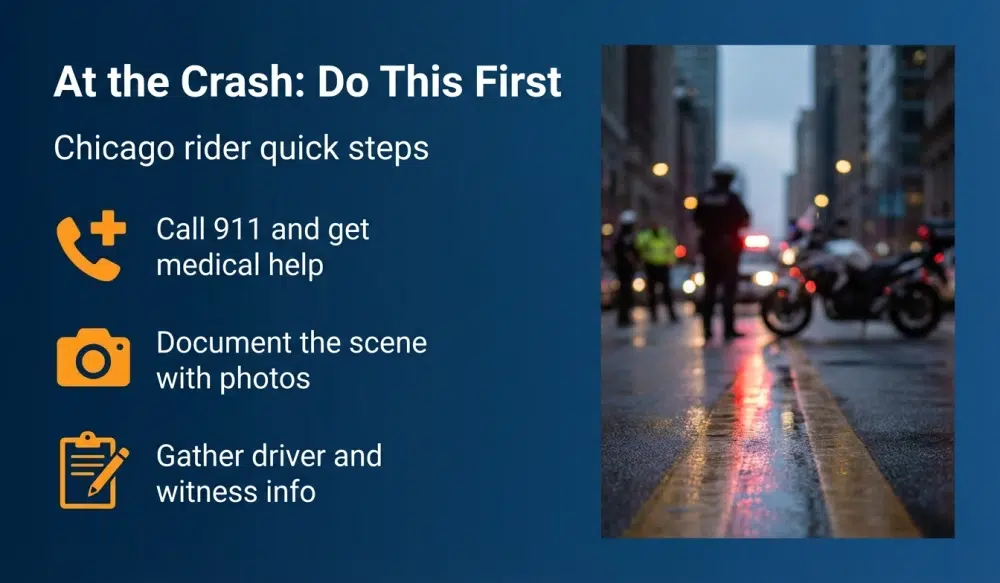
- Check for injuries and call 911. Request police and medical help and remain at the scene unless you need emergency treatment. Illinois law imposes duties after injury crashes [10].
- Document the scene. If it is safe, take wide, mid and close photos and short video clips of final vehicle positions, skid or yaw marks, debris, fluids, gouges, traffic signals, signage and weather conditions.
- Collect driver information. Get the other driver’s name, address, phone, license number, license plate, insurer and policy number. Photograph these details if possible.
- Identify witnesses. Ask for names, phone numbers and email addresses. A short voice memo or text to confirm contact info can help later.
- Preserve the motorcycle and gear. Do not repair, sell or discard your bike, helmet, jacket, gloves or boots until your claim is resolved. Treat them as physical evidence.
If you are too injured to gather information, do not worry. The priority is medical care. Other sources can often fill the gap, including police reports, traffic camera data, nearby business videos and vehicle telematics.
Which photos and videos help most and how do you capture them safely?
Visuals have high persuasive value because they show conditions that may be gone hours later. Here is a quick guide to what matters and how to capture it.
- Final resting positions. Photograph the motorcycle, other vehicle and any debris from multiple angles. Include context like lane markings and nearby landmarks.
- Surface evidence. Photograph skid marks, scuffs, gouges, scrapes and fluid trails. These markings can help reconstruct speed, braking and impact angles.
- Traffic controls. Capture the specific traffic light, stop sign, yield sign or lane control signs and their sightlines.
- Damage close ups. Photograph crush points, broken parts, mirror impacts, handlebar and fork damage, fairing scrapes, and any transfer paint on both vehicles.
- Injuries over time. Take photos of cuts, bruises and swelling over several days. Document visible changes and healing progress.
- Environmental factors. Photograph weather, standing water, potholes, gravel, construction barrels, detours and temporary signage.
Record short videos panning the scene, narrating what you see. When safe, include ambient audio such as a loud, malfunctioning turn signal or a driver admission. Remember, do not put yourself at risk to take photos or videos. If the scene is unsafe, wait for police direction.
How do you secure dashcam, GoPro and traffic camera footage in Chicago?
Video can be decisive. The challenge is that many systems overwrite data quickly. Move fast and use formal requests.
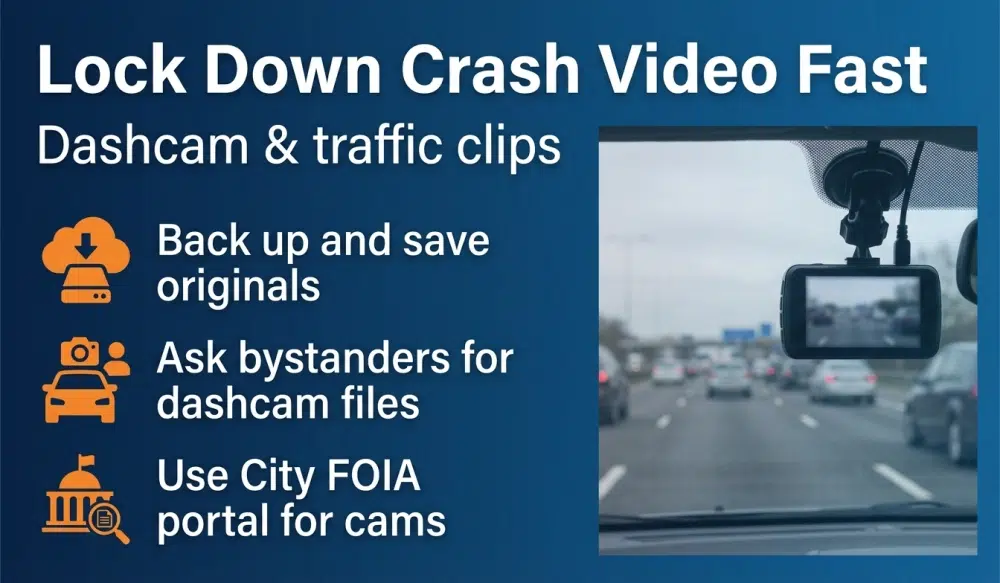
- Personal devices. Secure phone videos and GoPro files immediately. Back them up to a cloud folder and a physical drive. Do not edit the originals. Create a simple log noting file names, date and time, and location to support authenticity under evidence rules [13].
- Other vehicles’ dashcams. If bystanders recorded the crash, politely ask for a copy and their contact information. Follow up by email or text the same day. If needed, a preservation letter can request that they keep the original file untouched.
- Business and residential cameras. Note the exact address and camera location. Many systems overwrite within days. A prompt, polite request and follow up preservation letter can make the difference.
- Traffic and red light cameras. In Chicago, you may request public records from city agencies through the City’s public records portal pursuant to the Illinois Freedom of Information Act [11] and the City portal [12]. Be as specific as possible about date, time range, intersection, lane and direction of travel.
If litigation is reasonably anticipated, parties must preserve relevant electronically stored information. In federal court, sanctions may apply for failing to preserve relevant electronic evidence under the civil rules [14]. Early legal help can send targeted preservation letters to at fault drivers, fleet owners and nearby businesses to reduce the chance of data loss.
How do you get the police crash report and why does it matter?
The Illinois police crash report is a central document that consolidates driver identities, insurance, location, road conditions, vehicle damage, preliminary narratives and diagramming. Officers must forward certain crash reports to the state Department within the time frames set by statute [10].
In Chicago, you can request a copy through the Chicago Police Department’s process for traffic crash reports [9]. Keep your report number, date and location ready. Review the report for accuracy and note any corrections needed. If the report contains an error, you can submit a supplemental statement to the officer or agency.
Remember that the report is often not admissible by itself to prove fault, but it guides investigation and settlement discussions. It also points you to witness names, exact time stamps and roadway details that help you find more evidence.
How do witness statements strengthen your claim?
Witnesses help bridge gaps in the timeline and can resolve disputes about speed, signals and lane changes. A short, timely statement is usually more reliable than a delayed memory.
- Collect contact information at the scene. Ask for names, phone numbers and emails. Confirm by sending a quick text on the spot.
- Request a written or recorded statement. A calm description focusing on what the witness saw, heard and smelled is most persuasive. Avoid leading questions.
- Note vantage point and conditions. Ask where the witness stood, which way they faced and any obstructions to view.
- Preserve metadata. If a witness shares a photo or video, save the file with its original metadata. Keep a simple receipt log to support authenticity under the rules of evidence [13].

Which medical records and bills matter and how do you get them?
Medical proof connects the crash to your diagnoses, treatment and prognosis. Accurate records and itemized bills support negotiations and are necessary for trial.
- Emergency care and EMS. Obtain EMS run reports and emergency department records. These documents capture mechanism of injury, initial complaints and objective findings. You can request your own records under federal patient access rules, subject to reasonable safeguards [8].
- Imaging and specialty care. Request radiology reports and images, orthopedic and neurological consults, and physical therapy notes. Ask for digital DICOM files in addition to PDFs when possible.
- Work capacity and restrictions. Keep work notes, off duty slips and functional capacity evaluations. These guide wage loss calculations and life activity impacts.
- Itemized billing and liens. Request itemized statements and accounting ledgers. Be aware that Illinois has a health care services lien statute that governs certain medical liens on settlements and judgments [15].
Maintain a treatment journal recording pain levels, sleep changes, medication side effects and activity limits. Consistent entries help explain care decisions and recovery progress.
How should you preserve your motorcycle, gear and damaged property?
Physical items are evidence. Preserve them as they were immediately after the crash.
- Do not repair or discard. Keep the motorcycle, helmet and riding gear in their post crash condition until all parties have had a chance to inspect and photograph.
- Secure storage. Store the motorcycle in a locked garage or tow yard with limited access. Keep a simple custody log noting who accessed it and when, to support authenticity [13].
- Document condition. Photograph the motorcycle top, bottom, both sides and the cockpit. Capture the odometer, aftermarket parts and any diagnostic codes on the instrument panel.
- Keep broken parts. Place small parts in labeled bags. Save the helmet, visor and face shield. Head impact evidence can be important even though Illinois does not mandate helmets [6].
What digital preservation steps prevent spoliation?
Modern crash cases rely on electronic data. Preservation helps avoid loss and dispute.
- Send preservation letters. Ask at fault drivers, employers, rideshare companies, nearby businesses and property owners to preserve relevant video, phone logs and telematics. Federal courts can sanction loss of relevant data under the civil rules if certain conditions are met [14].
- Back up your files. Keep original photos and videos unchanged. Create a read only archive and a working copy. Maintain a simple inventory that lists file name, date, device and location.
- Avoid file conversions. Do not compress or transcode videos if you can avoid it. If conversion is necessary to view, keep the original and document the process.
- Protect communications. Save all emails and texts with insurers and repair shops. Export complete threads and attachments.
Which Illinois motorcycle laws often shape liability in Chicago?
Understanding state rules helps you focus your evidence on the facts that matter most for fault and defenses.
- No statewide adult helmet requirement. Illinois does not require adult riders to wear helmets. Even so, helmets reduce the risk of death and head injury, and medical records about helmet use can appear in disputes over injury causation [6] [8].
- Lane sharing and filtering rules. Illinois prohibits operating a motorcycle between lanes of traffic or between adjacent lines or rows of vehicles, and restricts passing in the same lane. This can be relevant when a driver claims the rider was between lanes [5].
- Police reporting. Officers must prepare and forward certain reports to the state after qualifying crashes. The officer narrative, diagram and coded data elements are frequently used by insurers and investigators [10].
- Comparative negligence statute. A plaintiff cannot recover if more than half at fault, and recoveries are reduced by the percentage of fault otherwise. Targeted evidence about speed, signals, lane position and visibility helps contest any fault attributed to you [3].
How do insurance claims use your evidence and how should you communicate?
Insurers evaluate liability and damages by reviewing the record you create. Keep communications calm, accurate and complete, and be mindful that recorded statements can be used to limit your claim.
- Notify your insurer promptly. Provide the basics and state that an investigation is ongoing. Submit the police report number and photos once available.
- Send a concise evidence packet. Include the crash report, scene photos, videos, medical records and itemized bills. Provide lost wage documentation such as pay stubs and employer letters.
- Track claim numbers and adjusters. Keep a log of calls, emails and requests with dates. Organize documents by category and date.
- Be careful with recorded statements. Consider obtaining legal help before agreeing to detailed recorded interviews with the at fault driver’s insurer.
To protect your rights and build a complete record, many riders choose to work with Chicago motorcycle accident lawyers who can gather, organize and present the evidence in a way that meets the legal standards for liability and damages.
What are the time limits in Illinois and what exceptions apply?
Illinois law sets civil filing deadlines. Missing a deadline can end a claim regardless of its strength. Evidence collection should be planned with these time frames in mind, because some records take weeks to obtain.
- Personal injury claims. In most cases, a suit for injury must be filed within two years of the crash date [1].
- Property damage claims. Claims for property loss often have a five year filing limit [2].
- Claims against local public entities. Claims against a city or other local public entity generally have a shorter one year period under the Tort Immunity Act [4].
Because these are general rules with exceptions for minors and other circumstances, early review by a lawyer helps align your evidence plan with the correct deadline and forum.

How does comparative negligence work in Illinois and how can evidence push back?
Illinois follows a modified comparative negligence system. If you are half or less at fault, your recovery is reduced by your percentage of fault. If you are more than half at fault, you cannot recover [3]. Defendants and insurers often argue that a motorcyclist’s speed, lane position, or visibility contributed to the crash. Targeted evidence can counter those claims.
- Signal timing and phasing. Photos and intersection diagrams support testimony about whether a light was green, yellow or red at entry.
- Headlight and gear visibility. Photos of your headlight setting and retroreflective gear help answer visibility questions.
- Speed and stopping distance. Skid measurements, vehicle damage profiles and scene geometry may help a reconstruction expert estimate speed ranges.
- Other driver conduct. Phone records, turn signal status, mirror damage and blind spot explanations can shift fault toward the other driver.
A clear, well documented record often narrows disputes about fault and strengthens settlement posture.
What special steps apply if a city vehicle or employee is involved?
When a Chicago city vehicle or employee is involved, additional considerations apply.
- Shorter filing window. Many claims against local entities must be filed within one year [4].
- Public records requests. Use the City of Chicago records portal to request dashcam, AVL or work order data relevant to the city vehicle, in addition to the Illinois FOIA statute [11] [12].
- Preservation letters. Prompt letters seeking preservation of city video and records reduce the risk of routine overwriting.
What is the complete Chicago motorcycle crash evidence checklist?
Use this practical list to organize your case record from day one.
What scene documentation should you gather?
- 911 call details. Date, time, dispatcher name if available and incident number.
- Police agency and report number. Officer names and badge numbers. Event or RD number in Chicago [9].
- Location details. Exact intersection, lane, direction of travel, nearest address and mile markers.
- Traffic controls. Photos of signals, signs, construction and lane markings.
- Scene condition. Weather, lighting, visibility, surface hazards and obstructions.
What visual evidence should you save?
- Photos and videos. Wide and close angles of vehicles, debris, skid marks, injuries and environment.
- Bystander video. Names and contact info for anyone who filmed.
- Business and residential cameras. Addresses and camera locations; preservation requests sent same day.
- Traffic cameras. FOIA request draft with date, time, direction and approach for Chicago intersections [12].
What identification and insurance information matters?
- Driver and vehicle info. Names, addresses, phone numbers, plates and VINs. Photos of licenses and insurance cards.
- Insurance coverage. Policy numbers and coverage letters. Illinois minimum liability proof is required for vehicles, including motorcycles [15].
What medical and economic documents should you compile?
- Medical records. EMS, emergency department, imaging, specialist notes and therapy records [8].
- Billing. Itemized statements, explanations of benefits and pharmacy receipts.
- Work and income. Pay stubs, W 2 forms, employer letters and work restriction notes.
- Daily impact journal. Pain levels, sleep, missed events and activity limits.
What physical items must be preserved?
- Motorcycle. Store securely without repairs until inspection.
- Riding gear. Helmet, jacket, gloves, pants and boots bagged and labeled.
- Broken parts. Labeled in separate bags with collection date.
What formal steps help lock down evidence?
- Preservation letters. To drivers, employers, nearby businesses and agencies.
- Public records requests. Illinois FOIA and City of Chicago portal submissions for video and records [11] [12].
- Chain of custody. Custody logs for physical and digital evidence to support authenticity under the rules of evidence [13].

How do courts decide if your photos, videos and records are admissible?
Two core ideas govern whether evidence gets in front of a jury: relevance and authenticity. Relevance is a low bar, asking whether the evidence has any tendency to make a fact more or less probable. Authenticity requires proof that the item is what the proponent claims it is. Foundational testimony, metadata, hash values, or a simple chain of custody can satisfy authenticity requirements for many photos and videos under evidence rules [13].
For electronic evidence, courts can impose remedies if relevant data is lost after a duty to preserve arises. In federal court, the civil rules provide specific standards for addressing loss of electronically stored information and potential prejudice [14]. In practice, preservation letters, backups and careful handling of original files help avoid these disputes.
Who is GoSuits and how do we support riders in Chicago, Illinois?
We built this guide for people harmed in a motorcycle crash in Chicago, Illinois. If you were injured, a free consultation with our team can help you understand which evidence matters most, what to do next and how to avoid common pitfalls with insurers. We practice throughout Illinois and handle serious motor vehicle injury cases across the state.
GoSuits combines seasoned trial attorneys with proprietary technology that organizes crash evidence, medical records and claim communications faster so you get clear answers sooner. Our exclusive software streamlines video preservation, record retrieval and damages modeling, while your designated attorney remains your direct point of contact. We do not use case managers. Every client has unfettered access to their attorney from start to finish.
Our attorneys have tried and resolved significant injury cases and have achieved meaningful results for clients across Illinois. You can review a selection of outcomes at prior cases, learn about the team at our attorneys and see who we are at about us. We cover a wide range of personal injury matters, including motorcycle, car and truck crashes, premises liability, construction injuries, product liability and wrongful death. Explore our full list at practice areas. With more than 30 years of combined experience and real trial backgrounds, we prepare every case as if it may be tried, which often improves negotiations and helps surface the truth.
If you want help preserving camera footage, organizing your medical documentation or speaking with insurers, reach out. Chicago motorcycle accident lawyers at our firm can take the evidence work off your plate so you can focus on recovery.
References and resources
- 735 ILCS 5 13 202 Personal actions – Illinois General Assembly
- 735 ILCS 5 13 205 Five year limitations – Illinois General Assembly
- 735 ILCS 5 2 1116 Comparative fault – Illinois General Assembly
- 745 ILCS 10 8 101 Actions against local public entities – Illinois General Assembly
- 625 ILCS 5 11 703 Overtaking, passing and lane use for motorcycles – Illinois General Assembly
- Illinois Motorcycle Operator Manual – Illinois Secretary of State
- Traffic Safety Facts 2021 Data Motorcyclists – NHTSA
- Motorcycle Safety and Helmets – Centers for Disease Control and Prevention
- Obtain a Traffic Crash Report – Chicago Police Department
- 625 ILCS 5 11 406 Police officer accident reports – Illinois General Assembly
- Illinois Freedom of Information Act – Illinois General Assembly
- Public Records Request Portal – City of Chicago
- Rule 901 Authenticating or Identifying Evidence – Legal Information Institute
- Rule 37 Failure to Make Disclosures or to Cooperate in Discovery – Legal Information Institute
- Mandatory Insurance Requirements – Illinois Secretary of State