- What makes left-turn motorcycle crashes common in Chicago, IL?
- How does Illinois right-of-way law assign fault when a car turns left in front of a motorcycle?
- What evidence helps prove fault in a Chicago left-turn motorcycle crash?
- How does comparative negligence work in Illinois motorcycle cases?
- Which traffic citations and statutes commonly matter in left-turn cases?
- What defenses do drivers and insurers raise, and how do courts evaluate them?
- How are police reports, traffic camera and dashcam videos used in Chicago?
- What injuries and damages are common, and how do you document them for a civil claim?
- What steps should you take after a left-turn motorcycle crash in Chicago?
- How do insurance claims and litigation proceed in Cook County courts?
- What timelines and statutes of limitations apply in Illinois?
- Why do local conditions at Chicago intersections matter for left-turn motorcycle collisions?
- Who is GoSuits and how can we help riders and families in Chicago, IL?
- References and resources
What makes left-turn motorcycle crashes common in Chicago, IL?
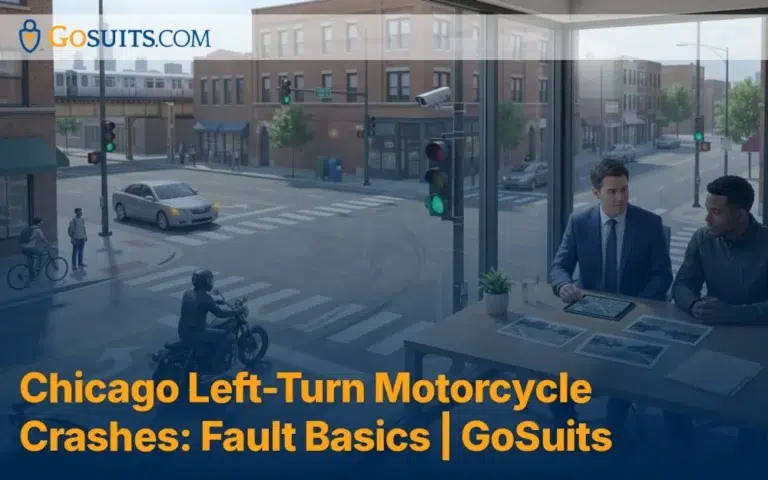
You are not imagining it. National traffic safety data show that a large share of fatal two-vehicle motorcycle collisions involve a turning vehicle, often a driver turning left while a rider travels straight through the intersection. In 2021, about four in ten fatal two-vehicle motorcycle crashes involved the other vehicle turning left while the motorcycle was going straight, passing, or overtaking [1]. Intersections concentrate conflict points, and left-turn movements combine several visibility and judgment challenges at once.
Local roadway context matters. Chicago’s grid, high traffic volumes on arterials like Western, Ashland, and Cicero, and complex multi-lane intersections can magnify the classic left-turn scenario. Congested lanes and parked vehicles can hide a smaller profile motorcycle from a turning driver until it is too late. Statewide statistics also show that intersection crashes are a persistent safety problem for vulnerable users, including motorcyclists [3].
Speed differentials, glare, wet pavement, and poor gap selection during peak travel times all add risk. At night, a motorcycle’s single headlamp and narrow frame can cause drivers to misjudge distance. During the day, cluttered sightlines near bus stops or construction zones can obscure riders. Understanding why these crashes happen helps you frame fault arguments under Illinois traffic laws.
How does Illinois right-of-way law assign fault when a car turns left in front of a motorcycle?
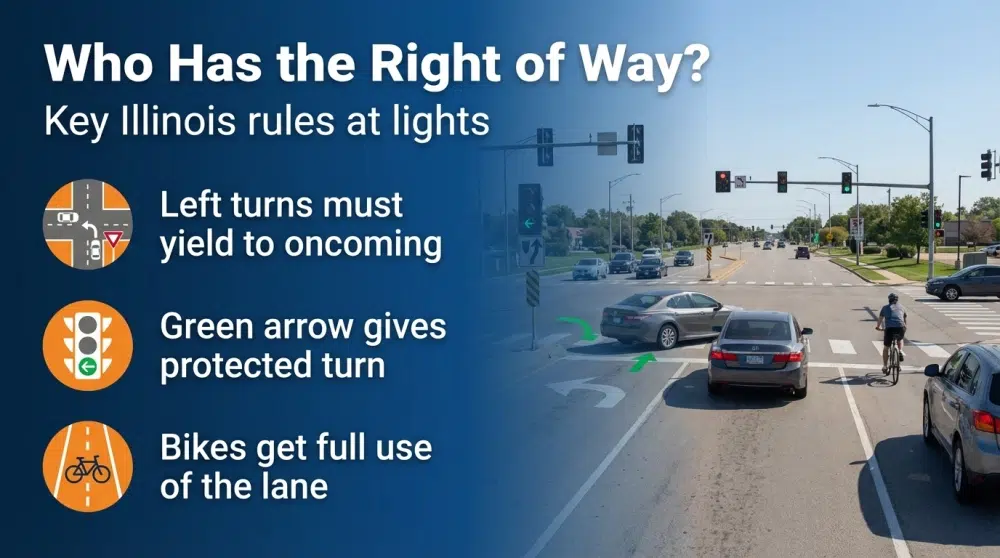
Illinois law requires a driver intending to turn left to yield to oncoming traffic that is so close as to constitute an immediate hazard. This applies to motorcycles and passenger vehicles alike. The left-turning driver must wait until the movement can be made with reasonable safety [4]. That rule is the backbone of many fault determinations when a car turns left across a rider’s path.
Traffic signals still matter. If a driver turns left on a green arrow, then oncoming traffic must yield to that protected movement. If the signal is a circular green or flashing yellow arrow, the turning vehicle must yield to oncoming traffic that has the right of way, which includes motorcycles proceeding straight on a green indication [5]. When drivers misread signals or try to squeeze through a gap, they can violate their duty to yield.
Illinois also affirms that motorcycles are entitled to the full use of a lane. Other vehicles may not deprive a motorcycle of that lane by squeezing or cutting across its path. That principle reinforces the argument that a driver who turns across a motorcycle’s lane without adequate clearance fails to yield properly [6].
What evidence helps prove fault in a Chicago left-turn motorcycle crash?
To allocate fault, you need a clear picture of who had the right of way, who had a protected signal, speeds, distances, and line of sight. Strong cases are built on timely, corroborated evidence.
Which types of scene evidence are most persuasive?
- Intersection control data. Photos and video of signal heads, stop bars, turn arrows, and any sign restricting turns help apply the Illinois Vehicle Code to the facts [5].
- Video recordings. Red light camera clips and private dashcams can show whether the turning driver yielded. Chicago’s red light camera program maintains footage you may request, which can be pivotal for left-turn disputes [11].
- Event Data Recorder information. Most passenger vehicles record limited pre-crash data like speed and brake status, relevant to timing and gap acceptance. EDR data is often discoverable and can corroborate estimates [12].
- Physical marks. Skid, yaw, and scrape marks, plus the rest positions of the vehicles, help reconstruct timing and angles when combined with photos and roadway measurements.
- Lighting and weather. Documenting sun position, rain, or nighttime illumination addresses visibility arguments at the heart of left-turn cases.
How should you gather official documents and records?
- Police crash reports. Reports often include diagrams, statements, and citations. They are an early roadmap to fault theories.
- FOIA requests. For city-held video or signal timing sheets, Illinois Freedom of Information Act requests can secure records from relevant agencies [13].
- Discovery tools. In litigation, interrogatories and requests to produce are governed by Illinois Supreme Court Rules 213 and 214, which shape how you obtain witness identities, statements, and electronic data [9] [10].

Why do witness accounts still matter?
Independent witnesses can confirm whether the motorcycle had a stale green and whether the left-turning driver hesitated or accelerated into the turn. Ask for contact details at the scene if you can do so safely. Statements are often taken early by insurers, so prompt outreach is important to preserve neutral testimony.
How does comparative negligence work in Illinois motorcycle cases?
Illinois follows a modified comparative negligence rule. A plaintiff’s recovery is reduced by their percentage of fault, and recovery is barred if the plaintiff is more than 50 percent at fault. This allocation applies in motorcycle crashes as in any negligence case [7].
Consider a typical argument: the left-turning driver failed to yield, but the insurer claims the rider was traveling 10 miles per hour over the limit. A jury could assign percentages based on the evidence. If the rider is found 20 percent at fault, damages are reduced by 20 percent. If the rider is found 51 percent at fault, the claim is barred. Understanding this framework helps you evaluate settlement offers and the risks of trial.
Violations of safety statutes do not automatically decide a case, but they can be powerful evidence of negligence when linked to the crash. Courts generally treat statutory violations as evidence a factfinder may consider when deciding whether someone acted reasonably under the circumstances [14].
Which traffic citations and statutes commonly matter in left-turn cases?
Several Illinois Vehicle Code provisions frequently come into play when a car turns left across a rider’s lane:
- Left turns must yield. Drivers turning left must yield to oncoming traffic that presents an immediate hazard, including motorcycles proceeding straight [4].
- Obey traffic signals. A protected left arrow grants the turner the right of way, but a circular green requires yielding to oncoming vehicles and pedestrians. Signal violations are often cited after left-turn crashes [5].
- Motorcycle lane rights. Motorcycles are entitled to the full use of a lane. Overtaking or turning across a lane occupied by a motorcycle can violate this rule and support fault [6].
When you align the facts with these statutes, you help insurers and courts assess duty, breach, and causation. Police citations are not conclusive proof of negligence, but they often track the same code sections that civil courts apply.
What defenses do drivers and insurers raise, and how do courts evaluate them?
Is “I didn’t see the motorcycle” a valid defense?
Drivers often say they looked but did not see a motorcycle. While perceptual limits are real, failure to detect a reasonably visible road user does not excuse the duty to yield. Courts weigh whether a reasonably careful driver would have seen the motorcycle given lighting, distance, and speed. Evidence like headlamp status, conspicuity gear, and line-of-sight photos helps test this claim.

What about claims that the motorcycle was speeding?
Speed arguments aim to shift a portion of fault to the rider. EDR data from the turning vehicle, brake marks, and video can help quantify timing. Even if modest speeding is proven, the left-turning driver still bears the statutory duty to yield to oncoming traffic that is close enough to be hazardous [4]. Comparative negligence allows the factfinder to assign a fair percentage to each party [7].
Do signal timing debates matter?
Yes. Left-turn crashes often hinge on who had a protected left versus a permissive left. Signal phase diagrams and timing sheets can clarify whether the left-turner had a green arrow or only a circular green at the moment of impact. Those documents can be obtained from the city through records requests [11] [13].
Does lane sharing or filtering affect fault?
Illinois recognizes a motorcycle’s right to full lane use. Lane sharing that deprives a rider of lane space or a turn that cuts into an occupied lane can support fault arguments against the driver. Riders should avoid actions that violate the lane-use rules to protect both safety and legal standing [6].
How are police reports, traffic camera and dashcam videos used in Chicago?
Chicago maintains a network of red light cameras at select intersections. These systems can capture pre-crash behavior, including red light violations and timing of left turns. Footage, when available, can decisively show whether the turning driver yielded or turned across a motorcyclist’s right-of-way [11].
Police reports provide diagrams, statements, and citations that establish an early narrative. However, they are not the final word. Independent video, 911 audio records, and dashcam clips from nearby vehicles can fill gaps and counter self-serving statements. Where video is controlled by public agencies, Illinois FOIA provides a process to request records [13].
Nationwide, motorcycle safety analyses underscore the significance of turning conflicts in severe crashes, which is why objective video receives particular weight when reconstructing fault [1] [2].
What injuries and damages are common, and how do you document them for a civil claim?
Left-turn collisions often produce angular impacts that can eject a rider, leading to orthopedic trauma, road rash, and head injuries. Nationally, motorcyclist fatalities reached 5,932 in 2021, the highest since at least 1975, a statistic that reflects the severe energy transfers in these crashes [1]. In nonfatal cases, documenting medical care, lost wages, and the impact on day-to-day activities is essential in civil claims.
- Medical records. Treatment notes, imaging, and discharge instructions establish causation and the extent of harm.
- Work and income proof. Pay stubs, employer letters, and tax records support wage loss claims.
- Out-of-pocket expenses. Keep receipts for prescriptions, mobility aids, and transportation to appointments.
- Daily-life documentation. Journals and family statements can help explain pain, limitations, and the human impact of the injuries.
Insurers often scrutinize gaps in treatment or preexisting conditions. Consistent records and timely care help avoid disputes about causation and the reasonable value of damages.
What steps should you take after a left-turn motorcycle crash in Chicago?
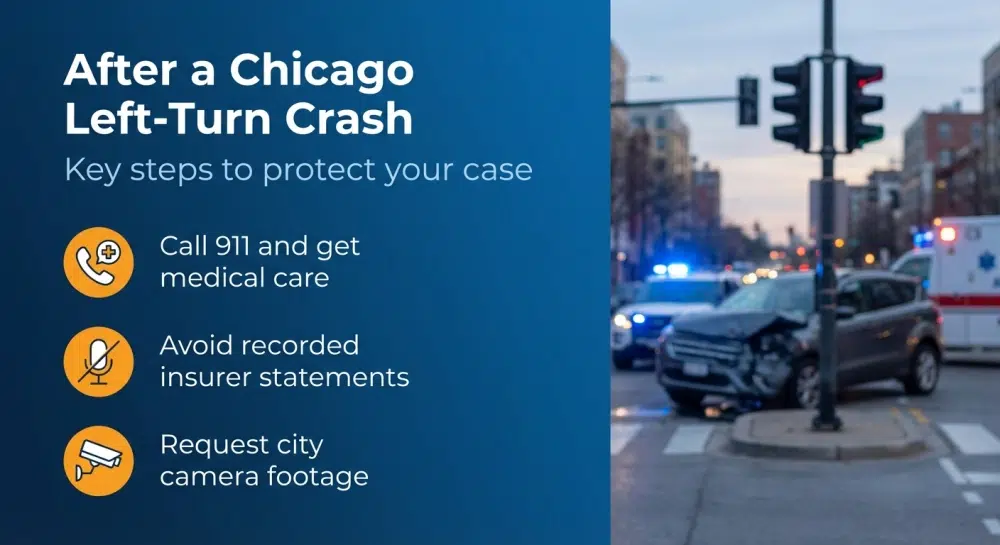
- Call 911 and seek care. A contemporaneous police report and prompt medical attention protect both health and the claim record.
- Preserve the scene. Photograph signal heads, lane markings, debris, and vehicle positions if safe. Note nearby cameras and potential witnesses.
- Avoid recorded statements. Early insurer interviews can lock you into incomplete or inaccurate summaries. Consider speaking with counsel first.
- Request public records. Use FOIA to request traffic camera footage and signal timing sheets where relevant [13].
- Document expenses. Keep all repair invoices and injury-related costs organized from day one.
Early guidance from trusted professionals can help you avoid pitfalls, preserve key evidence, and meet deadlines. Speaking with motorcycle accident lawyers early in the process can help you understand your options and protect your rights in a complex claims environment.
How do insurance claims and litigation proceed in Cook County courts?
A typical Chicago left-turn motorcycle crash case moves through several stages:
- Investigation and notice. You or your counsel collect evidence, notify insurers, and address property damage. Liability carriers often evaluate statements, photos, and citations quickly.
- Claim evaluation. Insurers apply comparative negligence and reserve rights to apportion fault. They may request recorded statements and broad authorizations, which can be narrowed to protect privacy.
- Settlement negotiations. After initial medical care stabilizes, you can evaluate damages with documentation. Negotiations weigh statutory duties, video evidence, and reconstruction analysis.
- Filing suit. If settlement stalls, a civil complaint is filed in the Circuit Court of Cook County. Discovery proceeds under Illinois Supreme Court Rules, including interrogatories and document requests under Rules 213 and 214 [9] [10].
- Motions and trial. Parties may file motions about evidence and liability. If not resolved, a jury weighs fault and damages under Illinois law, including the comparative negligence statute [7].
Because left-turn cases often turn on timing and visibility, litigation can benefit from objective electronic evidence. Vehicle data, camera footage, and precise measurements often carry more weight than post-hoc recollections.
When you are ready to talk through strategy with a local team, Chicago motorcycle accident lawyers can walk you through these steps and help align the case plan with the facts and the law.
What timelines and statutes of limitations apply in Illinois?
In most Illinois personal injury cases, you must file suit within two years from the date of the injury [8]. There are exceptions and shorter deadlines for claims against governmental entities, and other claim types may have different periods. Missing a deadline can extinguish your claim, so calendar dates early and verify the correct defendant identities promptly.
Other timing considerations include:
- Preservation requests. Send spoliation letters quickly for camera footage and vehicle data that may be overwritten on short cycles.
- Property damage claims. These can sometimes proceed in parallel so transportation needs are addressed while injury claims develop.
- Medical documentation. Establishing a consistent record soon after the crash helps link symptoms to the collision and avoid disputes about causation.

Why do local conditions at Chicago intersections matter for left-turn motorcycle collisions?
Urban intersection design, phasing, and traffic mix shape risk. Protected left-turn arrows are safer for turners but can introduce surprise for riders when a permissive phase follows. Short left-turn bays can prompt last-second turns. Bus stops near corners can block views. Construction detours and utility work change lane alignments and sign placement. Chicago’s open data on crashes offers insight into hot spots and patterns that can inform both prevention and case strategy [15].
Understanding the actual layout and control devices at the specific intersection is critical. Photos and video taken soon after the crash provide ground truth for how signals, signs, and markings looked on the date in question, which supports accurate application of Illinois right-of-way rules [4] [5].
Who is GoSuits and how can we help riders and families in Chicago, IL?
If you were hurt in a Chicago left-turn motorcycle crash, your civil case will turn on right-of-way rules, careful evidence work, and timelines under Illinois law. A free consultation with a personal injury attorney can help you make informed decisions, understand your options, and avoid early mistakes that make claims harder to prove.
GoSuits represents clients across Illinois, including Chicago and Cook County, with 30 years of combined experience in personal injury litigation. We pair seasoned trial attorneys with exclusive proprietary software that streamlines evidence collection and case development for faster, more organized results. Although we use technology to expedite your case, every client works directly with a designated attorney, not a case manager, and has unfettered access to that attorney throughout the matter.
Our approach is practical and focused on outcomes. We have tried cases to verdict and resolved complex claims through negotiation and mediation. Past results demonstrate our ability to prepare thoroughly and present clear, persuasive cases for injured riders and their families. You can review a sample of our work at prior cases, learn about the team at our attorneys, and see how we operate at about us. For a broader view of what we handle, visit our practice areas.
- What we do. Personal injury litigation for riders and passengers, intersection and roadway claims, serious injury cases, and wrongful death actions.
- How we do it. Technology-driven organization, rapid evidence preservation, and attorney-led strategy from day one.
- Why trial experience matters. Preparedness for trial strengthens negotiation leverage and helps present complex left-turn fault issues clearly to juries.
If you are comparing options after a left-turn collision, k in Chicago can explain timelines, evidence needs, and next steps in plain language so you can move forward confidently.
References and resources
- Traffic Safety Facts 2021: Motorcycles – NHTSA
- Motorcycle Safety Overview – NHTSA
- Crash Facts and Statistics – Illinois Department of Transportation
- 625 ILCS 5/11-902 Left-turning vehicle to yield – Illinois Compiled Statutes
- 625 ILCS 5/11-306 Traffic-control signal legend – Illinois Compiled Statutes
- 625 ILCS 5/11-703 Overtaking rules and lane use – Illinois Compiled Statutes
- 735 ILCS 5/2-1116 Comparative negligence – Illinois Compiled Statutes
- 735 ILCS 5/13-202 Personal injury limitations – Illinois Compiled Statutes
- Illinois Supreme Court Rule 213 – Written interrogatories to parties
- Illinois Supreme Court Rule 214 – Discovery and requests to produce
- Red Light Camera Enforcement – City of Chicago
- Event Data Recorders Overview – NHTSA
- Illinois Freedom of Information Act – 5 ILCS 140/1 et seq.
- Negligence Per Se – Cornell Law School Legal Information Institute
- Traffic Crashes Dataset – City of Chicago Data Portal