- What should you do immediately after a crash at Culver Dr & Irvine Blvd?
- How do you stay safe and comply with California law at the scene?
- What evidence should you gather in Irvine to support your claim?
- When and how should you report the crash to Irvine Police, CHP, and the DMV?
- How do California insurance and claims work after an Irvine car accident?
- Who could be at fault at Culver Dr & Irvine Blvd and how does comparative negligence apply?
- What deadlines apply for California injury and property damage claims?
- How do you get medical care after a car accident in Irvine?
- How should you handle vehicle repairs, total loss, and rentals in Irvine?
- What if it was a hit-and-run or the other driver lacks insurance?
- How can traffic cameras, 911 audio, and public records help your Orange County case?
- What are the civil lawsuit steps in Orange County and what should you expect?
- Why consider legal help and how do you choose the right fit in Irvine?
- Who is GoSuits and how can we help after a crash in Irvine?
- References and Resources
What should you do immediately after a crash at Culver Dr & Irvine Blvd?
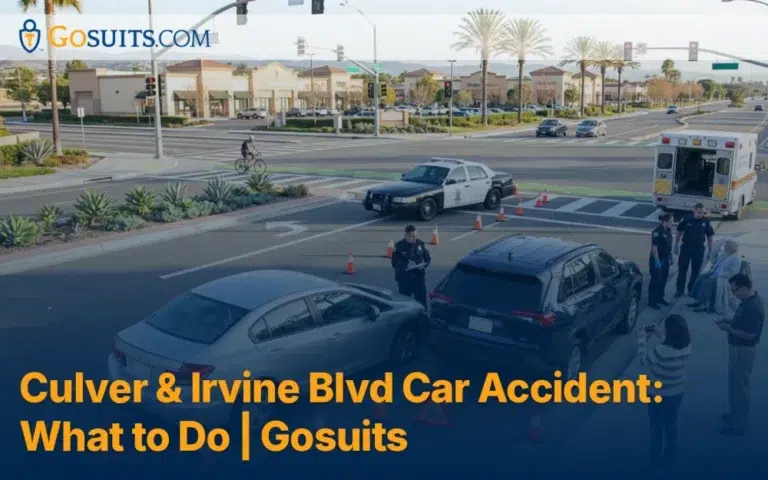
If you’ve been involved in an accident at Culver Drive and Irvine Boulevard, prioritizing your safety and well-being should be top priority. If injured or suspect any medical issues, addressing them immediately is crucial. Secondly, always remember to follow some important legal steps which could prove valuable for your health and any potential claim: 1) Attend to your injuries or call emergency services if required. 2) Adhere to federal guidelines following the crash, moving to a safe location and calling 911 if possible. Document the scene thoroughly. 3) Collect all essential details about the accident, such as witnesses’ names and contact information, damage to both vehicles, and any other relevant factors. 4) Speak with a legal professional experienced in personal injury cases who can help guide you through the process of making claims or seeking compensation. 5) Keep track of medical expenses resulting from the accident for potential reimbursement. 6) For more information, visit [11] and #ref-11.
- Indeed, prioritizing everyone’s safety is of utmost importance during this event. We must be vigilant and act swiftly if someone appears injured, as not all injuries are immediately apparent. Some may only become evident hours or even days later. In such situations, always put safety first and ensure you seek professional help as soon as possible.
- Move to safety and prevent secondary crashes. If your vehicle is drivable, California safety guidance supports moving it out of the travel lanes when safe to do so [11].
- Driving in low visibility conditions can pose many risks as it often becomes difficult to see potential dangers or obstacles ahead. In such scenarios, using your car’s hazard lights is crucial for alerting other drivers about any possible threats on the road. This allows them enough time to react and take necessary safety precautions. Alongside utilizing your vehicle’s hazard lights, placing visible markers like cones, flares, or reflective triangles strategically around your car can help guide other drivers safely past any potential dangers they may encounter. Safety should always be our primary concern on the road. By working together and adopting these safety measures, we can create a safer environment for all road users. As responsible drivers, let’s remain vigilant behind the wheel to ensure that everyone reaches their destination safely.
- Call law enforcement. If there are injuries or major property damage, request an officer. If an officer does not respond to an injury crash, California law requires a written report to police or CHP within 24 hours [6].
- Exchange information. California Vehicle Code requires drivers to exchange names, addresses, and vehicle and insurance details at the scene [7].
In unfortunate circumstances such as a car accident in California, having access to helpful resources can greatly impact the outcome of your case. The success of such cases often hinges on the quality of evidence gathered and understanding California’s car accident laws. To navigate these incidents and address any injuries or damages that may result, here are some valuable resources for you: 1. Article/Link (____ [6] _) 2. Article/Link (____ #ref-6 _) 3. Article/Link (____ [7] _) 4. Article/Link (____ [9] _) 5. Article/Link (____ #ref-9 _) 6. Article/Link (____ #ref-9 _) 7. Article/Link (____ # _) 8. Article/Link (____ #ref-9 ref-9 _) 9. Article/Link (____ #ref-9 _) 10. Article/Link (____ #ref-9 _) 11. Article/Link (____ #ref-9 _) 12. Article/Link (____ #ref-9 _) 13. Article/Link (____ #ref-9 _) 14. Article/Link (____ #ref-9 _) 15. Article/Link (____ #ref-9 _) These resources will help you understand California’s car accident laws and the type of evidence needed to strengthen your case. By educating yourself on these aspects and taking advantage of these available tools, you’ll significantly improve your ability to handle any accidents that may occur on California roads.
How do you stay safe and comply with California law at the scene?
According to California state laws, drivers involved in an accident must fulfill certain obligations. These include offering assistance when possible, exchanging necessary information and completing specific forms for the relevant authorities. If the accident results in injury or death, a written report must be submitted either to local law enforcement or the CHP within 24 hours if no officer was present at the scene to document it – even if that means submitting the report online or by mail if there is no local police station available. [6]
- Call 911 for injuries. If anyone is injured, request police and medical response. Complying with reporting rules helps with later DMV and insurance filings [6].
- Exchange required details. Share and collect names, addresses, driver license numbers, vehicle information, and proof of financial responsibility, as required by California Vehicle Code section 16025 [7].
- Avoid admitting fault at the scene. Stick to facts for safety and reporting. Fault is determined later under California comparative negligence principles [1] [2].
- If you happen to be at the scene of a car crash, always make sure to document everything carefully for future reference. Take photos of both cars, focusing on visible damage, nearby debris, and skid marks. Don’t forget to also photograph any traffic lights or signs in the area to provide context. Be sure to note down the weather conditions at the time of the accident as well. Lastly, write down all injuries sustained by everyone involved in the incident. By doing this, you’ll be better prepared to understand the circumstances that led to the accident later on.
- Seek medical evaluation. An early evaluation documents injuries and supports your claim, even if symptoms seem minor initially [11].
In unfortunate situations like car accidents in California, staying calm and following the proper procedures according to state law is crucial for everyone’s safety. [6] [7] . Collecting important information like names, contact info, vehicle descriptions, insurance details, driver’s license numbers, registration plate numbers, location of the accident, witness accounts, dates and times, and a detailed account of the incident is vital. Use your phone to take pictures or videos of the scene, vehicles involved, and any injuries sustained. Always remember not to admit responsibility for the incident as it could be used against you later if another party is deemed at fault. Immediately after an accident, call law enforcement even if no severe physical injuries occurred. Police officers can help resolve disputes between drivers, provide medical assistance or call emergency services if needed, and file a report that may aid in processing insurance claims later on. Make sure you receive a copy of the police report either at the scene or request one afterward.
What evidence should you gather in Irvine to support your claim?
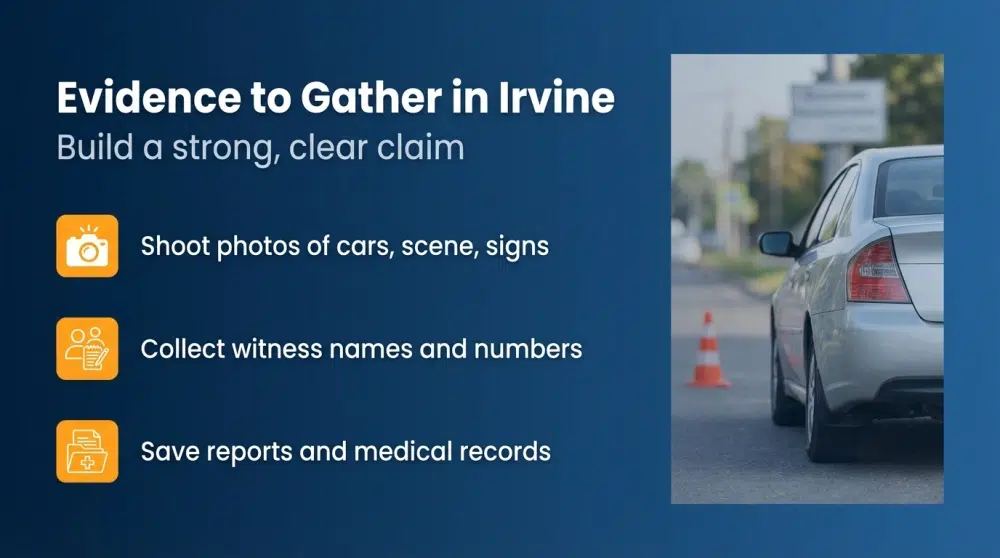
In the event of a car accident at Culver Drive and Irvine Boulevard, it is vital to gather crucial details that could be essential if there are injury or damage claims. This information can help avoid future legal complications. Be sure to document the following: 1. Full names, phone numbers, and email addresses of all involved parties including passengers, witnesses, and officers at the scene. 2. License plate numbers and make/model of both vehicles involved. 3. Insurance policy details for each driver (such as insurer’s name, contact information, policy number). 4. Photos or videos showing any vehicle damage and visible injuries sustained during the incident. 5. Statements from witnesses who saw the accident happen, including their contact info if possible. 6. A detailed description of the weather and road conditions at the time of the crash. 7. Information about traffic signs and signals present at the scene. 8. An extensive account of events leading up to the accident from both drivers involved. 9. The exact location, date, and time when emergency services arrived on the scene. 10. Police report numbers and contact information for additional assistance if required. Gathering this specific data will aid in building a strong case for addressing any potential legal matters arising from this automobile accident incident.
- Hello! Thanks for getting in touch about photographing the intersection, focusing on traffic lights from different perspectives. If possible, could you also include timestamps on these images? This would be very helpful to us in understanding what happened and evaluating if safety measures are required immediately. We’d also appreciate it if you could capture any visible damages or injuries related to the event – this information will be crucial for our assessment. Thank you so much for your assistance with this matter!
- Could you kindly collect the witnesses’ details – including their names, contact details, and a brief account of what they observed, provided they are ready to share this information?
- Understanding the aftermath of a car accident is paramount, especially given how intricate traffic signals are and their various components like turn arrow configurations, pedestrian phases, and signal timings play crucial roles in reconstructing the chain of events that led to an incident. These elements should be photographed at the scene – ideally with time stamps – so as to accurately capture when the accident occurred. This information is essential for assigning liability and ensuring fairness for all parties involved.
- Police incident number and later a certified copy of the traffic collision report when it becomes available. For injury crashes, a report is typically created by Irvine Police or the California Highway Patrol depending on jurisdiction [6] [11].
- Medical records for all evaluations and treatments, including urgent care, emergency department, primary care, imaging, therapy, and medications [11].
- DMV SR-1 filing confirmation if applicable, since many insurers will request proof that required reporting was done after an injury crash or certain property damage thresholds [9].
California agencies provide various resources to analyze collision data in context. One such tool is the Statewide Integrated Traffic Records System, which can be accessed through UC Berkeley’s SafeTREC TIMS (Traffic Incident Management System). This resource allows you or your legal team to review crash patterns around Culver Drive and Irvine Boulevard. Additionally, valuable information comes from the annual collision rankings published by the California Office of Traffic Safety. These rankings help identify local risk trends in cities and counties across the state. You can access UC Berkeley’s SafeTREC TIMS at: [13] . The California Office of Traffic Safety’s annual collision rankings are available at: [12] .
When and how should you report the crash to Irvine Police, CHP, and the DMV?
A recent car accident scenario in California highlights the importance of several key factors to consider. First and foremost, it is vital to ascertain if any injuries or fatalities have occurred due to the crash. This not only helps in assessing the gravity of the situation but also provides insight into potential legal consequences. Additionally, evaluating the extent of damage sustained by all vehicles involved and nearby structures is essential. In accordance with California Department of Motor Vehicles (DMV) financial responsibility guidelines, specific rules have been established for motorists following an accident. These rules aim to hold each driver accountable for their actions during the event, covering all costs related to it. To effectively manage car accidents in California, I suggest visiting two helpful websites: [ and 10]. Both of these sites offer valuable assistance in navigating such situations smoothly.
Do you have to file a DMV SR-1 after an Irvine collision?
Just in case you find yourself involved in an accident over the next ten days that results in injuries, fatalities, or significant property damage, please make sure to fill out Form SR-1. This can be accessed on the Department of Motor Vehicles (DMV) website at _ [9 _ _ ]. It doesn’t matter whose fault it was or if a police report has been filed – it is your responsibility to submit the completed form.
When do you report to local police or CHP?
- Injury or death. If no officer responded and took a report at the scene, California Vehicle Code section 20008 requires a written report to local police or CHP within 24 hours [6].
- In the city of Irvine, the local police department handles city events that usually occur on everyday streets. These cases can involve different law enforcement agencies operating within the area. Highway accidents fall under the jurisdiction of the California Highway Patrol (CHP). While they have specific expertise and specialized training in managing such incidents along highways, their proficiency comes from the numerous encounters with various highway-related situations they’ve experienced over time. This has enabled them to handle these cases efficiently.
- How to get the report. Once ready, you can request a certified copy through the reporting agency’s records process. Keeping your incident number and photo ID ready will help [11].
What information must you exchange at the scene?
California Vehicle Code section 16025 requires drivers to share identifying and insurance information after a collision [7]. Recording this accurately reduces later disputes with insurers.

How do California insurance and claims work after an Irvine car accident?
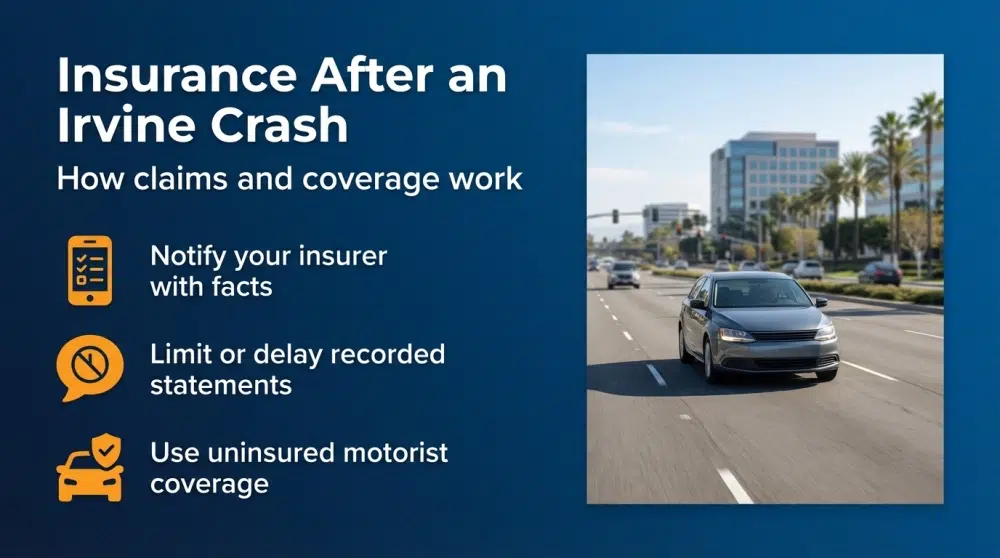
In California, state authorities play a vital role in overseeing insurance responsibilities and claim processing. Their primary goal is to safeguard consumers’ interests by enforcing proper rules and procedures. It is crucial for policyholders to comprehend these processes so they can navigate them without any hiccups or delays. Both you and your insurer have certain duties that are governed by specific rules and guidelines designed to maintain fairness and protection for all parties. Since both sides must adhere to predetermined protocols in order to provide the best possible consumer protection, understanding these regulations is essential. By knowing your rights as a policyholder and having an understanding of these protocols, you can avoid misunderstandings, prevent financial problems due to unexpected events, establish effective communication with your insurer, and ultimately ensure that you receive the highest level of protection available.
What is financial responsibility and why does it matter?
In California, drivers are required to prove their financial responsibility by obtaining auto liability insurance or alternative means of meeting the requirements. This proof must be readily available when requested by law enforcement or the Department of Motor Vehicles (DMV) [10]. Failing to maintain this coverage can make it difficult for you to register your vehicle and may result in increased out-of-pocket costs if you get into an accident.
Should you contact your insurer and the other driver’s insurer?
- It’s absolutely crucial to promptly inform your insurance company if there’s an incident, as per the terms of your policy agreement. Whether you believe another driver was responsible for the accident or not, it’s vital to keep them in the loop with the facts rather than giving your personal opinions about who might be at fault.
- Be cautious with recorded statements. You can schedule a time to speak, review your notes and photos, and consider speaking with a lawyer before giving a detailed statement, especially to the other driver’s insurer [14].
- Keeping track of all your claim numbers for both property damage and bodily injury incidents is essential. Make sure to keep a record of anything relevant to these claims, including the adjuster’s name and deadlines. This way, you will stay organized if any disputes arise concerning these claims.
What benefits are available and how are medical bills addressed?
- Liability insurance is a vital form of protection for drivers who want to safeguard themselves against financial losses caused by accidents they may be held responsible for. This type of coverage takes care of expenses related to injuries and property damage resulting from your actions, ensuring that any harm done doesn’t lead to crippling costs. With a policy in place with a limit, you can have peace of mind knowing that even if an accident occurs, your financial stability won’t be compromised due to negligence or unforeseen incidents. By having this coverage, you can drive with confidence, secure in the knowledge that your finances will remain intact should an unexpected accident happen.
- When you buy medical payment coverage or personal injury protection, they can help cover necessary medical expenses, regardless of who’s responsible, as long as it complies with the terms and conditions set out in the policy you choose.
- Uninsured and underinsured motorist coverage can apply if the at-fault driver lacks sufficient coverage, which is common in hit-and-run or low-limits scenarios [14].
The California Department of Insurance provides consumer guidance on handling post-crash insurance claims and adjuster practices, which can aid in understanding the next steps and timeline. For more information, visit [14].
Who could be at fault at Culver Dr & Irvine Blvd and how does comparative negligence apply?
Intersection accidents can involve complex fault scenarios due to the numerous factors that contribute to such incidents. Common examples include left-turn collisions, running red lights or stop signs, unsafe speeds during green light conditions, rear-end impacts during heavy traffic, and pedestrian and cyclist conflicts in crosswalks. Under California law, even if you were partially at fault for an accident, you may still recover damages because the state follows a doctrine called “pure comparative negligence” [1] .
What is pure comparative negligence in California?
Pure comparative negligence, adopted by the California Supreme Court in Li v. Yellow Cab Co., allows an injured person to recover damages reduced by their percentage of fault [1]. The court tied this doctrine to the broad duty of ordinary care codified in California Civil Code section 1714, which informs everyday negligence claims in the state [2].
How does comparative negligence affect settlement value?
- When assessing fault in cases, both parties typically collect evidence on various factors such as signal timing, vehicle speed and position in the lane, along with witness testimonies. These details are then utilized to present their respective arguments regarding each side’s percentage of responsibility.
- Damage reduction. If you are deemed 20 percent at fault, your damages would generally be reduced by 20 percent under comparative negligence principles [1].
- Multiple defendants. Claims may involve several parties, such as drivers, employers of commercial vehicles, and potentially governmental entities if roadway design or signal maintenance is implicated, subject to strict notice rules [5].
The legal framework favors a fact-driven analysis rather than an all-or-nothing bar, which is why timely documentation and a thorough accident reconstruction can be pivotal [1] [2].

What deadlines apply for California injury and property damage claims?
California imposes strict time limits. Missing a deadline can permanently bar a claim, so it is crucial to track the timelines that apply to your situation.
What is the statute of limitations for personal injury in California?
For most personal injury claims arising from car accidents, the limitation period is two years from the date of injury under Code of Civil Procedure section 335.1 [3] [15].
What about vehicle and other property damage?
Claims for damage to personal property, including vehicles, generally have a three-year limitation period under Code of Civil Procedure section 338 [4].
Do special deadlines apply when a public entity may be involved?
Yes. If you believe a public entity may be partly at fault, such as for roadway design, signal timing, or maintenance, you must typically file a government claim within six months under Government Code section 911.2 before filing a civil action [5]. There are exceptions and tolling rules, so prompt evaluation is important.
How do you get medical care after a car accident in Irvine?
Your health comes first. Even if you feel okay immediately after a Culver Dr and Irvine Blvd car accident, consider a prompt evaluation. Some injuries present subtle symptoms at first, including concussion, soft tissue injuries, or internal injuries. Federal safety guidance emphasizes seeking medical attention quickly and following up on treatment plans [11].
- Emergency care. If you have red flag symptoms such as loss of consciousness, severe headache, chest pain, or shortness of breath, call 911.
- Urgent care or primary care. For non-emergency injuries, get checked the same day. Document all complaints, even minor ones, and keep copies of discharge instructions.
- Follow referral plans. Imaging, physical therapy, and specialist visits help confirm diagnoses and support safe recovery timelines [11].
From a broader safety perspective, roadway injuries remain a serious public health concern. NHTSA reports that in 2022, tens of thousands of people died in U.S. motor vehicle traffic crashes, underscoring the stakes for prompt treatment and prevention [11].
How should you handle vehicle repairs, total loss, and rentals in Irvine?
Most collisions at Culver Dr and Irvine Blvd involve property damage that must be addressed quickly for mobility and work. Claims often proceed on two tracks: property damage and bodily injury.
- Choose your repair shop. In California, you generally have the right to select your repair facility. Keep all estimates, invoices, and photos for your file [14].
- Total loss valuation. If your car is a total loss, the insurer must provide a valuation method and comparable vehicles used. Review the valuation and provide evidence of higher comparables if appropriate [14].
- Rental or loss of use. Ask the adjuster about rental coverage or compensation for loss of use when the other driver is at fault.
- Diminished value. Post-repair value loss may be claimed in some circumstances, depending on the facts and insurer practices [14].
What if it was a hit-and-run or the other driver lacks insurance?
California law requires stopping and exchanging information after a property-damage crash, and leaving the scene can be a crime under Vehicle Code section 20002 [8]. If you are the victim of a hit-and-run, take steps to protect your claim.
- Report promptly. Call 911 and give as much detail as possible about the fleeing vehicle. If injuries occurred and no officer arrives, file the required report with local police or CHP within 24 hours [6].
- File the SR-1 with DMV if the crash meets the criteria for injury, death, or qualifying property damage [9].
- Open an uninsured motorist claim with your insurer if you carry UM/UIM coverage. This can cover injuries and sometimes property damage depending on your policy [14].
How can traffic cameras, 911 audio, and public records help your Orange County case?
At busy intersections like Culver Dr and Irvine Blvd, third-party data can make a strong difference in disputed liability or comparative fault [1] [2].
- Traffic signal records. Municipal signal timing plans and maintenance logs may clarify phasing and whether protected or permissive turns were active. Requesting these through public records procedures may be appropriate.
- 911 audio and CAD logs. Call recordings, dispatch notes, and officer narratives can help establish timing and initial observations.
- Regional collision data. Reviewing TIMS SWITRS data for the immediate area can show prior collision patterns that align with your crash type, which can inform settlement negotiations and litigation strategy [13] [12].
What are the civil lawsuit steps in Orange County and what should you expect?
While many claims settle through insurance, some proceed into litigation in the Orange County Superior Court. Although every case is unique, the phases below are common in California civil practice.
How does a case typically progress?
- Prior to filing a lawsuit, we gather medical records, bills, employment documents, and accident scene information to assemble a comprehensive claim packet for the insurance company.
- Filing the complaint. If settlement is not reached within the statute of limitations, a complaint alleging negligence and damages is filed in the appropriate venue [3] [4].
- Discovery. Both sides exchange documents, conduct depositions, and may use experts for accident reconstruction or medical opinions. Comparative negligence is often a central topic [1].
- Motions and alternative dispute resolution (ADR). In many legal cases, courts may require mediation or settlement conferences to help resolve disputes. Motions can also be used to narrow down the issues that need to be addressed during a trial.
- Trial. If the case does not settle, a judge or jury determines liability and damages, applying California’s pure comparative negligence standard [1] [2].
Insurance carriers evaluate risk at each stage, considering medical evidence, collision reconstruction, witness credibility, and potential jury allocations of fault under comparative negligence [1].
Why consider legal help and how do you choose the right fit in Irvine?
Intersection accidents often lead to disputes when deciding who is at fault, proving medical causation, and estimating future damages. Gathering relevant signal data, coordinating with your treating providers, and navigating through the complex procedures of the DMV, police, and insurance companies can take a lot of time while you recover from any injuries sustained in the accident.
- Complex fault issues. Left-turns, yellow intervals, and crosswalk phases can complicate liability and lead to comparative negligence arguments [1] [2].
- Medical proof. Linking delayed-onset symptoms to the crash requires consistent medical documentation and careful claim presentation [11].
- Deadlines and forms. Tracking SR-1 filings, government claim notices, and statutes of limitations is critical to preserving rights [9] [5] [3] [4].
When searching for a car accident attorney, it’s essential to ask about their experience handling intersection crashes, how they obtain traffic engineering records, and their expertise in comparative negligence cases during trials. Having an experienced lawyer by your side can make all the difference in reducing the administrative and evidentiary burdens of your case while allowing you to focus on your recovery process.
If you find yourself in a specific situation, it is highly recommended that you consult with experienced car accident lawyers based out of Irvine. These accomplished professionals have an extensive knowledge of local laws and rules due to their years working within Orange County. This expertise enables them to provide valuable guidance when dealing with regional insurance companies. Additionally, they are well-versed in setting reasonable timelines for any potential legal actions that may arise in the future.

What practical steps can you take now?
- Before you submit your claim, make sure to gather all the necessary documents right away. Usually, this involves collecting pictures, contact information, police reports, DMV records, medical files, and any related invoices or receipts. To ensure a smooth process, it’s advisable to keep everything in one centralized location.
- Follow medical advice. Gaps in treatment can be used to dispute injury causation and damages [11].
- Mind your words. Be careful on social media and limit opinions shared with insurers. Stick to facts and documents [14].
- Calendar deadlines. Include SR-1 timing and limitation periods [9] [3] [4].
When preparing to meet with car accident attorneys, it’s essential to gather any crucial documents and information beforehand in order to build a strong case. Organize your case file in a structured manner by including key claim numbers or reference codes. Moreover, create an inclusive timeline of events since the accident, detailing all medical treatments you have received thus far. This will make discussing your case with legal professionals smoother and more efficient.
Who is GoSuits and how can we help after a crash in Irvine?
GoSuits is tailored to assist Californians who have been involved in personal injury incidents along Culver Drive and Irvine Boulevard. Should you require assistance or guidance, a complimentary consultation can offer valuable insights into your subsequent actions, the impact of comparative negligence on your case, the significance of evidence collection, and comprehension of insurance claim progression in California. For further details about GoSuits or personal injury law in California, please visit our website: https:// [1] . For resources and support for accident victims, go to: https:// [2 . If you’re interested in learning more about California’s complex comparative negligence laws or how insurance claims function within the state, this blog post might be informative: https:// ] . To schedule a free consultation with GoSuits, simply fill out this form: https:// [14] .
- At our esteemed legal firm, we take immense pride in offering premium quality services. Our proficient team boasts an extensive wealth of experience and a diverse range of expertise spanning multiple legal arenas. This makes us adept at handling even the most intricate and complex legal cases with remarkable ease. We have made quite a name for ourselves by successfully resolving civil injury claims across California, showcasing our adeptness in navigating these situations with finesse. Whether we are operating in bustling urban centers such as Irvine and Orange County or remote rural areas, our commitment to excellence has earned us the reputation of being a reliable legal firm renowned for delivering outstanding results consistently.
- At the core of our operations is technology, playing a crucial role in helping us handle cases efficiently. Our sophisticated tools have a transformative effect on how we approach tasks, from simplifying evidence submission to organizing medical records and constructing timelines. Armed with these powerful resources, we are better able to improve our performance and swiftly respond to client demands. This not only expedites the process but also markedly enhances the overall efficiency of our organization.
- Our primary objective revolves around harnessing cutting-edge data analysis tools to develop highly effective strategies, especially during critical moments. This can only be accomplished if we have immediate access to crucial traffic engineering reports and accident statistics when needed. Our number one mission is to provide top-notch solutions that ensure safety for all parties involved in the situation at hand.
- Collaborating closely with our legal team is critically important for us. We place great emphasis on direct communication with your designated attorney, as we firmly believe this significantly improves your chances of success in court. To ensure smooth interaction, we employ cutting-edge technology while simultaneously maintaining a personalized approach. Our attorneys do not rely on case managers or intermediaries; they remain easily accessible and fully invested in your case at every step along the way.
- We have been successful in this field for years due to our knowledge and experience. We have provided remarkable results to many clients dealing with negligence cases across various industries. For more information on the favorable outcomes we’ve achieved, please visit prior and cases to get a comprehensive understanding.
- Our team has more than three decades of combined experience that enables us to expertly manage complex intersection accidents, multi-vehicle collisions, and challenging liability cases effortlessly. This comprehensive background not only showcases our deep understanding of this specialized area but also underscores our unwavering dedication and commitment to delivering exceptional service in this field.
- In every legal matter we handle, our top priority is to meticulously prepare ourselves for potential litigation. We firmly believe that this mindset is essential as it enables us to identify and address potential issues early on in the process. This approach not only strengthens our negotiation positions but also significantly increases the likelihood of smoother outcomes should the case ultimately end up in court. Our ultimate objective is to provide outstanding service by being trial-ready from day one.
- Our practice areas encompass a comprehensive range of personal injury cases. Dive into our practice areas to discover more, meet some key team members about us and learn how we can assist you our via attorneys .
In case you’re dealing with the aftermath of a car crash at the intersection of Culver and Irvine Blvd., we want to lend a hand in making your decision-making process easier. We are here to provide informed and practical advice, and help you move forward with confidence.
Once you’re all set, let’s go over your timeline step by step, scrutinize the paperwork, and analyze how the legal framework of California applies to your injury and property damage cases using clear, uncomplicated terms.
References and Resources
- Li v. Yellow Cab Co., 13 Cal. 3d 804 – CourtListener
- California Civil Code section 1714 – California Legislative Information
- Code of Civil Procedure section 335.1 – California Legislative Information
- Code of Civil Procedure section 338 – California Legislative Information
- Government Code section 911.2 – California Legislative Information
- Vehicle Code section 20008 – California Legislative Information
- Vehicle Code section 16025 – California Legislative Information
- Vehicle Code section 20002 – California Legislative Information
- California Accident Report SR-1 – California DMV
- Financial Responsibility Requirements – California DMV
- What To Do After a Crash – NHTSA
- Collision Ranking Results – California Office of Traffic Safety
- TIMS SWITRS Tools – UC Berkeley SafeTREC
- After an Auto Accident: What to Do – California Department of Insurance
- Statutes of Limitations Overview – California Courts