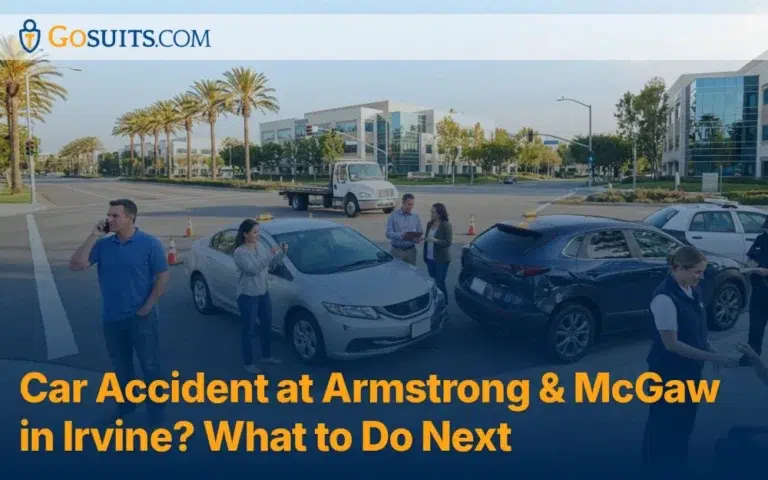
- What should you do in the first 10 minutes after a crash at Armstrong Ave and McGaw Ave in Irvine?
- When should you call 911 or non emergency law enforcement in Irvine?
- How should you document the scene and exchange information under California law?
- Where and how can you file required reports after an Irvine crash?
- How do California fault rules and comparative negligence affect your claim?
- What deadlines and statutes of limitations apply in California civil cases?
- What evidence helps prove liability and damages after an intersection crash?
- How do insurance claims work in California after a car crash?
- What are common defenses in California car accident cases and how do plaintiffs respond?
- Which Irvine specific questions come up for Armstrong Ave and McGaw Ave crashes?
- When should you contact a lawyer and what can legal counsel do?
- About GoSuits
- References and resources
What should you do in the first 10 minutes after a crash at Armstrong Ave and McGaw Ave in Irvine?
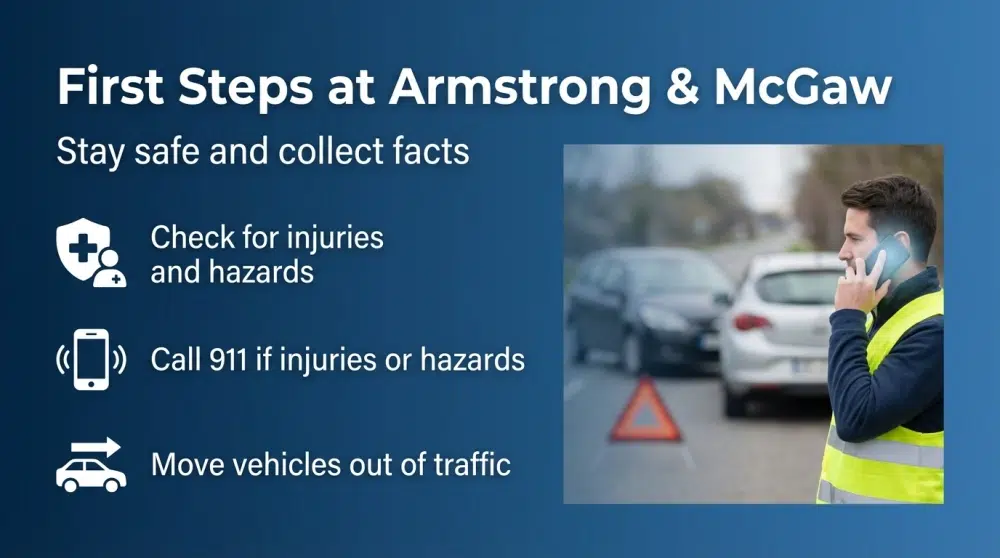
If you’ve just been involved in an accident at Armstrong Ave and McGaw Ave in Irvine, take a moment, slow down, and focus on safety first. Assess yourself and any other individuals involved for injuries and ensure that the traffic area is safe. Turn on your hazard lights if you can do so safely, and deploy traffic triangles or cones if you have them available. If both vehicles are driveable and no one has suffered serious injuries, move them out of the travel lanes to prevent further accidents, following the guidelines given in the California Driver Handbook [14].
- Check for injuries Look over yourself and passengers for pain, bleeding, dizziness or confusion. Even if you feel okay, some injuries are not obvious at the scene. The CDC advises getting evaluated after a crash due to the risk of delayed symptoms such as concussion, internal injury or whiplash [12].
- Call 911 if anyone may be hurt A dispatcher can send medical help and law enforcement. You can also request traffic control if lanes are blocked. California law requires prompt reporting of injury collisions to police or the California Highway Patrol within 24 hours [4].
- Move to a safe location if possible If it is safe, relocate vehicles to the shoulder or a nearby parking area to reduce danger to you and other drivers. If movement is unsafe, stay seated with your seat belt fastened until help arrives [14].
- Do not discuss fault Keep conversation factual. Exchange information and focus on safety. Fault is determined later based on evidence and California’s comparative fault rules [1].
When someone has been involved in a car accident, it’s not uncommon for them to immediately start looking for a lawyer specializing in these matters. However, before worrying about legal representation, make sure that your first priority is always your own health and wellbeing, as well as preserving any potential evidence from the scene of the accident. This could greatly impact the options you have down the line when it comes to pursuing compensation or other remedies for damages incurred.
When should you call 911 or non emergency law enforcement in Irvine?
Call 911 for emergencies involving injuries, blocked traffic, hazards or suspected impairment. In minor incidents with only property damage and no dangers, you can use a non-emergency line. However, under California law, injury crashes must be reported to local police or CHP within 24 hours [4] .
- Injury or death Report immediately. Drivers involved must stop, provide aid if they can, and remain at or near the scene as required by California Vehicle Code sections 20001 and 20008 [5][4].
- Property damage only You must stop and exchange information and may move to a safe nearby spot. Failing to stop can trigger penalties under Vehicle Code section 20002 [6].
- Official report copy For city streets in Irvine, collision reports are generally maintained by the Irvine Police Department Records unit. CHP also provides traffic collision report information for incidents within its jurisdiction [13][15].
At a national level, preliminary NHTSA figures indicate that traffic fatalities decreased by around three percent in 2023 compared to the historically high levels experienced in both 2021 and 2022. Despite this downward trend, the number of lives lost remains concerning [11]. It’s crucial to report accidents immediately as it aids responders in managing safety and allows for a more accurate account of the events that transpired.
How should you document the scene and exchange information under California law?
Proper documentation is crucial for any potential insurance claim or civil lawsuit in Orange County, as it greatly aids in your case if these issues ever arise in the future.
- Exchange required information Share and record each driver’s name, address, registration, and driver license data. For injury crashes, remain at or near the scene and offer reasonable assistance until law enforcement arrives, as required by Vehicle Code section 20001 [5].
- Take photographs and videos at the scene, including the positions of vehicles, debris, skid marks, traffic signals, lane markings, and nearby businesses. If possible, capture these images using cameras that may have recorded the incident. Remember to take photos of visible injuries and property damage from multiple angles as well.
- Gather as many witnesses as possible by asking bystanders for their names, contact information, and a brief statement if they’re willing to help. Be sure to also note down any ride-share or delivery vehicles in the area, especially those with dash cameras that could have potentially captured the incident on video.
- Please make a note of the road conditions. Make sure to record the weather, lighting, any ongoing construction work, and signal timings if they are applicable.
- Saving electronic data: Many modern vehicles store important events. Phones, smartwatches, and car infotainment systems can all capture valuable info. Make sure to keep all this data untouched.
As reported by the CDC, minor car accidents can actually result in hidden injuries. Therefore, it’s vital for you to get yourself checked medically as soon as possible. This is not just for your own health but also to ensure accurate medical records that link any post-accident symptoms to this crash [12] .
Where and how can you file required reports after an Irvine crash?
In California, there are particular reports that need to be filed following numerous accidents. Failure to do so in a timely manner can lead to issues with your driving licence and insurance claims.
- Police or CHP report for injury or death Drivers must report to the local police department or CHP within 24 hours if anyone was injured or killed, even if officers responded at the scene, under Vehicle Code section 20008 [4].
- DMV SR 1 within 10 days You must file a DMV SR 1 report for any crash involving injury, death, or apparent property damage of one thousand dollars or more within 10 days, regardless of fault or where it occurred. This can be completed online or by mail [3].
- Irvine Police Department report copies For crashes on city streets, you can request a copy of the collision report through the Irvine Police Department Records unit. For state routes or CHP investigated incidents, see CHP traffic collision report instructions [15][13].
The California Driver Handbook section on collision involvement provides a quick checklist of steps and reminders for reporting and safety at the scene [14].

How do California fault rules and comparative negligence affect your claim?
California follows pure comparative negligence. That means each party’s recovery is reduced by their percentage of fault instead of being completely barred if they share any blame. The California Supreme Court adopted this rule in Li v. Yellow Cab, which remains foundational for evaluating fault in motor vehicle crashes [1].
- Multiple at fault drivers At an intersection like Armstrong Ave and McGaw Ave, fault can be shared between drivers based on speed, signal compliance, lookout, lane position, and evasive actions. A plaintiff who is 20 percent at fault can still recover 80 percent of proven damages under Li v. Yellow Cab [1].
- Noneconomic damages apportionment Proposition 51 limits noneconomic damages to several liability, meaning a defendant is responsible for noneconomic damages only in proportion to their fault share, codified at Civil Code section 1431.2 [9].
- An evidence-driven analysis is crucial in assessing and establishing the truth about an incident. This involves analyzing various forms of evidence such as photographs, videos, event data recorders, testimony from eyewitnesses, and even expert reconstructions to provide a more refined understanding of speed, timing, and sightlines that matter when evaluating comparative negligence.
The importance of early evidence preservation cannot be overstated when it comes to civil litigation. This is crucial as the credibility of evidence can significantly affect the distribution of percentages and settlement amounts in both plaintiffs’ and defendants’ favor, as well as influence the outcomes of trials.[1]
What deadlines and statutes of limitations apply in California civil cases?
In California, there are specific timeframes for filing insurance claims and lawsuits related to car accidents.
- Personal injury Two years from the date of the injury to file a lawsuit, under Code of Civil Procedure section 335.1 [2]. The California Courts self help guide confirms this general deadline and notes some exceptions [10].
- Wrongful death Two years from the date of death, also under section 335.1 [2].
- Claims against public entities If a government entity is involved, such as a claim alleging a dangerous condition of public property or a claim against a public employee in the scope of duty, a government claim typically must be presented within six months under Government Code section 911.2 before any lawsuit can be filed [8].
- Insurance notifications Policies require prompt notice. Delays can complicate coverage or lead to disputes. California’s Fair Claims Settlement Practices Regulations govern insurer timelines and conduct once notice is given [7].
Don’t delay medical evaluations and notifications. Timely care can improve health outcomes and provide clear documentation supporting causation and damages for your [12] case.
What evidence helps prove liability and damages after an intersection crash?
At the intersection of Armstrong Ave and McGaw Ave, factors such as visibility, traffic controls, turn movements, and commercial traffic patterns can all impact traffic safety. To build a strong case for any issues that may arise at this juncture, it is crucial to detail both how the accident occurred and its aftermath on you or anyone involved.
- Photographing the scene and vehicle: Capturing photos of vehicle positions, yaw marks, crush profiles, and debris fields is crucial for later reconstructions. Make sure to preserve any existing dashcam or security footage as it can provide additional evidence.
- Event Data Recorders (EDRs) are digital devices that can capture vital information such as vehicle speed, accelerator pedal position, brake application, and seat belt usage just moments prior to a collision.
- Independent witness statements are crucial in helping to validate specific traffic events, such as signaling phases or lane changes. These testimonials provide valuable insight into a given situation from the perspective of an unbiased party, which can be particularly helpful when assessing complex or disputed traffic incidents.
- Medical proof Prompt examinations, imaging, and follow up records draw a clear line between the crash and your symptoms. The CDC encourages getting checked even after seeming minor crashes because some injuries are delayed [12].
- Keeping records of your losses is essential when you’re dealing with potential property damage claims or insurance disputes. Make sure to save all relevant documents like pay stubs, letters from your employer, invoices, and estimates related to repair or rental costs. These will be crucial in providing evidence when it comes time to negotiate or dispute any damages you may have suffered.
If law enforcement responded, request the traffic collision report and any supplemental diagrams or photographs from the Irvine Police Department or CHP depending on jurisdiction. These reports often include diagrams, statements, and a primary collision factor that insurers will review [13][15].
How do insurance claims work in California after a car crash?
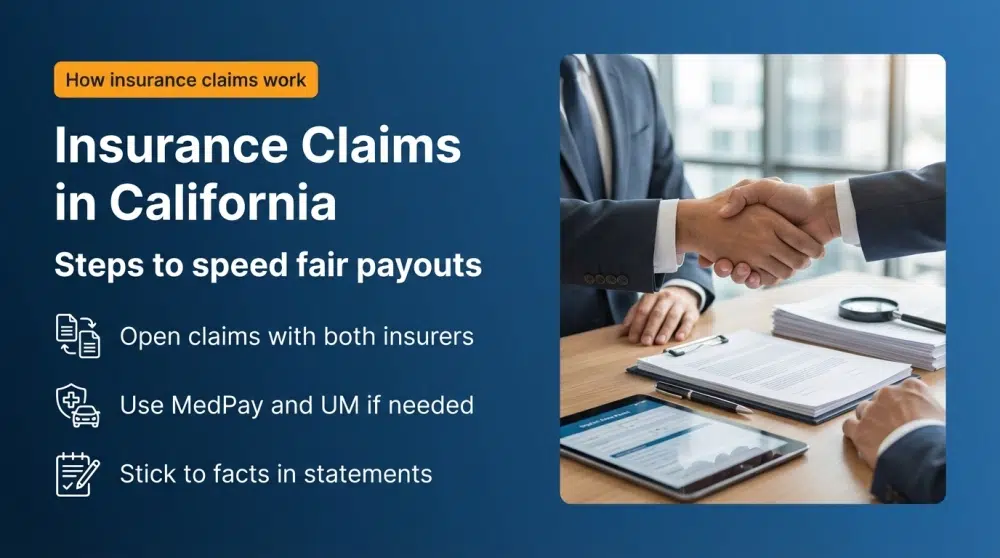
Many car accidents in Irvine are typically dealt with through insurance claims. How you handle the situation and collect evidence can greatly influence the duration it takes to resolve these cases and its overall outcome.
- First party and third party claims You may open a claim with your insurer and with the at fault driver’s insurer. California’s Fair Claims Settlement Practices Regulations require timely acknowledgment, investigation, and reasonable settlement efforts by insurers [7].
- It’s crucial to review your car insurance policy carefully, as it should include both medical payment coverage and uninsured/underinsured motorist coverage. The former can provide essential financial aid when you or your passengers are injured in an accident, regardless of whose fault it was, while the latter protects you if an at-fault driver has insufficient insurance to cover all damages. Make sure these aspects are well taken care of in your policy to avoid potential financial pitfalls.
- Property damage Obtain independent repair estimates. If your vehicle is a total loss, valuation must be consistent with fair market value standards in your policy and California regulations [7].
- Recorded statements Provide accurate information without speculation. Stick to facts. If you have counsel, coordinate communications through your attorney.
- Medical care Follow through with treatment plans. Gaps can be used by insurers to dispute causation or severity.
Filing an insurance claim after a crash can feel overwhelming while you are healing. Organizing records and using your claim number on every document helps keep things on track under California claim handling timelines [7].
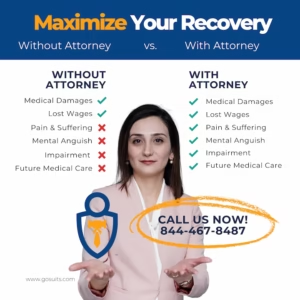
What are common defenses in California car accident cases and how do plaintiffs respond?
Because California uses pure comparative negligence, defendants and insurers often look for ways to shift percentages of fault.
- Comparative negligence Arguments may focus on speed, distraction, lane compliance, or failure to yield. Plaintiffs can respond with time distance analyses, signal timing data, event data recorder downloads, and eyewitness corroboration to refine fault percentages under Li v. Yellow Cab [1].
- Causation disputes Insurers may argue that injuries were preexisting or minor. Prompt medical records, specialist evaluations, and consistent symptom histories help connect the dots [12].
- Damage mitigation Defendants may claim a plaintiff failed to mitigate damages by delaying treatment or returning to strenuous activity too quickly. Clear medical guidance and adherence to care plans are key.
- Proposition 51 For noneconomic damages, defendants emphasize several liability to limit exposure to their proportional fault share, as codified in Civil Code section 1431.2 [9].
Well organized evidence and timely filings protect your ability to present the strongest version of what happened and how it changed your life in Irvine and across Orange County.
Which Irvine specific questions come up for Armstrong Ave and McGaw Ave crashes?
Armstrong Ave and McGaw Ave is a busy commercial corridor serving offices, warehouses, and local service traffic in Irvine, CA. That mix raises practical questions.
How do you get an Irvine Police Department accident report and why does it matter?
For a crash investigated by the Irvine Police Department, you can request a copy of the report through the department’s Records unit. The report number or date, location, and involved party names help locate it. If CHP investigated, use CHP’s traffic collision report process. Reports help insurers evaluate fault and often include diagrams and witness information [15][13].
Do you still need to file a DMV SR 1 if police responded?
Yes. The DMV SR 1 is separate from police reporting. You must file within 10 days for any crash with injury, death, or apparent property damage of one thousand dollars or more, even if officers came to the scene and even if you were not at fault [3].
What if a delivery truck or rideshare was involved at the intersection?
Commercial and rideshare collisions can involve multiple insurers and contractual coverage layers. Accurate identification of the operating status and employer or platform matters. California’s comparative fault rules still apply and fault is apportioned among all responsible parties [1].
How can you locate nearby video in a commercial corridor?
Ask surrounding businesses promptly. If necessary, counsel can send preservation letters quickly to reduce the risk of routine video deletion. Public records requests for certain agency held recordings may be available in some situations under California law, subject to exemptions and retention policies.
When should you contact a lawyer and what can legal counsel do?
If you needed emergency care, if someone was injured, if there is a dispute about fault, or if the other driver’s insurer is contacting you for a statement, it is a good time to consider counsel. A lawyer can coordinate evidence, protect communications, and keep your claim on the correct legal timelines in California. Many people also search for Irvine car accident lawyers to help with these steps. If you prefer local support for an Armstrong Ave and McGaw Ave crash, you can look for car accident lawyers in Irvine who have handled intersection collisions and insurer negotiations in Orange County.
- Early evidence action Counsel can request and review collision reports, video, and electronic data quickly.
- Medical record organization Linking care to the crash, tracking bills, and addressing subrogation can prevent confusion and delays.
- Negotiation and litigation Insurers must follow California claim handling rules. If a fair outcome does not come through negotiation, a civil lawsuit can be filed within the deadlines discussed above [7][2].
About GoSuits
You can reach us after a crash at Armstrong Ave and McGaw Ave in Irvine or anywhere in Orange County for a free consultation focused on your questions and next steps. GoSuits practices personal injury law across California. We combine technology with dedicated attorney attention to move cases forward faster.
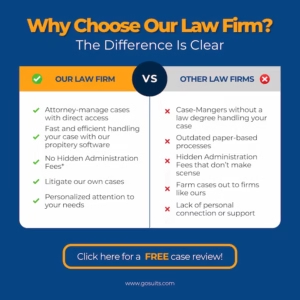
- Technology driven case work We use exclusive proprietary software that streamlines evidence intake, medical record organization, and insurer communication for faster, clearer results, while your attorney remains your direct point of contact at every stage.
- Attorney access without barriers We do not assign case managers to stand between you and your lawyer. Every client has unfettered access to their attorney.
- Track record See a selection of our past results at prior cases.
- Who we are Learn more about our attorneys and about us, and review our practice areas.
- Experience Our team brings 30 years of combined experience in negotiation and trial, which helps us evaluate cases accurately and present them clearly in court when needed.
- Trial readiness Being ready for trial often improves settlement posture. We prepare from day one with that standard in mind.
If you prefer to talk now, call GoSuits at 844 467 8487 for a free consultation. We can help you understand options, timelines, and documentation specific to California law and Orange County courts, and we coordinate promptly with insurers under California’s claim handling rules [7].
References and resources
- Li v. Yellow Cab Co. 13 Cal. 3d 804 1975 – CourtListener
- Code of Civil Procedure section 335.1 two year limitation – California Legislative Information
- Accident Report SR 1 requirements – California DMV
- Vehicle Code section 20008 injury collision reporting within 24 hours – California Legislative Information
- Vehicle Code section 20001 duties in injury or death collisions – California Legislative Information
- Vehicle Code section 20002 duties in property damage only collisions – California Legislative Information
- Fair Claims Settlement Practices Regulations title 10 section 2695.1 – California Department of Insurance
- Government Code section 911.2 six month claim requirement – California Legislative Information
- Civil Code section 1431.2 several liability for noneconomic damages Prop 51 – California Legislative Information
- Personal injury overview and timelines – California Courts Self Help
- Early Estimate of Motor Vehicle Traffic Fatalities in 2023 – NHTSA
- After a Motor Vehicle Crash get checked by a health care provider – CDC
- Traffic Collision Reports information – California Highway Patrol
- Collision involvement guidance – California Driver Handbook DMV
- Irvine Police Department records and information – City of Irvine