- What happened on Domenigoni Parkway in Winchester
- Road closures and impact on morning traffic
- How crash investigations work in heavy-vehicle collisions
- Civil liability and legal options for injured people and families
- Essential records to request and who to call
- Important next steps after a serious crash or loss
- Insurance issues after a deadly crash
- Preserving evidence and reconstruction basics
- Local safety context along Domenigoni Parkway
- Community and state support resources
- Why taking action promptly matters
- Commentary from Gosuits Winchester, California Personal Injury Attorney
- References and resources
What happened on Domenigoni Parkway in Winchester
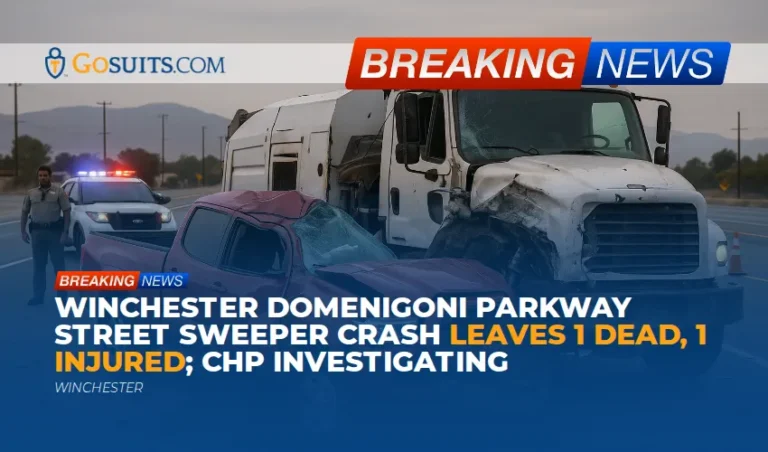
Shortly after 6 a.m. on a weekday morning in Winchester, a red Toyota Tacoma and a street sweeper collided near Westbound Domenigoni Parkway and Prairie Loop. According to dispatch information, one person was trapped and died at the scene. A second person suffered moderate injuries and was transported by ground ambulance to a nearby hospital. The Riverside County Coroner’s Office was requested shortly after 7 a.m., and the scene response was transferred to the California Highway Patrol and Menifee Police for investigation and traffic management. Lanes remained restricted through the morning while a heavy-duty tow crew worked to remove the approximately 33,000-pound street sweeper with a broken right-rear axle, along with the severely damaged pickup.
Residents who drive this corridor know it well. Domenigoni Parkway serves as a fast-moving link between Menifee, Winchester, and the Hemet Valley, with early commuters headed toward I-215 or around Diamond Valley Lake. Heavy maintenance equipment, including street sweepers, is often present near daybreak to clear debris before rush hour. That mix of speed, early light, and work vehicles can be unforgiving when something goes wrong.
Road closures and impact on morning traffic
Morning traffic in westbound lanes was pinched down as responders allowed limited movement and turned drivers around as needed until both the street sweeper and the pickup could be removed. By mid-morning, the right-hand lanes remained closed while CHP coordinated cleanup and documentation. It is common in serious or fatal crashes for law enforcement to keep part of the roadway closed for extended periods to preserve the scene for measurements, skid mark documentation, evidence scans, and safe vehicle recovery. CHP crash teams often rely on standardized collision reporting protocols and reconstruction methods that require space and uninterrupted time to complete properly [1].
How crash investigations work in heavy-vehicle collisions
When a crash involves a heavy maintenance vehicle like a street sweeper and a passenger pickup, investigators typically look at several broad categories of facts before they determine fault. They will review roadway and lighting conditions around first light, lane configurations, speed estimates, vehicle positions, and the existence of any temporary traffic control if the sweeper was operating in or next to live lanes. They will also document damage profiles, any intrusion into vehicle cabins, and whether the vehicles rotated or rolled. If a work operation was underway, they will examine whether traffic control complied with the California Manual on Uniform Traffic Control Devices, which governs how cones, taper lengths, signs, and arrow boards should be placed for maintenance and utility work zones in our state [7].
Investigators also seek physical and electronic evidence. That can include scene photographs, total station or laser measurements, Event Data Recorder information from the pickup if available, GPS or telematics from the sweeper fleet, and any mobile phone or dash camera recordings. Witness statements and first responder narratives fill in crucial timing gaps. If work-zone activity is suspected, additional protocols from the Federal Highway Administration’s work zone guidance may be considered to understand safe practices for staging vehicles, shadow trucks, and warning devices near moving traffic [8].
For a deeper plain-English look at how these cases are built in California, this resource can help: Legal overview for truck accident victims in California.
Civil liability and legal options for injured people and families
California civil law provides paths to pursue claims for injuries and wrongful death after roadway crashes, including those involving maintenance vehicles or heavy equipment. While every case turns on its facts, families commonly ask who might be responsible and how claims are evaluated. Without speculating on this collision, these are the general avenues that often arise:
Wrongful death and survival actions
When someone dies in a crash, certain family members may bring a wrongful death claim under California Code of Civil Procedure section 377.60. The statute defines who has legal standing to bring a claim and outlines the categories of recoverable damages, such as loss of financial support and the intangible loss of companionship [5]. A related but distinct claim, called a survival action, allows the decedent’s estate to recover certain losses that the person could have claimed had they lived, under CCP section 377.30 [6].

Potentially responsible parties in heavy-vehicle cases
Depending on the facts, potential defendants in a civil claim can include a vehicle operator, the company that owns or operates the street sweeper, a third-party contractor, the owner of the pickup, or, in some limited circumstances, a public entity responsible for roadway maintenance or traffic control. Claims that implicate a government agency must be treated with extra urgency because California’s Government Claims Act imposes very short deadlines for presenting claims, often within six months of the incident in many personal injury contexts [4].
Deadlines matter
For most California personal injury and wrongful death matters against non-government defendants, the standard statute of limitations is generally two years from the date of injury or death under CCP section 335.1 [3]. There are exceptions and tolling scenarios, but the key takeaway is that deadlines are strict. Early legal guidance often prevents missed windows and helps ensure evidence is preserved.
Essential records to request and who to call
Families and injured people often feel overwhelmed by paperwork immediately after a deadly or serious crash. Organizing records early makes a real difference. Here are the core documents to request, with notes on where to start and why they matter. Where possible, we cite official government sources at the end of this article.
CHP collision report and scene documentation
What to request: The Traffic Collision Report, any supplemental narratives, scene diagrams or measurements, and photographs if available. CHP uses standardized reporting and maintains instructions for requesting a collision report using CHP Form 190 [1].
Where to call: Contact the California Highway Patrol office that handled the investigation and ask for their records unit. Provide the date, approximate time, location, and vehicles involved. Ask whether the report is ready, whether photographs exist, and how to submit a CHP 190. If Menifee Police assisted, ask CHP if the file is joint or if a separate city report exists, then contact the city’s records unit accordingly.
Death certificate and cause of death documentation
What to request: Certified copies of the death certificate from the California Department of Public Health, plus any coroner’s reports, autopsy findings, and toxicology if performed.
Where to call: For certified death certificates, the California Department of Public Health Vital Records has statewide guidance on obtaining copies [13]. For coroner materials, contact the county medical examiner or sheriff-coroner office that responded. In California, coroner duties are defined by statute and include investigating sudden or accidental deaths [12]. Next of kin can ask the coroner’s office about report availability and release timelines.

DMV SR-1 accident reporting
What to know: California requires drivers to submit an SR-1 report to DMV within 10 days for crashes that involve injury, death, or more than a minimal amount of property damage, regardless of fault. The DMV provides the SR-1 form and instructions online [2]. When a crash is fatal, the at-issue drivers or their insurers typically handle this, but it is smart to verify with your attorney whether an SR-1 is needed in your situation.
911 audio, CAD logs, and traffic camera footage
What to request: 911 recordings, computer-aided dispatch logs, and any municipal traffic camera footage. In California, public records may be available through the California Public Records Act, which is codified in Government Code beginning at section 6250. Agencies vary in retention length, and some footage may be overwritten quickly. Prompt requests are critical. Even when exemptions apply, timestamps and existence confirmations can still be valuable.
Heavy tow and vehicle storage records
What to request: Tow operator logs, chain of custody, and photos taken during recovery. These can help show how vehicles came to rest, why roofs or axles failed, or whether secondary damage occurred during recovery. Ask the investigating agency which tow provider responded so you can contact them quickly.
Important next steps after a serious crash or loss
The hours and days after a catastrophic crash move fast. A clear plan helps you protect your rights and reduce the risk of losing key evidence. Consider the following:
- Pause before speaking to insurers. Consult a qualified attorney first. Recorded statements can be used against you later, and small inconsistencies are often exploited during negotiations or litigation.
- Preserve vehicles and parts. Ask that the involved vehicles and any detached components be held for inspection. A well-timed preservation letter can prevent critical evidence from being destroyed.
- Document injuries and care. Keep a running timeline of medical visits, symptoms, and work impacts. Accurate documentation supports both treatment and lawful claims.
- Track expenses and losses. Save receipts for medical bills, transportation, and out-of-pocket costs. Maintain notes on missed work and caregiving needs.
- Identify witnesses. Collect names, phone numbers, and any dash cam or cell phone footage. Provide this list to your attorney so they can secure statements promptly.
If you are comparing options for guidance, many firms that handle roadway fatalities are seasoned with complex claims. Some people look for truck accident lawyers who understand heavy-vehicle dynamics and how to obtain fleet maintenance and telematics data.
Insurance issues after a deadly crash
After a fatal collision, insurers for each involved vehicle will move quickly to open claims, establish reserves, and gather statements. They may also request medical authorizations that are broader than necessary. These authorizations can allow intrusive fishing expeditions into unrelated medical history. That is one reason many people choose to speak with counsel before interacting with any insurance adjuster.
Local knowledge can help when a crash happens near neighborhood corridors like Domenigoni Parkway. Winchester truck accident lawyers are often familiar with how early commuter patterns, lane tapers, and temporary maintenance operations can factor into liability analysis in our area. Keep in mind that California law places the burden on the claimant to prove liability and damages, so early strategy matters.
Preserving evidence and reconstruction basics
Preservation of evidence starts immediately. Here are common categories that matter in heavy-vehicle crashes:
- Event Data Recorder and telematics. Many pickups have EDRs that capture speed, braking, and throttle inputs seconds before impact. Fleet sweepers may keep GPS breadcrumbs, maintenance alerts, and engine hours through telematics systems. Securing these records early can be pivotal. Procedures for commercial fleets often include inspection and maintenance logs that are subject to federal safety rules in trucking contexts, and similar recordkeeping discipline is helpful for non-interstate fleets as well [15].
- Work-zone traffic control compliance. If a maintenance operation was underway, compliance with the California MUTCD and FHWA guidance on work zones is probative. Investigators look at taper lengths, sign spacing, and whether an attenuator or arrow board was in place when operations encroached on live lanes [7] [8].
- Flagging operations. In some settings, trained flaggers are required, and they must meet regulatory standards for visibility and signaling [14]. If flaggers were present, their training logs, positions, and timing of signals should be documented.
- Scene data and roadway conditions. Skid marks, yaw marks, gouges, glass distribution, and debris fields help reconstruct dynamics like speed and angle of impact. Weather, sun position near dawn, and sightline obstructions are noted.
- Third-party recordings. Public cameras, private business cameras near Prairie Loop, and vehicle dash cams can fill blind spots. Records are often overwritten in days, not weeks, so time is of the essence.
Local safety context along Domenigoni Parkway
Folks living in Winchester and Menifee know Domenigoni Parkway is a primary east-west arterial that carries high volumes during the morning push. Maintenance crews frequently target early hours so it is clean before the peak commute begins. As traffic picks up near Prairie Loop and other access points, lane changes and speed differentials can create sudden conflicts. California’s basic safety messaging about work zones and speed emphasizes that small lapses can have fatal consequences, particularly where fast-moving traffic meets roadside operations [8] [10].
Statewide data show that large vehicles pose unique risks due to mass and stopping distance, especially when interacting with lighter passenger vehicles. Federal safety agencies have long called attention to the severity of injuries in crashes with heavy vehicles, underscoring the need for diligent investigation and careful claims handling [9].
Community and state support resources
In the aftermath of a tragedy, neighbors often ask how to support the families involved. While many needs are private, there are established avenues for official documents and victim assistance programs that can help with funeral costs, counseling, and related expenses. California maintains a statewide vital records process for death certificates through the Department of Public Health [13]. Depending on eligibility, the California Victim Compensation Board can also assist qualifying victims and survivors of violent crimes, which may include vehicular incidents under specific circumstances; review their official materials for program scope and criteria [11].
For crash details, the CHP collision report is the foundational document that insurers and attorneys rely on. If CHP was the primary investigating agency, follow their official request procedures and include as much identifying detail as possible, including the exact location on Domenigoni Parkway and the approximate time of the crash [1].
You can also find practical, California-focused guidance on preserving evidence and making timely requests in resources like our in-depth guide to collecting and safeguarding proof in roadway cases, including topics such as camera footage and public records practice Request CCTV footage after a California car accident.

Why taking action promptly matters
When a crash is severe or fatal, the window to protect your rights can be much shorter than people expect. Here is what timely action accomplishes and why it matters in our region:
- Preserves time-sensitive evidence. Traffic camera data, dash cam files, and fleet telematics may be overwritten within days. Quick preservation letters and requests prevent permanent loss.
- Clarifies the investigative record. Early witness outreach and scene documentation reduce disputes about how the crash unfolded. That leads to more accurate evaluations by all sides.
- Meets strict claim deadlines. California imposes a general two-year statute for injury and wrongful death claims, and only six months to present certain claims against public entities. Missing a deadline can bar recovery entirely [3] [4].
- Prevents insurance missteps. Insurers often seek broad medical releases and recorded statements. Consulting an attorney first helps ensure only appropriate information is shared and that your words are not taken out of context later.
- Sets a consistent medical record. Establishing care promptly documents injuries, connects symptoms to the crash, and supports an appropriate treatment plan.
Put simply, acting now protects the facts. It also creates space for healing by reducing the scramble later. If an insurance claim will be made, it is wise to consult counsel before contacting the insurer to understand rights and obligations. What is said to any insurance company can be used against a claimant in the future.
Commentary from Gosuits Winchester, California Personal Injury Attorney
Our hearts go out to everyone affected by the crash on Domenigoni Parkway. These collisions are devastating for families and for the whole Winchester and Menifee community that travels this corridor every day. The information provided here is educational and general. It is not a substitute for advice about any specific situation.
From a civil-injury perspective, a heavy maintenance vehicle and a passenger pickup colliding near daybreak raises immediate questions about visibility, line-of-sight, traffic control, and the precise location of the sweeper relative to live lanes. Whether there was an active work operation or a simple passing maneuver can change the analysis. That is why preservation of physical evidence, telematics, and camera footage is so important in the first days.
Insurance companies and corporations that own or manage fleets know the value of early control over information. They move fast to collect statements, secure their data, and sometimes shape the narrative. People who are grieving or recovering may not realize that casual comments in a recorded call can be used to undercut a claim months later. Seemingly routine medical authorizations can open the door to unrelated history that is then used to dispute causation.
A free consultation with a seasoned injury attorney can level the playing field. It helps families understand which deadlines apply, how to preserve vehicles and electronics for inspection, and what to request from CHP, the coroner, and hospitals. It also clarifies how damages are typically calculated in California wrongful death and serious injury claims, and what to expect from insurers. Even if no case is ultimately pursued, that early conversation often prevents irreversible mistakes.
References and resources
- Request a Collision Report – California Highway Patrol
- SR-1 Report of Traffic Accident – California DMV
- CCP § 335.1 Statute of Limitations – California Legislature
- Gov. Code § 911.2 Government Claims Act Deadline – California Legislature
- CCP § 377.60 Wrongful Death – California Legislature
- CCP § 377.30 Survival Actions – California Legislature
- California MUTCD – Caltrans
- Work Zone Management Program – Federal Highway Administration
- Large Trucks Road Safety – NHTSA
- Crash Rankings and OTS Research – California Office of Traffic Safety
- Victim Compensation Board – State of California
- Gov. Code § 27491 Coroner Duties – California Legislature
- Vital Records: Certified Copies – California Department of Public Health
- Title 8 §1599 Flaggers – Cal/OSHA
- Hours of Service Overview – FMCSA