- What we know about the Kennedy Expressway crash in the West Loop
- Where it happened and how traffic was affected
- Why stopped-vehicle crashes at night are so dangerous
- What investigators will examine on I-90
- Potential civil liability and victim rights under Illinois law
- Key records to request and who to contact in Cook County and Illinois
- Insurance coverage issues after a fatal Chicago highway crash
- Preserving evidence specific to Chicago expressway collisions
- Medical treatment, grief, and community support considerations
- Why timely action matters after a fatal expressway crash
- Commentary from Gosuits Chicago, Illinois Personal Injury Attorney
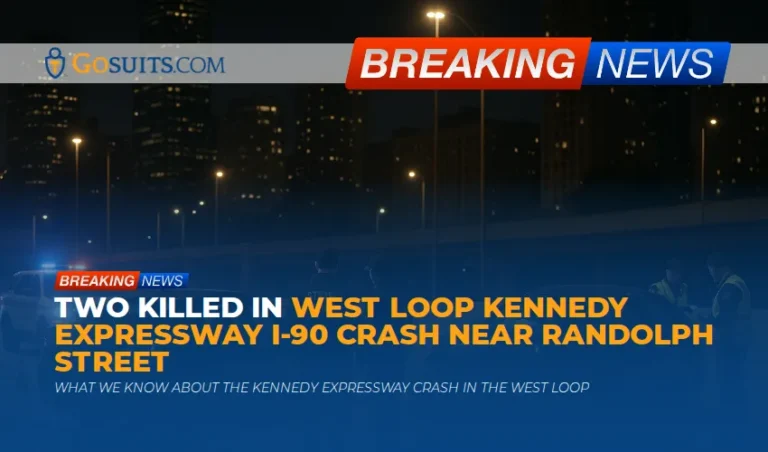
What we know about the Kennedy Expressway crash in the West Loop
Shortly before 2 a.m. on a quiet Sunday morning, a violent two-vehicle crash on the southbound Kennedy Expressway disrupted life in the West Loop and left two people dead. According to information provided by the Illinois State Police, a southbound vehicle struck a car that was stopped in the southbound lanes of I-90 near Randolph Street around 1:45 a.m. Five people were involved. The driver of the moving vehicle was alone, and four people occupied the stopped car. All five were transported to nearby hospitals. Two people were later pronounced deceased. At the time of reporting, authorities had not specified which occupants suffered fatal injuries, where the survivors were treated, or why the first car was stopped. Southbound lanes in that stretch remained closed until about 7:30 a.m. while crews investigated and cleared the scene.
When something like this happens along the Kennedy just west of the Loop, it ripples through families and the broader community. The corridors around Randolph Street connect to major downtown arteries and residential pockets where many commuters and night-shift workers travel, especially on weekends. That is why full lane closures last into the morning. Clearing debris, documenting the roadway, and ensuring safety takes time, and investigators usually work meticulously before reopening a high-speed corridor like I-90.
Where it happened and how traffic was affected
The collision occurred on the southbound side of I-90, commonly known as the Kennedy Expressway, near the Randolph Street area in the West Loop. If you drive this stretch, you know it sits right by downtown and connects to the Jane Byrne Interchange. Even at off-peak hours, speed differentials can be high, and sightlines are interrupted by curves, ramps, and lane shifts from ongoing improvement projects. A stopped car in an active lane at that hour can be extraordinarily dangerous.
All southbound lanes were closed in the immediate vicinity until about 7:30 a.m., which aligns with typical major crash protocol in Chicago. Investigators often shut down travel lanes to take measurements, document skid or yaw marks, and preserve any vehicle debris field. Illinois State Police manage expressway crashes through District Chicago, while city responders and IDOT support with traffic control and scene safety. Families and coworkers are often caught off guard when a loved one is late or unreachable during these extended closures.
Why stopped-vehicle crashes at night are so dangerous
Nighttime expressway conditions increase the risk and severity of rear-end or high-speed impacts into stopped vehicles. National traffic safety data trends show that darkness reduces visibility, compresses reaction time, and makes it harder for drivers to recognize unexpected hazards in their lane. Even when lighting is decent, the combination of speed, limited shoulder space, and a disabled or stopped car can set the stage for catastrophic outcomes. Federal crash tracking programs have long documented the disproportionate share of severe crashes during nighttime hours relative to traffic volume, a pattern that underscores how quickly a breakdown or stop in a live lane can turn tragic on an urban interstate like the Kennedy [9], [10].
Illinois traffic laws also reflect how unsafe it is to stop in a controlled-access highway lane. As a general rule, stopping, standing, or parking on a controlled-access highway is prohibited except in specific circumstances, like emergencies or when a vehicle is disabled. Even then, drivers are expected to move as far to the right as practicable and use hazard lights when possible. These rules are meant to protect everyone on the road, including the people inside the disabled vehicle, and the drivers approaching at highway speeds [1].

What investigators will examine on I-90
When Illinois State Police and crash reconstruction teams investigate a fatal interstate collision, they typically gather a range of evidence to determine what happened. Some of the key questions in a crash like this include: Was the stopped car disabled or stopped for another reason, and if so, where exactly in the lane did it come to rest? How fast was the southbound car traveling, and did the driver have a reasonable opportunity to avoid the collision? What were the lighting and weather conditions? Did either vehicle have mechanical issues? Were hazard lights on? Were any roadway factors involved, like debris, lane closures, or unusual congestion?
Evidence in these cases often includes:
- Physical roadway evidence such as skid marks, debris patterns, gouge marks, and fluid trails that help map the point of impact and post-impact movement.
- Vehicle inspections to assess damage profiles, brake condition, lighting systems, and, when available, event data recorder information that can suggest pre-impact speed and braking.
- Witness and occupant statements that may clarify why a vehicle stopped in the lane, whether any evasive maneuvers occurred, and what traffic patterns looked like in the moments before impact.
- Scene photographs and video from law enforcement, nearby traffic or security cameras, and dash cameras, if any can be located and preserved.
It is routine for authorities to take hours documenting a fatal crash scene on a busy corridor. While that can feel agonizing for families waiting for answers, it is part of ensuring a complete record.
Potential civil liability and victim rights under Illinois law
Illinois is a fault-based state. In civil cases, potential liability hinges on whether a party failed to use reasonable care and that failure caused harm. A collision with a stopped vehicle raises several negligence theories. One involves the vehicle that impacted the stopped car, for example, following too closely or traveling too fast for conditions. Another involves the stopped vehicle if it was unlawfully or unsafely stopped in a live lane without due precautions. Because multiple acts can contribute to a single crash, Illinois law applies a modified comparative fault system. Damages are reduced by a person’s percentage of fault, and recovery is barred only if that person is more than 50 percent at fault [2].
When a crash results in fatalities, the Illinois Wrongful Death Act allows certain surviving family members to seek compensation for losses, including loss of companionship, grief, and financial support. Separate from that, the Illinois Survival Act allows the decedent’s own claims, such as pain and suffering before death, to continue through the decedent’s estate. Each statute serves a different purpose and both may be pursued depending on the facts [3], [4].
In the aftermath, families often consult with car accident lawyers to understand how these rules might apply to their situation and to protect their rights while evidence is still available.
Key records to request and who to contact in Cook County and Illinois
In serious and fatal expressway crashes, multiple agencies hold pieces of the puzzle. Even if it feels overwhelming, retrieving these records early helps families and their representatives piece together what happened. Before contacting any insurance company, it is strongly recommended to speak with an attorney, because statements made to insurers can be used against claimants later. Below are common records and where they typically come from. Links to official government sources appear in the References section at the end of this article.
Traffic crash reports and related records
- Illinois State Police crash report. Because this occurred on the Kennedy Expressway, the primary crash report and reconstruction documents are usually prepared by the Illinois State Police. The ISP website provides information on obtaining traffic crash reports, with instructions specific to expressway incidents [5].
- Supplemental scene documentation. Depending on the case, additional materials can include crash diagrams, measurements, photographs, and citations, which may be available through ISP upon request or as part of the case file.
- Traffic management records. In some cases, relevant information may be held by IDOT or the City of Chicago related to lane closures, traffic signal timing for ramp areas, or camera footage. Requests are typically routed through the appropriate public records process under Illinois FOIA [11].

Medical and fatality records
- Hospital records. Individuals have a right under federal law to access their medical records or the records of a deceased relative where authorized. Hospitals in and around the Near West Side and West Loop often include Level 1 trauma centers that receive serious crash patients. The Illinois Department of Public Health maintains the statewide list of trauma centers, which includes several in Chicago such as Northwestern Memorial Hospital, John H. Stroger Jr. Hospital of Cook County, Mount Sinai Hospital, and University of Chicago Medicine, among others. The Right of Access under HIPAA governs how to request those records [6], [8].
- Autopsy and death investigation records. The Cook County Medical Examiner handles death investigations within the county. Families may request autopsy findings and related reports from the Medical Examiner’s Office. Procedures and request forms are published by Cook County government [7].
Who to contact
- Illinois State Police District Chicago. For expressway crash reports and investigative questions related to I-90 within the city.
- Cook County Medical Examiner’s Office. For autopsy, toxicology, and death certification details related to this incident.
- Illinois Department of Public Health and local hospitals’ Health Information Management departments. For medical treatment records of surviving occupants, where authorized.
- City of Chicago public records office. For city-held records, including potential OEMC logs or city-managed traffic management data. Formal FOIA submission may be required [11].
Families sometimes wonder whether there is a single clearinghouse for everything. There is not. Each agency controls its own records, so a set of parallel requests is common. If that feels like too much to juggle, consider seeking help promptly so deadlines are not missed and evidence is not lost.
Insurance coverage issues after a fatal Chicago highway crash
Highway collisions involving a stopped vehicle can present complex insurance questions. The moving driver’s liability insurance is often the primary source of recovery if that driver is found negligent. But other coverages may apply as well, depending on the facts. For example, if the stopped vehicle had hazard or emergency-related issues that implicate other parties, or if a roadway maintenance contractor created a hazard, multiple insurers may get involved.
Uninsured and underinsured motorist coverage can be highly important when liability is disputed or policy limits are low. In Illinois, many auto policies include these coverages by default. These benefits are generally pursued through the injured person’s own insurer, but they are still adversarial claims where recorded statements and medical authorizations can affect the outcome. It is wise for people to consult with Chicago car accident lawyers before giving any statement or signing broad releases.
When fatalities occur, two bodies of law often intersect with insurance: the Wrongful Death Act and the Survival Act. Wrongful death claims are brought for the benefit of eligible surviving family members, while survival claims are brought on behalf of the decedent’s estate for harms the decedent suffered before death. Insurers evaluate and defend both sets of claims differently, and timing rules apply to each [3], [4].
Beyond liability and UM or UIM, there are property damage, rental, and loss-of-use issues for surviving victims, as well as potential lien claims from medical providers and health insurers that must be resolved properly in Illinois. These layers make early organization critical. People often seek guidance from car accident lawyers to coordinate claims and avoid missteps that could limit available coverage.
Preserving evidence specific to Chicago expressway collisions
In urban interstate crashes, certain categories of evidence can disappear fast. Skid marks fade within days. Dash cam systems overwrite themselves. Third-party businesses near Randolph Street that might have exterior cameras sometimes purge footage within 7 to 30 days. Without quick action, crucial proof may be lost. Consider the following steps, tailored to a West Loop Kennedy Expressway scenario:
- Secure vehicle inspections. Ensure that salvage yards or storage facilities preserve both vehicles until independent inspections are completed. A hold letter should ask the custodian not to alter or destroy the vehicles without notice.
- Request nearby footage. Identify businesses or residential buildings along Randolph Street ramps or adjacent structures overlooking I-90. If a camera points toward the expressway, politely ask the owner to preserve footage for the timeframe surrounding 1:45 a.m.
- Look for vehicle modules and telematics. Many late-model vehicles record pre-crash data. Some also transmit telematics to manufacturers or fleet operators. Preservation requests may need to go to multiple companies to secure logs.
- Obtain 911 and dispatch logs. City or state dispatch records can establish timing and real-time observations called in by motorists. These are often subject to public records procedures [11].
- Document injuries and damages thoroughly. Maintain photos, invoices, towing paperwork, and medical summaries. An organized file helps keep the timeline clear.
For a practical, Chicago-focused overview of immediate steps after a roadway crash, see What to do after a car accident in Chicago.
Medical treatment, grief, and community support considerations
Right after a major interstate collision, emergency responders route patients to the nearest appropriate hospital, often a Level 1 trauma center in the city. Chicago is fortunate to have multiple trauma centers relatively close to the West Loop and Near West Side, including facilities familiar with high-speed crash injuries. The Illinois Department of Public Health publishes the roster of designated trauma centers and updates it as needed [8].
For families coping with a fatality, the Cook County Medical Examiner will typically complete an autopsy when appropriate and notify next of kin of preliminary findings. The office also provides information on how to request official records. These documents can be hard to read, but they often help answer questions about cause and manner of death [7].
From a practical standpoint, many people need a consolidated plan for the first week. That usually means tracking hospital discharges, communicating with employers, securing vehicles and personal property, and ensuring children or dependents have consistent support. Grief services and counseling options are available through many hospitals and community organizations in the city. If you are unsure where to start, Chicago’s main public information portal and county-level resources can point to reliable, low-cost options.
Why timely action matters after a fatal expressway crash
Here is what people should consider doing next, and why acting soon matters:
- Organize and preserve evidence quickly. Physical and digital evidence can be lost within days or weeks. Early preservation requests for vehicles, dash cam files, and nearby video give investigators the best chance to reconstruct events accurately.
- Request official records from the right agencies. Submitting requests to the Illinois State Police for crash reports and to the Cook County Medical Examiner for autopsy materials begins the paper trail needed for insurance and legal claims [5], [7].
- Prioritize medical follow-up. Even injuries that seem minor immediately after a crash can evolve. Consistent diagnosis and treatment create both a better medical outcome and a clear record for any future claim [6].
- Consult an attorney before speaking to insurers. Insurance representatives will often request recorded statements and broad medical authorizations early. People should consult with a qualified attorney first, because what is said to the insurer can be used to reduce or deny claims later.
- Understand the time limits. Illinois applies statutes of limitations to wrongful death and injury claims, often two years in many cases, though certain facts can shorten or extend deadlines. Knowing the general framework helps people plan their next steps without rushing decisions at the last minute [3], [4].
- Document real-life impacts. Keep a written record of missed work, out-of-pocket costs, changes in daily routines, and the emotional toll. This contemporaneous record helps tell the full story later.
These steps do not promise any particular outcome. They simply preserve options, which is essential given how quickly rights can be affected by evidence loss, filing deadlines, or inadvertent statements to insurance companies. Well-timed guidance from seasoned Chicago practitioners can also reduce the administrative burden on families while they focus on recovery and mourning. In many situations, that includes working with car accident lawyers who can coordinate record retrieval, evidence preservation, and early insurer communications.

Commentary from Gosuits Chicago, Illinois Personal Injury Attorney
Our hearts go out to everyone affected by the tragic collision on the Kennedy near Randolph. Two families are dealing with an unimaginable loss, and others are recovering from injuries that may change their daily lives for some time. This commentary is offered for educational purposes and general information only.
Based on what has been publicly reported, a moving vehicle struck a car that was stopped in a live southbound lane just before 2 a.m. on the Kennedy. Crashes like this are among the most dangerous events we see in the city. At highway speeds, even a brief stop in the lane can be devastating, and that is before considering the reduced visibility and reaction time at night. Investigators will focus on why the car was stopped, whether it was disabled, what warnings were available, and whether the approaching driver had a reasonable opportunity to avoid impact under the conditions. Illinois law prohibits stopping on controlled-access highways except in narrow circumstances, while also holding all drivers to a duty of reasonable care. In our experience, comparative fault can be a significant factor in these cases, and a careful reconstruction is essential.
We also see, time and again, how large insurance companies and corporate actors use their head start to shape the narrative. They deploy adjusters quickly, request recorded statements, and press for blanket medical authorizations. They are trained to minimize payouts and shift blame, especially where facts are still unsettled. Without guidance, people may unknowingly say or sign things that limit coverage or reduce the value of claims.
That is why obtaining a free consultation early can be so important. A skilled local attorney can outline the decisions that cannot wait, draft preservation requests so vehicles and digital data are not destroyed, and handle insurer communications to reduce the risk of harmful statements. They can also help families pursue the correct claims, whether under the Wrongful Death Act, the Survival Act, or under their own uninsured or underinsured motorist policy. The right next step is not the same for everyone, but starting with a no-cost conversation can clarify the path forward while families focus on healing and remembrance.
References
- 625 ILCS 5/11-1303 Stopping, standing, or parking on controlled-access highways – Illinois General Assembly
- 735 ILCS 5/2-1116 Contributory fault – Illinois General Assembly
- 740 ILCS 180 Wrongful Death Act – Illinois General Assembly
- 755 ILCS 5/27-6 Survival Act – Illinois General Assembly
- Traffic Crash Reports – Illinois State Police
- Individuals’ Right under HIPAA to Access their Health Information – U.S. Department of Health and Human Services
- Cook County Medical Examiner’s Office – Cook County Government
- Illinois Trauma Center System – Illinois Department of Public Health
- Fatality Analysis Reporting System (FARS) – National Highway Traffic Safety Administration
- Overview of Motor Vehicle Crashes – NHTSA Releases Annual Traffic Crash Data
- Freedom of Information Act Requests – City of Chicago