- What we know about the Turtle Creek crash
- Local context around Turtle Creek and Oak Lawn
- How serious Dallas crashes are investigated
- Why official records matter for families
- How to request key records in Dallas County and Texas
- Potential civil liability after a deadly Dallas crash
- Insurance issues in Texas after a catastrophic collision
- Timeframes, preservation, and deadlines
- Community safety takeaways for Turtle Creek and nearby corridors
- Where people commonly seek help and information
- Why acting promptly matters after a serious Dallas crash
- Commentary from Gosuits Dallas, Texas Personal Injury Attorney
What we know about the Turtle Creek crash
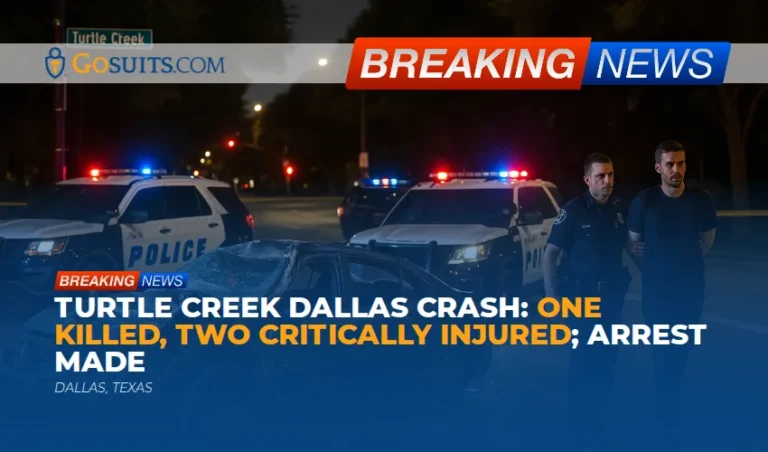
Local reporting indicates that on November 30, 2025, a serious crash in Dallas’ Turtle Creek area resulted in one person losing their life and two others being critically injured. Police reported that one individual was arrested following the collision. At the time of these early reports, details about the exact sequence of events and the specific allegations related to the arrest had not been publicly released. In situations like this, official updates typically come from the Dallas Police Department and, in fatal cases, the Dallas County medical examiner’s office.
When early accounts reference an arrest, it signals that officers on scene believed there may have been a violation of law connected to the crash. That does not predetermine civil fault or fully explain what happened. The civil investigation often relies on measurable evidence, witness statements, vehicle data, and formal reports compiled in the days and weeks after the incident.
Our hearts go out to those who are grieving and those fighting to recover. Turtle Creek and the broader Oak Lawn area see a mix of neighborhood traffic, commuters, and weekend visitors, which can complicate traffic flow and investigations. If you live nearby, you likely know how quickly conditions can change along Turtle Creek Boulevard, Lemmon Avenue, Cedar Springs Road, and the stretches that feed into Oak Lawn Avenue and the Katy Trail crossings.
Local context around Turtle Creek and Oak Lawn
Turtle Creek is a leafy, winding corridor that hugs the waterway and greenbelt. It connects dense residential blocks, mid-rise condos, and popular spots like Reverchon Park. The nearby Oak Lawn and Cedar Springs areas are active both after work and late into the night, especially around weekends and during holiday periods. Traffic can bottleneck around intersections that line up with shopping corridors on Lemmon and the restaurant scene nearer to Cedar Springs and Maple.
Anyone who uses the Katy Trail entrances near Turtle Creek knows that pedestrian and jogger activity spikes during pleasant weather, particularly in the mornings and evenings. Seasonal events, holiday lights, and shopping trips can increase unfamiliar drivers on local streets. None of this tells us what caused a single crash, yet it underscores why investigators look carefully at visibility, speed, impairment indicators, traffic signal timing, lane design, and nearby driveways or parking access points.
How serious Dallas crashes are investigated
After a fatal or potentially fatal crash in Dallas, officers typically secure the scene, aid victims, and preserve evidence. Specialized crash investigators often take measurements, map debris fields, document vehicle rest positions, and look for braking or yaw marks. In severe collisions, vehicle event data recorders, if present and accessible, can help reconstruct speed and braking inputs in the seconds before impact. NHTSA maintains guidance and information on event data recorders, which are essentially black boxes for passenger vehicles in many makes and models, although not all vehicles record the same parameters or duration and access requires proper legal authority or owner consent. See NHTSA on Event Data Recorders.
When there is a fatality, the Dallas County medical examiner evaluates cause and manner of death. Autopsy findings can be critical in understanding injuries and timing, which may become relevant in a civil wrongful death or survival claim. Early arrests or citations do not end the investigation. Agencies may take additional statements, review nearby cameras, and analyze blood tests if impairment is suspected. Additional lab results sometimes take weeks.
Why official records matter for families
Families often feel overwhelmed and unsure where to start. While no document can undo what happened, certain records help establish the who, what, when, and how of a crash. They are also essential for life insurance claims, property damage claims, probate tasks, and potential civil actions like wrongful death or survival claims.
Key documents commonly include the Texas Peace Officer’s Crash Report, supplemental narratives and diagrams, the medical examiner report for the deceased, death certificates, and medical records for the injured. In Texas, the main crash report is typically the CR-3, and it can be requested through the state’s system once it is ready. Some pieces become available earlier than others, and some items are restricted to certain parties under state law.

How to request key records in Dallas County and Texas
Texas Peace Officer’s Crash Report
The official CR-3 crash report can usually be purchased through the Texas Department of Transportation’s Crash Records Information System when it is released. You will need information like the date, location, and involved names to search. See TxDOT’s portal: TxDOT CRIS Purchase.
TxDOT also emphasizes the scale and seriousness of roadway harm in Texas through its End the Streak campaign, noting Texas has experienced fatal crashes every day for years. Context on that public safety effort is available here: TxDOT End the Streak.
Medical examiner records and autopsy reports
In Dallas County, the medical examiner functions are handled by the county’s forensic sciences office. Access to autopsy and certain investigating records is governed by Texas law. The Code of Criminal Procedure describes medical examiner records and who may access them. See Texas Code of Criminal Procedure art. 49.25. Next of kin may be able to request copies when available, subject to privacy rules and any active law enforcement exceptions.
Death certificates
Official death certificates are issued by the Texas Department of State Health Services, Vital Statistics. These are needed for many post-incident processes, including life insurance and estate matters. Guidance is here: Texas DSHS Death Certificates.

Medical records for the injured
People receiving treatment have rights under federal privacy rules to access their health information. HHS provides guidance on the right of access under HIPAA, including timelines and allowed fees. See HHS HIPAA Right of Access. In Dallas, trauma care often occurs at regional centers such as Parkland Memorial Hospital and UT Southwestern Medical Center, but individual facilities and release procedures vary. Be prepared with valid ID, patient information, and any required authorizations.
Public information requests in Texas
Some materials may be available through the Texas Public Information Act, which governs how public records are requested and released. The Office of the Attorney General provides instructions and explanations on exemptions and timelines. Learn more here: Texas Attorney General Open Government. Keep in mind that active investigative materials may be withheld or redacted under specific exemptions.
Potential civil liability after a deadly Dallas crash
This incident, as reported, involved fatalities and critical injuries. In civil terms, several liability theories may be relevant depending on the evidence.
- Driver negligence may involve speed, failure to yield, inattention, or improper lane use. If a driver breached a duty of care and that breach caused harm, that driver can face civil responsibility for the damages.
- Negligent entrustment or owner liability can arise when the vehicle owner knew or should have known a driver was unfit or unsafe, yet still allowed the use of the vehicle.
- Commercial or rideshare vehicles can trigger layered insurance and corporate policies. The applicable coverage can depend on whether the driver was on app, on dispatch, or engaged in a commercial purpose at the time.
- Alcohol service liability may come into play if a provider overserved an obviously intoxicated person who then caused harm. Texas law recognizes potential civil liability in overservice scenarios. See the Texas Alcoholic Beverage Code, Chapter 2. Whether this applies depends entirely on facts not yet public.
- Roadway design or maintenance claims are complex and rare. They require careful engineering analysis and consideration of governmental immunities. The Texas Tort Claims Act has strict notice rules and limitations for suits involving governmental units. See Texas Civil Practice and Remedies Code § 101.101.
For fatal cases, Texas law recognizes two civil pathways that families often hear about:
- Wrongful death claims are brought by the decedent’s spouse, children, and parents, as authorized under Texas Civil Practice and Remedies Code § 71.004. Damages can include mental anguish, loss of companionship and society, loss of financial contributions, and related losses, depending on proof.
- Survival claims continue the decedent’s own claim through the estate and can address the decedent’s conscious pain and suffering, medical bills, and other damages between injury and death. See Texas Civil Practice and Remedies Code § 71.021.
It is common to see multiple insurance carriers involved in a severe loss, especially if several vehicles or a commercial policy is implicated. Early preservation of evidence is essential because vehicles are often repaired or salvaged quickly and businesses may overwrite video after short retention periods.
Insurance issues in Texas after a catastrophic collision
Understanding insurance coverage can be daunting. Texas requires vehicle owners to carry minimum liability coverage, often called 30, 60, 25. That means at least 30,000 for injuries per person, 60,000 per crash, and 25,000 for property damage. The Texas Department of Insurance explains these coverage basics here: TDI Auto Insurance.
In serious events, minimum limits are quickly exhausted. Additional policies sometimes come into play:
- Umbrella or excess policies that sit on top of the at-fault driver’s auto policy
- Commercial auto or motor carrier coverage if a business vehicle was involved
- Uninsured and underinsured motorist coverage on a victim’s own policy, which can provide benefits when the at-fault driver lacks adequate coverage
- Personal injury protection or medical payments coverage, which can help with certain medical costs regardless of fault, depending on the policy
Insurance adjusters often move fast after a high-profile crash. Recorded statements and broad medical authorizations can affect later claims. As a practical safeguard, people commonly seek a free consultation with a qualified attorney before giving any insurance statement. What someone says to an insurance company can be used against them later.
Timeframes, preservation, and deadlines
Texas law sets strict time limits for filing civil cases. The general statute of limitations for personal injury and wrongful death claims is two years from the date of the incident, as outlined in Texas Civil Practice and Remedies Code § 16.003. There are exceptions and specific rules for claims involving governmental entities, including notice requirements under the Texas Tort Claims Act, which often require notice within six months. See § 101.101. Some municipal charters impose shorter, local notice windows.
Early steps that frequently matter in severe crashes:
- Send preservation letters to drivers, owners, and relevant businesses to prevent deletion of camera footage, telematics, or personnel records.
- Document vehicle condition with photographs and secure access to inspect before repair or salvage. Considering potential EDR data is important. See NHTSA EDR guidance.
- Track medical care by keeping discharge notes, imaging CDs, and billing statements in an organized file. HIPAA guidance on records access is provided by HHS at this page.
- Obtain the official CR-3 report when available via TxDOT’s portal at CRIS Purchase.
Community safety takeaways for Turtle Creek and nearby corridors
While investigators will determine the specific factors in this crash, broad safety patterns are worth remembering. Nationally, speeding continues to be tied to a significant share of traffic deaths. NHTSA emphasizes that speed reduces a driver’s ability to steer safely and extends stopping distances. More speed equals more energy in a crash and more severe injuries. See NHTSA on Speeding.
Impaired driving also remains a persistent risk. NHTSA notes alcohol-impaired driving is involved in a substantial portion of fatal crashes nationwide, with late evenings and weekends showing higher proportions. See NHTSA on Drunk Driving.
Seat belt use is another proven lifesaver. CDC highlights that seat belts reduce the risk of serious injury and death for front seat occupants. See CDC Seat Belt Facts.
In Dallas, Turtle Creek and Oak Lawn bring together residents, visitors, rideshares, and delivery drivers. Drivers turning onto Turtle Creek Boulevard may encounter quick merges or shaded curves. Pedestrians exiting the Katy Trail near Reverchon Park sometimes cross mid-block. During the holiday season, more out-of-town drivers visit nearby shops and restaurants, which can add unpredictable movement on and off Lemmon and Cedar Springs. The shared takeaway for all of us in the neighborhood is caution, patience, and scanning for the unexpected.
Where people commonly seek help and information
In the aftermath of a catastrophic crash, multiple agencies and records offices may be involved. People often contact the following:
- Police report: The primary crash report for Texas is accessible through TxDOT’s system once released. Link: TxDOT CRIS Purchase.
- Autopsy and medical examiner information: Dallas County’s medical examiner functions are governed by Texas law. Access is described generally in Tex. Code Crim. Proc. art. 49.25.
- Death certificates: Request through the Texas Department of State Health Services. Link: Texas DSHS Death Certificates.
- Public information requests: The Texas Attorney General outlines how to use the Public Information Act to request certain records. Link: OAG Open Government.
- Medical records: Federal guidance on access rights is here: HHS HIPAA Right of Access.
- Crime Victims’ Compensation: In some circumstances, especially when the crash involves criminal behavior like intoxication offenses, Texas offers a program that can help eligible victims with certain expenses. See the Attorney General’s page: Crime Victims’ Compensation Program.
It is common for hospitals, law enforcement, and county offices to require identification, proof of relationship for next of kin, or additional documentation. Processing times vary. If a record is part of an active, ongoing investigation, there may be delays or redactions under state law. The Attorney General’s open government resources explain those exceptions and timelines.

Why acting promptly matters after a serious Dallas crash
When a collision in Turtle Creek or anywhere in Dallas leads to catastrophic harm, key evidence can disappear in days. Vehicles are towed to lots with storage fees, then repaired or sold. Businesses along Cedar Springs or Lemmon may overwrite security video in a week or less. Witnesses return to out-of-state homes after a holiday weekend. Acting promptly preserves facts that later determine responsibility and coverage.
- Secure the official crash report: Monitor the TxDOT CRIS system for the CR-3 report release at this portal. Supplemental diagrams and narratives add important detail.
- Preserve vehicles and data: Request that tow yards and insurers preserve the vehicles for inspection. Event data recorders may contain short pre-crash data windows. See NHTSA EDR information.
- Request time-sensitive video: Ask nearby businesses or residences along Turtle Creek Boulevard, Oak Lawn Avenue, or Lemmon Avenue to retain footage. Written preservation notices help.
- Document injuries and treatment: Keep discharge summaries, imaging, and itemized bills. HHS explains access rights here: HIPAA Right of Access.
- Be cautious with insurance communications: Insurers often seek recorded statements. It is prudent to consult an attorney first before speaking with any insurance company. Statements may be used against a claimant later.
- Calendar legal deadlines: Texas generally provides two years to file personal injury and wrongful death claims. Government-related claims may have shorter notice requirements. See § 16.003 and § 101.101.
Taking these steps helps ensure decisions are based on a full and accurate record. It also promotes accountability and fair evaluation of losses, including for those critically injured whose recovery may evolve for months.
Commentary from Gosuits Dallas, Texas Personal Injury Attorney
First, our sincere condolences go to the family mourning a loved one and to the two people reported to be in critical condition. This discussion is intended for educational purposes and general information. It is not a substitute for personalized guidance.
From the limited details reported publicly, a serious multi-victim crash occurred in the Turtle Creek area on November 30, 2025, and one person was arrested at the scene. In civil terms, this type of event raises urgent questions about driver conduct, possible impairment or distraction, and whether additional entities are involved, such as an employer or an alcohol provider. The immediate priority in a case like this is preserving vehicles, obtaining the official CR-3, and securing any camera footage from nearby buildings or traffic cameras while it still exists. For families facing a wrongful death and for those critically injured, documentation in the first two weeks often shapes every conversation that follows.
Insurance companies and large corporations know the value of early control over information. Adjusters may arrive quickly, ask for broad medical authorizations, and request recorded statements before people have the full picture or time to process what happened. Those statements can be used to minimize claims or create confusion about injuries that evolve over time. Corporations sometimes argue that vague policies or third parties are to blame, which can delay or dilute accountability. Without experienced guidance on coverage layers, exclusions, and policy triggers, claimants can be boxed into low ceilings or miss additional policies entirely.
That is why a free consultation matters. A conversation costs nothing but can clarify next steps, identify all potential sources of coverage, and help prevent unforced errors in the early insurance process. It can also ensure timely preservation of evidence and compliance with Texas deadlines, including notice rules that are easy to miss if a governmental entity is involved. Most importantly, it empowers people with information before they make decisions that affect their future.
As the community absorbs this tragedy, we are thinking of those who call Turtle Creek and Oak Lawn home, the first responders who arrived, and the healthcare teams working through the night. Dallas traffic is a shared responsibility. When a crash happens, transparency, careful investigation, and compassion for those harmed should guide what comes next.