- What we know about the Townsgate Road pedestrian collision
- Where and when it happened, and local context
- Immediate steps after a serious pedestrian injury in Thousand Oaks
- How fault is evaluated in California pedestrian collisions
- Evidence to preserve in and around Townsgate Road
- Medical care, follow up, and accessing records
- Which agencies hold reports and how to request them
- Insurance and financial considerations after a pedestrian crash
- Safety context: older adults, low light, and pedestrian risk
- Civil timelines in California and why prompt action matters
- What neighbors and the community can do to support recovery
- Why acting promptly matters: practical next steps
- Commentary from Gosuits Thousand Oaks, California Personal Injury Attorney
- References
What we know about the Townsgate Road pedestrian collision
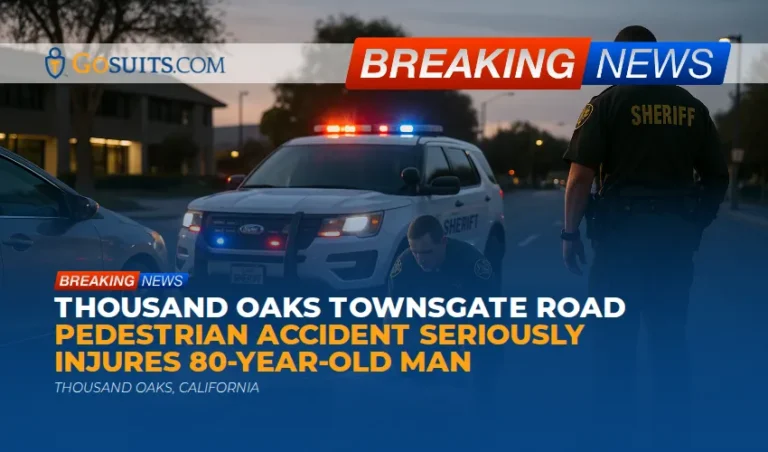
Authorities report that an 80-year-old male pedestrian was struck by a vehicle on the 2700 block of Townsgate Road in Thousand Oaks on March 6. Ventura County Sheriff’s deputies, who provide police services for Thousand Oaks, responded around 6:20 p.m. The pedestrian sustained major injuries and was transported to Los Robles Regional Medical Center, where he was expected to survive, according to Capt. Kevin Kipp of the Ventura County Sheriff’s Office. The involved driver was a man in his 50s. No additional official details had been released at the time of reporting.
In the early hours after a crash like this, families often face a blur of urgent questions about medical care, evidence, and how to get official records. The outline below walks through those essentials while respecting that the investigation is ongoing.
Where and when it happened, and local context
The collision occurred on Townsgate Road, a corridor near the 101 freeway and Westlake Boulevard that serves nearby office parks and shopping destinations on the Thousand Oaks and Westlake Village border. Around 6:20 p.m. in early March, traffic can be steady with commuters heading home and people arriving for dinner or errands. Side streets feed into the main artery, and lighting transitions during dusk can make it harder for drivers to see pedestrians if headlamps, street lighting, or reflective clothing are not present. While we do not yet know the precise lighting or traffic conditions for this incident, dusk generally increases visibility challenges for drivers and walkers alike.
Because businesses line much of Townsgate Road, nearby shops and restaurants sometimes have exterior cameras that may capture the moments before and after a collision. If you witnessed the event, even a small detail like braking sounds, horn use, or a vehicle description can help investigators fill in the timeline.
Immediate steps after a serious pedestrian injury in Thousand Oaks
Every situation is unique, but these practical steps can help protect health and preserve important information following a pedestrian crash in our community.
- Seek and continue medical care promptly. Even when someone is expected to survive, injuries in older adults can evolve over days. Follow through on imaging, specialist visits, and physical therapy as directed. The CDC notes that pedestrian crashes can cause head injuries and fractures that benefit from early and consistent care [1].
- Document what you remember. Write down the date, time, exact location on Townsgate Road, travel direction of the pedestrian and vehicle, weather, and anything said by witnesses or the driver. Memory fades fast.
- Preserve clothing and personal items. Do not wash or repair damaged items yet. They can illustrate impact points and forces. Store them in paper bags with labels.
- Identify possible cameras. Note businesses, residential doorbells, or traffic-adjacent cameras near the 2700 block that may have captured activity around 6:20 p.m. Ask owners to preserve footage.
- Get the police report number. Ask the responding agency for the incident or report number. This streamlines later requests for collision reports.
- Consider legal guidance before talking to insurers. What a person says to any insurance company, even their own, can be used to narrow or challenge a later claim. Consulting with seasoned car accident lawyers first can help avoid common pitfalls.
How fault is evaluated in California pedestrian collisions
California law requires drivers to yield the right of way to pedestrians in marked crosswalks and at most unmarked crosswalks at intersections, and to exercise due care to avoid colliding with any pedestrian [2]. At the same time, pedestrians must not suddenly leave a curb or other place of safety and walk or run into the path of a vehicle that is so close as to constitute an immediate hazard, and they must not unnecessarily stop or delay traffic within a crosswalk [2].
Establishing civil liability often turns on evidence of negligence. Under California Civil Code section 1714, everyone is responsible for injuries caused by their lack of ordinary care in the management of their person or property [3]. Investigators and, later, insurance adjusters or juries, look at factors such as vehicle speed, driver attentiveness, lighting conditions, whether a crosswalk or pedestrian signal was present, and whether each party acted reasonably for the circumstances.
California law also allows fault to be apportioned if more than one person’s conduct contributed to the harm. Even when a pedestrian is alleged to share some responsibility, recovery may still be available in proportion to the driver’s share of fault. The details matter, and they hinge on careful documentation and analysis of the scene, injuries, and witness accounts.
Evidence to preserve in and around Townsgate Road
Pedestrian cases can rise or fall on early evidence. The following items are frequently pivotal in Thousand Oaks collisions near commercial corridors.
- Surveillance and dashcam video. Businesses on Townsgate Road, rideshare vehicles, and personal dashcams may capture approach angles, speed cues, headlight use, and the point of impact. Request preservation within days, since many systems overwrite footage quickly. For a practical walkthrough on locating and requesting video, see Request CCTV footage after a California car accident.
- Scene photographs and measurements. Map the exact location relative to nearby driveways, crosswalks, or intersections. Document skid marks, debris fields, shoe scuffs, and any nearby obstructions.
- Lighting and visibility. Note which streetlights were operating and photograph shadows or glare patterns at a similar time of day. Low-light conditions can influence perception-reaction time [4].
- Vehicle inspection. Damage patterns, headlamp status, and event data recorder downloads can corroborate impact points and speed changes.
- Medical records and imaging. Orthopedic and neurological findings often help reconstruct the mechanics of a pedestrian impact. Collect hospital records, radiology reports, and discharge summaries.
Medical care, follow up, and accessing records
Los Robles Regional Medical Center is the primary receiving hospital for many Thousand Oaks traumas. After emergency stabilization, follow-up care may involve orthopedics, neurology, or rehab specialists depending on the injuries. Keep a simple care log that tracks symptoms, medications, missed activities, and follow-up appointments. This helps clinicians assess progress and can later help explain how injuries affected daily life.
Patients and designated representatives have a right to access their medical records under federal law. The U.S. Department of Health and Human Services explains how to request records and the timelines providers must follow under the HIPAA Right of Access rule [5]. When requesting, include the patient’s full name, date of birth, dates of service, the facility name, and where to send the records. Ask for billing records as well as clinical records, since both are often needed for insurance coordination.
Which agencies hold reports and how to request them
After a serious injury collision in Thousand Oaks, several agencies may hold records useful for understanding what happened and for insurance claims.
- Ventura County Sheriff’s Office collision report. Thousand Oaks contracts with the Sheriff’s Office for police services. The investigating deputies typically generate a traffic collision report that includes the parties, diagram, statements, and any initial findings. You can request the report once it is approved by providing the report number, date and time, and location.
- California DMV accident reporting. If a crash causes injury or death, or property damage of at least the statutory threshold, a driver must submit an SR-1 to the California DMV within 10 days, regardless of fault [6]. While a pedestrian is not a driver, if the pedestrian carries auto insurance with medical payments or uninsured motorist coverage, their insurer may still ask for basic documentation that aligns with DMV reporting rules.
- Statutory duty to report to law enforcement. California Vehicle Code section 20008 requires drivers involved in an injury or fatal crash to report it to the local police or the California Highway Patrol within 24 hours if no officer was present to take a report [7]. In this case, deputies responded, so that requirement would typically be satisfied through the on-scene investigation.
- Medical examiner or coroner. If an injury case later becomes a fatality, the county medical examiner may have records such as a coroner’s report or autopsy report. In Ventura County, the medical examiner operates at the county level. Families can request information as next of kin. This is not applicable unless a death occurs.
- Public records rights. The California Public Records Act gives the public rights to inspect or obtain copies of non-exempt public records. The California Attorney General provides an overview of these rights and how to request records [8]. Some traffic collision reports may have redactions or restrictions, especially while an investigation is open.
Insurance and financial considerations after a pedestrian crash
In California, most injury claims after a vehicle-pedestrian collision are resolved through insurance. The driver’s liability coverage is the usual starting point, but other coverages can be involved, such as a pedestrian’s own medical payments coverage, health insurance, or, in some cases, uninsured or underinsured motorist coverage if the driver’s policy limits are low. California’s minimum auto liability limits are set by state law, and drivers must maintain financial responsibility at all times [9].
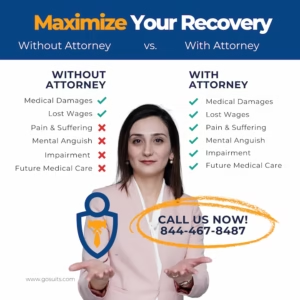
Insurance companies often reach out early for recorded statements or quick settlements. It can feel like the path of least resistance, especially when medical bills arrive fast. However, statements made before injuries are fully diagnosed can later be used to challenge causation or the need for treatment. Before engaging with any adjuster, it is generally wise to consult with Thousand Oaks car accident lawyers who can explain options, typical timelines, and how to avoid missteps that can reduce the value of a claim.
If you do speak to an insurer, keep conversations factual and brief, avoid speculation, and do not guess about speeds, distances, or prior conditions. Provide documents through secure channels and keep copies of everything you send.
Safety context: older adults, low light, and pedestrian risk
Pedestrian injuries remain a national concern. Federal safety agencies and California programs have documented the heightened vulnerability of people on foot, particularly older adults and during low-light periods.
- National risk trends. NHTSA’s pedestrian safety materials note that thousands of pedestrians are killed and many more are injured nationwide each year, with a significant share of fatal crashes occurring during hours of darkness [10].
- Older adults face unique fragility. The CDC reports that older adults tend to experience more severe outcomes from road injuries, including higher risk of fractures and head trauma, due to age-related changes in bone density and recovery capacity [1]. An impact that a younger person might weather with fewer complications can mean longer recovery for an 80-year-old.
- Visibility and design matter. The Federal Highway Administration’s Safe Transportation for Every Pedestrian initiative highlights measures that improve pedestrian safety in mixed-use corridors, including enhanced lighting, high-visibility crosswalks, and traffic calming strategies [4]. Corridors like Townsgate Road that interface with driveways and shopping centers benefit from attention to sightlines and driver yielding behavior.
- California’s statewide focus. The California Office of Traffic Safety supports education and enforcement campaigns to reduce pedestrian injuries, including community-level efforts that emphasize yielding to pedestrians, slowing down at night, and scanning for walkers in parking-lot exits and driveway mouths [11].
Civil timelines in California and why prompt action matters
Under California’s statute of limitations for personal injury, many claims must be filed within two years of the injury date [12]. Claims involving public entities can carry much shorter administrative deadlines. Furthermore, practical deadlines matter just as much as legal ones, since many forms of electronic evidence are routinely overwritten in days or weeks, and witness recollections fade quickly.
Acting promptly to request preservation of surveillance video, obtain the collision report, and coordinate medical care keeps options open. If a responsible party is a government entity, such as a city agency managing roadway maintenance or lighting, consult an attorney about government claim requirements well before the six-month administrative claims deadline that often applies to public entity matters.
What neighbors and the community can do to support recovery
Thousand Oaks residents are known for looking out for one another. If you live, work, or shop along Townsgate Road and witnessed anything that could help investigators, consider providing a statement and any videos or photos you may have. Even brief clips showing traffic flow, brake lights, or pedestrian movement a minute or two before the collision can be useful.
Community members can also support recovery in practical ways, like helping with transportation to medical appointments, checking mail and deliveries, and coordinating meals. For seniors, these simple acts can help them maintain independence while healing.
Why acting promptly matters: practical next steps
Here are concrete actions that help protect health, evidence, and rights. Timing is important given how quickly video and digital data can disappear.
- Request record preservation immediately. Ask nearby businesses on the 2700 block of Townsgate Road to save any exterior footage from 5:50 to 6:40 p.m. on March 6. Provide your contact information and follow up in writing. Many systems auto-delete within days.
- Organize medical documentation. Maintain a single folder with hospital discharge papers, imaging results, specialist referrals, and a running symptom diary. This reduces delays in care coordination and claim evaluation.
- Obtain the collision report when available. Contact the Ventura County Sheriff’s records unit with the report number, date, and location. Ask about processing timelines and acceptable proof of involvement.
- Hold off on detailed insurer statements. Before giving any recorded statement, consult an attorney. Early statements can be used to dispute future care or to minimize impacts on daily life. A brief notice of the incident is usually enough until you have guidance.
- Calendar deadlines. Note the two-year personal injury filing period under California law [12], and shorter government claim deadlines if a public entity might be involved. Set reminders months in advance.

Commentary from Gosuits Thousand Oaks, California Personal Injury Attorney
Our hearts go out to the pedestrian injured on Townsgate Road and to everyone who rushed to help. Incidents like this shake a neighborhood. The thoughts here are offered for general information and education during a difficult moment, not as guidance for any one person’s situation.
From what is publicly known, this was an early evening collision in a mixed-use corridor where pedestrian and vehicle paths frequently intersect. In our view, careful fact-gathering is essential in these settings. Lighting conditions, approach angles from driveways, and yielding behavior can all factor heavily into how responsibility is assessed. Evidence from nearby cameras and prompt, detailed medical documentation often makes the difference in understanding both what happened and how injuries have changed a person’s day-to-day life.
Insurance carriers and corporate defendants are trained to move fast after an injury. Adjusters may offer early settlements before diagnoses are complete, or they may request recorded statements that box people into incomplete descriptions of pain and limitations. They might downplay the significance of an older adult’s injuries by blaming preexisting conditions. Without context and advocacy, those tactics can chip away at fair consideration of the harm actually caused.
A free consultation is an important early step. It helps people understand how California law treats pedestrian right of way, what kinds of insurance might apply, and how to preserve critical evidence around Townsgate Road before it is lost. It also gives space to plan medical follow up and to set expectations for timelines and communications with insurers. Even one conversation can prevent avoidable missteps that later prove costly.
References
- Pedestrian Safety – Centers for Disease Control and Prevention
- California Vehicle Code § 21950, Right-of-Way at Crosswalks – California Legislative Information
- California Civil Code § 1714, Responsibility for Willful Acts or Negligence – California Legislative Information
- Safe Transportation for Every Pedestrian (STEP) – Federal Highway Administration
- Individuals’ Right under HIPAA to Access their Health Information – U.S. Department of Health and Human Services
- Accident Reporting Requirements in California – California DMV
- California Vehicle Code § 20008, Duty to Report Accidents – California Legislative Information
- California Public Records Act: Consumer Information – California Attorney General
- Insurance and Financial Responsibility – California DMV
- Pedestrian Safety Overview – National Highway Traffic Safety Administration
- Research and Statistics – California Office of Traffic Safety
- California Code of Civil Procedure § 335.1, Personal Injury Statute of Limitations – California Legislative Information