- What we know about the West Third Street crash in Santa Rosa
- Key questions families ask after a serious injury crash involving children
- Potential civil liability and insurance paths
- Immediate practical steps to protect health, rights, and evidence
- Where to get official records and help in Sonoma County
- Child passenger safety and replacing car seats after a crash
- Merging and passing rules relevant to this collision
- How minors’ injury claims are handled in California
- Timelines that can affect a civil claim
- Insurance company tactics to expect
- Local context near West Third Street and Arboleda Drive
- Commentary from Gosuits Santa Rosa, California Personal Injury Attorney
- Act now: steps that should happen soon
What we know about the West Third Street crash in Santa Rosa
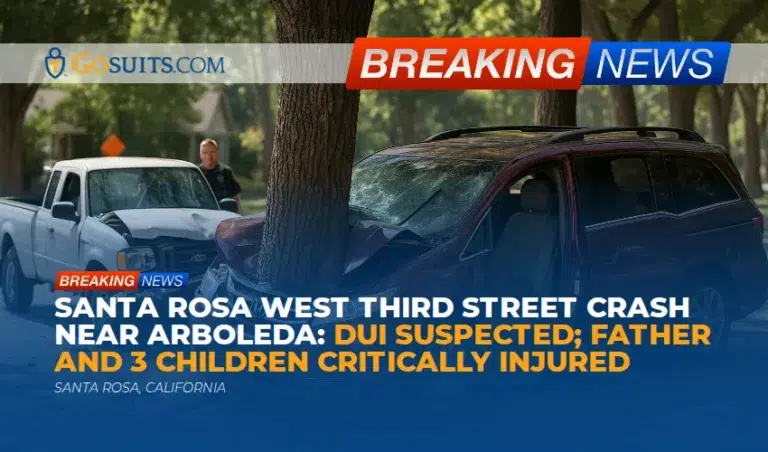
On a June afternoon at about 2:37 p.m., multiple 911 calls reported a collision near West Third Street and Arboleda Drive in Santa Rosa involving a red Honda Odyssey minivan and a white Ford Ranger pickup operated by a City of Santa Rosa employee. According to information shared by local police, the minivan attempted to pass the city truck on the left while lanes merged into one. The minivan reportedly struck the truck and then hit two trees in the median.
The driver of the minivan, a Santa Rosa father, had his three sons on board, ages 5, 11, and 12. All four in the minivan sustained major injuries and were transported to a trauma center in critical condition. The city employee driving the Ford Ranger was not reported injured. Following an investigation and toxicology testing, police stated that test results confirmed the presence of drugs in the driver’s system at the time of the crash. The driver was later arrested on suspicion of driving under the influence causing injury and felony child endangerment with injury.
Because minors were seriously hurt, the civil side of this incident now involves complex questions about medical bills, insurance coverage, liability, and the rights of children who were passengers. The information below focuses on those civil issues, practical next steps, and where local families can turn for official records and support.
Key questions families ask after a serious injury crash involving children
Serious roadway injuries shake families to the core. In Santa Rosa, traffic on West Third can be brisk in the afternoon, especially as workdays wrap and school and camp pickups are underway. When children are hurt, the questions families ask tend to be immediate and deeply practical.
Who pays for the children’s medical care?
Medical bills may initially be processed through health insurance. If there is auto insurance medical payments coverage on the involved vehicles, that can sometimes help with initial expenses. Ultimately, liability insurance from the driver who is found responsible may be a primary source for compensation in a civil claim. For minor passengers, claims are brought on their behalf by a parent or court-appointed guardian ad litem.
Can children bring claims even if the at-fault driver is a parent or family member?
In California, injured minors generally can pursue civil claims even if a family member was driving. Left to the insurance policies, not the child’s good will, is how bills and losses are handled. This is a difficult family topic, but the claim typically proceeds against insurance, not personal assets in most routine cases.
What if a city vehicle was involved?
If evidence suggests a city employee or city vehicle contributed to the crash, special government claim rules and short deadlines may apply. California law generally requires written notice of a claim to the public entity within six months of the incident. See California Government Code section 911.2. There can be limited exceptions, but they are narrow and time-bound.
Does a DUI allegation change the civil claim?
Driving under the influence is prohibited under California law and, when linked to causing injury, can weigh heavily in a civil negligence analysis. California Vehicle Code provisions governing impaired driving include Vehicle Code section 23152 and, for injury, Vehicle Code section 23153. A violation of a safety statute may support a theory often referred to as negligence per se in civil court.
Potential civil liability and insurance paths
Every crash deserves a careful, evidence-driven review. On West Third Street, lanes merging to one can create momentary confusion or impatience. But the legal standard remains: drivers must use reasonable care and follow the rules of the road. Here are potential civil issues that often arise in a case like this:

Negligence, negligence per se, and impaired driving
Evidence that a driver was impaired at the time of a collision can support a finding of negligence. If a driver violated a statute designed for public safety, such as California’s DUI laws, and that violation caused the injury, the doctrine known as negligence per se may apply. This reduces the burden of proving that the conduct fell below a reasonable standard, though causation and damages still must be shown.
Comparative fault and merging maneuvers
California applies pure comparative negligence. If more than one person contributed to a crash, fault can be apportioned by percentages. When a lane is ending, the passing and merging driver must ensure the movement can be made safely. The driver continuing in the through lane generally has the right-of-way. However, investigators still examine speed, signaling, positioning, and any sudden maneuvers by both vehicles.
Claims involving public entities
If evidence indicated the city truck contributed to the collision, a claim against the City would likely require a timely government claim submission. The six-month deadline in Gov. Code 911.2 is strict. If the six months have passed, a written application for late claim relief may sometimes be made within one year of the incident under Gov. Code 911.4, but the standards are narrow.
Insurance coverages to consider
- Liability insurance: Pays for injuries and losses caused by a driver found at fault, up to policy limits. For children injured as passengers, the responsible driver’s liability coverage is central.
- Medical payments coverage: Some auto policies include “med-pay,” which can cover reasonable medical expenses for occupants regardless of fault, up to the med-pay limit.
- Uninsured/underinsured motorist (UM/UIM): If another at-fault driver was involved and had insufficient insurance, UM/UIM on a household policy may help.
- Health insurance coordination: Health plans often pay first and later seek reimbursement (subrogation) from a liability recovery.
Before speaking to any insurance adjuster, it’s prudent to get a free consultation from a seasoned injury attorney. Statements to insurers can be recorded and used later; clarity and strategy at the outset matter.
Immediate practical steps to protect health, rights, and evidence
Families in Santa Rosa already navigating doctor visits, school reentry, and transportation challenges after a crash don’t need a lecture. But a few concrete steps can make a big difference in the long run.
- Prioritize follow-up care: Keep all specialist referrals, therapies, and imaging appointments. Pediatric injuries can evolve as children grow.
- Preserve the child safety seats: Don’t discard damaged or even seemingly intact car seats from a serious crash. They may be evidence and, in many cases, should be replaced. More on replacement appears below.
- Photograph injuries and the vehicle: Document bruising, abrasions, splints, casts, and the vehicle’s interior and exterior. Photos taken soon after the crash help demonstrate forces involved.
- Collect critical records: Save discharge summaries, imaging reports, bills, and explanation of benefits. Keep a simple timeline of symptoms, missed school, and changes in activities.
- Avoid early recorded statements: If insurers call quickly, thank them and schedule a call later. Contact an attorney first. Anything said may be used to minimize the claim later.
- Consider a preservation letter: Request that involved entities preserve relevant evidence such as dash or traffic camera footage, vehicle data, and 911 recordings.
Where to get official records and help in Sonoma County
Accessing the right records and community resources can support both recovery and any potential claim. The items below focus on government sources families commonly use.
Police traffic collision report
For a collision within Santa Rosa city limits, the investigating agency is typically the Santa Rosa Police Department. Families can request a copy of the traffic collision report through the department’s Records Bureau once it is available. While each agency has its own process, California law provides a framework for access to public records. See the California Public Records Act guidance from the state Attorney General’s office at oag.ca.gov/consumers/general/pra.
Paramedic and EMS records
Pre-hospital care records can be important for understanding injury timing and severity. Sonoma County’s Emergency Medical Services Agency regulates EMS providers countywide. See the county EMS information at the Department of Health Services portal: sonomacounty.ca.gov/health-and-human-services/health-services/divisions/ems.
Medical records
Hospital and clinic records can be requested directly from providers’ Health Information Management departments. California law permits parents and legal guardians to access minors’ records in most circumstances.
Coroner and death certificates, if a fatality occurs
This crash was reported as causing serious injuries. If a family faces a fatality in a traffic collision in Sonoma County, the state’s vital records office provides death certificates, and the coroner may have investigative materials. For certified death certificates statewide, visit the California Department of Public Health Vital Records at cdph.ca.gov/Programs/CHSI/Pages/Vital-Records.aspx.
Victim assistance resources
California’s Victim Compensation Board may help eligible victims with certain out-of-pocket expenses related to violent crimes, including DUI. Learn more at victims.ca.gov.
Child passenger safety and replacing car seats after a crash
Injury prevention doesn’t end at the crash scene. Proper restraint use and seat replacement guidance can reduce secondary harm.
- Replace car seats after a moderate or severe crash: The National Highway Traffic Safety Administration advises replacing child restraint systems after moderate or severe crashes. See guidance from NHTSA at nhtsa.gov/car-seats-and-booster-seats/replacing-car-seats-after-crash.
- Evaluate seat fit by age and size: For updated recommendations on booster use and belt fit by age, the Centers for Disease Control and Prevention provides clear guidance at cdc.gov/transportationsafety/child_passenger_safety.
- Seek a free seat inspection: The California Highway Patrol offers child passenger safety services. Visit the CHP child passenger safety page at chp.ca.gov/programs-services/programs/child-safety-seats to locate assistance.
Even if a seat looks fine after a serious impact, internal components may be compromised. Save the seats for documentation before replacing them.
Merging and passing rules relevant to this collision
West Third Street’s transitions can create quick decisions about merging and passing. California’s general rules emphasize patience and space. The California Driver Handbook reminds drivers to maintain appropriate following distances, signal well in advance, and merge only when it’s safe to do so. For statewide guidance on safe merging and lane changes, see the California DMV’s driver resources at dmv.ca.gov/portal/driver-handbooks.
As a practical matter, the driver in the through lane typically holds the right-of-way as lanes drop. A passing maneuver during an active merge requires extra caution. At a median with trees, sightlines can narrow, and small steering inputs can magnify when speeds are higher. Those dynamics are often reflected in the physical evidence in a traffic collision report and diagram.
How minors’ injury claims are handled in California
Because three children were hurt, it helps to understand the added protections California law builds into minors’ claims.
- Guardian ad litem: A responsible adult, often a parent, is appointed to act on a minor’s behalf in a civil case.
- Court approval of settlements: Settlements for minors typically must be approved by a court to ensure funds are fair and protected. The California Courts provide information about compromises of minors’ claims at selfhelp.courts.ca.gov/petition-approve-compromise-childs-claim.
- Structured protections: Approved settlements may be placed into blocked accounts or structured annuities to safeguard the child’s funds.
These safeguards can feel procedural, but they aim to protect children from pressure and ensure medical and future needs are considered.
Timelines that can affect a civil claim
Time limits can be confusing, especially when healing and school schedules are front of mind. Here are general timing rules that often matter in California injury cases. Specific facts can change how these apply.
- Government claim deadlines: Claims against a public entity generally require written notice within six months of the injury. See Gov. Code 911.2. Requests for late claim relief may be possible within one year in limited circumstances under Gov. Code 911.4.
- Impaired driving and negligence statutes: DUI-related injury cases still proceed under civil statutes of limitations. California generally allows two years for personal injury claims, though minors often have extended timelines. However, government claim rules can still apply if a public entity is involved.
- Evidence retention: Traffic camera footage, vehicle electronic data, and 911 recordings may be overwritten within weeks. Early preservation requests matter.
Insurance company tactics to expect
Adjusters are trained to resolve claims efficiently, which can conflict with what a family actually needs. Here are common tactics after a serious crash involving kids.
- Early recorded statements: An adjuster may call within days. Statements can be used later to challenge symptom timelines or minimize injuries. It’s wiser to consult an attorney first before speaking.
- Quick, low offers: A fast payment can be tempting during a medical crisis. Early offers often don’t reflect future therapy, growth-related complications, or educational impacts.
- Broad medical authorizations: Insurers may ask for blanket access to years of records. That can open unrelated histories to scrutiny. Narrow, tailored releases protect privacy.
- Disputing mechanism of injury: Insurers sometimes blame preexisting conditions or argue that child injuries are minor. Thorough pediatric follow-up and specialist opinions can be crucial.
If a claim will be made, contact an attorney first. What’s shared with any insurer can be used later, and once recorded, it’s hard to undo.
Local context near West Third Street and Arboleda Drive
Neighbors know that West Third Street, west of downtown Santa Rosa, handles a lot of afternoon activity. Nearby residential pockets, parks, and feeder streets make for busy merges as lanes compress. Trees in the median enhance the corridor but can also add unforgiving fixed objects close to the roadway. When a vehicle loses control during a merge, striking both another vehicle and median trees is sadly consistent with the kinds of secondary impacts we see on that stretch.
Summer afternoons, like the day this crash occurred, bring brighter light angles and heat shimmer off the pavement. Those factors can complicate judging speed and distance during a pass or merge. That’s part of why patience in a lane drop is so often the safest choice.
Commentary from Gosuits Santa Rosa, California Personal Injury Attorney
Our hearts go out to the three children who were seriously injured and to the families walking through the long road of recovery. This discussion is intended for education and general information. Every case turns on specific facts and law.
Based on the details reported, investigators concluded the minivan attempted to pass a city pickup as two lanes merged, with subsequent impacts to the truck and median trees. Police later reported toxicology results indicating drugs in the driver’s system. From a civil perspective, an impaired passing maneuver during a lane drop raises significant safety concerns. California’s impaired driving statutes and rules of the road regarding safe merging and passing exist to prevent exactly this kind of harm, especially to child passengers who have no control over the situation.
In the aftermath of a high-profile crash, insurance carriers and, when involved, government risk management programs move quickly. They know most people don’t deal with these systems often. Carriers may seek early statements, broad medical releases, and quick settlements that don’t account for ongoing pediatric care, therapies, or the ways serious injuries can affect school and development. Public entities have short claim deadlines that can catch families off guard.
A free consultation is an important step to understand rights, timelines, and the evidence needed before talking to any insurer. The goal isn’t to be combative; it’s to be informed. Knowing how liability, insurance coverages, government claim rules, and minors’ settlement approvals work helps families make sound decisions during a difficult season.
Act now: steps that should happen soon
- Secure the paper trail: Request hospital and clinic records, EMS run sheets, and imaging reports. These documents anchor the injury timeline and reduce disputes later.
- Preserve all physical evidence: Keep the child safety seats, damaged vehicle parts, and any clothing or equipment involved. Do not repair or discard potential evidence until claims are evaluated.
- Mark your calendar for deadlines: If a public entity might be implicated, the six-month claim window runs fast. Put a reminder in the calendar now to avoid missing it.
- Pause before speaking to insurers: Schedule time to understand options before giving recorded statements or signing medical releases. What’s said now can shape the entire claim later.
- Document the child’s recovery: Maintain a simple journal of pain levels, sleep, missed school, therapy sessions, and activity limits. Small daily notes become powerful evidence of impact over time.
- Replace car seats appropriately: Follow federal guidance on replacement after moderate or severe crashes and keep receipts. The guidance at NHTSA can help you determine replacement needs.
- Explore supportive resources: Consider state resources such as the California Victim Compensation Board for eligible expenses related to DUI incidents.
Why timing matters
Evidence disappears, memories fade, and deadlines approach. Early organization of records, careful communication with insurers, and timely consideration of government claim requirements can preserve options and reduce stress. Acting now doesn’t mean filing a lawsuit; it means being prepared, informed, and steady during a critical window.
Where this matters
On corridors like West Third Street in Santa Rosa, collisions during merge zones create complex questions about speed, positioning, and sightlines. Quick steps to capture photos, collect records, and evaluate the roadway context can make the factual picture clearer, which helps any resolution process later.
How this helps
Clarity reduces uncertainty. With the right records, preserved evidence, and an understanding of deadlines and insurer strategies, families can better navigate medical care and any civil claim process with less guesswork and more confidence.
Sources and further reading
- California Vehicle Code § 23152 and § 23153 on impaired driving and injury.
- Government Code § 911.2 and § 911.4 on claims against public entities.
- California DMV Driver Handbooks for safe merging and lane change guidance.
- NHTSA: Replacing Car Seats After a Crash.
- CDC: Child Passenger Safety.
- California Highway Patrol: Child Passenger Safety.
- California Attorney General: Public Records Act Overview.
- California Courts: Approving a Child’s Settlement.
- California Victim Compensation Board.
- California Department of Public Health: Vital Records.
- Sonoma County EMS Agency.