- What this Capitol announcement means for Sacramento and California families
- Quick overview of the proposed DUI and dangerous driving bills
- Why now: what the data shows about impaired driving in California
- Civil law after a DUI crash: negligence, punitive damages, and who can be held responsible
- If there is a fatality: where to get police, coroner, and vital records in California
- How insurers tend to respond after suspected DUI crashes
- Evidence that matters in DUI-involved crashes and how to protect it
- How the proposals could change day-to-day driving and enforcement
- Community safety notes for Sacramento corridors and weekends
- Before speaking with any insurer
- Why timing matters and what action to take
- References
- Commentary from Gosuits Sacramento, California Personal Injury Attorney
What this Capitol announcement means for Sacramento and California families
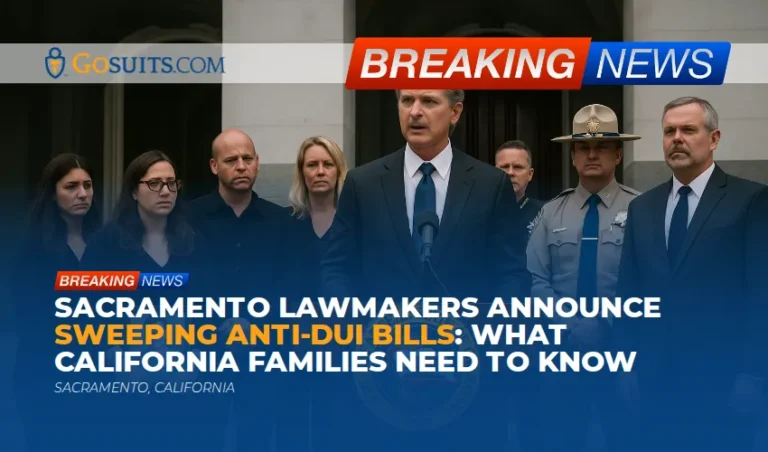
At the Capitol Annex Swing Space in downtown Sacramento, lawmakers stood alongside grieving families and law enforcement leaders to unveil what they describe as California’s most sweeping anti-DUI and dangerous driving package in decades. The push follows years of rising roadway deaths and highly publicized tragedies on corridors familiar to Sacramento drivers, from Interstate 5 and Highway 99 to the I-80 stretch linking Davis, West Sacramento, and the Sierra foothills. While the proposals target criminal penalties, license rules, and enforcement training, the civil side of a crash does not wait. Families and injured people still face immediate questions about medical care, records, insurance, and potential civil claims, regardless of what the Legislature ultimately enacts.
This guide explains what was proposed, what present law already allows families to do after a DUI crash, and where to obtain key records in California. It also highlights how insurers normally behave in suspected DUI claims and why early, informed steps can make a difference.
Quick overview of the proposed DUI and dangerous driving bills
Based on the details shared publicly, the package seeks to strengthen how California addresses drivers who drink or use drugs and cause harm. Lawmakers discussed several major ideas:
- Reclassifying vehicular manslaughter with gross negligence as a “violent” felony. This would alter sentencing rules on the criminal side. The civil rights of victims to bring wrongful death or injury claims already exist under current law.
- Raising DMV license points for fatal crashes and ensuring license suspensions begin after incarceration. These changes aim to keep the most dangerous drivers off the road longer by adjusting how and when suspensions run. See DMV’s current point system for context [3].
- Allowing some DUIs to be charged as felonies earlier in the repeat cycle. Today, felony charging can occur in limited circumstances, including injury DUIs or after multiple priors. The proposals would make felony options available sooner on repeat offenses.
- Mandating ignition interlock devices for all DUI offenders. California already requires IIDs in certain cases; the proposal would expand that to all DUI offenders statewide [4].
- Expanding DUI training standards for officers. Training consistency is intended to improve roadside investigations, documentation, and eventual case outcomes.
These measures have to move through the legislative process. In the meantime, current civil rules for injured people and families continue to apply in Sacramento County and across the state. For additional context on recent statewide traffic law changes, see our resource on california laws chp dmv 2026.
Why now: what the data shows about impaired driving in California
Nationally, alcohol-impaired driving remains a leading cause of traffic fatalities. Federal data show thousands of lives lost in alcohol-impaired crashes each year, underscoring the persistent risk on American roads [1]. Within California, state traffic safety officials have documented troubling trends in DUI-involved crashes and fatalities, particularly in the post-pandemic period, with impairment and speed consistently cited as severe crash factors [2].
Local residents in the Sacramento region know these risks too well. Late weekend nights when Old Sacramento bars let out, game nights around Golden 1 Center, and holiday travel on I-80 toward Tahoe or I-5 to the Delta can all coincide with increased DUI enforcement. CHP and local agencies often surge patrols during these periods, yet impaired driving continues to cause catastrophic harm. The push at the Capitol reflects public frustration with repeat offenders and a desire to align California with stricter practices used by other states.

Civil law after a DUI crash: negligence, punitive damages, and who can be held responsible
Even as lawmakers debate criminal consequences, civil claims continue on a separate track. A criminal case addresses punishment and public safety. A civil case focuses on compensating those harmed by negligent or wrongful conduct. If a driver was impaired, several California legal principles may come into play:
- Negligence and negligence per se. A driver who violates a safety statute or regulation can face a presumption of negligence under Evidence Code 669 if the violation proximately caused injury and the person harmed was in the class the law was designed to protect [6]. DUI statutes, speed limits, and rules of the road help define those duties.
- Punitive damages in egregious cases. California Civil Code 3294 allows punitive damages where a plaintiff proves by clear and convincing evidence that the defendant acted with oppression, fraud, or malice. Courts have recognized that highly reckless impaired driving can satisfy this standard in the right facts, though every case is different and outcomes vary [5].
- Dram shop and social host rules are limited. California Civil Code 1714 generally shields businesses and social hosts from civil liability for selling or furnishing alcohol to someone who later causes harm, with narrow exceptions such as furnishing alcohol to an obviously intoxicated minor. This often means the impaired driver is the primary civil defendant, not the seller or host, but specific facts matter [7].
Families sometimes ask where to even begin. It often starts with medical treatment and documentation, identifying all insurance coverages, and preserving crucial evidence. Many people choose to work with car accident lawyers to coordinate investigation, evidence holds, and communications while they focus on healing.
If there is a fatality: where to get police, coroner, and vital records in California
In a fatal crash, several agencies may hold records needed for insurance claims and potential civil actions. Sacramento families, and families anywhere in the state, can typically obtain the following:
- Police or CHP collision reports. If CHP investigated, collision reports are requested through CHP using the CHP 190 process. You will need the date, location, and parties involved, and you must be an eligible party like next of kin or an involved insurer [10]. If a city police department investigated, that agency usually maintains its own records unit.
- Coroner or medical examiner records. County coroners maintain autopsy reports, cause of death findings, and next-of-kin communications. In Sacramento County, the Coroner’s Office publishes contact information and procedures for records requests [12]. Other counties maintain similar pages on their official .gov sites.
- Death certificates. Certified copies are available through the California Department of Public Health or county vital records offices. Insurers and probate proceedings usually require certified copies [11].
- Victim support services. The California Victim Compensation Board provides resources for eligible expenses and guidance for violent crime victims and certain qualifying incidents. Eligibility and benefits are defined by statute and program rules [8].
- Public records requests. Some investigative materials can be requested under the California Public Records Act. Exemptions often apply to protect ongoing investigations and privacy, but families can use CPRA to ask for releasable records and status updates [13].
Practical tip for the Sacramento area: if the collision occurred on a state highway such as I-5, I-80, or Highway 99, CHP likely handled the scene. If it happened on a city arterial like Florin Road, Broadway, or in Midtown near 16th Street, the Sacramento Police Department may be the custodian. Confirm the investigating agency before submitting requests, and keep copies of everything you send.
How insurers tend to respond after suspected DUI crashes
Insurance adjusters have a job to limit payouts. In suspected DUI cases, an at-fault driver’s insurer may quickly try to separate injury claims from property damage, push recorded statements, or float early offers before the full medical picture is known. California’s Fair Claims regulations require insurers to investigate promptly and communicate in specific time frames, but they do not require an insurer to explain all legal implications to a claimant [14].
Recorded statements can be used against a claimant later. Medical records collected early can be taken out of context if additional diagnoses appear in the weeks ahead. Before contacting any insurer, it is wise to understand your rights, available coverages, and how timelines like the statute of limitations apply. In California, most personal injury and wrongful death lawsuits must be filed within two years, subject to exceptions, tolling, and special shorter rules for claims involving public entities [8] [9].
Evidence that matters in DUI-involved crashes and how to protect it
If impairment is suspected, the civil investigation often follows several parallel tracks with the goal of proving negligence and damages:
- Scene and vehicle documentation. Photos, measurements, and downloads from event data recorders can corroborate speed and braking. When a public agency holds a car, a timely preservation request can help ensure key evidence is not lost.
- Body camera and dash camera footage. Many agencies use cameras that can capture field sobriety testing, statements, and other context. Release rules vary; some footage may not be available until the criminal case concludes. CPRA requests can be used where permissible [13].
- Toxicology and lab data. In fatality cases, coroner files may include toxicology results relevant to cause of death and timing. Access depends on next-of-kin status and case posture [12].
- Medical records and billing. Consistent treatment documentation supports causation and damages. In Sacramento, UC Davis Medical Center serves as a Level I trauma center for the region and can generate complex records after serious injuries [15].
- Prior driving record and license status. DMV records about suspensions or points can be relevant in discovery. California’s point system and IID programs outline what the state requires in repeat cases [3] [4].
Evidence laws and privacy protections limit what can be obtained and when. When in doubt, ask the investigating agency which records are releasable and which must await case closure.
How the proposals could change day-to-day driving and enforcement
If enacted, several proposals would affect drivers throughout the Sacramento Valley:
- Ignition interlocks for a wider range of offenders. An IID requirement for all DUI offenders would mean more cars disabled unless a sober breath sample is provided, potentially reducing repeat offenses on local roads [4].
- More meaningful license consequences. Increased points for fatal crashes and later-starting suspensions tied to release dates could keep high-risk drivers off city streets like Stockton Boulevard and J Street longer [3].
- Enhanced officer training. Consistent DUI training could bolster the quality of investigations and reports that civil cases later rely on, including better roadside documentation in neighborhoods from Oak Park to Natomas.
For the public, these changes would not alter the fundamental civil right to pursue compensation when harmed by negligent driving. They would, however, influence who is legally allowed to drive, how repeat offenders are monitored, and perhaps, over time, the frequency of serious crashes on familiar corridors.
Community safety notes for Sacramento corridors and weekends
We often hear from neighbors who worry about late-night speeds on I-5 near Pocket-Greenhaven, weaving traffic on Business 80, or weekend cut-throughs in East Sacramento. A few reminders that reflect local patterns:
- Plan rides in advance. If a night out takes you to Midtown, R Street Corridor, or Old Sacramento, arrange a ride before the first drink to avoid a last-minute decision to drive.
- Expect saturation patrols and checkpoints during holidays and big events. Enforcement often rises during Kings home games, holiday weekends, and graduation season.
- Report dangerous driving when safe to do so. If you can safely note a plate and location, report impaired or reckless driving to authorities. On highways, CHP can be reached from a mobile phone by dialing 911 and stating your location.
Before speaking with any insurer
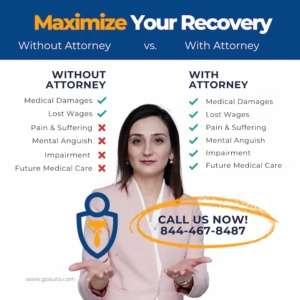
If a crash happens, insurance adjusters may contact people quickly. Statements given early can be misinterpreted later. Medical complaints can evolve over days or weeks, especially after high-speed impacts. It is prudent to consult an attorney before speaking with any insurer, particularly in suspected DUI cases, to understand what to share, what to request, and how to avoid common pitfalls. Statements to insurers can be used against claimants later, and once recorded, they are hard to undo.
In serious injury and wrongful death matters, many people choose to involve experienced advocates who routinely handle negotiations, evidence preservation, and communications. That allows families to focus on treatment, funeral planning, and day-to-day needs without taking on insurer pressure alone. The reality is that car accident lawyers help level a playing field that otherwise favors repeat corporate actors who manage claims daily.
Why timing matters and what action to take
There are practical reasons to act promptly after a serious crash:
- Evidence degrades fast. Vehicles are repaired or scrapped, skid marks fade, and businesses overwrite camera footage. Early preservation requests can prevent loss of crucial proof.
- Medical care needs direction. Following through with referrals, imaging, and therapy builds a clear record that ties injuries to the crash, which is essential for claims.
- Legal deadlines are strict. California’s general two-year deadline for personal injury and wrongful death can be shorter for claims involving public entities, which often require a claim within six months before any lawsuit [8] [9]. Missing a deadline can forfeit rights.
- Insurance communications set the tone. Early missteps, including recorded statements or broad medical authorizations, can narrow options later. A measured plan helps keep control of your claim.
What should be done first depends on the circumstances, but a typical order includes seeking appropriate medical care, identifying the investigating agency for the police report, preserving vehicles and electronic data, and learning the insurance coverages at play, including your own uninsured or underinsured motorist benefits. Many in the region turn to Sacramento car accident lawyers for help coordinating these steps while they recover.

References
- Alcohol-Impaired Driving: 2022 Data – NHTSA
- Crash Data and Statistics – California Office of Traffic Safety
- Negligent Operator Treatment System and Points – California DMV
- Ignition Interlock Device Program – California DMV
- Civil Code 3294 Punitive Damages – California Legislature
- Evidence Code 669 Negligence Per Se – California Legislature
- Civil Code 1714 Liability for Furnishing Alcoholic Beverages – California Legislature
- Code of Civil Procedure 335.1 Two-Year Limitation – California Legislature
- Government Code 911.2 Claim Presentation Deadline – California Legislature
- Collision Reports and CHP 190 – California Highway Patrol
- Vital Records: Birth, Death, Marriage – California Department of Public Health
- Coroner’s Office – Sacramento County
- California Public Records Act – Office of the Attorney General
- Fair Claims Settlement Practices Regulations – California Department of Insurance
- UC Davis Health Level I Trauma Center – UC Davis
Commentary from Gosuits Sacramento, California Personal Injury Attorney
Our hearts are with every family who stood at the Capitol and everyone in our community who has lost a loved one to an impaired driver. This overview is meant for general information so people understand the civil landscape and where to find key records.
From a civil perspective, the proposals announced in Sacramento reflect what we see after serious crashes on I-5, Highway 99, and city streets. Repeat dangerous driving leaves a long trail of harm, and families often find that the criminal process does not address their medical needs, funeral costs, or long-term losses. Civil claims remain the tool for accountability on those issues, regardless of criminal outcomes.
Insurance companies and large corporate defendants know how to use delays and information gaps to their advantage. Adjusters may request recorded statements right away, push quick settlements before injuries are fully understood, or ask for broad medical authorizations that sweep in unrelated history. They do this because it reduces what they pay. People who know their rights, gather the right records early, and get clear guidance tend to avoid those traps.
It is important to speak with a seasoned advocate for a free consultation before giving any statement to an insurer. What someone says early can be used against them later, and there are strict timelines that can silently run in the background. A brief conversation can help clarify immediate steps, from evidence preservation and medical documentation to identifying all available coverages.