- What we know about the East Los Angeles pedestrian fatality
- Local context around E. Olympic Boulevard and S. Arizona Street
- How investigations typically proceed in fatal pedestrian crashes
- Steps families can take in the first days
- Safety and legal implications for pedestrians and drivers in California
- Potential civil liability pathways after a fatal pedestrian crash
- Insurance issues families often face
- Where to get official information and support in Los Angeles County
- A practical timeline for the next few weeks
- What witnesses, nearby businesses, and community members can do
- Why acting promptly matters in East Los Angeles fatal crash cases
- References
- Commentary from Gosuits East Los Angeles, California Personal Injury Attorney
What we know about the East Los Angeles pedestrian fatality
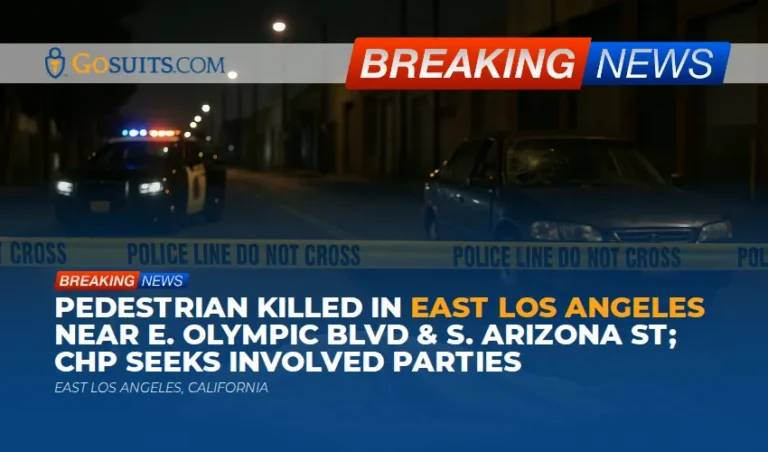
Late Monday night, around 11 p.m., a person was struck and killed while crossing the street near E. Olympic Boulevard and S. Arizona Street in East Los Angeles. According to the California Highway Patrol, officers were called about an individual lying in the roadway and the person was pronounced dead at the scene. The victim has not been publicly identified as of this writing. Video from the scene reportedly showed a nearby vehicle with significant damage, and CHP has stated it is looking for those involved in the crash. Details about the events leading up to the impact have not been released.
Information remains preliminary. In situations like this, investigators typically focus on locating involved drivers, reconstructing the crash sequence, and identifying potential witnesses or camera footage that captured the moments before and after impact. Families and neighbors in East L.A. understandably want clarity as soon as possible. That clarity will take careful evidence work.
Local context around E. Olympic Boulevard and S. Arizona Street
Anyone who drives or walks the East L.A. industrial corridors knows Olympic Boulevard can carry steady traffic even late in the evening. The intersection with South Arizona Street sits close to the Commerce border and not far from the 710 corridor and freight rail lines. Large trucks, shift changes, and night operations at nearby warehouses often mean activity later than in strictly residential areas. Lighting, sightlines, and vehicle speed all matter at this hour, especially when pedestrians are crossing.
East Los Angeles residents often cross to get to bus stops or to move between work and home in neighborhoods around Belvedere Park, the East L.A. Civic Center, and the Atlantic and Maravilla Metro stations. After sunset, drivers and pedestrians have overlapping responsibilities under California law to exercise due care. We address those duties below in the safety and legal section, but it is important to ground any discussion in the realities of this corridor at night.
How investigations typically proceed in fatal pedestrian crashes
CHP and, in Los Angeles County’s unincorporated areas, other responding agencies coordinate several evidence-gathering steps after a fatal collision:
- Scene preservation and measurements. Investigators document final rest positions, skid or yaw marks if present, debris fields, and lighting or visibility conditions. They note posted speed limits, lane widths, and any traffic control devices operating at the time.
- Vehicle inspections. If an involved vehicle is recovered, officers examine windshield damage, bumper height, hood dents, and undercarriage marks looking for consistency with a pedestrian impact. Event data recorders, when available, can provide vehicle speed and brake inputs close in time to the collision.
- Witness canvassing. Crews survey nearby businesses and residences for eyewitnesses and camera systems pointed toward Olympic Boulevard or Arizona Street. Footage from security cameras, buses, or traffic signal systems can be crucial if a driver left the scene.
- Medical examiner findings. The Los Angeles County Medical Examiner-Coroner conducts a cause and manner of death determination, which can include injury pattern analysis that sometimes helps confirm impact direction or height relative to a vehicle.
Because many late-night corridors have multiple private cameras, time is a factor. Video systems often overwrite within days. Families or their representatives sometimes send preservation requests to protect relevant footage. Separately, published federal and statewide data provide context for risks on foot after dark, when visibility drops and higher travel speeds increase the chance of a severe outcome. State and national agencies have repeatedly found that pedestrian fatalities are more common during nighttime hours than daytime, underscoring why investigators focus on both driver behavior and visibility factors [11] [12].
Steps families can take in the first days
Secure official reports
Official records provide the foundation for understanding what happened and evaluating next steps. Here are the key documents and where they typically come from:
- CHP collision report. The collision report includes diagramming, preliminary fault assessments, and contact information for involved parties and witnesses. The California Highway Patrol explains how to request a report, including what information you will need to provide, on its official site [1].
- Autopsy report and death certificate. In Los Angeles County, the Medical Examiner-Coroner handles postmortem examinations and issues reports that document injuries and cause of death. Request procedures and timelines are published by the office [2]. Certified copies of the death certificate are available through the Los Angeles County Registrar-Recorder/County Clerk [3].
- Victim support services. The California Victim Compensation Board may help with certain funeral and burial expenses and related support for qualifying victims’ families, depending on case specifics. Program details are publicly available through the agency [4]. The Los Angeles County District Attorney’s Bureau of Victim Services also supports families impacted by crime, including coordination with investigators and information on the justice process [15].
Preserve evidence early
- Identify nearby cameras. Businesses fronting E. Olympic Boulevard, industrial yards on Arizona Street, and transit-adjacent corridors often have exterior cameras. Footage can be overwritten within days. A timely, written preservation request can make a difference.
- Collect scene photographs and notes. Even after the roadway reopens, photos of lighting, crosswalk visibility, signage, and any remaining debris can help a reconstruction expert. Note times, weather, and traffic flow patterns.
- Avoid recorded statements to insurers before consulting counsel. Statements given in the first 48 to 72 hours can be used later. Consider speaking with a lawyer first to understand your rights and obligations.
Many families find it helpful to use a structured checklist to track which documents to request, who has been contacted, and upcoming deadlines. A practical resource like Los Angeles Wrongful Death Paperwork Checklist for Families can help keep tasks organized during a difficult time.
Safety and legal implications for pedestrians and drivers in California
California law balances pedestrian right-of-way with a shared duty of care between people on foot and drivers. A few provisions commonly referenced in investigations and civil evaluations include:
- Pedestrian right-of-way at crosswalks. Drivers must yield to pedestrians crossing the roadway within any marked crosswalk or within any unmarked crosswalk at an intersection, while pedestrians also must not suddenly leave a curb and walk into the path of a vehicle so close as to constitute an immediate hazard. Both sides must exercise due care for safety [5].
- What counts as a crosswalk. Not every safe crossing is marked with paint. California defines crosswalks to include the prolongation of sidewalk boundary lines at intersections, even if unmarked, with certain exceptions. This matters when determining right-of-way at corners without paint or signage [6].
After-dark visibility and safe speeds are always part of the analysis. Even when a pedestrian is outside a crosswalk, drivers still have a duty to exercise due care to avoid collisions when reasonably possible. Investigators look at headlight use, line of sight, and whether a reasonably attentive driver could have perceived and reacted in time given the conditions.
Potential civil liability pathways after a fatal pedestrian crash
Without speculating about fault in this specific East L.A. crash, there are common civil pathways families consider when a loved one is killed by a motor vehicle:
- Driver negligence. Claims may allege unsafe speed for conditions, failure to yield, distracted driving, or inadequate lookout. Evidence often includes the police report, physical evidence on the vehicle, and witness or video accounts.
- Owner liability for permissive use. California law can hold a vehicle’s owner financially responsible if another person negligently operated the owner’s car with permission, subject to statutory limits and defenses [7].
- Employer responsibility. If an on-duty employee driving a company vehicle caused the crash within the scope of their employment, the employer may face liability under respondeat superior principles.
- Public entity claims for dangerous conditions. In limited cases, an inadequately designed or maintained roadway or lighting can contribute to a collision. Claims involving public entities have strict prerequisites and timelines under the Government Claims Act, often requiring a written claim be filed within six months of the incident [9].
Because the law sets a two-year general statute of limitations for wrongful death in California, timing matters. Gathering facts early helps ensure families have the information they need to make informed decisions about potential civil claims [8].
Many families in similar situations choose to consult wrongful death attorneys to understand these options, evidence needs, and deadlines in plain terms before deciding on any next steps.
Insurance issues families often face
Insurance can be a confusing patchwork after a fatal pedestrian crash, especially if the involved driver fled the scene or details remain under investigation.
- Uninsured or underinsured motorist coverage. If the decedent carried auto insurance with UM or UIM coverage, or if they lived with a relative whose policy extends protection to resident family members, this coverage can sometimes apply in a fatal pedestrian crash where the at-fault driver is unidentified or underinsured. California’s Insurance Code outlines how UM claims work, including specific provisions for hit-and-run collisions under certain conditions [10].
- Liability coverage of the driver and owner. When the responsible driver and vehicle owner are identified, their liability policies typically respond up to policy limits. Permissive use issues and exclusions can affect how coverage applies.
- Medical payments and funeral benefits. Some policies include medical payments coverage that may contribute to immediate costs, though coverage varies and is sometimes limited in fatal claims.
- Victim compensation programs. Separate from insurance, CalVCB may assist eligible families with certain funeral and burial expenses if the death resulted from a qualifying crime. Program criteria and caps apply [4].
Insurance adjusters may request recorded statements quickly. What is said early can shape a claim’s trajectory. Many families in Los Angeles choose to speak with Los Angeles wrongful death attorneys before engaging with insurers so they understand obligations and avoid assumptions that could be taken out of context later.
Where to get official information and support in Los Angeles County
These public agencies publish how to request records and where to find support. Check the official pages for current forms, fees, and processing times:
- California Highway Patrol for collision reports and updates on the investigation process [1].
- Los Angeles County Medical Examiner-Coroner for autopsy and postmortem records [2].
- Los Angeles County Registrar-Recorder/County Clerk for certified death certificates needed to manage affairs [3].
- California Victim Compensation Board for information about potential financial assistance for eligible families [4].
- LA County District Attorney’s Bureau of Victim Services for support navigating the justice process and connecting with services [15].
- Vision Zero Los Angeles County for countywide efforts addressing traffic deaths on roads in unincorporated communities like East L.A. [13].
A practical timeline for the next few weeks
First 72 hours
- Identify a family point person to receive calls and manage a shared checklist.
- Note potential camera locations on Olympic Boulevard and Arizona Street and prepare preservation requests. Time is critical because many systems auto-delete quickly.
- Gather basic information for the CHP collision report request, including the date, location, and any report or incident number provided by officers at the scene [1].
First 1 to 2 weeks
- Request the collision report once available and track follow-up dates.
- Request the autopsy report and order certified death certificates in the quantities needed to handle immediate affairs [2] [3].
- Preserve the decedent’s insurance information and avoid initiating claim calls until after you understand coverage and obligations. Early statements can be used against you later.
- Document expenses such as funeral arrangements and keep receipts. Review CalVCB eligibility if the facts suggest a qualifying crime, such as a hit-and-run [4].
First month and beyond
- Track legal deadlines, including the two-year period to bring a civil wrongful death claim in California in most cases [8].
- Evaluate potential public entity involvement if roadway design or lighting appears to be a factor. Government claims demand early attention due to the six-month claim deadline [9].
- Consolidate evidence into a single file: reports, photos, contact logs, video requests, and expenses. Organization reduces later stress.
What witnesses, nearby businesses, and community members can do
Community help can be decisive. Were you driving on E. Olympic Boulevard around 11 p.m. and saw something unusual? Did your exterior camera record the sound or lights of a sudden stop or impact near S. Arizona Street? If so, promptly sharing what you have with investigators can move the case forward. Documentation from a few blocks away can still matter, especially if it shows a vehicle’s approach or departure route. Businesses with camera systems might designate an employee to review footage from a window stretching 10 to 30 minutes before and after the reported time, then secure a copy to provide upon request. Time-stamped stills can help identify the right clips.
Why acting promptly matters in East Los Angeles fatal crash cases
When a fatal crash happens on a corridor like Olympic Boulevard, the facts do not wait. Cameras overwrite. Skid marks fade. Vehicles get repaired. Acting while the trail is fresh helps investigators and preserves options for any civil claims that the family may consider later.
- What to do now. Designate a coordinator, start a written checklist, request official records on the published agency schedules, and map potential camera sources along the route. Speak with a qualified attorney before any insurance interviews so rights and obligations are clear.
- Why it matters. Early steps reduce the risk of losing key information and clarify coverage paths such as uninsured motorist claims if a hit-and-run is suspected. Knowing the timelines for government claims in potential roadway condition cases prevents missed deadlines.
- Urgency and timing. Many video systems auto-delete within days, and the Government Claims Act imposes a six-month timeline in cases involving public entities. Families who prepare in the first two weeks are better positioned later should they choose to pursue a claim.
References
- Request a Collision Report – California Highway Patrol
- Requesting Records – Los Angeles County Medical Examiner-Coroner
- Death Records – Los Angeles County Registrar-Recorder/County Clerk
- California Victim Compensation Board – CalVCB
- CVC 21950. Right-of-Way at Crosswalks – California Legislature
- CVC 275. Crosswalk Definition – California Legislature
- CVC 17150. Owner’s Liability – California Legislature
- CCP 335.1. Two-Year Statute of Limitations for Wrongful Death – California Legislature
- Gov. Code 911.2. Government Claims Act Deadline – California Legislature
- Ins. Code 11580.2. Uninsured Motorist Coverage – California Legislature
- Pedestrian Safety – National Highway Traffic Safety Administration
- Pedestrian and Bicycle Safety – California Office of Traffic Safety
- Vision Zero Los Angeles County – LA County Public Works
- Bureau of Victim Services – Los Angeles County District Attorney
Commentary from Gosuits East Los Angeles, California Personal Injury Attorney
Our hearts go out to the family and loved ones of the person killed on E. Olympic Boulevard. Losing someone so suddenly is devastating. This article is intended for general information and education. It is not a substitute for guidance about any particular situation.
From a civil injury perspective, fatal pedestrian cases usually turn on careful fact work. Investigators and, later, reconstruction experts evaluate visibility, speed, driver attention, and where exactly the person was when the collision occurred. Even in areas without painted crosswalks, California recognizes unmarked crosswalks at many intersections, which can affect right-of-way and duties at the corner. When a driver leaves the scene, it adds complexity and urgency, since video preservation and uninsured motorist considerations move to the forefront.
Insurance carriers and large corporations understand these timelines well. They often contact families quickly, request recorded statements, and may frame questions in ways that seem harmless but can narrow future options. Adjusters may also downplay the significance of certain evidence or suggest the facts are already clear before all reports and videos are collected. That early positioning can influence outcomes if it is not balanced by a full evidence review.
For these reasons, it is important to obtain a free consultation with a seasoned attorney before speaking with any insurer. Understanding coverage, deadlines, and how to preserve critical footage and documents can protect a family’s options while the investigation unfolds. A short call can clarify what to do now, what not to say yet, and how to keep next steps organized during a difficult period.