- What we know so far about the I-55 Romeoville fatal crash
- Where it happened and early-morning traffic impacts
- Who is involved in the investigation and what each agency does
- How families can obtain official records and information
- Legal context for a three-vehicle fatal interstate crash in Illinois
- Evidence that often decides liability in multi-vehicle interstate crashes
- Insurance considerations after a fatal highway crash
- Local safety context on I-55 through Will County
- Time-sensitive actions the public can take now
- Commentary from Gosuits Romeoville, Illinois Personal Injury Attorney
- References
What we know so far about the I-55 Romeoville fatal crash
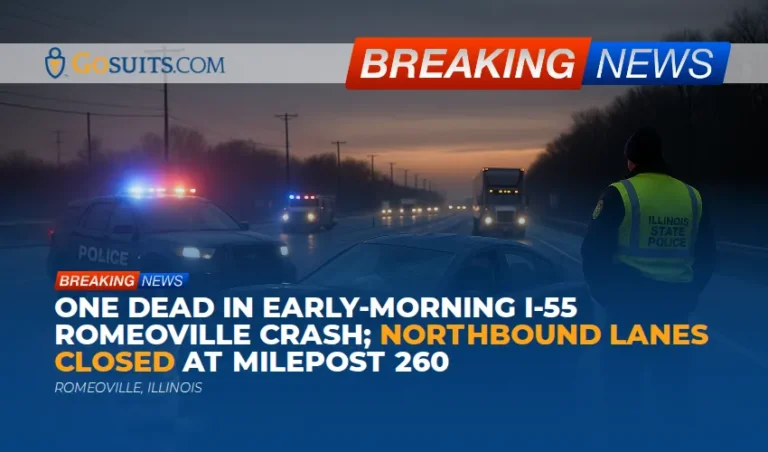
Early Thursday, northbound lanes of I-55 in Romeoville were shut down after a three-vehicle crash at milepost 260, just before 3:50 a.m., according to Illinois State Police. One person died at the scene. At the time of reporting, no additional injury counts were available, and traffic was being rerouted at Route 30 while the Romeoville Police Department investigated. These facts come from initial statements; as with any developing highway incident, details may be updated as agencies complete on-scene work and reconstruct the crash timeline.
When interstate traffic is diverted during the pre-dawn commute, it affects drivers across the I-55 Stevenson corridor through Will County, including those coming from Bolingbrook, Plainfield, and Joliet who use the Route 30 and Weber Road interchanges. It also prompts a coordinated response from multiple agencies, each with a distinct role in scene safety, crash documentation, and next steps for families.
Where it happened and early-morning traffic impacts
The crash occurred at milepost 260 on I-55 northbound, within Romeoville. In practical terms for local drivers, this is the stretch that funnels traffic toward the I-355 junction and into the Stevenson toward Chicago. With traffic rerouted at Route 30, motorists heading from Joliet or Shorewood toward Romeoville and Bolingbrook likely saw heavier volumes on frontage and arterial roads. Early mornings in January around Will County can also bring slick conditions, patchy fog, or black ice in shaded overpasses, which can complicate both the crash dynamics and the recovery efforts.
Residents in nearby neighborhoods off Weber Road and commuters from the Lewis University area often depend on this corridor. Even after lanes reopen, responders may leave residual closures for debris clearance or scene mapping. IDOT and state police typically emphasize that motorists slow down near responders and follow posted detours to prevent secondary crashes.
Who is involved in the investigation and what each agency does
Illinois State Police
On Illinois interstates, the Illinois State Police typically lead or assist with traffic crash response, lane closures, and initial crash reporting. They also manage the statewide system for traffic crash reports following investigations. Families and insurers often rely on ISP’s officially filed crash report for the initial factual summary, vehicle placements, and listed contributing factors. ISP provides information to the public on requesting crash reports once they are finalized [1]. District 5, which covers the Joliet and Will County area, often coordinates on I-55 incidents in this corridor [2].
Romeoville Police Department
The Romeoville Police Department is reported to be investigating. For a crash within village limits, Romeoville PD may conduct or assist with scene documentation, witness interviews, and preservation of local evidence, such as nearby business camera footage. While Romeoville’s records unit can advise on local report requests, availability depends on the status of the investigation and whether ISP is the primary record holder.
Will County Coroner’s Office
The Will County Coroner’s Office is responsible for investigating deaths within the county that occur suddenly or from trauma. The coroner determines cause and manner of death and may conduct an autopsy. Families typically coordinate with the coroner on identification, release of remains, and, later, obtaining portions of the case file once legally releasable. The coroner’s office is a county agency, and contact information is maintained on the Will County government site [3].

Illinois Department of Transportation
IDOT supports traffic management, signage, and detours and maintains crash data and annual crash statistics that help contextualize risks on Illinois highways [4]. While IDOT does not determine civil fault, its engineers and operations teams assist with traffic control and sometimes provide infrastructure-related details if a feature of the roadway is relevant to safety analysis.
How families can obtain official records and information
In the aftermath of a fatal crash, official records can feel overwhelming to locate. The agencies below generally provide guidance. Availability depends on investigative status and statutory rules.
Traffic crash report
Illinois traffic crash reports are typically requested from the investigating agency. If Illinois State Police is the custodian, requests go through the ISP crash report portal once the report is approved for release [1]. If Romeoville Police Department is the primary custodian, families can contact the PD’s records division for instructions on obtaining the report. Keep in mind that multi-agency investigations sometimes mean separate documents or supplements exist at more than one agency.
Autopsy, cause, and manner of death
The Will County Coroner’s Office manages autopsy reports, toxicology (if performed), and findings. Some documents may be available to next of kin after the investigation reaches certain milestones. The coroner’s office can explain timelines, fees, and eligibility for access. Contact information is maintained on Will County’s government site [3].
911 audio, CAD logs, and traffic camera data
Depending on the agency and whether data is retained, families or their representatives may request 911 audio, computer-aided dispatch logs, and certain traffic management records. Retention windows can be short. If in doubt, a promptly submitted records request can help preserve access. Requests in Illinois are governed by the Freedom of Information Act (FOIA) [5]. Not every item will be releasable during an active investigation, but agencies typically provide instructions or partial disclosures where permitted by law.
How FOIA works in Illinois
Illinois FOIA gives the public the right to request records from public bodies, with exemptions for sensitive material such as personal identifiers and actively investigatory records. The Illinois Attorney General provides plain-language guidance and request procedures [5]. If you plan to seek records tied to a fatal crash, it helps to be specific about the date, time, location, and types of records you are requesting. For multi-agency events, requests may need to be submitted to each relevant public body.
Legal context for a three-vehicle fatal interstate crash in Illinois
Every crash is unique, and investigators will work to determine how and why this tragedy occurred. That said, Illinois civil law offers a framework for evaluating potential responsibility in a multi-vehicle collision on the interstate.
Duty of care and potential liability
All drivers owe a duty of reasonable care, including maintaining a safe speed for conditions, keeping proper lookout, and leaving enough distance to avoid a collision. In a three-vehicle chain, liability can be complex and may involve multiple drivers, a commercial carrier if a commercial vehicle is involved, or, in rare cases, a roadway hazard that implicates non-driver contributors. The official crash report, physical evidence, and any reconstruction will be central to evaluating fault.
Modified comparative negligence in Illinois
Illinois follows a modified comparative negligence rule with a 51 percent bar. A claimant whose fault is more than 50 percent cannot recover damages. Otherwise, damages are reduced by the claimant’s percentage of fault. The statute governing comparative fault is 735 ILCS 5/2-1116 [6]. In multi-vehicle cases, this allocation often becomes a focal point as insurers apportion blame among drivers.
Wrongful death and survival claims
When a crash causes a death, Illinois allows two civil paths. A wrongful death action compensates next of kin for losses like grief and loss of financial support under the Illinois Wrongful Death Act, 740 ILCS 180 [7]. Separately, a survival action allows the decedent’s estate to seek damages the person could have claimed had they lived, such as pain experienced between injury and death, under 755 ILCS 5/27-6 [8]. These are different claims with different beneficiaries and proof considerations. Families often consult seasoned counsel to understand how these claims work together and how insurance coverage may apply.
Timelines and preservation of evidence
In Illinois, the general limitations period for personal injury claims is two years, under 735 ILCS 5/13-202 [9]. Wrongful death claims are generally subject to a two-year period as well under 740 ILCS 180, subject to certain exceptions [7]. Evidence moves quickly in highway cases. Black box data, dashcam SD cards, third-party telematics, and nearby security cameras can cycle or overwrite within days or weeks. Prompt spoliation notices and targeted record requests can be crucial for preserving the facts needed to evaluate fault.
Evidence that often decides liability in multi-vehicle interstate crashes
Three-vehicle crashes on interstates like I-55 can hinge on precise sequencing. Was there a sudden brake? An evasive lane change? Reduced speed due to weather or a stalled vehicle? These questions are answered through a mix of human and digital evidence:
- Event data recorders from modern vehicles can show pre-impact speed, braking, throttle, and seatbelt usage.
- Dashcam or body camera video can capture lane position, following distance, and signaling.
- Commercial telematics, if a heavy vehicle is involved, can log speed and hours of service.
- Physical evidence, including skid marks, gouge marks, and debris fields, helps reconstruct angles and impacts.
- 911 calls and dispatch logs can provide real-time descriptions of hazards or secondary impacts.
- Weather and lighting conditions corroborate whether drivers adjusted to early-morning visibility or surface risks.
Because responsibility may be shared in a chain reaction, a detailed reconstruction can clarify which impacts were avoidable and which were unavoidable due to prior events. That clarity directly affects how insurers evaluate claims and how damages may be apportioned under Illinois comparative negligence law [6].
Insurance considerations after a fatal highway crash
A fatal crash often triggers multiple insurance layers. The details will depend on the vehicles involved, policy limits, and whether commercial vehicles or ride-for-hire platforms played any role.
Liability coverage and competing claims
Each at-fault driver’s liability policy is a potential source of recovery. In a three-vehicle crash, there can be competing claims and complex sequencing of whose coverage applies first. If the at-fault driver has insufficient limits, underinsured motorist coverage may be implicated on a personal policy. Where multiple parties share fault, negotiations can involve several insurers testing comparative negligence arguments under 735 ILCS 5/2-1116 [6].
Wrongful death and survival damages
Wrongful death claims seek damages for next of kin under 740 ILCS 180, while survival claims seek damages that belonged to the decedent’s estate under 755 ILCS 5/27-6 [7] [8]. When multiple insurers are involved, allocating payments between these claims can become technical, especially if there are lienholders for medical or funeral expenses. Navigating this landscape is where experienced wrongful death attorneys can help organize claims, protect statutory rights, and prevent avoidable missteps with carriers.
Before calling any insurer
Insurance adjusters will typically contact involved parties quickly. It is prudent to consult an attorney before providing recorded statements, signing authorizations, or accepting any early offers. Statements made to insurers can later be used to challenge fault or damages. A brief conversation with wrongful death attorneys at the outset can help the family decide what to share, what to preserve, and how to channel communications so nothing important is missed.
Low-visibility and early-morning conditions
When crashes occur before sunrise, insurers often debate whether drivers adjusted to conditions. The availability of dashcam video, EDR data, and witness accounts can make or break this issue. A structured evidence plan reduces the chance that critical proof is lost while carriers are still positioning their coverage arguments. Families who keep a written record of contacts and claim numbers can save significant time later as the case evolves.
Local safety context on I-55 through Will County
Will County’s stretch of I-55 is a major freight and commuter artery. Heavy volumes and merging turbulence at interchanges like Route 30, Weber Road, and I-355 mean that small mistakes can escalate quickly. IDOT’s statewide crash facts help illustrate common contributors to serious and fatal crashes, including speed, impairment, distraction, and weather-related surface issues [4]. While county-level rollups vary by year, the corridor’s mix of long-haul trucks and local commuters is a constant. That is why early-morning response and detours are designed to limit secondary crashes while investigators work.
Locals know the landmarks: the industrial corridors near Taylor Road, the retail clusters around Weber Road, and the proximity to Lewis University and the nearby airport. Winter mornings can bring slick bridges over the Des Plaines River valleys. Even after lanes reopen, debris and damaged vehicles can linger on shoulders. Drivers heading toward Chicago from Joliet and Shorewood may want to keep a close eye on speed advice from variable message signs and keep greater following distance during predawn commutes.
Time-sensitive actions the public can take now
When a serious crash shuts down an interstate, there are practical steps community members can take promptly. These actions are not directed at any specific person involved in the incident; they are general guidance meant to protect rights and preserve information in the immediate aftermath of a major highway event.
- Write down what you saw if you were a passerby or nearby driver. Memory fades fast. A short note on time, direction of travel, lane position, and any unusual observations helps if an agency or insurer later requests a witness statement.
- Save dashcam footage now. Many devices overwrite within hours. Back up the file and note the exact time and GPS if available.
- Preserve vehicle data. If your vehicle was involved but drivable, avoid disconnecting the battery or making repairs until you receive guidance on preserving EDR data.
- Document road and weather conditions. Photos of surface conditions, fog, and lighting taken shortly after the crash can be probative.
- Check official channels for report availability. Illinois State Police provides information on traffic crash report requests when reports are finalized [1].
- Learn the fundamentals of Chicago-area post-crash steps. An accessible, plain-language resource on local next steps is here: what to do after a car accident in chicago.
- Consult an attorney before contacting insurers. Early recorded statements can have unintended consequences. Even a short call with wrongful death attorneys can clarify what to share, what to hold, and how to request evidence preservation.
- Use FOIA when appropriate. Illinois FOIA outlines how to request public records and what to expect from agencies during active investigations [5].
Why timing matters: dashcams loop quickly, nearby businesses recycle footage in days, and some traffic data is transient. Evidence that exists this week may be gone next week. Acting promptly is about preserving truth, not jumping to conclusions.
Commentary from Gosuits Romeoville, Illinois Personal Injury Attorney
Our hearts go out to the family and everyone affected by this early-morning loss on I-55. The information here is offered for educational purposes and general community awareness during a difficult time.
Interstate crashes at dawn often turn on seconds and feet. In a three-vehicle chain, a snapshot of speed, following distance, and lane position can decide who bears responsibility. The combination of commuter flow and heavy truck traffic through Will County means that a single misjudgment can ripple into multiple impacts. Careful reconstruction, data downloads, and timely preservation requests are essential to reaching a fair understanding of what happened.
Insurance companies and large corporations are sophisticated about claims that follow fatal crashes. They frequently move fast to gather statements, shape fault narratives, and lock in documentation on their terms. People who are grieving may not realize that even casual comments in a recorded call can be used later to argue about fault or to minimize damages. Adjusters may sound helpful, but their job is to protect the carrier’s interests. That makes it especially important to understand rights and options before engaging deeply on the record.
A free consultation can help clarify the difference between wrongful death and survival claims, what deadlines apply, and what evidence to secure right now. It can also set a plan for handling insurer outreach, preserving digital data, and coordinating with public agencies like the Illinois State Police, the Romeoville Police Department, and the Will County Coroner’s Office. This is about informed decision-making during an incredibly hard moment, not rushing into anything.
References
- Traffic Crash Reports – Illinois State Police
- District 5 (Joliet) – Illinois State Police
- Will County Government – Will County, Illinois
- Illinois Roadway Crash Facts and Statistics – Illinois Department of Transportation
- Freedom of Information Act in Illinois – Office of the Illinois Attorney General
- 735 ILCS 5/2-1116 – Comparative Fault – Illinois General Assembly
- 740 ILCS 180 – Wrongful Death Act – Illinois General Assembly
- 755 ILCS 5/27-6 – Survival of Actions – Illinois General Assembly
- 735 ILCS 5/13-202 – Personal Injury Limitations – Illinois General Assembly