- What we know about the 605 Freeway tragedy near Norwalk
- Timeline of events and official statements
- Civil liability questions raised by a chain-reaction freeway crash
- How families can get official records in Los Angeles County
- Insurance considerations after a high-speed freeway collision
- Practical next steps for impacted community members
- Safety takeaways for 605 Freeway and LA County drivers
- Click to Action: Why taking action early matters
- Commentary from Gosuits Norwalk, California Personal Injury Attorney
What we know about the 605 Freeway tragedy near Norwalk
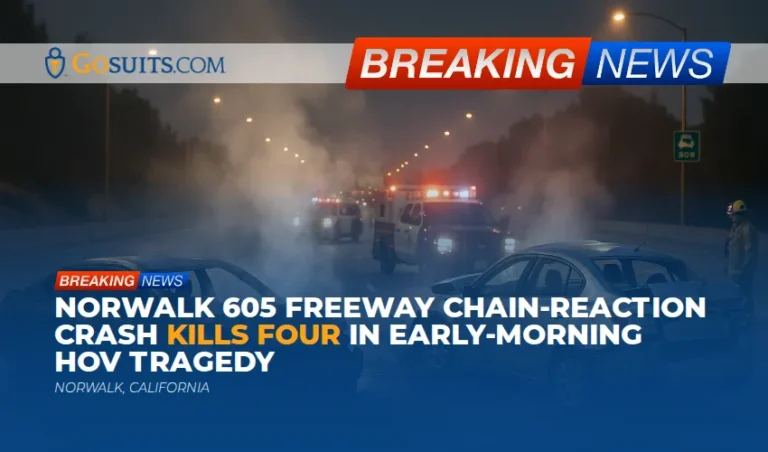
Just after 1 a.m. on July 20, 2025, a chain-reaction collision in the southbound HOV lane of Interstate 605 near the Rosecrans Avenue exit, by Norwalk, led to a devastating fire that claimed four young lives. According to statements reported publicly, a then-California Highway Patrol officer, driving an assigned patrol vehicle, allegedly struck the back of a Nissan Versa at very high speed, leaving the Versa disabled in the carpool lane. Minutes later, a second vehicle traveling at over 100 mph is alleged to have crashed into the stopped Versa, causing a fiery explosion and immediate fatalities at the scene. The victims had reportedly been driving home from a concert, and families later said several of them were able to communicate after the first impact.
Authorities have stated the former officer was not responding to an emergency at the time and that his lights and sirens were not activated. Prosecutors indicated the second driver is suspected of impairment. The case has drawn intense attention throughout Southeast Los Angeles County, including Norwalk, Bellflower, Santa Fe Springs, and down the 605 corridor where late-night traffic and high speeds often intersect in dangerous ways.
Timeline of events and official statements
Authorities have provided the following general sequence based on prior public accounts. Times are approximate and reflect what has been publicly discussed to date.
- Initial impact near Rosecrans Avenue: A patrol unit allegedly traveling at least 130 mph strikes a Nissan Versa in the southbound HOV lane. The Versa becomes disabled in the lane, a high-risk scenario during low-visibility early morning hours when speeds routinely exceed posted limits. Research has consistently shown that high speed increases both stopping distance and crash severity, heightening the chance of fatal outcomes when a second impact occurs [10].
- Minutes pass at the scene: Public statements indicate the officer remained near his vehicle. In general, first responders and motorists who come upon an incident are expected to take steps to warn other traffic when it is safe to do so, consistent with widely accepted traffic incident management principles designed to prevent secondary crashes [12].
- Second high-speed collision and fire: Another car traveling at over 100 mph crashes into the disabled Versa, causing an explosion and fatal injuries. In separate safety guidance, federal agencies continue to warn about the catastrophic risks of impaired driving and speed on limited-access highways like the 605 [11], [10].
- Criminal proceedings: Prosecutors announced charges against both drivers. Civil cases arising from fatal crashes are separate from criminal proceedings and follow distinct rules, burdens of proof, and deadlines.
As investigations and court proceedings continue, the families and the broader community are left with pressing questions about accountability, safety protocols, and how to navigate the complex civil process that follows a tragedy of this scale.
Civil liability questions raised by a chain-reaction freeway crash
When multiple vehicles and potential factors like speed, scene management, and suspected impairment converge, civil liability analysis often examines several layers: duty of care, breach, causation, and damages. Below are core issues that typically arise in similar freeway incidents across Los Angeles County and California.
Duty to prevent secondary crashes and scene safety
On California freeways, any driver who becomes involved in a collision has legal obligations that include stopping at the scene and, when reasonably possible and safe, rendering aid or taking steps that reduce risks to others. While criminal statutes govern specific duties for collisions involving injury or death, civil courts routinely evaluate whether a person failed to act as a reasonably careful person would under similar circumstances. In the traffic safety realm, widely taught incident management concepts emphasize quick detection, safe positioning, and prompt scene warning to prevent secondary crashes [12].
Proximate cause and comparative fault in multi-vehicle crashes
California’s comparative fault framework allows juries to assign responsibility across multiple actors based on each person’s contribution to the harm. In a chain-reaction crash, civil courts may consider whether the first collision, subsequent conduct, and a later high-speed or impaired driver’s actions were each substantial factors in the resulting injuries. These determinations can be complex, especially where the initial crash leaves a vehicle disabled in a fast lane and a second driver arrives at excessive speed or under the influence.
Families considering civil action often consult with car accident lawyers to assess how evidence like event data recorder downloads, roadway lighting, debris field mapping, and agency policies relate to causation and fault allocation in a specific case.

Claims against public entities and strict deadlines
When a claim involves a California state agency, such as the California Highway Patrol, the California Government Claims Act typically requires that most claims for money damages be presented to the state within six months of the incident date in cases involving injury or death [6]. This process usually runs through the Government Claims Program at the Department of General Services, Office of Risk and Insurance Management [5]. Failing to file a timely government claim can bar a later lawsuit against the public entity in many situations.
Because multi-vehicle freeway incidents often involve complex timelines and agency records, many families in LA County seek guidance from Norwalk car accident lawyers to ensure the correct office, forms, and deadlines are met, and to preserve evidence that could be in the hands of public agencies.
For families focusing on immediate paperwork and organization during a difficult time, this guide may help: los angeles wrongful death checklist.
Wrongful death and survival actions
California recognizes two distinct types of civil actions after a fatal crash. The wrongful death statute allows certain surviving family members to sue for their own losses, such as loss of financial support and companionship [8]. A separate survival action, typically brought by the decedent’s personal representative or successor in interest, can seek recovery for certain harms the decedent suffered before passing, subject to statutory limits [9].
Both claims can be pursued together, but they serve different purposes. The wrongful death claim compensates statutory heirs for their losses, and the survival action carries forward the decedent’s cause of action that existed at the time of death.
Statute of limitations
In many California wrongful death and personal injury matters, the general statute of limitations is two years from the date of injury or death [7]. However, claims that involve a public entity must typically start with the Government Claims Act’s shortened deadline to preserve the right to sue the public entity later [6], [5].
How families can get official records in Los Angeles County
When a freeway crash involves a fatality, official records are dispersed across multiple agencies. Below are the most commonly requested documents and where they can be obtained.
CHP collision report
Freeway collisions in LA County are generally investigated by the California Highway Patrol. Families can request the traffic collision report using CHP’s process. The standard approach involves submitting CHP Form 190 with proper identification and a valid interest in the report [1], [2]. The report will identify involved parties, witnesses, scene diagrams, and preliminary findings.
- What to prepare: Collision date, approximate time, location details such as “southbound I-605 near Rosecrans Avenue,” names of involved parties if known, and a government-issued ID.
- Why it matters: The CHP report is foundational for understanding the initial facts, who investigated, and which area office holds evidence.
Medical examiner and autopsy records
In Los Angeles County, the Department of Medical Examiner maintains records related to cause and manner of death. Authorized family members can request autopsy and related records through the department’s online portal and request system [3].
- What to know: Toxicology results can take time. The Department will provide instructions on eligibility, fees, and processing times for certified copies.
Death certificates
Certified death certificates are issued by the Los Angeles County Registrar-Recorder or County Clerk. Orders can be made through the county’s official portal, with identity verification requirements that vary by request type [4].
911 audio, dispatch logs, and additional agency records
Depending on the investigation, families may seek 911 recordings, CAD logs, and radio traffic. Requests can be made under the California Public Records Act to the relevant agency holding the records. For CHP, there is a dedicated process for public records requests [14]. Note that exemptions and redactions are common in active investigations and where privacy laws apply.
Criminal case victim resources
When criminal cases are filed, the Los Angeles County District Attorney’s Office provides victim services, including updates, guidance on restitution, and court support. Contact and program details are available on the DA’s official website [15].
DMV SR-1 accident reporting
California law generally requires drivers to report certain motor vehicle crashes to the DMV within 10 days using the SR-1 form, including crashes that cause injury or death or a specific amount of property damage. The DMV provides an online overview and virtual office for this function [13]. Families of decedents are typically not the reporting party, but understanding the requirement helps ensure all administrative steps are covered.
Insurance considerations after a high-speed freeway collision
Multi-defendant freeway tragedies often present layered insurance questions. Here are issues that frequently arise and how they are typically approached in California civil cases.
- Multiple liability policies: Claims may involve private passenger auto policies, potential employer or public entity coverage, and in some cases excess or umbrella coverage. Untangling who pays first in a multi-car crash can be fact-intensive and may depend on liability determinations and policy language.
- Uninsured and underinsured motorist coverage: UM and UIM coverage on a household policy can be essential where at-fault coverage is limited. The California Department of Motor Vehicles and the California Department of Insurance both provide consumer-facing information about coverage fundamentals, and families often discover that their own policies have important protections that can be triggered by a wrongful death claim.
- Preserving vehicle and roadway evidence: Event data recorder downloads, airbag module data, and retained parts like bulbs and control modules can be vital to reconstruct speed, braking, and lighting. Early preservation efforts reduce the chance of spoliation disputes later.
- Recorded statements and early negotiations: Before speaking with any insurer, it is generally prudent to consult an attorney. What someone says to an insurance company can be used against them, and early statements sometimes omit crucial context that later becomes clear. Many families prefer to have seasoned counsel handle communications and protect privileges before engaging with carriers.
Because claims from a chain-reaction fatal crash often span multiple carriers and potential public entities, engaging with car accident lawyers can help clarify policy stacks, priority of coverage, and the timing of claims notices to avoid avoidable coverage disputes.
Practical next steps for impacted community members
Even as grief and shock are front and center, taking a few structured steps can make a major difference in a civil case. In LA County, and especially along the 605 corridor that threads Norwalk, Santa Fe Springs, and Cerritos College, evidence shifts quickly. Here is a grounded, local-first checklist.
- Identify the investigating CHP area office: For collisions on the 605 near Norwalk, the CHP Santa Fe Springs Area commonly responds. Confirm the exact area office on the CHP collision report, then use CHP Form 190 to request the report and any approved attachments [1], [2].
- Request coroner records early: Initiate a request with the Los Angeles County Department of Medical Examiner. Ask about timelines for autopsy, cause of death findings, and toxicology, and keep copies of all correspondence [3].
- Preserve digital and physical evidence: Save texts from loved ones, call logs, rideshare receipts from the concert night, dashcam files, toll transponder logs, and any photos or videos shared after the first impact. If a private tow yard has a vehicle, request in writing that it be preserved in its current state.
- Document the human story: Write a contemporaneous account of what you know, including timelines, messages, and updates from hospitals or first responders. These details can help later when memory fades.
- Avoid early insurance statements without counsel: Families often receive quick outreach from insurers. Before engaging, consider speaking with an attorney to understand rights, the Government Claims Act timeline if a public entity is implicated, and how to structure communications to protect your claims [5], [6].
- Leverage community support in Norwalk and nearby cities: Faith leaders, neighborhood groups near Norwalk Town Square, and campus support services at nearby colleges can be invaluable. Seek trauma-informed resources that fit your family’s needs.
Safety takeaways for 605 Freeway and LA County drivers
Anyone who drives the 605 at night around Norwalk knows how quickly speeds climb and how fast gaps close. A few reminders that align with national safety data and incident management principles:
- High speed magnifies risk: The faster a driver goes, the less time there is to react and the greater the force of impact. Speed is a persistent factor in freeway fatality rates nationwide [10].
- Never assume a stopped vehicle in a live lane is visible: Early morning darkness, curves, and the visual complexity around interchanges like Rosecrans can make it hard to detect a disabled vehicle in time, which is why quick scene warning and hazard lighting are vital [12].
- Impairment remains deadly on limited-access highways: Even with robust enforcement and education campaigns, impaired driving continues to cause preventable tragedies [11]. Designate a sober ride, especially when traveling long freeway stretches home from late events or concerts.
- Know the basics of incident management: If safe and possible, move vehicles to the shoulder, activate hazard lights, use reflective triangles or flares when available, and call 911 quickly. These steps align with national Traffic Incident Management guidance aimed at stopping secondary crashes before they happen [12].
Click to Action: Why taking action early matters
What should community members do next after a catastrophic freeway event like this?
- Clarify the legal pathways before calling insurers: Contact an attorney for a free consultation to understand which claims apply, how California’s Government Claims Act might affect timing, and how to protect your rights. Early statements to an insurer can be used later and might limit recovery if not carefully handled.
- Request key records without delay: Collision reports, coroner findings, and potential 911 or dispatch audio often guide next steps. These records can take weeks or months. Starting now preserves options if civil filing deadlines approach [1], [3], [14].
- Secure evidence while it exists: Vehicles get moved, data can be overwritten, and surveillance footage is routinely deleted on short cycles. Preserving evidence strengthens any future civil case and reduces disputes about what happened.
- Track all expenses and losses: Keep organized records of funeral expenses, travel for court or agency appointments, grief counseling, and time missed from work. These details matter in wrongful death and survival claims [8], [9].
- Prepare for a marathon, not a sprint: Complex freeway fatality claims often involve multiple defendants and agencies. Early planning helps families stay focused on healing while counsel handles the procedural and investigative load.
Commentary from Gosuits Norwalk, California Personal Injury Attorney
Our hearts are with the families and friends of those who died in this terrible 605 Freeway crash. What follows is educational and general information meant to help the community understand common civil issues that can arise in tragedies like this.
In our view, the publicly reported facts raise profound questions about speed, scene management, and preventable secondary impacts on a busy LA County freeway. Chain-reaction collisions are often about moments. Seconds where hazard lights, flares, or positioning can change outcomes, and decisions by other drivers approaching at high speed can compound the danger. Civil law tends to focus on whether actions were reasonable under the circumstances, and whether each actor’s conduct was a substantial factor in causing harm. These are the questions that typically drive fault analysis in multi-vehicle freeway cases across the county.
It is also common for insurance companies and large institutions to move quickly to manage exposure. That can mean early outreach for recorded statements, fast offers before all facts are known, or complicated coverage positions that downplay comparative fault of multiple drivers. Without guidance, people can feel pressured to accept terms or make statements that do not capture the full story. A free consultation can help level that playing field, clarify deadlines under the Government Claims Act when a public entity is involved, and ensure families understand how their own policies, like UM or UIM, might play a role in a wrongful death claim.
References
- Obtain a Collision Report – California Highway Patrol
- CHP 190: Application for Release of Information – California Highway Patrol
- Request Records – Los Angeles County Department of Medical Examiner
- Death Records – Los Angeles County Registrar-Recorder/County Clerk
- How to File a Claim Against the State of California – DGS ORIM
- Government Code § 911.2 – California Legislative Information
- Code of Civil Procedure § 335.1 – California Legislative Information
- Code of Civil Procedure § 377.60 – California Legislative Information
- Code of Civil Procedure § 377.30 – California Legislative Information
- Speeding – National Highway Traffic Safety Administration
- Drunk Driving – National Highway Traffic Safety Administration
- Traffic Incident Management – Federal Highway Administration
- Accident Report SR-1 – California DMV
- Public Records Act Requests – California Highway Patrol
- Victim Services – Los Angeles County District Attorney