- What we know about the North Dallas pedestrian crash near Coit and Frankford
- The location and why this intersection draws safety concerns
- Pedestrian safety and right-of-way at intersections in Texas
- Potential civil liability pathways after a fatal intersection crash
- Evidence families and investigators will look for
- How to obtain key records in Dallas County and statewide
- Trends: pedestrians and intersection crashes in Texas
- If insurance carriers reach out: why speaking prematurely can harm a civil case
- A community snapshot: Coit and Frankford at dusk
- How a wrongful death claim proceeds in Texas after a traffic fatality
- Why timely action matters after a fatal crash
- Commentary from Gosuits Dallas, Texas Personal Injury Attorney
What we know about the North Dallas pedestrian crash near Coit and Frankford
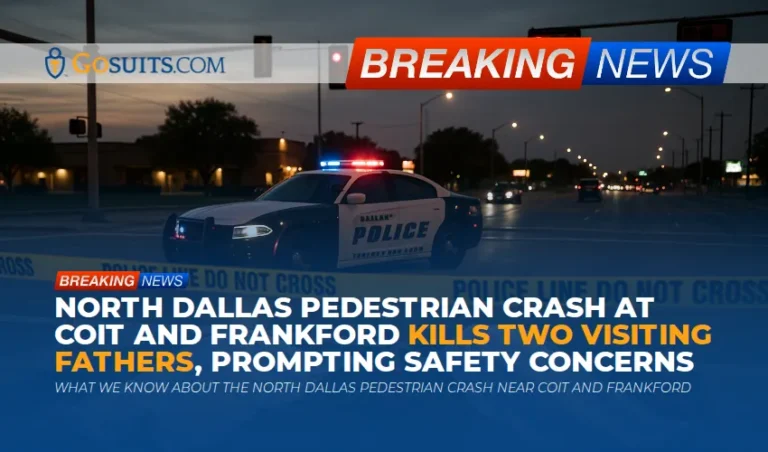
In the early evening of February 6 around 6 p.m., two visiting fathers were walking near the intersection of Coit Road and Frankford Road in far North Dallas when a vehicle that had been involved in a collision nearby reportedly left the roadway and struck them. Both men were in the Dallas area for a work conference and were brothers-in-law. Family members and people who work and drive in the area have voiced grief and renewed concerns about safety at that busy, multilane crossroads. Dallas police have confirmed an investigation is underway, with no additional public updates as of the most recent reporting.
Witness accounts describe a sudden, violent impact following a separate vehicle collision, and community members have noted frequent red-light running and congestion near the Coit-Frankford intersection. Neighbors and drivers also expressed worry for pedestrians, including UT Dallas students who regularly cross and walk in this part of North Dallas.
It is common for crash investigations of this type to take days or weeks while officers collect physical evidence, canvass for camera footage, analyze vehicle data, and formalize witness statements. For families, the initial period can be the hardest time to wait, but it is also when records start to take shape for any future civil claims.
The location and why this intersection draws safety concerns
Coit Road and Frankford Road sit at a hectic confluence of commuter routes that feed residential neighborhoods, retail strips, and campuses along the Dallas-Addison-Plano corridor. At rush hour the westbound and eastbound approaches can stack quickly. Drivers attempt to catch short signals, and turning movements from multiple lanes create competing demands for space and time. That alone does not make any one crash inevitable, but it does increase the margin for error if drivers are distracted, speeding, or attempting to beat a light.
This corner is also a common walking area. People move between apartment complexes, restaurants, grocery stores, and bus stops, and some UT Dallas students head south or east for food and services. As dusk settles, visibility drops, glare from low sun can be intense, and traffic volumes remain high. Those conditions are known risk multipliers for pedestrian safety at urban intersections, which is why engineers often deploy countermeasures like enhanced crosswalk markings, leading pedestrian intervals, and better lighting in similar settings [5].
Pedestrian safety and right-of-way at intersections in Texas
Texas law sets clear rules for how drivers and pedestrians should interact at intersections. When a pedestrian is in a crosswalk with a “Walk” signal, drivers must yield and allow that person to finish crossing. Even outside marked crosswalks, motorists have a duty to exercise due care to avoid colliding with a pedestrian and to honk a horn when necessary for safety [1]. At signalized intersections, pedestrians should follow the control signals, and drivers facing a red light or stop must stop before entering the crosswalk and remain stopped as required by traffic control devices.
These rules exist to reduce conflict points and protect vulnerable road users who have no physical protection. In many civil cases after an intersection crash, investigators and reconstructionists assess the signal phase at the time of impact, whether a pedestrian was within a crosswalk, sight lines, speeds, and whether either party violated a traffic control device. FHWA guidance encourages local agencies to adopt proven measures such as leading pedestrian intervals and high-visibility crosswalks, which can significantly reduce turning conflicts and improve conspicuity [5].
For a deeper, plain-language walkthrough of rights and duties for people on foot in Texas, see our guide, pedestrian rights in car accidents in texas.
Potential civil liability pathways after a fatal intersection crash
From a personal injury and wrongful death perspective, several civil questions tend to arise in a case of this nature. Because this tragedy reportedly followed an initial vehicle collision and then a roadway departure, the chain of events matters. Investigators will look at how the first collision occurred, whether a driver was negligent, and whether the subsequent impact with pedestrians was a foreseeable result of that negligence under Texas law.
Potential civil liability can include one or more of the following, depending on the evidence:
- Negligent driving by one or more motorists including running a red light, speeding, failing to yield, or driving inattentively at the intersection.
- Negligent entrustment or negligent maintenance where a vehicle owner allowed use by an unsafe driver, or a known mechanical defect was ignored, if evidence supports those theories.
- Comparative responsibility allocation among involved drivers if multiple negligent acts combined to cause the harm.
- Potential roadway design or signal timing issues in rare cases where a governmental entity’s actions are implicated. Claims against a city or state agency must comply with the Texas Tort Claims Act’s notice and immunity framework, which is complex and has strict timelines [9].
Families often ask how their civil rights fit into this. Texas recognizes wrongful death and survival actions that allow certain relatives to pursue damages for the losses caused by a person’s wrongful act, neglect, or carelessness. Beneficiaries and recoverable categories are set out by statute [7]. The general limitations period for wrongful death and personal injury is two years in Texas, though specific facts and defendants can affect deadlines [8].
It is also common for insurance companies representing drivers or vehicle owners to contact families very early. Before speaking to any insurer, it is prudent to consult with a qualified attorney who can explain rights and risks. Statements given to insurers can be used to narrow or contest claims later, and even routine facts can be misinterpreted without context.

Evidence families and investigators will look for
Modern intersection crashes generate a wide range of evidence. Some sources are in the hands of public agencies, while others belong to private businesses or vehicle owners. Early preservation is critical.
- Official crash report and diagram compiled by Dallas Police and made available via the state’s system after processing. This typically lists involved parties, vehicles, initial findings, and possible contributing factors. Access is governed by Texas law, and eligible requesters can obtain certified copies after the report is finalized [3].
- Traffic signal data including timing charts, phasing, preemption logs, and any malfunctions recorded around the time of the crash. Engineers often keep timing records that can help determine the signal phase at impact. When a safety study is requested, agencies may review historical crash data and operations to assess countermeasures [6].
- Nearby cameras such as business exterior cameras, apartment complexes, gas stations, and transit cameras. These systems often overwrite within days. Prompt outreach can prevent loss.
- Vehicle Event Data Recorder (EDR) downloads with speed, brake, and throttle information leading up to the collision, subject to consent and legal process. Preservation letters help ensure no inadvertent deletion.
- Witness statements and 911 recordings which can corroborate signal phases, speeds, and sequence of events. 911 audio and Computer Aided Dispatch logs are typically requestable under the Public Information Act with some redactions [2].
- Scene evidence including skid marks, debris fields, gouges, and rest positions. Investigators use standard traffic engineering references like the MUTCD to interpret control devices and compliance at the scene [6].
Strong, early evidence collection can shape liability findings and protect a family’s ability to pursue the full measure of civil remedies available under Texas law.
How to obtain key records in Dallas County and statewide
Police crash report and supplemental records
In Texas, crash reports are released through the state’s Crash Records Information System. Qualifying requesters can purchase a certified copy online after the report is uploaded by the investigating agency [3]. Supplemental materials like photos, body-worn camera footage, and dispatch logs may be available from the Dallas Police Department through a Public Information Act request. The Texas Attorney General’s office provides guidance on how to submit such requests and what to expect regarding timelines and possible redactions [2].
Autopsy report and cause-of-death documentation
In Dallas County, the county medical examiner conducts autopsies in cases of sudden, unexpected, or non-natural deaths. The autopsy report and associated toxicology are typically held by the medical examiner’s office. Release rules can vary, but next of kin or authorized representatives can request copies once complete. Certified copies of death certificates are issued at the state level through the Texas Department of State Health Services Vital Records division [12].
911 audio and CAD logs
911 calls and dispatch logs can provide crucial timing and observational details. These records are often requestable under the Texas Public Information Act. Some content may be redacted to protect personal information, but the timestamps and general narratives are commonly released [2].

Traffic engineering records
Families or their counsel can request intersection timing charts, recent timing changes, warrant analysis documents for signals, maintenance logs, and any prior safety studies. Agencies use the MUTCD and FHWA guidance to set and evaluate signal timing and operations [6]. While some materials may require formal requests, others might be shared as part of a post-crash evaluation.
Trends: pedestrians and intersection crashes in Texas
Across the country, pedestrians have faced increased risk over the past decade. NHTSA has documented a long-term rise in pedestrian fatalities, with many events occurring during low-light conditions on urban arterial roads like Coit and Frankford. Intersections are focal points of conflict between turning vehicles and street-level pedestrians, especially when signal timing is tight and sight lines are constrained [4].
Federal highway safety research identifies a suite of countermeasures with measurable crash reduction potential at busy intersections. These include:
- Leading pedestrian intervals to give walkers a head start before vehicles turn.
- High-visibility crosswalks and improved lighting to enhance conspicuity.
- Protected-only left-turn phases where permissive turns threaten pedestrians.
- Median refuge islands on wide crossings to reduce exposure time.
- No-turn-on-red restrictions where sight lines or volumes create conflicts [5].
Intersection-specific studies analyze volumes, speeds, crash types, and near-miss behavior to choose the right mix. The MUTCD provides the national baseline for traffic control devices, while FHWA’s Safe System approach emphasizes designing for human error and vulnerability [5] [6].
If insurance carriers reach out: why speaking prematurely can harm a civil case
After a high-profile collision, insurance adjusters may contact families quickly. They might ask for recorded statements, medical details, or even discuss early settlement options. While adjusters can be courteous, their role is to evaluate and limit their company’s exposure. Without full facts and the complete investigative record, early statements can lock in assumptions that are hard to correct later.
Before engaging with any insurer, it is wise to consult with a seasoned attorney who can explain rights, prepare a preservation strategy, and manage communications. Texas law also outlines important consumer protections in the auto insurance context and explains what carriers can and cannot require during the claim process [10]. In general, sharing only basic, non-opinion information until counsel is in place helps prevent misunderstandings.
When families do decide to explore options, many turn to car accident lawyers for help coordinating records requests, preserving evidence, and engaging with multiple insurers involved in multi-vehicle events.
A community snapshot: Coit and Frankford at dusk
Anyone who has rolled through Coit and Frankford around the dinner hour knows it can feel like a small city of its own. Traffic hums, left-turn pockets fill, and brake lights ripple down the block. The glow from grocery stores and neighborhood eateries lights the sidewalks. People jog by with dogs, a pair of roommates hustle across the crosswalk before the light flips, and you might catch a group of UT Dallas students walking for a bite between study sessions. It is an everyday Dallas scene until it is not. A sudden collision can turn a familiar corner into a place of shock and sirens.
When neighbors say they have seen drivers run lights there, that does not mean every night is dangerous. It does mean the community is paying attention. Public agencies hear those observations as data points that can guide whether a formal safety study would help. And for families processing a loss, that kind of community care can be a small comfort amid a week that otherwise feels unreal.
How a wrongful death claim proceeds in Texas after a traffic fatality
After a fatal crash, Texas law provides two closely related civil pathways: the wrongful death claim and the survival action. Understanding the basics helps families organize paperwork and expectations.
- Wrongful death claim allows certain relatives to seek damages for losses caused by another person’s wrongful act, neglect, or carelessness. Eligible beneficiaries and categories of damages are set by statute [7].
- Survival action continues the decedent’s own claim for injuries they suffered before death. It can include damages such as medical expenses and conscious pain and suffering through the estate representative, subject to proof and statutory rules [7].
- Statute of limitations is generally two years from the date of death, though exceptions and special provisions may apply in some cases, including claims against governmental entities that have additional notice requirements [8] [9].
- Evidence strategy often starts with preservation letters, formal record requests, and engagement with law enforcement to obtain the official crash report and supplements. Counsel may retain reconstructionists and human factors experts as needed.
- Insurance landscape can involve multiple policies: the at-fault driver, the vehicle owner, any employer policy if a driver was on the job, and potentially uninsured or underinsured motorist coverages.
Many families find it helpful to use a written roadmap for forms and documents. Our in-house guide offers a structured approach tailored to the area and courts families often interact with in North Texas: Dallas wrongful death checklist families.
Separately, Dallas car accident lawyers are often asked to explain how the wrongful death and survival action claims interact, how proceeds may be apportioned among beneficiaries, and how liens from healthcare providers or insurers may affect distributions. Early, precise guidance can prevent avoidable delays later.
Why timely action matters after a fatal crash
There are concrete steps the public can take to protect civil rights and ensure that critical records are preserved while memories are fresh and systems still retain data. Here is what that looks like, and why acting sooner is wise:
- Secure essential records by calendaring requests for the official crash report and any available supplements. Some business camera systems overwrite within days. Early outreach can mean the difference between having pivotal footage and having none.
- Preserve vehicles and EDR data through written preservation notices. Once a totaled vehicle is salvaged, data can be lost, and later reconstruction efforts are limited.
- Organize family documents including funeral expenses, travel costs, and employment records. These materials support specific categories of damages in a wrongful death and survival claim.
- Respect statutory deadlines such as the two-year limitations period and the Texas Tort Claims Act notice rules when public entities are implicated. Missing these windows can bar otherwise valid claims [8] [9].
- Channel insurance communications through counsel whenever possible. Adjusters are trained to lock in facts early. A single imprecise answer can cloud the record later.
Taking these steps promptly tends to reduce disputes about facts, mitigates data loss, and supports a clearer path through insurance and litigation processes. For many, consulting with car accident lawyers early is a practical way to coordinate preservation while the family focuses on care and arrangements.
Commentary from Gosuits Dallas, Texas Personal Injury Attorney
Our hearts are with the families grieving this unimaginable loss near Coit and Frankford. This overview is shared for education and general information only. It is not a substitute for speaking with a lawyer about the specifics of any situation.
From our perspective, intersections like this combine heavy turning movements, rush-hour pressure, and low-light conditions. When drivers run signals or fail to control their vehicles after an initial collision, pedestrians in a crosswalk or adjacent sidewalk can face catastrophic danger within seconds. The community’s calls for a fresh safety look at this corner are understandable. Proven tools exist to make these crossings safer, and post-crash reviews can help determine which measures fit the location best.
In the days after a tragedy, insurance carriers often move fast. They may sound compassionate, but they are gathering statements and documents to shape their defense. Corporations and insurers know most people are unfamiliar with concepts like comparative responsibility, signal timing evidence, or EDR downloads. They sometimes use that information gap to press for early, narrow settlements or statements that limit future claims. That dynamic is why informed guidance matters so much.
Obtaining a free consultation before speaking with any insurer helps families understand their choices, preserve key evidence, and prevent avoidable missteps. A knowledgeable advocate can coordinate records, sequence requests to the right agencies, and ensure the story of what happened is built on solid, verifiable facts.

Where to begin with official records and support
- Police crash report Request a certified copy through the state’s Crash Records Information System once available [3].
- Autopsy and death record The county medical examiner completes the autopsy, while certified death certificates are issued through Texas DSHS Vital Records [12].
- Public Information Act requests Use the Texas Attorney General’s guidance to request 911 audio, dispatch logs, and certain supplemental records [2].
- Traffic operations data Signal timing charts and engineering logs can be requested for the intersection to inform safety analysis [6].
For those navigating the early days after a North Dallas crash, even a short planning conversation can clarify next steps and reduce guesswork.
References
- Title 7, Subtitle C, Chapter 552 Pedestrians – Texas Transportation Code
- Public Information Act: What to Expect After You Submit a Request – Texas Attorney General
- Purchase Texas Crash Reports – TxDOT CRIS
- Pedestrian Safety – NHTSA
- Proven Safety Countermeasures – FHWA
- Manual on Uniform Traffic Control Devices – FHWA
- Chapter 71 Wrongful Death and Survival – Texas Civil Practice and Remedies Code
- Section 16.003 Limitations Period – Texas Civil Practice and Remedies Code
- Texas Tort Claims Act – Texas Civil Practice and Remedies Code Chapter 101
- Consumer Bill of Rights for Auto Insurance – Texas Department of Insurance
- Intersection Safety – FHWA
- Death Certificates – Texas Department of State Health Services