- What we know about the SR-73 wrong-way crash in Newport Beach
- Timeline and location details along SR-73
- Initial official information and the ongoing investigation
- Why wrong-way crashes are so catastrophic
- Legal context in California after a wrong-way collision
- Where and how to get official records in Orange County
- Evidence that can help families and injured people
- Common injuries in high-speed wrong-way collisions and getting care
- Practical next steps and common pitfalls
- Local context and community safety on SR-73 and nearby corridors
- Why timely action matters now
- Commentary from Gosuits Newport Beach, California Personal Injury Attorney
- References
What we know about the SR-73 wrong-way crash in Newport Beach
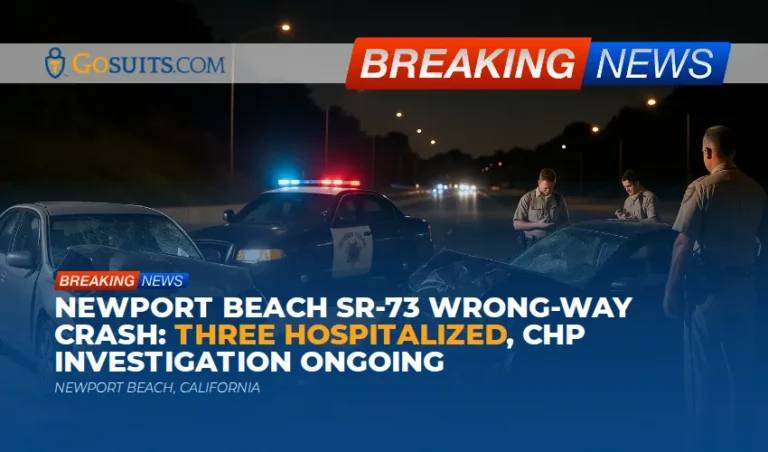
Late Friday night, a wrong-way driver on State Route 73 in Orange County set off a frightening chain of events that ended in a violent two-car collision in Newport Beach. The California Highway Patrol reported multiple 911 calls about a car traveling northbound in the southbound lanes. A few minutes later, near Bonita Canyon Drive, the wrong-way vehicle collided with another car. Three people were taken to nearby hospitals with major injuries. CHP said the vehicle traveling the wrong way is registered to a missing person from Cypress, and as of Friday night, no arrests had been confirmed. The investigation is ongoing.
For local families, this happened on a corridor many of us take between Laguna Niguel, Newport Coast, and the Irvine area. Hearing that speeds reportedly reached up to 100 mph is chilling. It also helps explain why injuries were described as major. Nights on the 73 can be quiet and dark, and sudden wrong-way movements give other drivers almost no time to react.
Timeline and location details along SR-73
Based on CHP’s account and witness reports, here is the basic sequence:
- Shortly before 8:05 p.m. Calls come in to CHP about a car going northbound in the southbound lanes near Greenfield Drive in Laguna Niguel at around 45 mph.
- A few minutes later Witnesses spot the wrong-way vehicle again near El Toro Road, now reportedly reaching speeds up to 100 mph.
- Approximately 8:16 p.m. The wrong-way vehicle collides with another car south of Bonita Canyon Drive in Newport Beach.
- After the collision Three people are hospitalized with major injuries as responders secure the scene and begin the investigation.
South of Bonita Canyon Drive, the 73 curves as it approaches the Newport Coast area, and late-evening visibility can vary. Anyone familiar with the stretch between El Toro Road and the Newport Beach city limits knows there are few refuge options when a vehicle is coming straight at you in the wrong lanes.
Initial official information and the ongoing investigation
CHP confirmed that the vehicle going the wrong way is registered to a missing person from Cypress. At the time of the report, it was not clear who was behind the wheel at the moment of impact, and CHP had not confirmed any arrests. That kind of uncertainty is common in the early stages of a serious crash investigation. Officers typically gather 911 recordings, witness statements, vehicle black-box data, roadway evidence such as skid marks or gouges, and any available traffic camera footage. Toxicology testing may also be part of the process, depending on circumstances, but those details were not released.
Families often feel frustrated by how long it takes for answers. A full crash reconstruction can take weeks, and formal reports can take longer. While the investigation unfolds, you can still take steps to preserve your own documents and evidence that may matter later, from medical records to photos of the vehicles.
Why wrong-way crashes are so catastrophic
Wrong-way collisions are rare but disproportionately severe. National safety investigators have found that wrong-way crashes have a higher likelihood of causing fatal or severe injuries compared to other types of collisions, largely because they often lead to head-on or high-speed side-impact crashes. Studies of wrong-way driving emphasize how speed, visibility, and driver confusion can multiply risk quickly. The National Transportation Safety Board has published in-depth reports on this phenomenon that remain widely cited by highway safety professionals [1].
Here in coastal Orange County, drivers on the 73 are used to steady cruising speeds and gentle grades. On a late winter evening, with lights stretching toward Newport Coast and limited shoulder access in some segments, encountering a wrong-way car gives little room for evasive maneuvers. The force of two vehicles moving toward one another at speed can be devastating.

Legal context in California after a wrong-way collision
Civil liability and California’s traffic safety laws
In a civil personal injury case, a driver who travels the wrong way on a divided highway may be found negligent. The California Vehicle Code prohibits driving on the wrong side of a divided highway [2]. The state’s basic speed law also requires motorists to drive at a speed that is reasonable and prudent for the conditions, and never in a way that endangers people or property [3]. When a driver violates a safety statute and that violation causes injury, courts may consider a negligence per se theory in the civil context. That does not determine fault in this crash, but it explains how traffic safety rules interact with civil responsibility generally.
Registered owner issues and permissive use
CHP’s preliminary information noted that the wrong-way vehicle is registered to a missing person from Cypress. In California, the vehicle’s registered owner can sometimes be held vicariously responsible for a driver’s negligence when the driver was using the vehicle with the owner’s permission [4]. Whether the use was permissive is a fact question that investigators and insurers scrutinize. If the driver was not authorized to use the car, different coverage and liability questions can arise. It is too early to know how that will apply here, and the investigation is still active.
Public entity claims and short deadlines
Occasionally, families ask whether a roadway feature or a lack of wrong-way signage contributed to a crash. That can involve complex engineering questions. When a claim potentially involves a public entity, California’s Government Claims Act imposes a short deadline to submit a claim, generally within six months of the incident, before any civil suit may be filed [5]. This does not mean a public entity is responsible in this case. It is simply a reminder that different deadlines may apply if a public claim is pursued.
Insurance coverage basics after a high-speed collision
After a serious crash, several coverages can come into play in California. Bodily injury liability coverage of the at-fault driver is the primary source for injury claims. If the at-fault driver is uninsured or underinsured, uninsured and underinsured motorist coverage on the injured person’s policy may help, depending on the policy’s terms. The California Department of Insurance provides consumer guidance on these coverages [6]. Medical payments coverage may also apply for immediate medical costs, independent of fault, again depending on the policy. Each policy is different, and coordination between coverages can be complicated, especially when multiple people are injured.
Where and how to get official records in Orange County
In the days following a major crash, families often need to locate official documents. Here is where to start for this kind of incident on SR-73 in Newport Beach.
- CHP Traffic Collision Report. Because this crash occurred on a state toll road corridor, the collision report is typically handled by the California Highway Patrol. Requests are usually made using the CHP 190 collision request form. The CHP explains how to request traffic collision reports on its website [7]. Reports can take time to finalize, especially for serious incidents. Be prepared to provide the date, approximate time, location, and parties involved, if known.
- 911 audio and dispatcher logs. Families sometimes request 911 recordings or CAD logs to understand the sequence of events. These may be obtainable under the California Public Records Act from the agency that received the calls. Availability may vary, and portions can be redacted under law.
- Autopsy or coroner records. If a traffic collision results in a fatality, the Orange County Sheriff-Coroner handles death investigations countywide. The Coroner Division provides information about public records and reports, including how to request them [8]. In this incident, authorities reported injuries but no fatalities, so this resource is provided for general awareness.
- California DMV SR-1 accident report. California law requires that any driver involved in a crash with injury, death, or property damage of at least the statutory threshold report the collision to the DMV within 10 days using Form SR-1. The DMV’s page explains who must file and how to submit it [9]. Not filing can have licensing consequences, separate from any insurance claim.
- Traffic or roadway video. Depending on location, some freeways and interchanges have traffic cameras or detection systems. Video, if available, may be held by a public agency and must be requested promptly because retention periods are often short. Our step-by-step resource on how to pursue this kind of video is here: Request CCTV Footage After a California Car Accident.
Evidence that can help families and injured people
While agencies complete their work, it helps to gather and preserve your own evidence. In a high-speed, head-on or near head-on crash, details get lost quickly if they are not recorded early.
- Medical records and imaging. Keep discharge papers, lab results, and imaging studies, along with follow-up recommendations. These records show the link between the crash and the injuries, as well as prognosis and future care needs.
- Vehicle data and inspection. Many modern vehicles contain event data recorders that log speed, brake application, and other variables at the time of impact. Work with your insurer or a qualified professional to avoid vehicle disposal or repair before preserving data.
- Photos and video. Capture the vehicle interior and exterior, any visible injuries, road debris patterns, and weather or lighting conditions similar to the time of the crash.
- Witness information. Names, phone numbers, and brief summaries of what witnesses observed can be invaluable if memories fade or people move.
- Employment and wage documents. Pay stubs, work schedules, and employer letters are used to verify time missed and wage loss related to injuries.
One more practical tip: create a single folder or binder to centralize everything. Serious crashes create a paperwork blizzard, and organization matters.
Common injuries in high-speed wrong-way collisions and getting care
Wrong-way freeway collisions often cause a specific pattern of injuries because energy transfer is so high. While every situation is different, emergency physicians often see combinations of the following:
- Head and brain trauma. Concussions and more severe traumatic brain injuries can occur even when airbags deploy. Follow-up neuro evaluations are common if symptoms persist.
- Chest and abdominal injuries. Seat belt loading and airbag impact can cause rib fractures, lung contusions, or internal organ injuries that require monitoring or surgery.
- Spine and orthopedic injuries. Cervical and thoracolumbar strains, herniated discs, pelvic fractures, and long bone fractures are not unusual in high-speed impacts.
- Psychological trauma. Post-crash anxiety, sleep disturbances, and post-traumatic stress symptoms can be real and disabling. Early mental health support helps many people recover more fully.
In Orange County, emergency departments coordinate transfers when patients need specialized care. Ask treating providers what the anticipated recovery trajectory looks like. Keep a simple daily journal of symptoms, mobility, sleep, and pain levels to document progress over time. That type of record can support care decisions and any future insurance claim.
Practical next steps and common pitfalls
It is normal to feel overwhelmed after a crash like this. A measured approach helps.
- Prioritize medical follow-up. Go to all appointments and follow through on referrals. If pain worsens or new symptoms develop, return to care quickly.
- Preserve evidence. Notify your insurer that your vehicle should not be disposed of or repaired until you have had a chance to preserve data and take thorough photos.
- Be careful with insurance communications. It is common for insurers to ask for recorded statements soon after a crash. Consider speaking with a qualified attorney first so you understand your rights. What you say can be used to limit or contest your claim later.
- Track all crash-related costs. Save receipts for medications, mobility aids, rides to appointments, and vehicle-related expenses.
- Use official channels for reports. Follow the CHP and DMV processes so nothing falls through the cracks.
Many people search for car accident lawyers at this stage because the process can become confusing quickly. Whether you ultimately hire counsel or not, an early conversation can help you avoid common mistakes that insurance companies sometimes leverage later.
Local context and community safety on SR-73 and nearby corridors
The 73 is a toll facility woven into the foothills between Laguna Niguel and Newport Beach. Late-evening traffic can be light, speeds can be high, and ramps can feel isolated. California transportation officials have tested and deployed wrong-way driving countermeasures such as ramp signage improvements, LED-illuminated wrong-way signs, and detection systems in various districts across the state [10]. The goals are straightforward: alert a confused driver quickly and give authorities a way to respond faster.
Still, even the best systems cannot eliminate all risk. When something goes wrong, the community feels it. From Newport Coast neighborhoods to Bonita Canyon Park and the businesses near Fashion Island, a serious crash on the 73 can ripple outward, causing closures, delays, and a sense of unease that lingers. In situations like this, people often look to Irvine car accident lawyers for help understanding insurance and deadlines while they focus on healing.
Why timely action matters now
When injuries are major, days matter. Memories fade, vehicles get moved, and video can be overwritten in short order. Acting promptly can protect important rights and make later steps less stressful.
- What to do. Secure medical care and follow-up, request the CHP collision report when available, file any required DMV SR-1 forms, preserve vehicle evidence, and document all injury-related effects and costs. Consider a free consultation with a seasoned injury attorney before giving recorded statements to any insurer.
- Why it helps. Early documentation supports both medical decisions and any future insurance claim. It reduces disputes about what happened and the severity of injuries. It also helps identify all potentially applicable insurance coverages.
- Urgency. Traffic camera and 911 data may be overwritten within days or weeks. Public entity claims, if ever relevant, can carry a six-month deadline under California law [5]. Quick action preserves options while the investigation continues.
If an insurance company contacts you quickly, be cautious. Adjusters may sound helpful but their job is to limit their company’s exposure. Speak with a lawyer first so you do not unintentionally say something that is later used to reduce your claim.
Commentary from Gosuits Newport Beach, California Personal Injury Attorney
Our hearts go out to everyone hurt in this SR-73 crash and to the families who spent the night in Orange County hospitals waiting for updates. This piece is intended for general information and community awareness. It is not a substitute for guidance on any specific situation.
Based on what authorities shared, this appears to be a high-speed wrong-way collision on a divided toll road. In civil cases, driving the wrong way on a divided highway is a serious safety violation under California law, and that can weigh heavily in how fault is analyzed. However, we also know early facts can change. It is important to let investigators do their work and to avoid assumptions about who was behind the wheel, whether the driver had permission to use the vehicle, or whether impairment or confusion played a role.
In the aftermath, insurance companies and, at times, corporate stakeholders exploit knowledge gaps. They may ask for broad medical authorizations, press for a recorded statement, or suggest quick, low settlements before injuries are fully understood. People recovering from shock and pain understandably want to move on, and that is exactly when critical rights can be signed away without realizing it.
That is why a no-cost initial consultation can be so important. A brief conversation helps people understand claim timelines, available coverages such as uninsured or underinsured motorist benefits, the practical steps to preserve evidence, and how to avoid common missteps in those early days. When the stakes are high, having a skilled advocate in your corner levels the playing field while you focus on recovery.
References
- Wrong-Way Driving: Special Investigation Report – NTSB
- California Vehicle Code 21651: Divided Highways – California Legislature
- California Vehicle Code 22350: Basic Speed Law – California Legislature
- California Vehicle Code 17150: Owner Liability for Permissive Use – California Legislature
- Government Code 911.2: Government Claims Act Deadlines – California Legislature
- A Consumer’s Guide to Auto Insurance – California Department of Insurance
- How to Obtain a Traffic Collision Report – California Highway Patrol
- Coroner Forms and Public Records – Orange County Sheriff-Coroner
- Accident Reporting Requirements SR-1 – California DMV
- Wrong-Way Driving Safety Efforts – Caltrans
- Time to Sue: Deadlines in Civil Cases – California Courts Self-Help