- What California law says about putting on makeup while driving
- How officers evaluate grooming behind the wheel on Los Angeles roads
- When grooming becomes negligence or recklessness in a crash
- Insurance implications in grooming related collisions
- Practical safety guidance for Angelenos
- What to do right after a suspected distracted driving crash in Los Angeles
- Who to contact for official records in Los Angeles County
- California and national research on distraction
- How courts and juries may view makeup at the wheel cases
- Actions the public can take now to reduce risk and protect rights
- Commentary from Gosuits Los Angeles, California Personal Injury Attorney
What California law says about putting on makeup while driving
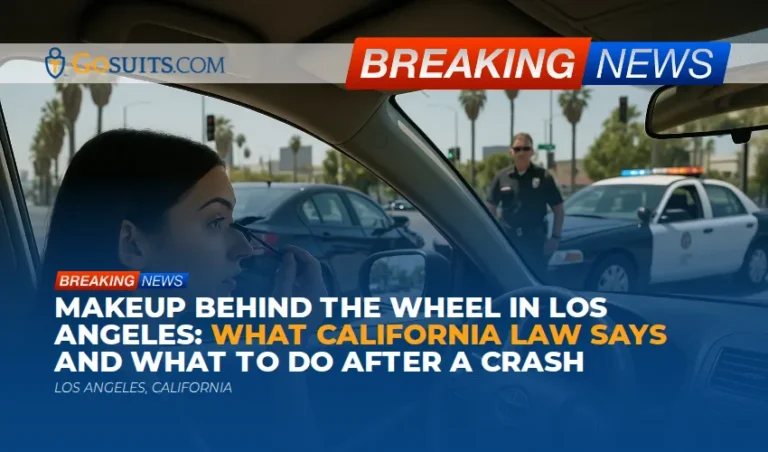
In California, there is no statute that specifically bans applying makeup while driving. That said, the law does prohibit operating a vehicle in a manner that is not careful and prudent, and it also restricts specific distracting behaviors like handheld phone use. If grooming causes a driver to swerve, roll through a red light, or rear end someone on the 405, officers may cite the driver under broadly applicable safety and movement rules. The most commonly implicated laws include California’s hands free device law for mobile phones and the general duty to operate a vehicle safely [1] [2].
California’s hands free law applies to wireless communications devices, not makeup. But it is part of a larger public safety focus on distraction. The California DMV and traffic safety agencies consistently warn that any activity taking a driver’s eyes off the road, hands off the wheel, or mind off driving is risky. Personal grooming, whether it is applying mascara, using a lash curler, or adjusting hair in the mirror while the car is moving, falls into the same risk category of visual, manual, and cognitive distraction that can lead to a citation if it results in unsafe driving behavior [1] [5].
California civil law also matters. In an injury case, the core question is typically whether a driver used reasonable care. That standard does not require perfection, but it does require attention and prudence. If a driver was applying makeup and failed to see a stopped vehicle ahead on the Hollywood Freeway, a civil jury could find the driver negligent for breaching the duty of ordinary care, regardless of whether any specific grooming statute exists [9].
How officers evaluate grooming behind the wheel on Los Angeles roads
On the streets of Los Angeles, from Pico Boulevard to Sepulveda and through the canyons into the Valley, officers judge conduct based on what they can observe and document. They typically look for the same telltale signs that indicate distraction of any type.
- Observable cues of distraction
- Lane departures, weaving within the lane, or drifting onto lane markers
- Failure to maintain speed in flowing traffic, sudden speed changes, or delayed starts at green lights
- Near misses, abrupt braking, or rolling stops at controlled intersections
- Driver seen looking into a visor mirror, using both hands off the wheel, or manipulating objects while moving
- Evidence they may collect
- Dash camera or body worn camera footage that shows driver behavior
- Witness statements from other motorists, cyclists, or pedestrians
- Skid marks, vehicle resting positions, and collision damage patterns
- Driver statements made at the scene, which are often documented in the collision report
Even without a statute that names makeup application, officers can issue citations for unsafe turning, following too closely, failure to yield, or reckless driving if the driving pattern shows a disregard for safety. And if the incident occurs on a state route like the 101, CHP usually handles the collision report process using its standard form and procedures [6].
When grooming becomes negligence or recklessness in a crash
Negligence in California is the failure to use reasonable care to prevent harm to oneself or to others. A jury can infer negligence from conduct like applying mascara during rush hour on the 110 while traffic compresses near the Downtown exits. The analysis is fact specific, but three themes recur in makeup while driving cases.
- Inattentiveness that causes a rule violation
- Rear ending someone at a light because eyes were on the mirror, not on the crosswalk signal change
- Drifting into a bike lane on Venice Boulevard while using one hand to apply eyeliner
- Foreseeable risk ignored
- Choosing to do personal grooming in heavy rain or Santa Ana wind conditions, when visibility and control are already reduced
- Attempting grooming through canyon curves on Laurel Canyon or Topanga where split second attention is crucial
- Severe inattention amounting to recklessness
- Prolonged eyes off road or both hands off the wheel at freeway speeds, suggesting a conscious disregard for safety
In civil court, the absence of a grooming statute does not shield a driver from liability. The question remains whether a reasonably careful person would have postponed makeup application until safely parked. If a jury answers no, liability can attach for injuries, property damage, and related losses. California’s comparative fault rule can also reduce recovery if multiple drivers shared responsibility, for example if one driver was grooming and the other was speeding through a yellow that turned red [9].

Insurance implications in grooming related collisions
Insurance adjusters often focus on distraction as a way to contest or reduce claims. If a policyholder or claimant admits to applying makeup, an insurer may argue the person failed to use reasonable care and is partially or entirely at fault. Early recorded statements can be used later to dispute liability. That is one reason many people choose to speak with car accident lawyers before giving any statement to an insurer.
Comparative fault also comes into play in Los Angeles. An adjuster might assert that a victim who was momentarily adjusting hair shares fault for a rear end collision, even if the other driver was following too closely. The degree matters. Minor self grooming that played no role in the collision is different from long periods of eyes off the road. Documentation, witness accounts, and scene evidence often determine how these arguments land. In practice, Los Angeles car accident lawyers routinely gather evidence to establish the real cause of the crash, not just the insurer’s preferred narrative.
Practical safety guidance for Angelenos
Los Angeles traffic is unique. Long commutes on the 405, quick hops along Santa Monica Boulevard, and those tight neighborhood streets in Koreatown or Silver Lake all demand constant attention. Small choices make a big safety difference.
- Finish grooming before the ignition turns on
- Use the mirror only while parked and out of live traffic
- Plan an extra two to three minutes before leaving, especially for morning school drop offs
- Pull over safely if something cannot wait
- Choose a legal parking spot, a rest area, or a safe lot, not a shoulder in fast traffic
- Use hazard lights only when appropriate and legal, and be mindful of no stopping zones common along PCH
- Reduce other distractions at the same time
- Set navigation and music before moving
- Secure cosmetics and other items so they do not roll or fall onto the floorboard
- Adjust for conditions
- When it is raining on the 10 or foggy near the beach, prioritize both hands on the wheel and eyes up
- In dense pedestrian areas like Downtown LA and Westwood, expect sudden stops and crosswalk activity
What to do right after a suspected distracted driving crash in Los Angeles
After any collision in LA County, priority one is health and safety. Then, preserving information matters. Here is a practical sequence that community members often find helpful after a crash where grooming may have played a role.
- Get emergency help and medical care
- Call 911 for injuries or hazards, and follow dispatcher instructions
- Accept medical evaluation even if you feel fine, since some injuries show later
- Request a police response when appropriate
- On freeways and state routes, CHP typically responds and prepares the collision report [6]
- Within city streets, local police often handle the scene; be sure to get the report number
- Document the scene
- Photograph vehicle positions, damage, skid marks, traffic signals, and any visible makeup or grooming tools in the cabin area
- Note the other driver’s behavior and statements, plus the time, weather, and traffic density
- Exchange information correctly
- Exchange driver license, registration, and insurance details
- Do not discuss fault; stick to facts needed for the exchange
- Preserve evidence quickly
- Save dashcam footage and any eyewitness contact information
- Consider nearby businesses that may have CCTV, since many systems overwrite within days
- California requires drivers to report certain crashes to DMV using the SR 1 form within 10 days if there is injury, death, or property damage of 1000 dollars or more [7]
- Be cautious with insurers
- Before giving a recorded statement to any insurer, consider speaking with a qualified attorney to understand your rights and how statements may be used later
For a step by step evidence plan tailored to California claims, see our guide: how to gather strong evidence for personal injury cases in california.
Who to contact for official records in Los Angeles County
Access to official records helps families and injured community members understand what happened and why. Here are key agencies and what they provide in the greater Los Angeles area.
- California Highway Patrol collision reports
- CHP provides crash reports for incidents on state routes and freeways. Requests are made using the CHP 190 form and can be submitted by mail or in person to the appropriate CHP office. Eligibility and proof of involvement are required [6].
- DMV accident reporting and requirements
- California’s DMV SR 1 form must be filed within 10 days for any crash involving injury, death, or property damage of 1000 dollars or more, regardless of fault. The DMV describes when and how to file, and what information to include [7].
- Los Angeles County Medical Examiner Coroner
- In fatal collisions, the Medical Examiner Coroner maintains records related to cause and manner of death. Families can request certificates and certain reports through the county’s established process. Availability and timelines vary by case [8].
If a collision occurred on a city street and was handled by a municipal police department, the records division of that department typically processes police report requests. Processing times can vary with demand and case complexity.
California and national research on distraction
Why does the discussion about makeup behind the wheel matter so much in Los Angeles? Because distraction is a well documented crash factor on urban streets and high speed corridors alike. National and state agencies repeatedly find that taking attention away from the task of driving contributes to serious harm.
- National risk picture
- NHTSA identifies distraction as a leading risk that involves visual, manual, and cognitive components. Activities like texting and handheld phone use are the most studied, but personal grooming also creates similar off task patterns that elevate crash risk [3].
- Public health perspective
- CDC frames distracted driving as a preventable public health issue, emphasizing that even brief glances away at 55 mph can mean traveling the length of a football field without looking at the road [4].
- California’s enforcement and education focus
- The California Office of Traffic Safety highlights annual enforcement and awareness campaigns targeting distraction and reminds drivers that any activity that diverts attention from driving increases crash risk [5].
While statewide data sets often categorize distraction broadly, the common thread is clear. On Los Angeles corridors like the 134 or the 210, seconds matter. Grooming behaviors that seem quick or harmless can have outsized consequences in the flow of SoCal traffic.
How courts and juries may view makeup at the wheel cases
Jurors bring everyday experience into the courtroom. Many know what it is like to be cut off on the 405 by a driver looking into a visor mirror. In a civil case, each side presents evidence about what caused the crash. Here is how these cases often unfold.
- Establishing the standard of care
- Civil juries are instructed to decide whether the driver used reasonable care under the circumstances. Prolonged grooming while moving is usually hard to square with this standard [9].
- Proving what the driver was doing
- Direct evidence can include eyewitness accounts or admissions. Circumstantial evidence may include makeup smears on airbags, an open cosmetics bag on the passenger seat, or dashcam video capturing the behavior.
- Comparative fault arguments
- Defendants may claim other drivers were also negligent, such as speeding or unsafe lane changes. California’s comparative fault rule allows jurors to apportion percentages of responsibility among those involved [9].
- Damages and causation
- Even if grooming occurred, the core questions remain whether it contributed to the collision and what harms resulted. Medical records, expert opinions, and repair estimates typically support these findings.
In the end, a case about makeup while driving is not about appearances. It is about attention, safety, and the reasonable choices drivers make in Los Angeles traffic.
Actions the public can take now to reduce risk and protect rights
This section is intended to help the community understand practical next steps and why timing matters.
- Make a prevention plan before your next drive
- Set a routine to complete grooming before leaving the driveway. Build two extra minutes into your morning schedule to avoid the temptation of visor mirror touch ups in motion.
- Place a small cosmetic kit in your bag so you can park legally and finish after you arrive.
- Know where official records come from
- Learn in advance how CHP collision reports and DMV SR 1 reporting work so you are not scrambling after an incident [6] [7].
- Understand that certain records in fatal collisions come through the County Medical Examiner Coroner and can take time to process [8].
- Document early while details are fresh
- Photos, names, and notes taken the same day often carry more weight than recollections weeks later. Surveillance video from nearby businesses may overwrite within days.
- Vehicle event data recorders may capture speed and braking, which can be crucial in contested cases.
- Be careful with insurance communications
- What someone says to an insurer can be cited back to them later. Recorded statements can affect liability decisions. Consider getting a free consultation with a seasoned attorney before contacting any insurance company so you understand how to protect your rights.
- Act within key timeframes
- DMV requires SR 1 reporting within 10 days for qualifying crashes, and police report request windows and storage periods for video evidence may be short. Acting promptly can preserve critical proof [7].
Commentary from Gosuits Los Angeles, California Personal Injury Attorney
Our hearts go out to anyone hurt in a crash where distraction or grooming may have played a role. Los Angeles traffic already demands a lot from every driver. This overview is meant for general information and education, and it should not be taken as a substitute for personalized guidance on any specific case.
From our vantage point, applying makeup behind the wheel is a classic example of a small choice leading to big consequences in LA’s fast moving traffic. The absence of a statute that names grooming does not change the core duty to pay attention and drive safely. When a crash happens, the focus in civil claims is on what was reasonable in the moment and what actually caused the harm.
We also see how insurance companies and large corporations use unfamiliar rules and processes to their advantage. They may push for quick recorded statements, frame distraction to inflate a victim’s share of fault, or delay the release of key records. Without context, it is easy for someone to say something that later gets used to weaken a valid claim.
That is why early, no obligation consultations matter. A brief conversation can help someone understand their rights, how comparative fault may be argued, what evidence should be preserved, and the safest way to handle insurer outreach. Knowledge levels the playing field so decisions are made with clarity, not pressure.
References
- Cell Phones and Texting Laws – California DMV
- California Vehicle Code § 23123.5 Handheld Wireless Telephone/Device – California Legislature
- Distracted Driving Overview – NHTSA
- Distracted Driving Facts – CDC
- Distracted Driving Program and Research – California Office of Traffic Safety
- Collision Report Request CHP 190 – California Highway Patrol
- Report of Traffic Accident SR 1 Requirements – California DMV
- Los Angeles County Medical Examiner Coroner – County of Los Angeles
- California Civil Code § 1714 Duty of Ordinary Care – California Legislature