- What we know about the crash near Avenue 17 and Daley Road
- Local context and safety concerns at rural Madera County intersections
- Civil liability questions raised by a suspected DUI collision
- What families can do in the first days after a fatal crash
- How to request key records in California
- Insurance and financial considerations after a fatal crash
- Common pitfalls to avoid when insurers call
- Community resources and where to ask for help in Madera County
- Data on impaired driving and rollover risk
- What to expect from the investigation timeline
- Why taking action matters now
- Commentary from Gosuits Madera, California Personal Injury Attorney
- References
What we know about the crash near Avenue 17 and Daley Road
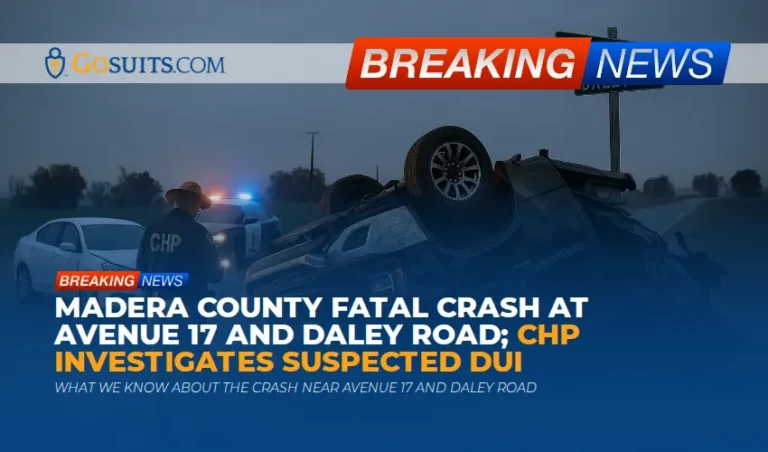
According to information released by the California Highway Patrol, a fatal traffic crash occurred in Madera County at the intersection of Avenue 17 and Daley Road in the early morning hours. Investigators report that a white Ford sedan was struck at the intersection. For reasons not yet known, the Ford’s driver fled on foot after the impact. A GMC Denali allegedly struck the Ford, then continued north on Daley Road and lost control, flipping multiple times. The Denali’s driver was ejected and pronounced deceased at the scene. CHP noted that DUI is suspected, stating that multiple beer cans were found inside the vehicle. No identities have been released, and the investigation remains ongoing.
At this stage, the official account emphasizes that details are still developing. In situations like this, CHP collision investigators typically document skid marks, roadway evidence, vehicle damage profiles, and any available video or witness statements to reconstruct the sequence of events. Toxicology testing, if ordered by the coroner, and evidence inside the vehicle can also become part of the investigative record.
Local context and safety concerns at rural Madera County intersections
Madera County’s grid of Avenues and Roads runs through farmland, orchards, and dairies. Many intersections outside the city of Madera have wider sightlines but limited lighting, fewer traffic signals, and variable shoulder conditions. That combination can make nighttime or pre-dawn driving more challenging, especially at rural crossroads like Avenue 17 and Daley Road. Even when traffic is light, higher speeds and driver impairment can dramatically increase the severity of crashes. Local residents know how quickly windborne dust, irrigation runoff, or uneven edges can complicate a driver’s split-second decision.
Community members also point out that the stretch north of Madera toward the San Joaquin River, and south toward Highway 145, includes routes used by farmworkers, school traffic on weekday mornings, and service vehicles. This layered traffic mix is one reason investigators look carefully at speed, sight distance, headlight use, and right-of-way at rural intersections when reconstructing collisions.
Civil liability questions raised by a suspected DUI collision
While criminal issues are separate and may develop later, a suspected DUI in a collision is highly significant to the civil law questions that follow. In California, impaired driving can be evidence of negligence, which is the foundation for civil liability in injury and wrongful death cases. State data and federal guidance consistently recognize that alcohol impairment increases crash risk and fatality risk substantially [6][7][8].
Additionally, California law requires drivers involved in a crash resulting in injury or death to stop, provide information, and render reasonable assistance. Fleeing the scene can have serious legal implications, including how insurers evaluate fault and cooperation, and it may affect civil claims that arise from the crash [2]. The reported fact that the Ford driver left on foot is a detail investigators will consider; however, civil liability often depends on who caused the initial impact, whether subsequent losses were foreseeable, and how each person’s conduct contributed to the harm. California’s comparative fault rules can apportion responsibility among multiple parties based on the evidence.
Because the Denali driver tragically died, the potential claims framework can be complex. If a decedent’s conduct is found negligent, claims against their estate may be pursued by injured parties. If other parties share fault, survivors of the decedent might consider certain civil avenues, subject to facts and the law. It is too early to draw conclusions from limited public details, which is why documentation and timely requests for records are so critical in the days and weeks after a fatal collision.
What families can do in the first days after a fatal crash
It is incredibly hard to navigate paperwork when grieving. Still, some early steps can protect a family’s ability to understand what happened and make informed choices later. Consider the following sequence, adjusting as appropriate to your circumstances:
- Preserve evidence quickly Save any photos, vehicle location data, dashcam footage, or phone records that might relate to the crash. Ask nearby residents or businesses along Avenue 17 and Daley Road if their security cameras caught any portion of the incident. A simple written request to preserve video can prevent automatic overwriting.
- Request the CHP collision report California Highway Patrol maintains the official collision report for crashes it investigates. Next of kin and involved parties can submit a CHP 190 form and proof of relationship to obtain the report when it becomes available [1].
- Track coroner and autopsy records Under California law, county coroners investigate certain deaths, including those from vehicle collisions [12]. Families can inquire about autopsy findings and toxicology timelines. Release policies vary, and some materials are confidential during an active investigation.
- Obtain death certificates Certified copies are needed for many tasks. The California Department of Public Health outlines how to request death certificates, either through the county or state office [11].
- Consider benefits and support programs California’s Victim Compensation Board may assist eligible families with certain expenses related to violent crimes, including DUI crashes under specific criteria [10]. Review eligibility carefully.
- Speak with a seasoned attorney before contacting insurers Early insurance statements can affect fault determinations and coverage decisions. In California, many families consult counsel first to understand what to say, what to request, and how to avoid unintentional admissions that could be used against them later.

How to request key records in California
CHP collision report for the Madera area
For crashes investigated by CHP, involved individuals or next of kin typically submit Form CHP 190 along with identification and any required fee. The report is requested from the specific Area office that handled the investigation. CHP describes eligibility, acceptable proof, and processing on its public site [1]. If you are unsure which office handled the report, CHP’s Find an Office page can help route your inquiry [13].
Coroner and autopsy records
California Government Code section 27491 outlines the coroner’s duty to investigate certain deaths, including vehicle fatalities [12]. Autopsy reports and toxicology results may be available to next of kin, subject to investigative holds and statutory privacy limits. If multiple agencies are involved, coordinate requests so you do not miss deadlines or receive partial records. Ask the coroner’s office about anticipated timeframes for toxicology, which often takes several weeks.
Death certificates and vital records
Death certificates are issued at the county level and by the California Department of Public Health. The state’s vital records page lists the application process, identification requirements, and options for obtaining certified copies by mail or in person where available [11]. Obtaining multiple certified copies can be helpful for estates, benefits, and insurance tasks.
Toxicology and DUI evidence
In suspected DUI cases, toxicology from the decedent or involved drivers can be central. Investigators may rely on breath or blood analysis collected under state protocols, and the coroner may conduct separate testing for a deceased driver. Ask both CHP and the coroner which office will release results, and whether those results will be appended to the final collision report or provided separately.
Insurance and financial considerations after a fatal crash
California allows two main civil pathways when a death results from a wrongful act. A wrongful death claim compensates certain surviving family members for their own losses under Code of Civil Procedure section 377.60 [3]. A survival action belongs to the decedent’s estate and can address harms the decedent suffered before death, including potential punitive damages when supported by evidence, as outlined in section 377.30 and Civil Code section 3294 [4][9]. The statute of limitations for wrongful death actions in California is generally two years from the date of death under CCP 335.1, but timing can vary depending on the claim and defendants involved [5].
Families sometimes also evaluate uninsured or underinsured motorist coverage on their own household policies, especially if any responsible party lacks adequate insurance. These claims have special notice and proof requirements, so review policy language early and track all deadlines. When a crash involves disputed fault or a driver who fled, insurers may scrutinize statements, timelines, and any inconsistencies in the file. A careful plan for communications helps protect your rights.
In tragic incidents like this one, many people search for Madera car accident lawyers to help coordinate accident reconstruction, subpoena records, and handle communications with multiple insurers. Whether you choose to consult with counsel or proceed on your own, keep organized files of every letter, email, and claim number related to the crash.
Common pitfalls to avoid when insurers call
There is a natural urge to cooperate quickly with any insurance request. That cooperation can still happen, but in a way that protects your long-term interests. Consider these frequent missteps:
- Providing recorded statements before understanding coverage Adjusters may ask broad questions or seek admissions about speed, distraction, or alcohol use. Talk to an attorney first. What you say can be used against you later.
- Signing blanket medical or billing authorizations Carriers sometimes request expansive releases that let them collect records beyond what is relevant. Narrow the scope to what is reasonably necessary.
- Assuming one policy is the only source of recovery Between liability, UM or UIM, medical payments, and potential third-party coverages, multiple policies can interact. Be cautious before accepting quick offers that may not account for all losses.
- Waiting too long to preserve evidence Traffic camera video, nearby surveillance, and vehicle event data recorders can be overwritten or lost without notice. Send preservation letters as soon as possible.
Some families choose to work with car accident lawyers for guidance on recorded statements, document requests, and preservation letters. Even a single consult can clarify your approach before you engage directly with adjusters.
Community resources and where to ask for help in Madera County
In and around Madera, multiple public agencies and service providers play a role after a serious crash. While contact details can change, the following are commonly involved for incidents in the Avenue and Road grid north and west of the city:
- California Highway Patrol, Madera Area Investigates many crashes outside city limits. Their collision report process and Area office directory are available to the public [1][13].
- County Coroner’s Office Responsible for death investigations and, when applicable, autopsies and toxicology. The office can explain access to reports for next of kin under California law [12].
- California Department of Public Health, Vital Records Guides families on obtaining certified death certificates for estate, benefits, and insurance matters [11].
- California Victim Compensation Board Offers potential financial assistance to eligible victims and families in qualifying incidents [10].
- Regional medical centers Depending on transport and severity, serious crash patients from Madera County are often taken to Fresno trauma centers. While this incident resulted in on-scene fatality, families in other cases may need to coordinate records and bills across multiple hospitals.
Data on impaired driving and rollover risk
Alcohol impairment remains a leading contributor to severe roadway trauma. State and national data underline why suspected DUI crashes are so devastating. Key points from public sources include:
- Impaired driving deaths remain significant National Highway Traffic Safety Administration research shows thousands of people die annually in alcohol-impaired crashes nationwide, and impairment increases the risk of fatal injury dramatically [7].
- California continues targeted enforcement and education The California Office of Traffic Safety reports ongoing campaigns to reduce DUI-related fatalities and serious injuries, with alcohol involvement remaining a critical safety focus [6].
- Rollover dynamics and ejection risk NHTSA notes that rollovers are among the most severe crash types. Unbelted occupants face a significantly higher risk of ejection and death in rollovers, while seat belt use markedly lowers that risk [14].
- Seat belt use saves lives Decades of data confirm that lap-shoulder belts are one of the most effective protections against fatal injury and ejection across all crash modes [14].
These are general safety findings and are not specific to this incident. Investigators will examine whether impairment, speed, belt use, or other factors contributed to the Madera County crash as more information becomes available.
What to expect from the investigation timeline
After a fatal crash on county roads like Avenue 17 and Daley Road, CHP typically completes a scene investigation, later supplements the report with lab or coroner findings, and may consult specialized units for collision reconstruction. Families and involved parties should expect staggered document availability. Initial collision reports may be released first, with toxicology and supplemental narratives following weeks later.
Because rural intersections sometimes lack fixed traffic cameras, it helps to think creatively about video. Ask nearby homes, farms, or small businesses for exterior footage. Also consider private dashcams from passersby and commercial fleet cameras. For larger city corridors, municipal traffic cameras or Caltrans cameras may exist, but out in the county, private footage is often the key. If you anticipate pursuing a claim, you can learn practical steps in our guide on Request CCTV Footage After a California Car Accident.
Vehicle event data recorders can capture speed and braking inputs in the moments before a crash. Timely preservation and proper access protocols are important if you plan to use this evidence later. Some families coordinate preservation letters to both involved drivers’ insurers and to any towing or storage yards that may have custody of vehicles.
Why taking action matters now
Here is what community members can do, and why timeliness matters:
- Document what you can while memories are fresh Within days, write down what you saw, heard, or were told, including times and weather conditions. Details fade quickly, and a contemporaneous account helps future investigators or insurers understand the sequence.
- Request essential records on a rolling basis CHP reports, autopsy findings, and toxicology results are released on different schedules. Submitting requests early creates a paper trail and can reduce delays.
- Secure private video before it is overwritten Many camera systems overwrite in 3 to 14 days. A brief written preservation request can be the difference between having objective video and having none.
- Plan communications with insurers deliberately Statements given early can shape a claim’s trajectory. Consult with legal counsel first to understand rights, coverage interactions, and potential pitfalls.
- Track deadlines California wrongful death and survival laws have strict timelines. Missing a deadline can foreclose options later, even if liability appears strong on the facts [3][4][5].

Commentary from Gosuits Madera, California Personal Injury Attorney
Our hearts are with everyone affected by this tragedy near Avenue 17 and Daley Road. A life lost on familiar county roads impacts neighbors far beyond one intersection. This discussion is meant for education and general information so people in our community can better understand what steps come next and what questions to ask.
From a civil perspective, a suspected DUI and a reported rollover with ejection raise serious concerns about decision-making behind the wheel and the violent forces at play when a heavy SUV loses control. When someone leaves the scene on foot, it also complicates the reconstruction process and can influence how fault is argued in insurance negotiations or, if necessary, in court. With details still emerging, the most productive thing families and involved parties can do is preserve evidence and request records promptly.
In our experience, insurance companies and corporations move quickly to contain their exposure. They may contact people at vulnerable moments, ask for broad medical and billing authorizations, and take recorded statements that are later interpreted in ways the speaker never intended. Without a plan, it is easy to give away leverage or miss sources of coverage entirely. Skilled guidance can help level the field, ensuring that communications are accurate, rights are preserved, and deadlines are met.
Obtaining a free consultation before speaking with any insurer is often a low-stress way to understand options. Even a short meeting can clarify which records to request, how to handle adjuster calls, and what timelines apply to wrongful death or survival actions in California. No one should have to navigate those steps alone while grieving.
References
- Collision Report CHP 190 – California Highway Patrol
- Vehicle Code § 20001 Duty to Stop – California Legislature
- Code of Civil Procedure § 377.60 Wrongful Death – California Legislature
- Code of Civil Procedure § 377.30 Survival Actions – California Legislature
- Code of Civil Procedure § 335.1 Two-Year Limit – California Legislature
- Quick Statistics – California Office of Traffic Safety
- Drunk Driving – National Highway Traffic Safety Administration
- Impaired Driving Facts – Centers for Disease Control and Prevention
- Civil Code § 3294 Punitive Damages – California Legislature
- Victim Compensation – California Victim Compensation Board
- Vital Records – California Department of Public Health
- Government Code § 27491 Coroner Duties – California Legislature
- Find an Office – California Highway Patrol
- Rollover Safety and Seat Belt Protection – National Highway Traffic Safety Administration