- What we know about the I-57 Markham crash
- When and where it happened, and why that spot matters locally
- Injury reporting and medical transport in the South Suburbs
- How multi-vehicle interstate crashes are investigated in Illinois
- Potential civil liability considerations under Illinois law
- Insurance after a four-vehicle crash: how coverage may stack
- How to get official records and information
- Practical steps after a highway crash in the Chicago region
- Community safety reflections for the I-57 and 159th corridor
- Why acting now matters: next practical steps
- Commentary from Gosuits Markham, Illinois Personal Injury Attorney
- References
What we know about the I-57 Markham crash
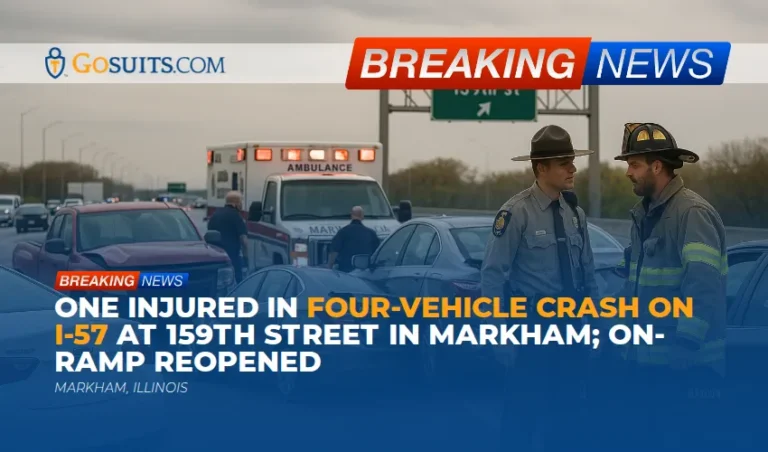
Illinois State Police reported a four-vehicle collision on northbound Interstate 57 at 159th Street in Markham around 11:58 a.m. One occupant was transported to a local hospital with injuries, and the on-ramp to northbound I-57 was briefly closed before reopening by 12:30 p.m. That is the extent of the confirmed public details at this time. The incident falls under Illinois State Police jurisdiction because it occurred on an interstate. Official crash reports are typically available through the Illinois State Police Crash Reports system once processed [1].
When and where it happened, and why that spot matters locally
The crash occurred just before noon, a time when lunchtime traffic often swells on the interstates feeding the South Suburbs. The 159th Street interchange area serves as a key connector for drivers moving between Markham neighborhoods, nearby Harvey and Posen, and retail corridors that sit off Kedzie Avenue and Pulaski Road to the west. Commuters who work in warehouses along the I-57 corridor or head toward Oak Forest and Midlothian also use this stretch regularly.
The I-57 and 159th Street interchange can feel busy even on a typical weekday. Merging traffic from the 159th on-ramp can interact quickly with through traffic moving at interstate speeds, and that mixed flow sometimes leads to sudden braking or lane changes. IDOT reminds drivers that congestion patterns and speed differentials at interchanges are common contributors to crashes statewide [2]. While the precise cause of this crash has not been released, the local traffic patterns help explain why incidents at this junction ripple fast through Markham midday routines.
Injury reporting and medical transport in the South Suburbs
When a crash with injuries happens on an interstate in Cook County, 911 dispatch routes ambulance services based on injury severity, roadway access, and hospital availability. Illinois operates a statewide trauma system overseen by the Department of Public Health, which designates trauma centers by level. In serious cases, EMS may transport to a Level I or Level II trauma center depending on proximity and capacity at that moment [5].
For families, it is common to receive few medical details initially. HIPAA privacy rules limit disclosure by hospitals to non-family members, and even family may initially receive limited information while clinicians stabilize a patient. Over the next 24 to 72 hours, the medical picture often becomes clearer as diagnostic tests return and physicians identify the full scope of injuries.
If injuries later prove significant, documenting symptoms early can help create a consistent record of pain, limitations, and treatment milestones. Keeping track of ER discharge instructions, follow-up appointments, prescriptions, and any work restrictions can be important if an insurance claim is later pursued.
How multi-vehicle interstate crashes are investigated in Illinois
Illinois State Police typically take the lead on scenes like this on I-57. Standard steps include securing the roadway, aiding the injured, preserving evidence, and documenting the positions of vehicles, debris, and skid patterns. Troopers may take statements from involved drivers and independent witnesses and record weather and lighting conditions.
Follow-on work can include measuring the scene, reviewing in-vehicle data where available, and checking for any potential roadside cameras. Not all highway cameras record or retain footage, and even when they do, retention can be short. Families often do not need to collect this evidence themselves; it is safer to focus on health and let the investigation process proceed. For later civil claims, experienced investigators and attorneys commonly request official records and, where appropriate, send preservation letters to help safeguard relevant material.
Because chain reactions are common in multi-vehicle highway events, investigators look carefully at sequence: who braked first, who struck whom, and whether any sudden lane changes or stopped traffic contributed. National highway safety guidance emphasizes that rapid detection and clearance of incidents can reduce secondary crashes, which is one reason responders quickly close or control on-ramps like 159th Street during an active investigation [8].

Potential civil liability considerations under Illinois law
Liability in a four-vehicle interstate crash can be straightforward or complex, depending on how the sequence unfolded. Illinois uses a modified comparative negligence rule with a 51 percent bar. That means a person’s recovery can be reduced by their percentage of fault, and if they are more than 50 percent at fault, they cannot recover from the other parties [3].
In practice, multi-vehicle crashes may involve several overlapping questions:
- Did any driver follow too closely or fail to maintain a safe speed? Rear-end impacts can indicate unsafe following distance, but investigators still consider road conditions and unexpected hazards.
- Were lane changes executed safely and with proper signaling? If an abrupt merge or unsafe lane movement led to sudden braking, fault can be apportioned accordingly.
- Did any vehicle stop or slow unexpectedly without hazard lights or with mechanical failure? Liability can sometimes extend to vehicle maintenance if a defect or failure is involved, though that requires evidence.
- Were any parties driving under conditions that reduced visibility or control? Rain, glare, or debris do not eliminate responsibility, but they may shape how fault is divided.
For those navigating civil claims after such crashes, the allocation of fault matters significantly. Even a small percentage can affect the final recovery under the comparative fault statute. This is one reason many people choose to consult counsel early, especially where multiple insurers and drivers are involved.
Insurance after a four-vehicle crash: how coverage may stack
Illinois requires liability insurance with minimum coverage limits for bodily injury and property damage. As of this writing, the Secretary of State outlines mandatory minimums all motorists must carry, and failing to meet those requirements can bring penalties and complicate claims [4].
In a multi-vehicle event, several coverage layers may come into play depending on fault allocation and injury severity:
- At-fault driver’s bodily injury liability for the injured person’s medical costs, lost income, and other damages up to policy limits.
- Underinsured motorist coverage from the injured person’s own policy if the at-fault policy is insufficient.
- Medical payments coverage where available to help with immediate medical bills regardless of fault.
- Multiple at-fault drivers can trigger multiple liability policies, with insurers negotiating contribution according to each driver’s share of fault.
Confusion often arises about which insurer pays first in chain-reaction collisions. For a deeper dive on how insurers typically sort out priority and contribution after a pileup, see Which insurance pays first after a multi-car crash.
A quick caution before speaking with any insurer: initial statements can be used later to limit recovery or dispute causation. It is usually prudent to consult an attorney first to understand rights and obligations, including what must be reported and when. When selecting help, many look to seasoned counsel familiar with multi-vehicle claims and how to coordinate medical documentation and wage proof across several adjusters.
How to get official records and information
Illinois State Police crash report
Because this collision occurred on I-57 in Markham, the primary police report should be available through the Illinois State Police Crash Reports system after processing. Request options and eligibility are outlined by ISP online [1]. If a case number is not known, the system typically allows searching by date and location.
Illinois State Police FOIA requests
For some materials not included in a standard crash report, a Freedom of Information Act request to ISP may be appropriate. ISP provides a FOIA portal that explains how to submit requests and what records may be available under state law, subject to exemptions that can apply in active investigations [7].
Cook County Medical Examiner information
This incident, as reported, involved injuries but no reported fatalities. In fatal events, next of kin can receive autopsy and cause-of-death information from the Cook County Medical Examiner’s Office. The county outlines record request procedures and public records availability on its official website [6].
Illinois Department of Transportation information
IDOT publishes statewide crash statistics and safety information that may help the public understand broader trends at interchanges and along interstate corridors. While IDOT does not release on-demand video from every camera, its safety and crash data resources are public and useful context for roadway risks [2]. For active travel conditions and incident impacts, Getting Around Illinois provides traveler information maps [9].
Practical steps after a highway crash in the Chicago region
Here are grounded, real-world actions people in our community often take after an interstate collision, especially one involving multiple vehicles. These steps are general information and not specific to any person’s situation.
- Seek and continue medical care. Even if an ER visit occurred, schedule prompt follow-up. Some injuries present gradually, and consistent documentation helps clinicians and later insurers understand causation and severity.
- Preserve evidence. Save photos from the scene, repair estimates, tow receipts, and damaged items like a cracked phone or child seat. If another driver’s dashcam footage exists, it may be requestable through counsel or preservation letters.
- Obtain the Illinois State Police crash report. The official report is a cornerstone document for insurance evaluation and, if necessary, civil claims [1].
- Track costs and time away from work. Keep pay stubs, timesheets, and a simple log of time missed and tasks you cannot perform. Those records often matter later.
- Be cautious with insurance communications. Recorded statements can be used to dispute fault or minimize injuries. Consulting an attorney first is generally recommended so rights are clear before speaking to any insurer.
- Review insurance coverages. Illinois minimums apply, but many drivers carry higher limits and optional coverages like underinsured motorist and medical payments that can help bridge costs [4].
- Document how injuries affect daily life. Short notes about sleep disruptions, missed family events, or difficulty driving can help clinicians and evaluators understand the human impact beyond bills.
When questions get technical, many people turn to car accident lawyers for guidance coordinating medical documentation, wage proof, and communications with several insurers at once.
In a large metro area, having Chicago car accident lawyers who routinely work with interstate pileups and multi-insurer coordination can help minimize common missteps during the first weeks after a crash.
Community safety reflections for the I-57 and 159th corridor
Residents who drive I-57 through Markham know that traffic can swing from brisk to bunched in a matter of seconds near 159th. Merge zones, lane shifts from construction seasons, and midday delivery traffic add up. IDOT’s crash data notes that interchanges are frequent locations for rapid speed changes and lane movements that elevate risk, which is why consistent spacing and signaling are emphasized in statewide safety campaigns [2].
Simple local habits can reduce risk for everyone:
- Leave longer following gaps at on-ramps. This gives merging drivers room and reduces chain-reaction braking.
- Signal early and check mirrors twice. Sudden lane changes in heavy Markham midday traffic often cascade into hard stops down the line.
- Scan ahead for brake lights and disabled vehicles. A quick check past the next semi or taller SUV can provide crucial extra seconds.
- During rain or after fresh snow, drop speeds and increase separation. IDOT and FHWA both stress that reduced friction and visibility magnify small errors into bigger events [2][8].
Local families and commuters share these lanes every day. Small courtesy moves, like letting one extra car in at the 159th on-ramp, genuinely help keep everyone flowing and safer.
Why acting now matters: next practical steps
Time-sensitive tasks often shape outcomes after a crash, especially on an interstate with multiple vehicles and insurers. Here is what should be prioritized, and why it matters:
- Request the official ISP crash report promptly. Reports are typically processed within days to weeks. Having it early helps clarify basic facts like vehicle order and contact details, which can speed up claims review [1].
- Consult an attorney before talking to insurers. Early statements can be used later to dispute causation or limit damages. A quick consultation helps align communications with your rights and obligations and reduces the chance of avoidable misstatements.
- Preserve evidence and send preservation notices where appropriate. Dashcam files, 911 logs, and commercial telematics may be overwritten on short cycles. Acting early increases the likelihood that relevant materials are saved.
- Coordinate medical follow-up and documentation. Missed appointments and gaps in care are frequently cited by insurers to question injury severity. Tight follow-up and consistent records counter that narrative.
- Identify all potential coverages. Liability, medical payments, underinsured motorist, and collision coverage may each play a role. Understanding the policy landscape early helps sequence claims efficiently [4].
- Track out-of-pocket costs and lost time right away. Receipts and a simple log of missed work are easier to assemble as you go than months later.
Acting within the first two weeks often preserves more evidence, reduces disputes over statements, and keeps medical records aligned with the timeline of the crash. Those advantages can be hard to recreate later.
Commentary from Gosuits Markham, Illinois Personal Injury Attorney
Our hearts go out to the person hurt on I-57 and to everyone shaken by the four-vehicle crash near 159th Street. This note is shared for educational purposes and general information so neighbors in Markham and the South Suburbs can better understand what usually happens after a multi-vehicle interstate collision.
Based on what has been reported, this appears to be a rapid, midday chain of events at a busy interchange. In our experience, crashes at on-ramps like 159th often involve a combination of merging friction and variable speeds, which means the sequence of impacts matters a great deal. Careful review of the police report, scene photos, and any available witness accounts usually clarifies the order of collisions and how responsibility should be allocated.
Insurance companies and large corporate policyholders are quick to take recorded statements and lock in versions of events. They may also request broad medical authorizations or push early, low evaluations before the full picture of injuries emerges. Those tactics count on people not knowing what must be shared, what can wait, and what the law allows insurers to ask. That is why it is important to understand your options and speak with a skilled advocate before providing statements or signing releases.
A free consultation can level the playing field. It gives a chance to review the Illinois comparative negligence framework, go over the Illinois State Police report, and discuss how to protect claims while medical care continues. That early clarity reduces avoidable mistakes and helps ensure the process respects the person behind the paperwork.
References
- Illinois State Police Crash Reports
- Illinois Crash Facts and Statistics – Illinois Department of Transportation
- 735 ILCS 5/2-1116 Comparative Fault – Illinois General Assembly
- Mandatory Insurance – Illinois Secretary of State
- Illinois Trauma Centers – Illinois Department of Public Health
- Cook County Medical Examiner – Cook County Government
- Freedom of Information Act Requests – Illinois State Police
- Traffic Incident Management Overview – Federal Highway Administration
- Getting Around Illinois – Illinois Department of Transportation