- What we know about the three-car crash at 183rd Street and Governors Highway
- Local context at 183rd Street and Governors Highway
- Immediate steps for witnesses and neighbors
- Where families can obtain official records and information
- Civil legal considerations after a fatal multi-vehicle crash in Illinois
- Preserving evidence in and around Homewood and Cook County
- Community safety reflections and data
- Practical guidance on insurance communications
- A compassionate note and ways communities often support grieving families
- Call-to-Action: Why acting promptly matters
- Commentary from Gosuits Homewood, Illinois Personal Injury Attorney
What we know about the three-car crash at 183rd Street and Governors Highway
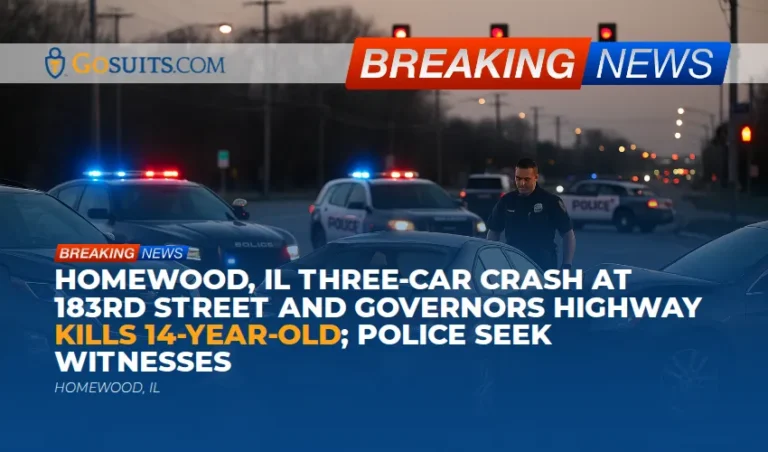
On Sunday night, a tragic three-vehicle collision at the intersection of 183rd Street and Governors Highway in Homewood took the life of a 14-year-old community member, identified publicly as Kyran Smith by the Cook County Medical Examiner. According to the Homewood Police Department, a Chevy Equinox traveling south on Governors Highway left the roadway and struck two cars that were stopped and facing westbound toward 183rd Street. The teen was a passenger in one of the stopped vehicles. He was pronounced deceased at approximately 8:50 p.m. Police reported that the Equinox’s driver initially fled but was quickly located, treated for minor injuries, and transported to a hospital. The drivers of the two stopped cars, along with another passenger, were also transported for medical care. The Homewood Police Department continues to investigate and asked witnesses to call 708-206-3420.
At this time, no official cause has been released. In multi-vehicle collisions like this, investigators typically review physical evidence at the scene, vehicle damage, roadway markings, possible surveillance footage, and witness accounts to reconstruct the sequence of events.
Local context at 183rd Street and Governors Highway
Neighbors know this is a busy junction that serves daily traffic across Homewood and adjacent communities. 183rd Street functions as a key east-west corridor, while Governors Highway carries significant north-south flow. Intersections with heavy turning movements, variable visibility at night, and mixed traffic speeds can challenge even attentive drivers. In early spring, evening hours can still bring glare, patchy illumination, or wet pavement depending on the weather. Those conditions can complicate braking distances and sightlines, though the official investigation will determine what mattered here.
If you drive this stretch routinely, you also know that rush hour stacks up westbound toward 183rd, and late-evening travel can feel deceptively quiet until a cluster of vehicles arrives at once. Community reports often highlight the importance of maintaining safe following distances approaching the stop line and keeping attention high for lane changes and merging movements near the intersection.
Immediate steps for witnesses and neighbors
If you witnessed the collision or have dashcam footage, even a few seconds of video or a clear recollection of vehicle positions can help investigators. The Homewood Police Department asked for tips at 708-206-3420.
- Share witness information promptly: Time matters because details fade and video systems overwrite quickly. If you saw anything or captured footage, call the number above and be ready to share the time, vantage point, and anything notable about the vehicles’ movements.
- Preserve any digital evidence: Save dashcam clips, doorbell camera footage, or smartphone photos to multiple places. Do not edit or add annotations. Note the exact time stamp if possible.
- Write down observations: Even brief notes about weather, lighting, traffic flow, horn sounds, braking, or lane positions can prove valuable. Keep them dated and in your own words.
- Mind personal wellbeing: If you were near the crash, consider a medical check. After high-stress incidents, symptoms sometimes appear later rather than immediately.
Where families can obtain official records and information
When a loved one is hurt or killed in a vehicle crash, families understandably need official documentation to understand what happened and to manage necessary paperwork. In Cook County and across Illinois, several agencies may hold relevant records.
Homewood Police Department crash report
The crash investigation is being handled by the Homewood Police Department. Families typically request a copy of the police report from the investigating agency once it is available. If a report is not immediately ready, you can ask when it is expected to be released and what the procedure will be for obtaining it. Some departments provide reports in person, others by mail, and some via a designated online vendor. Because Illinois public agencies operate under the Freedom of Information Act, written requests for certain records can be submitted pursuant to FOIA where appropriate [1].
If you plan to request records, include as much identifying information as you have: the date and time of the crash, the intersection, the vehicles involved, and the police report number if known.
Cook County Medical Examiner’s Office
The Cook County Medical Examiner’s Office oversees medicolegal death investigations in the county. For fatalities, families can request autopsy or official records through the Medical Examiner’s Office. Their official website provides instructions on how to request reports and what forms of identification or authorization may be required [2].
Hospital and EMS records
If your family member was transported by ambulance or treated at a hospital, medical records are generally maintained by those providers. Hospitals often have Health Information Management or Medical Records departments that provide copies upon proper authorization. If emergency medical services responded, EMS documentation may be requested from the responding fire department or ambulance service, subject to HIPAA and local procedures.
Traffic signal timing, 911 audio, and roadway data
In some cases, additional evidence such as 911 calls, CAD logs, or traffic signal timing data may exist. Certain traffic cameras or roadway devices are operated by state or county agencies. In Illinois, FOIA can be used to request non-exempt public records from state agencies like the Illinois Department of Transportation (IDOT) or local governments, though some materials may be exempt or retained only briefly [1]. If traffic control devices at this intersection are managed by IDOT, a FOIA request to IDOT may be an option for timing plans or maintenance logs [3].
Civil legal considerations after a fatal multi-vehicle crash in Illinois
While the official investigation will determine the facts, families often have pressing questions about civil responsibility and options in the aftermath of a deadly crash. The following information shares general Illinois principles and is intended for educational purposes.
Illinois law on duty to stop after a crash
Illinois law requires drivers involved in certain crashes to stop and remain at the scene, exchange information, and when appropriate, render reasonable assistance. These statutory duties are distinct from any criminal process, but the same facts can matter in a civil case focusing on negligence and damages. The Illinois Vehicle Code outlines obligations to stop and report in serious crashes involving injury or death [4].
Negligence basics and multi-vehicle claims
In a multi-vehicle collision, liability may rest with a single driver or be shared among multiple drivers depending on the facts. Civil negligence typically turns on whether a driver failed to use reasonable care under the circumstances, such as by speeding, becoming distracted, or failing to control the vehicle. In intersection and approach scenarios, issues can include lane position, following distance, roadway departure, and whether a vehicle was stopped lawfully and visibly. Insurance companies often conduct their own investigations in parallel with law enforcement.
Illinois modified comparative negligence
Illinois follows a modified comparative negligence framework. In general, an injured party may recover damages if they are not more than 50 percent at fault; however, their recovery can be reduced by their percentage of fault. The relevant statute codifies these principles for personal injury and wrongful death actions [5]. This becomes important in multi-vehicle claims when insurers attempt to apportion responsibility.
Wrongful death and survival actions in Illinois
After a fatal crash, Illinois law provides two complementary avenues that are commonly discussed: a wrongful death action and a survival action. The wrongful death statute generally allows certain family members, through a personal representative of the decedent’s estate, to seek damages for losses suffered due to the death caused by another’s wrongful act or neglect [6]. A survival action preserves certain claims the decedent could have brought had they lived, and those claims belong to the estate under the Illinois Probate Act’s Survival provisions [7].
Time limits apply. While statutes of limitation can vary depending on the facts and defendants, wrongful death actions in Illinois are generally subject to defined filing periods, and unique deadlines can apply if a governmental entity is involved. Families often find it helpful to understand these timelines early so that key evidence and records can be secured in time.
Insurance layers in a three-car crash
Determining which insurance pays first after a multi-vehicle collision depends on fault, available liability policies, and potentially uninsured or underinsured motorist coverage on involved vehicles. The Illinois Department of Insurance provides consumer-facing information on auto insurance requirements and coverage types, which can help people understand the role of liability and UM/UIM coverages in serious crashes [8]. For a deeper dive on how primary and secondary policies can interact after chain or multi-car events, see our plain-language guide, Which insurance pays first after a multi car crash.
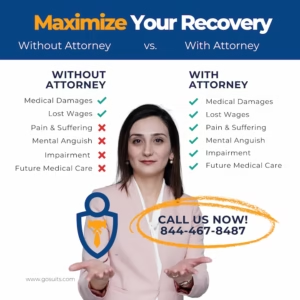
Because statements to a claims adjuster can affect fault allocation and coverage outcomes, many families prefer to consult with a trusted legal professional before engaging extensively with insurers. Experienced claim handling helps ensure that fault analysis is based on the full record, including vehicle data, scene mapping, and independent witness accounts.
Preserving evidence in and around Homewood and Cook County
Preserving evidence is often the backbone of a well-documented civil claim. Even when the official investigation is ongoing, additional materials can and should be safeguarded.
- Vehicle inspections and EDR data: Many modern vehicles contain an Event Data Recorder that can capture pre-crash speed, braking, throttle, and other parameters. Securing vehicles and retrieving EDR data properly can be critical in reconstructing what happened [9].
- Scene photographs and measurements: Skid marks, debris fields, gouges, and final rest positions can fade or be removed. Capturing high-quality photos and notes soon after the incident can be invaluable.
- Public records from transportation agencies: Depending on jurisdiction, signal timing charts, maintenance logs, and signage records may exist and can be requested via FOIA where appropriate [3].
- Medical and EMS documentation: Trauma care timelines, EMS narratives, and hospital records help anchor the medical picture. Illinois maintains a statewide trauma system, and understanding transfers or level-of-care decisions can contextualize injuries and attempts at resuscitation [10].
Community safety reflections and data
As neighbors process this loss, many also ask how often tragedies like this occur and what helps prevent them. State and federal data offer perspective, even as this specific investigation continues.
Illinois crash trends
IDOT publishes annual crash facts and statistics, including data on intersection crashes and multi-vehicle collisions across the state. While the most recent annual report may be pending at any given time, the Crash Facts series helps communities understand broader patterns and safety opportunities [11].
Teen risk and passengers
National traffic safety research has long noted that teen occupants are vulnerable in serious collisions, and that a vehicle’s speed, restraint use, and the number of passengers can influence risk. NHTSA’s resources on teen drivers and occupant protection remain a helpful reference for families and schools focused on prevention conversations [12].
Intersection safety principles
The Federal Highway Administration highlights various ways to reduce severe crashes at intersections, including improving sight distance, enhancing conspicuity of control devices, and encouraging speed management on approaches [13]. Locally, residents often advocate for measures like better lighting, refreshed markings, and public awareness, though specific engineering changes belong to the responsible road authority.
Practical guidance on insurance communications
Serious claims involve complex coverage questions, and recorded statements or casual comments can be used to shape fault determinations. Before calling an insurance company, it is prudent to discuss the situation with a qualified advocate. What you share with an insurer can be used to limit or challenge your claim later on.
Many people turn to car accident lawyers for help coordinating communications, preserving key evidence, and ensuring that all potential insurance layers are reviewed. When fatal or life-altering injuries are involved, aligning early on a careful documentation plan can make a significant difference as multiple carriers evaluate liability, medical causation, and damages.
In communities like ours, Homewood car accident lawyers are often asked to gather third-party evidence such as traffic signal data, canvass for nearby private cameras, and retain independent reconstruction professionals when warranted. That upfront work helps prevent incomplete narratives from forming too early in the process.
A compassionate note and ways communities often support grieving families
Homewood is a tight-knit place. When a young life is lost, people naturally ask what they can do. Common community responses include meal trains, school-based remembrance events, and support for siblings and classmates who may be struggling. For families facing unexpected end-of-life costs, Illinois also operates a Crime Victims Compensation Program in certain qualifying circumstances that may help with funeral and burial expenses. The Illinois Attorney General’s office provides public information about eligibility and application steps [14].
Faith communities, school counselors, and local nonprofits often coordinate emotional and logistical support. If you are organizing assistance, consider designating a single communication channel so the family is not overwhelmed by multiple simultaneous requests during the first days and weeks.
Call-to-Action: Why acting promptly matters
What should be done next? In serious crashes that cause catastrophic injury or death, there is a brief window where crucial details can still be captured and protected.
- Secure official records: Request the police report when it is available, and note the report number and investigating officer’s contact. If applicable, initiate requests for autopsy records and certified death certificates. Doing this early avoids delays later when you need them for administrative or legal needs.
- Preserve vehicles and data: If a vehicle is subject to storage or imminent disposal, ensure the responsible party knows it must be preserved. Event Data Recorder and component inspections are time-sensitive.
- Organize medical and expense documentation: Keep hospital bills, EMS invoices, funeral expenses, and any out-of-pocket receipts together. Clear records help accurately document losses.
- Plan insurance communications: Before calling any insurer, speak with a trusted legal professional to understand rights and avoid harmful statements. Insurance adjusters collect information immediately, and early statements can shape the entire evaluation.
- Identify and contact witnesses: Neighbors move, and camera systems overwrite quickly. Canvass the area for potential witnesses and ask them to write down what they saw, even if they think it is minor.
Why now? Most agencies retain digital materials for a limited time, and physical evidence changes by the day. Acting now preserves options for a thorough review later when decisions need to be made.
Commentary from Gosuits Homewood, Illinois Personal Injury Attorney
Our hearts are with the family and everyone in Homewood who is grieving this devastating loss. This article is meant to provide general information and education about processes and options that often follow a serious crash.
From what has been shared publicly, a southbound vehicle left the roadway on Governors Highway and struck two stopped cars at 183rd Street, tragically killing a 14-year-old passenger. In any multi-vehicle collision, especially at a busy intersection, it is vital that the full picture be documented: scene evidence, vehicle data, signal timing, witness accounts, and medical timelines. That complete record helps answer the most urgent questions families have.
Insurance companies and corporate defendants are skilled at moving quickly to shape fault narratives. Adjusters may seek early recorded statements, ask for broad medical authorizations, or propose partial payments before all facts or coverages are known. Those tactics can take advantage of people’s lack of familiarity with claims processes at the very moment they are least prepared to respond.
A no-cost consultation serves two purposes. First, it helps families understand their rights and the steps that protect them, without pressure to make immediate decisions. Second, it allows a skilled advocate to map out evidence preservation, coordinate with investigators, and manage insurer communications so that important details are not lost and premature conclusions do not take root. In a situation as serious and sensitive as this one, informed next steps matter.
References
- Illinois Freedom of Information Act Resources – Illinois.gov
- Cook County Medical Examiner’s Office – CookCountyIL.gov
- IDOT Safety and Roadway Information – Illinois Department of Transportation
- Illinois Vehicle Code, Duties After Accident – ILGA.gov
- 735 ILCS 5/2-1116 Comparative Fault – ILGA.gov
- 740 ILCS 180 Wrongful Death Act – ILGA.gov
- 755 ILCS 5/27-6 Survival of Actions – ILGA.gov
- Auto Insurance Basics – Illinois Department of Insurance
- Event Data Recorder Overview – NHTSA.gov
- Illinois Trauma Centers – Illinois Department of Public Health
- Illinois Crash Facts and Statistics – Illinois Department of Transportation
- Teen Driving Safety – NHTSA.gov
- Intersection Safety – Federal Highway Administration