- What Happened on Fillmore Street in Thermal
- Local Context: Thermal, Coachella Valley, and Fillmore Street Traffic Patterns
- Where Families Can Get Official Information and Records
- Emergency Care Pathways in the East Coachella Valley
- How Head-on Crash Investigations Work and Potential Civil Liability
- Common Injuries in Head-on Collisions and Why Documentation Matters
- Insurance Basics After a California Head-on Collision
- Victim and Family Rights in California: Deadlines and Key Protections
- Preserving Critical Evidence Early
- Community Safety Notes and Seasonal Risks in Thermal
- Action Steps People Can Take Now
- Commentary from Gosuits Thermal, California Personal Injury Attorney
- References
What Happened on Fillmore Street in Thermal
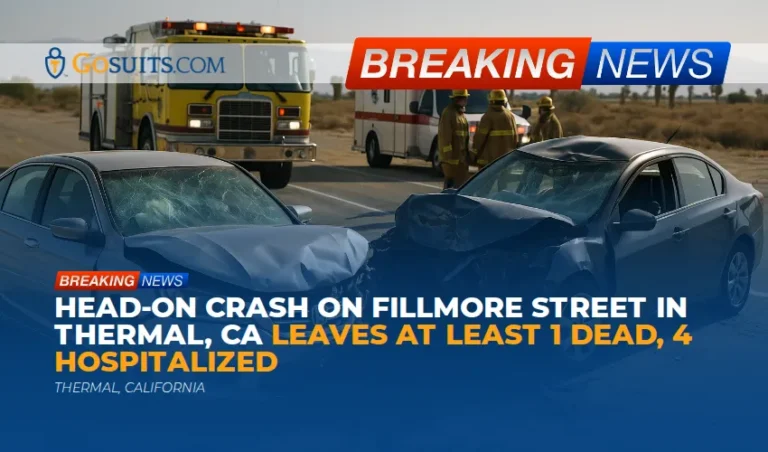
Shortly after 1 p.m. on Friday, March 13, 2026, a head-on collision involving two sedans occurred in the 58000 block of Fillmore Street in Thermal. First responders reported major damage to both vehicles. Four people were hospitalized from the scene. According to information released to the media, a Honda Accord traveling southbound on Fillmore veered into the northbound lane and struck a Toyota Camry that was traveling north. The Honda was occupied by a male driver, a female passenger, and a juvenile in the rear seat. The Camry was occupied by a male driver. Both drivers were transported by ambulance to area hospitals, while the woman and the juvenile were airlifted to a nearby hospital. Officials confirmed at least one fatality, though it was not immediately clear which party died from injuries. Authorities closed Fillmore Street in both directions for an unspecified period while they worked the scene and conducted the initial investigation.
Information provided publicly referenced the California Highway Patrol and a Riverside County firefighting response. In the Thermal area, traffic crashes on county roads often draw CHP investigation and local fire response. When fatalities occur, the county coroner’s bureau is also notified as part of the standard protocol in California.
Local Context: Thermal, Coachella Valley, and Fillmore Street Traffic Patterns
Thermal sits in the eastern Coachella Valley, just south of Indio and Coachella, and near Jacqueline Cochran Regional Airport. Fillmore Street runs through agricultural blocks where daytime traffic can include farmworkers, school traffic tied to Coachella Valley Unified School District schedules, and local residents traveling between neighborhoods like Mecca, Oasis, and Coachella. Around midday, drivers often encounter slow-moving equipment, pickups, delivery vehicles, and occasional dust or sand across the roadway that can reduce visibility. On straight rural segments, speeds can creep up unexpectedly, and opposing traffic may be closer than it looks. These local factors are not causes by themselves, but they can increase risk if drivers are distracted or misjudge closing distances.
Head-on collisions on two-lane roads are especially dangerous because the combined speed of both vehicles multiplies the energy of impact. National traffic safety publications have long noted the severity of frontal crashes compared with many other collision types, which is one reason centerline rumble strips and clear lane markings are proven safety countermeasures on rural corridors [5].
Where Families Can Get Official Information and Records
CHP Collision Report and Case Number
For injury or fatal crashes investigated by the California Highway Patrol, collision reports are requested using the CHP 190 form. Next of kin and involved parties can obtain the report, which typically includes diagrams, statements, and preliminary findings. CHP provides instructions on eligibility, identity verification, and how to submit by mail or in person [1] [2].
To help locate the correct file, have as much detail as possible ready: the date and time of the crash, the exact location on Fillmore Street, vehicle descriptions, and names of involved parties if known. If the investigation is ongoing, the report may not be immediately available, and certain sections can be temporarily withheld until the investigation phase is complete.

Coroner and Autopsy Information
When a traffic fatality occurs, the county coroner conducts an investigation that may include autopsy, identification, and determination of cause and manner of death as required by California law. While each county manages access to records, next of kin can typically request autopsy findings and related documents once they are finalized. General access to government records in California is guided by the California Public Records Act, although specific privacy protections and statutory exemptions apply to sensitive medical and investigative information [10].
Families also often need certified copies of the death certificate. In California, death certificates are issued through Vital Records. The California Department of Public Health explains how to obtain certified copies and what documentation is required for authorized copies [9].
Hospital and Medical Records
Injured patients, or a legal representative of a patient, can request medical records from the treating hospital. In the east valley, critical trauma cases are frequently routed to regional trauma centers depending on the patient’s condition and aircraft or ambulance availability, as described by the California Emergency Medical Services Authority’s trauma system framework [3].
Towing, Vehicle Location, and Personal Property
After a major collision, damaged vehicles are often towed to a local tow yard under law enforcement rotation. It can take several hours before records are updated. Involved owners should be prepared to show proof of ownership and valid identification to retrieve personal items once the vehicle is released. If a vehicle is retained for investigation, property retrieval may require additional coordination with the investigating agency.
Emergency Care Pathways in the East Coachella Valley
Air medical transport in the Coachella Valley commonly flies critical patients to the closest appropriate trauma resource. Desert Regional Medical Center in Palm Springs is a regional trauma hub for the valley, and other Southern California trauma centers can be used depending on aeromedical routing and patient needs. California EMSA maintains statewide trauma center listings and describes how trauma systems are organized, which helps explain why two injured individuals in this crash were transported by helicopter rather than ambulance [3].
Immediate care decisions aim to stabilize life-threatening injuries such as internal bleeding, traumatic brain injury, and complex fractures that are unfortunately common in head-on collisions. National agencies note that crash energy in frontal impacts can result in serious thoracic and head trauma, underscoring why early airway, breathing, and circulation management is critical [5].
How Head-on Crash Investigations Work and Potential Civil Liability
In a head-on collision, investigators typically examine lane positions, tire marks, debris fields, crush damage, and vehicle resting points to determine the line of travel and point of impact. On rural two-lane roads like Fillmore Street, measurements of skid or yaw marks and analysis of gouge marks near the centerline can be important. Vehicle event data recorders, where available, may store pre-crash speed, braking, and seat belt usage that can assist reconstructionists and insurers [11].
From a civil perspective, early statements that a vehicle crossed into the opposing lane suggest potential fault, but final liability assessments depend on the full set of facts, including any evidence of sudden mechanical failure, evasive maneuvers to avoid an obstacle, or unexpected hazards. California applies comparative negligence, which means responsibility for damages can be apportioned between multiple parties if more than one person’s negligence contributed to the crash. This modern fault framework stems from a seminal California Supreme Court decision that replaced the old all-or-nothing contributory negligence rule [8].
Because facts often change as more information is gathered, it is prudent not to draw conclusions before the collision report and any supplemental analyses are complete. If you plan to notify any insurer, consult a qualified attorney first. What someone says to an insurance adjuster can be used against them later if details were incomplete or misremembered. In serious cases like this, many people choose to speak with car accident lawyers before making recorded statements to carriers.
Common Injuries in Head-on Collisions and Why Documentation Matters
Head-on crashes are associated with significant traumatic forces. Medical literature and national safety analyses indicate a higher likelihood of serious injuries including brain trauma, spinal injuries, chest injuries from seat belts and airbags, abdominal injuries, and lower extremity fractures due to footwell intrusion in severe impacts [5] [12]. These injuries can be life-altering and may require surgeries, extended rehabilitation, and long-term follow up.
Detailed documentation helps both medical teams and future claims. That includes imaging results, surgical notes, discharge instructions, and follow-up treatment plans. Day-to-day symptom journals and photos of visible injuries can also help capture pain levels, limitations, and the real impact on daily life. Thorough documentation is not about litigation first. It is about ensuring continuity of care and creating a reliable record of what happened and how recovery progressed.
Insurance Basics After a California Head-on Collision
California uses a fault-based auto insurance system. Typically, the insurer for the at-fault driver is financially responsible for harms caused, subject to policy limits. Every policy is different, but common coverages include liability, medical payments, collision, and uninsured or underinsured motorist coverage. The California Department of Insurance provides consumer explanations of these coverages, including the role of uninsured and underinsured motorist protection that can be especially important in serious crashes where losses exceed the at-fault driver’s policy limits [6].
When families face catastrophic losses, it is common to see several claims proceed in parallel. Liability claims may be pursued with the at-fault driver’s carrier. Uninsured or underinsured motorist claims may be made on the injured person’s own policy when available. Medical payments coverage, if carried, can help with certain medical bills regardless of fault. Policy language has details and exceptions that are easy to overlook during a crisis. Before opening any claim or giving statements, many people consult Thermal car accident lawyers for guidance about sequencing claims and avoiding early missteps that complicate recovery.
In fatal collisions, California law allows certain relatives to bring civil actions under the wrongful death and survival frameworks. These are separate but related legal pathways. For a plain-language walk through of common issues that arise after a traffic death, see this resource on what happens if someone is killed in a car accident.
Insurance companies often move quickly after a severe crash. Adjusters may ask for recorded statements, authorizations, or encourage early settlements. People sometimes feel pressure to sign broad medical or employment releases. Before responding, it is wise to speak with car accident lawyers who can explain the implications of releases, reservation of rights letters, and policy limits disclosures available under California law [7].
Victim and Family Rights in California: Deadlines and Key Protections
Several time-sensitive rules can affect civil claims after a crash in California. The general statute of limitations for personal injury and wrongful death is two years from the date of the injury or death, though facts can change how these periods apply. The controlling statute is California Code of Civil Procedure section 335.1 [7]. There are shorter deadlines when a public entity may be implicated, and there are special rules for minors and certain delayed discovery scenarios. Because deadlines are strictly enforced, attention to timing is critical even while grieving or recovering.
California follows a comparative negligence system, which allows financial responsibility to be divided among at-fault parties based on their percentage of fault. This ensures that a claimant is not barred entirely if they are assigned a share of responsibility. The doctrine was established by the California Supreme Court and has been a foundation of modern California personal injury law for decades [8].
If a household faces funeral costs and related immediate expenses, it may be helpful to connect with the treating hospital’s social services team for resource lists, and to review applicable insurance coverages that may include limited funeral benefits. Each policy differs, and coverage depends on the contract language.
Preserving Critical Evidence Early
Evidence can degrade quickly on a rural road. Tire marks fade, sand is graded away, and vehicles are moved to tow yards. Here are practical steps many families choose to coordinate promptly with the help of a representative:
- Photograph the roadway and surroundings as soon as safely possible. Capture lane markings, shoulder conditions, lighting, and any debris or gouge marks.
- Document vehicle damage at the tow yard from all angles, including the interior. Photograph airbags, seat belt anchors, and pedals.
- Request preservation of event data recorder information when applicable. Many vehicles store limited pre-crash data that can be downloaded by qualified technicians [11].
- Secure 911 audio and dispatch logs through the appropriate agency’s records process. Response times and call details can matter.
- Identify potential third-party footage such as farm cameras, business cameras, or home doorbell cameras along Fillmore Street. Camera owners often overwrite footage within days.
- Track medical records and bills from every provider. Keep discharge summaries and follow-up instructions in a single folder.
If you are considering an insurance claim, consult an attorney first. What a claimant says to an adjuster can be used later to dispute fault or injuries, and early misstatements can be hard to correct. Many people choose to consult car accident lawyers before engaging directly with insurance representatives.
Community Safety Notes and Seasonal Risks in Thermal
In the Coachella Valley, seasonal wind events can reduce visibility and push sand across east valley roads. Agricultural harvest periods create peaks in local traffic, with early afternoon movement as shifts change. After storms, lane markings can be obscured by silt or puddling. Drivers unfamiliar with rural two-lane dynamics might misjudge closing speeds or attempt unsafe passing. State and national data continue to show that speed, distraction, and lane departures are key contributors to crash severity, especially on non-divided roads [4] [5].
Local agencies frequently evaluate countermeasures for corridors like Fillmore Street. These may include improved centerline markings, shoulder maintenance, and selective enforcement when warranted. Residents can support safety by reporting faded striping, downed signs, or persistent hazards through county service channels.
Action Steps People Can Take Now
Below are practical, time-sensitive steps that community members often take after a severe collision. These are general information points, not legal advice.
- Collect official identifiers. Note the investigating agency, incident number, and tow yard location as soon as possible. This reduces delays later when requesting records or property.
- Request the collision report the correct way. Use the CHP 190 process if CHP handled the investigation. Follow the identity verification and submission instructions carefully [1] [2].
- Obtain necessary vital records. If a loved one was lost, locate the needed documents and identification to request certified death certificates through California Vital Records [9].
- Preserve vehicles and data. Ask the tow yard not to crush or salvage the vehicle until a decision is made on inspection. Where applicable, request preservation of event data recorder information [11].
- Coordinate medical follow up. Keep every appointment and save discharge paperwork. Gaps in care can harm health and later claims documentation [12].
- Review insurance coverages. Carefully check policy limits, med-pay benefits, and uninsured or underinsured motorist coverage. The Department of Insurance provides plain-language information about auto coverages in California [6].
- Speak with a qualified attorney before calling insurers. Recorded statements and signed releases can affect fault determinations and recovery. Many people first consult car accident lawyers to understand their rights and obligations.
- Act within legal timelines. California has strict limitation periods for personal injury and wrongful death claims. Delays can forfeit rights even with strong facts [7].
Taking these steps early helps preserve choices. Acting now can reduce the risk of losing key evidence or missing deadlines that cannot be extended later.
Commentary from Gosuits Thermal, California Personal Injury Attorney
Our hearts are with everyone affected by the head-on collision on Fillmore Street. Incidents like this change lives in a moment, and there is nothing easy about the hours and days that follow. The information here is intended for education and general awareness so that our neighbors in the Coachella Valley have a clearer picture of the process ahead.
Based on publicly available details, investigators reported that a southbound sedan veered into the northbound lane and struck another vehicle head-on. That initial description points to a lane departure, but final responsibility depends on a full review of roadway evidence, witness accounts, and vehicle data. In rural two-lane head-ons, small details matter. Measurements of tire marks, roadway conditions like windblown sand, and even sun angle can factor into a complete reconstruction.
Insurance companies know most people are unfamiliar with fault rules, policy limits, and the way multiple coverages interact after a catastrophic loss. Adjusters may quickly seek recorded statements or broad releases. Corporations and insurers use that information to limit payouts or shift fault, especially when severe injuries or a death are involved. It is common to see early offers that do not account for long-term care needs or unseen harms like future wage loss.
A free consultation can help anyone understand the roadmap before engaging with insurers. It is an opportunity to ask questions about reports, timelines, preservation of vehicles and data, and how insurance coverages work in California. No one should feel rushed into a decision or a statement without first understanding how it might affect their rights later.
References
- How to Obtain a Traffic Collision Report – California Highway Patrol
- CHP 190 Collision Request Form – California Highway Patrol
- California Trauma Centers and Systems – California EMS Authority
- Traffic Safety Data and Research – California Office of Traffic Safety
- NHTSA Crash Stats and Traffic Safety Facts – National Highway Traffic Safety Administration
- Auto Insurance Consumer Guides – California Department of Insurance
- Code of Civil Procedure § 335.1 – California Legislative Information
- Li v. Yellow Cab Co. of California – Stanford Law School SCOCAL
- Vital Records in California – California Department of Public Health
- California Public Records Act Overview – California Attorney General
- Event Data Recorder Research and Resources – NHTSA
- Transportation Safety Research – Centers for Disease Control and Prevention