- What happened at Torrey Pines Road, Hidden Valley Road, and La Jolla Parkway
- Why this La Jolla junction is challenging for drivers
- Early legal and insurance questions after a fatal multi-vehicle crash
- Practical steps in San Diego during the first 72 hours
- Evidence to document and why it matters in a chain reaction crash
- Understanding red light rules and right of way in California
- Medical and grief resources near La Jolla
- How multi-vehicle crash investigations proceed in San Diego
- Common pitfalls with insurers after serious crashes
- Time sensitive steps that protect a potential claim
- Commentary from Gosuits San Diego, California Personal Injury Attorney
- References
What happened at Torrey Pines Road, Hidden Valley Road, and La Jolla Parkway
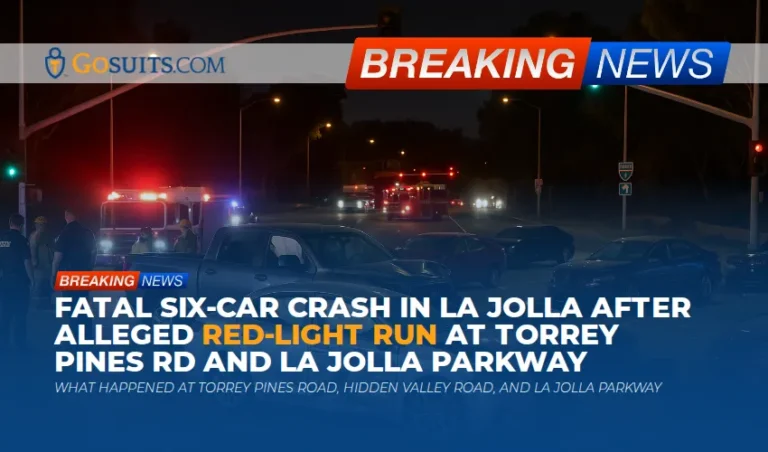
On Thursday evening just before 8:30 p.m., multiple motorists called 911 to report a serious multi-vehicle collision at the confluence of Torrey Pines Road and Hidden Valley Road near La Jolla Parkway, an area locals often call The Throat. First responders arrived to find bystanders attempting life-saving measures on one of the victims. Firefighters and police took over and transported the person to the hospital, where they were pronounced dead.
According to San Diego police, the preliminary investigation indicates a 2011 Toyota Tundra allegedly ran a red light and broadsided a 2015 Lexus CT200 as the Lexus entered the intersection on a green. After the initial T-bone impact, the Tundra reportedly hit two other vehicles, and those vehicles struck two additional vehicles, creating a six-vehicle chain reaction. The person who died was an occupant of the Lexus. It was not immediately clear if others suffered injuries. The San Diego Police Department Traffic Division is investigating.
Residents know this location well. The Throat funnels traffic between La Jolla Village and the coast, with drivers coming down from Torrey Pines and merging from La Jolla Parkway. Evening commutes can be brisk, and sightlines change quickly as the roads curve and narrow. Even one driver’s mistake at a red light can set off a cascade of impacts.
Why this La Jolla junction is challenging for drivers
If you live or work around La Jolla Shores, the Village, or head to the Torrey Pines Gliderport on weekends, you have probably navigated this complex junction. Several factors can make it difficult.
- Converging roads and grade changes The approaches into The Throat include downhill stretches where speeds can creep up, and the roadway geometry can reduce sight distance around curves.
- High traffic volume This is a primary route connecting La Jolla to I-5 and the wider UTC corridor. During peak times and evenings after events at UC San Diego, stacking at lights can be heavy.
- Signal timing challenges Intersections with multiple approaches, turn phases, and pedestrians heading to nearby trails or the cove are more complex and leave less room for driver error. Federal roadway safety agencies note that intersections present elevated crash risk because of conflict points where paths cross [1].
Good habits help: reduce speed on approach, watch stale green lights, and scan for late cross traffic. But as this tragedy shows, careful drivers can still be harmed by another motorist who enters against a red.
Early legal and insurance questions after a fatal multi-vehicle crash
Who might be liable under California law?
California law requires drivers to stop at steady red signals. A driver who runs a red light and causes a collision may be considered negligent, and violation of the traffic code can be evidence of negligence under civil law [2]. California also applies comparative fault, which means each party’s share of responsibility can be weighed, and damages can be reduced by a person’s percentage of fault if any [3].
In a chain reaction crash, liability analysis often looks at the first harmful event and whether subsequent impacts were foreseeable consequences of that initial negligence. Investigators and reconstruction specialists consider signal timing, pre-impact speeds, event data recorders, and vehicle rest positions to understand causation. Families should know that identifying all responsible parties takes time and technical analysis.
What civil claims are typically available after a traffic death?
- Wrongful death claim Eligible family members may bring a wrongful death claim for losses such as the loss of the decedent’s support, companionship, and related harms recognized by statute [4].
- Survival action The decedent’s estate may bring a survival action for certain damages the decedent sustained before death, such as medical expenses and property damage, if applicable [5].
These are distinct claims with different beneficiaries and damages frameworks, and they have deadlines. If a potential claim involves a public entity, special notice rules can apply promptly [13].
Which insurers get involved and in what order
Serious multi-vehicle collisions usually involve several layers of insurance: the at-fault driver’s liability coverage, other drivers’ coverages, uninsured or underinsured motorist coverage for victims, medical payments coverage, and health insurance with potential reimbursement rights. Policy limits can become a critical factor when multiple people are hurt. The California Department of Insurance provides consumer guidance about auto coverages and how they operate [6].
Because statements to insurers can be used later, it is wise to speak with a lawyer before any recorded statements. Many people look for car accident lawyers to help coordinate the moving parts, identify all available coverages, and avoid missteps with adjusters.
For a straightforward explainer on priority of coverage in multi-car scenarios, see which insurance pays first after a multi car crash. While every case is unique, understanding how different coverages interact can prevent delays and errors that reduce recovery.
Practical steps in San Diego during the first 72 hours
In the immediate aftermath, it is normal to feel overwhelmed. Still, a few organized steps can protect health, preserve evidence, and keep options open for later.
- Prioritize medical care and documentation Seek evaluation for anyone who may have been injured, even if symptoms feel minor at first. Many collision injuries evolve over 24 to 48 hours. Keep all discharge summaries and imaging records together.
- Preserve the vehicles If a vehicle is towed to a storage yard, note the location and avoid authorizing repairs or disposal until an inspection can be arranged. Event data recorders and physical crush patterns can be crucial later [15].
- Request the police collision report The San Diego Police Department provides instructions for obtaining traffic collision reports through its Records Division. Families and involved parties can request copies that become important for insurance and legal reviews [8].
- Contact the county Medical Examiner for questions about cause of death and reports The San Diego County Office of the Medical Examiner provides information for next of kin regarding autopsy status, cause and manner of death, and how to request reports when available [12].
- Consider your obligations to notify the DMV If the crash involved injury or death, California generally requires that a report be submitted to the DMV within 10 days, regardless of fault or insurance status [7].
- Secure scene evidence quickly Identify businesses or residences near Torrey Pines Road, Hidden Valley Road, and La Jolla Parkway that may have exterior cameras. Send prompt written requests to preserve footage. Public records requests to the City may also help with signal timing and certain records [9].
- Be cautious with insurance calls Adjusters may reach out quickly. Before giving any recorded statement or signing medical authorizations, consult with a qualified attorney. Many people prefer to speak with San Diego car accident lawyers first so they understand their rights and the consequences of statements.
Evidence to document and why it matters in a chain reaction crash
Multi-vehicle collisions often hinge on timing, speed, and sequence. The more precise the picture, the clearer the liability analysis. Here are sources of proof that commonly shape these cases.
- Event Data Recorder downloads Many vehicles store short pre-crash data including speed, throttle, braking, and seatbelt status. Trained technicians can download EDR data in a forensically sound way, but vehicles must be preserved and powered to do so [15].
- Intersection signal timing and phase logs Signal timing plans and records help determine whether a driver entered on green, yellow, or red and the length of the yellow interval. Public records requests to the City may yield timing plans and maintenance logs [9].
- 911 recordings and CAD logs Call recordings and dispatch logs can corroborate timelines and witness accounts. These are often obtainable through lawful records requests, subject to exemptions [9].
- Nearby camera footage Convenience stores, apartment garages, and traffic-adjacent businesses along Torrey Pines Road and Hidden Valley Road frequently capture helpful angles. Footage retention periods can be short, so early preservation requests matter.
- Medical examiner findings Autopsy and toxicology results can be relevant where impairment, seatbelt usage, or impact forces are in question. The Medical Examiner provides reports subject to their release standards [12].
- Witness statements Neutral witnesses who were stopped at the light or walking from the La Jolla Shores side toward the Village can fill in critical details about light phases and pre-impact driving. Gathering contact information early prevents loss of these accounts.
Taken together, these pieces help reconstruct who had the right of way, whether a red light was entered, and how the secondary impacts unfolded.
Understanding red light rules and right of way in California
California Vehicle Code section 21453 requires drivers to stop at a steady circular red signal and remain stopped until an indication to proceed. Right turns on red are allowed only after a complete stop and only if not prohibited by signs and if the movement can be made safely while yielding to pedestrians and cross traffic [2].
Intersections concentrate conflict points. Federal highway guidance emphasizes that engineering, enforcement, and education all play roles in reducing intersection crashes, but driver compliance with signals is foundational [1]. When a driver proceeds into an intersection against a red, the resulting T-bone impacts are among the most dangerous because there is less structural protection along vehicle sides.
Medical and grief resources near La Jolla
San Diego County operates a regional trauma system. Adults with the most severe trauma are typically transported to designated trauma centers, which include UC San Diego Medical Center in Hillcrest and Scripps Mercy Hospital among others. The County provides an overview of the system and facilities [10].
After a sudden loss, families often need practical support and clear information. The San Diego County Office of the Medical Examiner maintains next-of-kin guidance, including how to receive property, identify remains, and request reports when they become available [12]. For emotional support, the County’s behavioral health services share information about bereavement resources and how to find counseling and crisis support locally [11].
How multi-vehicle crash investigations proceed in San Diego
The San Diego Police Department’s Traffic Division investigates serious and fatal crashes in the city. Investigators document the scene, measure tire marks and crush patterns, collect photos and video, and canvass for witnesses and private cameras. Vehicles are examined for mechanical issues that could have contributed. If appropriate, EDR data is downloaded. Investigators often coordinate with the Medical Examiner to align physical findings with the collision dynamics.
At intersections, investigators will commonly review signal timing plans and maintenance records to confirm phase times. While preliminary statements may note a suspected red light violation, final determinations typically await full scene analysis. These inquiries can take weeks or months. Families can request copies of the collision report through the City once it is available [8].
Common pitfalls with insurers after serious crashes
- Recorded statements too early Adjusters may call within hours. A rushed statement can contain guesses that later conflict with evidence. Consider getting legal guidance first so your description is accurate and complete.
- Overbroad medical authorizations Some forms allow access to years of history not related to the crash. Narrow the scope to relevant dates and providers with careful review.
- Accepting policy limits without full picture Where multiple victims share limited liability coverage, early settlements can affect the availability of underinsured motorist benefits or equitable allocation among claimants. Reviewing the policy landscape first helps families avoid unintended waivers [6].
- Social media and public posts Insurers increasingly monitor posts for statements that undermine claims or defenses. Keeping case details offline protects credibility.
In a six-vehicle crash, the insurance web is complex. Before opening claims or giving statements, it is prudent to get a free consultation with a qualified attorney. What is said to any insurer can be used later.
Time sensitive steps that protect a potential claim
What to do
- Organize key documents Keep the incident number, tow yard details, hospital records, and any photos or video in one folder. Create a timeline while details are fresh.
- Request official records promptly Submit requests for the SDPD collision report and, when eligible, the Medical Examiner’s report. Calendar expected response windows and follow up.
- Preserve all physical and digital evidence Place written holds on vehicle teardown or salvage. Send preservation requests to nearby businesses for camera footage and to the City for relevant signal records.
- Map the insurance landscape Identify all potentially involved insurers and coverages. Confirm liability limits and any umbrella or excess policies before considering any settlement.
- Consult legal counsel early Before you speak with insurance companies or sign any releases, consult an attorney to understand rights, deadlines, and how multiple claims interact.
Why act now
- Evidence disappears fast Private camera footage can be overwritten within days. Vehicles can be scrapped if storage fees accrue. Early preservation can be the difference between clarity and guesswork.
- Deadlines are strict The DMV crash reporting deadline, civil statutes of limitation, and special notice rules if any public entity is potentially involved all operate on firm timelines [7][13].
- Multiple claimants complicate coverage When several people are hurt, prompt coordination can prevent a race to limited policy funds and ensure fair consideration of all losses.
Commentary from Gosuits San Diego, California Personal Injury Attorney
Our hearts are with everyone affected by the collision at The Throat. Bystanders tried to help, first responders worked urgently, and a family is now facing a devastating loss. This commentary is intended for general information and education during a difficult time.
From what has been publicly reported, investigators believe a pickup entered the intersection against a red and struck a smaller vehicle that had the green. At busy junctions like Torrey Pines and La Jolla Parkway, a single red light violation can turn into a chain reaction involving multiple cars within seconds. In civil terms, liability often centers on the initial violation and whether the subsequent impacts were foreseeable. Careful reconstruction, including signal timing and EDR data, will be key to a complete understanding.
In the weeks after a crash like this, insurance companies move quickly. Adjusters may seek recorded statements or push early settlements before the full scope of loss is known. Large carriers and corporate risk teams understand coverage layering, policy limits, and fault allocation. Many families do not, which can create an imbalance. Common tactics include broad medical releases, open-ended questions in recorded calls, and offers that sound helpful but close the door on additional claims if new information arises.
A free consultation with a seasoned attorney can level the field. It helps people understand which policies may apply, how to preserve evidence, and what to avoid saying so nothing is used against them later. Even if no lawyer is ultimately hired, having that early roadmap prevents missteps during a stressful and confusing period.
References
- Intersection Safety – Federal Highway Administration
- Vehicle Code § 21453: Steady circular red – California Legislative Information
- Civil Code § 1714: General duty and negligence – California Legislative Information
- Code of Civil Procedure § 377.60: Wrongful death – California Legislative Information
- Code of Civil Procedure § 377.30: Survival action – California Legislative Information
- Automobile Insurance – California Department of Insurance
- Accident Reporting Requirements – California DMV
- Police Records and Reports – City of San Diego
- California Public Records Act: Your Right to Access Public Records – California DOJ
- Trauma System Overview – County of San Diego Emergency Medical Services
- California Victim Services and Resources – California Victim Compensation Board
- Office of the Medical Examiner – County of San Diego
- Government Code § 911.2: Government Claims Act time limits – California Legislative Information
- Intersections Road Safety – National Highway Traffic Safety Administration
- Event Data Recorders – National Highway Traffic Safety Administration