- What we know about the semi-truck crash near Emporia
- Where and when it happened
- Who was involved
- Law enforcement response and what reports exist
- Why rollover crashes happen on interchange ramps
- Rights of families after a fatal truck crash in Kansas
- Potential civil liability considerations
- Key evidence in a commercial truck fatality and how it’s preserved
- How to obtain essential records and who to call in Lyon County
- Insurance and claims: practical steps and pitfalls
- Grief, support, and practical help in the Emporia area
- Data and safety context for large-truck crashes
- Timing matters: statutes and deadlines in Kansas
- Commentary from Gosuits Emporia, Kansas Personal Injury Attorney
- Why acting now matters
What we know about the semi-truck crash near Emporia
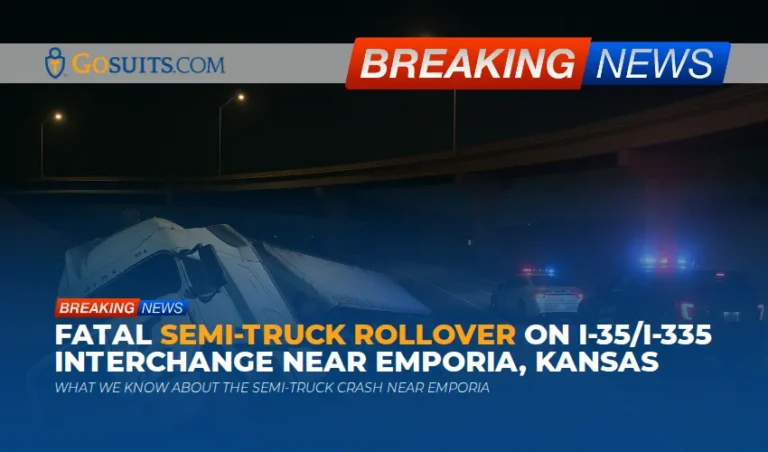
In the overnight hours near Emporia, a southbound semi-truck traveling on Interstate 35 toward the I-35 and I-335 interchange crashed on the southbound entry ramp. According to the initial report, the tractor-trailer entered the curve at a speed too high for the ramp. The vehicle left the roadway, struck three posts, overturned, and came to rest in a nearby ditch. The driver, a 64-year-old man from Berwyn, Illinois, was the sole occupant and died at the scene. The Kansas Highway Patrol investigated. This occurred just south of the Emporia Service Area, a location many drivers in Lyon County and the Flint Hills pass daily.
Late-night travel through this interchange is common for long-haul trucks moving between Wichita, Topeka, and Kansas City. For locals, the turn from I-35 to I-335 begins the Kansas Turnpike segment toward Topeka, which includes sweeping ramps posted with advisory speeds. Those Yellow-and-Black advisory signs are there for a reason, especially for high-center-of-gravity vehicles like tractor-trailers.
Where and when it happened
The crash occurred around 12:15 a.m. on Monday, November 24, on the I-35 southbound entry ramp feeding into I-335 near Emporia, in Lyon County. The location sits on the fringe of Emporia’s familiar corridor of interstate ramps, not far from Emporia State University and the daily truck traffic that moves through the heart of the Flint Hills.
Nighttime conditions on the prairie can change quickly. Even when skies are clear, temperatures drop fast and rural interchanges can be darker than urban systems in Topeka or Lawrence. While the exact weather isn’t detailed in the preliminary report, the timing and setting matter for understanding visibility and the importance of advisory speeds on ramps.
Who was involved
The Kansas Highway Patrol identified the driver as a 64-year-old man from Berwyn, Illinois. He was the only person in the vehicle at the time. No other vehicles were reported as involved. Families often want to know whether a trucker was on duty, who owned the tractor and trailer, and whether a motor carrier employed the driver or he was operating independently. Those answers typically appear in the crash report and associated investigative materials, not in early news briefs.
Law enforcement response and what reports exist
The Kansas Highway Patrol (KHP) responds to and documents serious crashes on the interstate system and the Kansas Turnpike. Their investigation generates a formal crash report that identifies drivers, vehicles, roadway details, and preliminary factors. Families can typically request these reports after they’re finalized. Kansas public records are governed by the Kansas Open Records Act, which generally presumes records are open unless a statutory exemption applies. See the Kansas Open Records Act at K.S.A. 45-215 et seq..
In a commercial vehicle fatality, additional materials may exist: scene diagrams, photographs, any reconstruction analysis, and, where available, electronic data from the truck’s event data recorder. Access to some of those items can be more limited and may require specific requests or legal process. But the initial crash report is the foundation for understanding what happened and what to do next.
Why rollover crashes happen on interchange ramps
Interchange ramps combine curvature, grade, and sometimes changing pavement friction. For heavy trucks, these factors create a real rollover risk if speed isn’t reduced sufficiently for the curve. Advisory speed plaques and ramp warning signs are designed to alert drivers to a safe operating speed for typical conditions. The Federal Highway Administration’s Manual on Uniform Traffic Control Devices explains the use of warning signs and advisory speed plaques for curves and ramps, including the W13-1 advisory speed plaque. See FHWA’s MUTCD overview at mutcd.fhwa.dot.gov.
Large trucks also have a higher center of gravity and may respond unpredictably if cargo shifts or if the vehicle hits uneven shoulder surfaces. Federal safety agencies have long cautioned that ramp speeds safe for passenger cars may not be safe for combination vehicles. The Federal Motor Carrier Safety Administration publishes national-level data and safety guidance for large trucks. See FMCSA’s data resources at fmcsa.dot.gov.
None of this assigns fault. It simply explains why a truck can overturn on a curve if velocity exceeds what the ramp and vehicle configuration can safely handle.

Rights of families after a fatal truck crash in Kansas
When a death is caused by the wrongful act or omission of another, Kansas law provides a civil cause of action commonly known as a wrongful death claim. The statute establishing this claim is K.S.A. 60-1901. Kansas law also addresses who may bring the claim (K.S.A. 60-1902) and the types of damages that may be considered, including nonpecuniary elements such as mental anguish and loss of society and companionship (K.S.A. 60-1903).
Every family’s circumstances differ. Some cases involve potential third-party responsibility, such as a trucking company’s maintenance practices or cargo loading decisions. Others may raise questions about roadway design or signage. Identifying all potentially responsible parties is a careful, fact-driven process that typically begins once the official reports and vehicle data can be reviewed.
Potential civil liability considerations
At this early stage, it’s not appropriate to speculate. Still, families often ask what issues lawyers commonly evaluate in single-vehicle truck rollovers. Investigations sometimes examine:
- Driver-related factors: hours-of-service compliance, fatigue risk, ramp approach speed, and whether ramp signage was visible and obeyed. Federal hours-of-service rules for commercial drivers are set in 49 C.F.R. Part 395.
- Vehicle condition: brakes, tires, steering components, and whether any mechanical issue contributed.
- Cargo loading: weight distribution and securement. Cargo that’s improperly loaded can raise rollover risk even at posted speeds.
- Roadway environment: advisory speeds, signage placement and visibility, pavement condition, shoulder drop-offs, and lighting.
- Employer and motor carrier practices: training, route scheduling, and safety monitoring.
- Governmental entities: in rare scenarios where roadway design or signage is credibly implicated, claims involving public entities may be governed by the Kansas Tort Claims Act, K.S.A. 75-6101 et seq. These claims have specific notice and immunity considerations.
Even in a single-vehicle event, several layers of responsibility can intersect. Understanding those layers requires timely preservation of evidence.
Key evidence in a commercial truck fatality and how it’s preserved
Physical and digital evidence fades quickly. Here’s what’s commonly important in a tractor-trailer rollover:
- Event Data Recorder (EDR): Modern trucks often capture pre-crash speed, brake application, engine parameters, and fault codes. Downloading EDR data requires the right tools and, often, cooperation from the vehicle’s custodian.
- Electronic Logging Device (ELD) and hours-of-service records: Federal rules require motor carriers to retain ELD records and supporting documents for specified periods (typically six months). See FMCSA’s ELD guidance and FAQs at fmcsa.dot.gov.
- Telematics and fleet management data: Many carriers track speed, hard-braking, and GPS breadcrumbs in real time.
- Cargo and bill of lading records: Weight tickets and load diagrams help assess weight distribution.
- Maintenance and inspection files: Federal safety rules and company policies require routine inspections and repairs.
- Scene documentation: Photographs, skid marks, gouge marks, strike marks on posts, and rest positions of vehicle components.
- Ramp signage and advisory speeds: Evidence of sign placement, visibility, and condition in effect at the time. Guidance on advisory speed signage is housed in the FHWA MUTCD at mutcd.fhwa.dot.gov.
- Medical and coroner records: Autopsy findings, toxicology, and cause of death from the county coroner can be essential for causation and damages analysis.
Preservation letters are often sent quickly to motor carriers, insurers, towing and storage facilities, and, where applicable, relevant government entities. Timing is critical.
How to obtain essential records and who to call in Lyon County
Several agencies and offices may hold key documents following a fatal crash near Emporia:
- Kansas Highway Patrol crash report: Request the finalized crash report directly from the investigating agency. For incidents on the Kansas Turnpike corridor near Emporia, KHP units that patrol the turnpike typically respond. Ask for the case number, date, time, and location when making your request. Kansas records generally fall under the Kansas Open Records Act (K.S.A. 45-215 et seq.).
- Lyon County Coroner: The coroner manages death investigations and may provide autopsy and toxicology reports when completed. Families can contact the coroner’s office through Lyon County’s administrative channels to learn the process and anticipated timelines.
- Death certificates: Certified copies are issued by the Kansas Department of Health and Environment, Office of Vital Statistics. See KDHE’s guidance on obtaining vital records at kdhe.ks.gov.
- Towing and storage yard: If the tractor-trailer was impounded, the tow operator’s yard will be the temporary custodian. Promptly ask in writing that the vehicle, ECM/EDR, and any loose cargo be preserved.
- Employer or motor carrier: If the driver was on duty, the carrier may have logs, dashcam video, and telematics. A written preservation request is important before records are overwritten or purged after routine retention periods.
If you plan to make any requests or speak with an insurer, strongly consider speaking with an attorney first. What’s said early, even casually, can later be used to dispute liability or damages.
Insurance and claims: practical steps and pitfalls
Commercial vehicle insurance policies can be complex. Layers may include primary liability, excess policies, cargo coverage, and sometimes separate policies for trailers. The path forward depends on who owned the tractor and trailer, whether the driver was an employee or contractor, and the motor carrier’s structure.
- Consider speaking to counsel before any insurer: Statements given to a claims adjuster can be used later to narrow or challenge claims. Initial calls are often recorded.
- Document economic losses: Gather wage records, benefits information, and out-of-pocket expenses. Kansas law contemplates both pecuniary and nonpecuniary losses in wrongful death actions (K.S.A. 60-1903).
- Keep a timeline: Note every contact with insurers, adjusters, tow yards, and agencies. Save claim numbers, names, and dates.
- Don’t post details on social media: Public posts are routinely harvested by defense teams.
- Be mindful of quick offers: Early settlements sometimes occur before key evidence is gathered. Once accepted, claims are usually closed permanently.
For families navigating shock and grief, even identifying which insurer to contact can be daunting. It’s reasonable to pause and get guidance about order of operations.
Grief, support, and practical help in the Emporia area
Emporia is a close-knit community. People here look out for one another, whether gathering at Peter Pan Park, cheering at Emporia State games, or supporting neighbors after a tragedy. In the immediate aftermath, routine tasks can feel overwhelming. Practical help often includes meal trains, child care, and rides to appointments. For evidence and records, designate a trusted person to help with calls and paperwork.
For information on healthy ways to cope with loss and traumatic stress, the Centers for Disease Control and Prevention provides accessible resources on grief and bereavement at cdc.gov/mentalhealth. These materials are general but can be a grounding place to start while local supports are assembled.

Data and safety context for large-truck crashes
Big-picture data can help frame what happened without reducing it to numbers. The Federal Motor Carrier Safety Administration’s annual Large Truck and Bus Crash Facts report compiles national fatality and injury trends, common crash configurations, and circumstances. Nationally, rollover events on curves and ramps remain an area of concern for combination vehicles because of high center of gravity and load dynamics. See FMCSA’s data portal at fmcsa.dot.gov.
- Ramps and curves: Advisory speeds are calibrated for typical passenger vehicles and conditions. Trucks often must travel below those advisory speeds to maintain margin for load shift, wind gusts, or pavement irregularities. FHWA’s MUTCD outlines the purpose and placement of these signs at mutcd.fhwa.dot.gov.
- Fatigue and hours: Federal hours-of-service rules limit driving time and require rest periods to reduce fatigue-related risk. Regulations are codified at 49 C.F.R. Part 395.
These data points don’t resolve this specific crash, but they highlight the system-level risks that investigators consider when a tractor-trailer overturns on a ramp.
Timing matters: statutes and deadlines in Kansas
Families frequently ask how long they have to take civil action. In Kansas, most wrongful death claims must be filed within two years. The general limitation period can be found in K.S.A. 60-513. Other deadlines can apply depending on facts, especially if a governmental entity is potentially involved under the Kansas Tort Claims Act (K.S.A. 75-6101 et seq.). Because some evidence retention periods are much shorter than any filing deadline, families often start with preservation efforts right away.
There’s also a practical timeline: towing and storage fees accumulate; vehicles may be disposed of; and digital data can be overwritten. Early organization helps prevent the loss of critical information.
Commentary from Gosuits Emporia, Kansas Personal Injury Attorney
First, to the family, friends, and colleagues grieving this loss, our hearts are with you. Articles like this are meant for general information and education. They can’t capture the person behind the headline or the weight of what you’re experiencing.
From the details available, this appears to be a single-vehicle tractor-trailer rollover on a curved ramp near the I-35/I-335 interchange. Interchange ramps in this corridor demand careful speed management from heavy vehicles, and even small misjudgments can have severe consequences. It’s appropriate that investigators will look at vehicle condition, load, digital data, and the ramp’s signage and surface to build a complete picture.
In our experience, insurance carriers and corporate risk departments often move fast after a fatality. They commonly contact families quickly, frame conversations around “helping with the claim,” and ask for recorded statements or authorizations that seem routine. Those early steps can narrow the scope of what’s compensable later or lock in statements made during a period of shock and grief. Meanwhile, key evidence in the company’s control can age, be overwritten, or be lost if it isn’t promptly preserved.
That’s why a free consultation matters. It gives people space to understand the process, the potential scope of recoverable losses under Kansas law, and the order of operations for preserving essential evidence before speaking with any insurer. Knowledge levels the playing field.
Why acting now matters
What to do
- Secure documents and identifiers: Collect the KHP case number, tow yard information, employer/motor carrier name, and any bill of lading or dispatch details you have.
- Preserve the vehicle and data: Send a written preservation request to the tow yard and motor carrier asking that the tractor, trailer, EDR/ECM, dashcam, and telematics data be retained for inspection.
- Request public records: Ask the investigating agency for the crash report once available. Note the incident date, time, and location.
- Obtain vital records: Begin the process for certified death certificates through KDHE and ask the Lyon County coroner about the timeline for autopsy and toxicology reports.
- Organize proof of losses: Keep wage statements, benefit summaries, medical bills, funeral invoices, and travel receipts together.
- Pause before calling insurers: Consult with an attorney first. Statements to adjusters can be used to limit or dispute claims later.
Why it matters now
- Evidence disappears fast: ELD and telematics data can be purged on routine schedules, often within months. Tow yards may release or dispose of vehicles absent a hold.
- Public deadlines exist: Kansas law imposes time limits on wrongful death claims (K.S.A. 60-513), and claims involving government entities can require specific steps under the Kansas Tort Claims Act (K.S.A. 75-6101 et seq.).
- Insurers move quickly: Early calls may include requests for recorded statements or broad releases. Once given, they’re hard to unwind.
- Clarity reduces stress: A clear plan for records, preservation, and next steps eases confusion during a difficult time.
Local context and community connection
Emporia sits at a crossroads. Rigs move through at all hours, from the Emporia Service Area on the turnpike to the industrial corridors that keep local businesses humming. Anyone who’s merged onto I-335 toward Topeka knows those curves and the feel of the wind in the Flint Hills, especially at night. In winter and spring, temperature swings can bring fog or black ice; in summer, heat can raise tire and brake stress. None of that explains a specific crash, but it’s the lived reality of driving here. When tragedy strikes on familiar pavement, it hits home for everyone in Lyon County.
Practical calls to make
- Kansas Highway Patrol: Ask for the finalized crash report and any available public records. Have the date, approximate time, and location ready.
- Lyon County Coroner’s Office: Inquire about autopsy and toxicology timelines and how to request copies once available.
- Kansas Department of Health and Environment – Vital Records: Request certified death certificates per KDHE instructions at kdhe.ks.gov.
- Tow/Storage Facility: Confirm the vehicle’s location and issue a written preservation hold for the truck, trailer, and all electronic modules.
- Employer/Motor Carrier: Send a preservation letter for ELD logs, dispatch records, maintenance files, and any in-cab video.
When calling, note the person’s name, date, and summary of what was discussed. Keep all paperwork in one folder. If you’re unsure what to request, pause and consult counsel before making detailed statements.

Legal framework in plain terms
To keep the legal landscape understandable:
- Wrongful death exists to shift loss to the responsible party: Kansas recognized this in K.S.A. 60-1901, allowing certain heirs to bring the claim (K.S.A. 60-1902).
- Damages include both economic and nonpecuniary elements: Kansas law lists categories a jury may consider, including mental anguish and loss of companionship (K.S.A. 60-1903).
- Most civil claims have a two-year filing window: See K.S.A. 60-513.
- Claims involving public entities can be different: The Kansas Tort Claims Act governs liability and immunities for governmental entities (K.S.A. 75-6101 et seq.).
These statutes don’t predict outcomes. They simply map the road families and insurers travel after a fatal crash.
Safety takeaways for our roads
Emporia’s interchanges are shared by families heading to school, local workers, and cross-country carriers. A few practical reminders for everyone:
- Respect advisory speeds on ramps: They’re posted for typical passenger vehicles; heavy trucks often need even more margin.
- Watch for changing conditions: Nighttime visibility, crosswinds across the Flint Hills, and seasonal temperature swings all matter.
- Maintain equipment: For commercial operators, diligent brake, tire, and steering checks reduce risks on curves and grades.
The goal is simple: fewer families suffering the loss of someone dear on our highways.
Closing thoughts on the Emporia crash
Even when only one vehicle is involved, comprehensive investigations matter. They bring clarity to families and can highlight steps to make dangerous locations safer. As the official report and related records are completed, the picture of what happened on that ramp should come into sharper focus.