- What we know about the I-15 Lake Elsinore multi-vehicle crash
- Timeline and exact location
- Vehicles and people involved
- Official response and ongoing investigation
- Safety and legal takeaways for Riverside County drivers
- Where families can call or request records
- How liability can be assessed in a chain-reaction crash
- Insurance coverage after a multi-car freeway collision
- Potential civil claims and damages under California law
- Local context on I-15 through Lake Elsinore and collision patterns
- Practical steps for those involved or who witnessed the crash
- Why taking action matters now
- Commentary from Gosuits Lake Elsinore, California Personal Injury Attorney
- References
What we know about the I-15 Lake Elsinore multi-vehicle crash
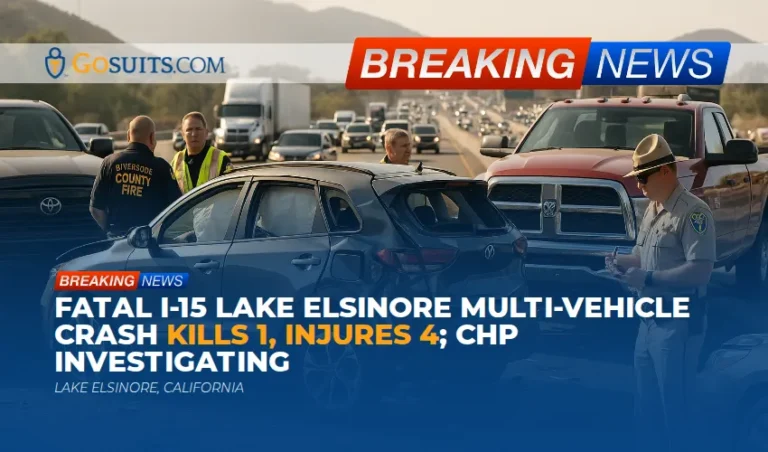
On a busy weekday afternoon in Lake Elsinore, a chain-reaction crash on the northbound I-15 led to tragic consequences. According to information provided by the California Highway Patrol’s Temecula Area office, a collision sequence began when a 2016 Toyota Tacoma driven by a 32-year-old Perris man struck the back of a 2023 Kia Niro driven by a 37-year-old San Diego woman. That set off a cascade of impacts that ultimately involved at least five vehicles. The San Diego driver in the Kia was killed. Four others suffered injuries, with two drivers transported for minor injuries and two treated on scene by Riverside County Fire paramedics. A SigAlert shut all northbound lanes around 4:05 p.m., with impacts that stretched into the evening commute.
Lake Elsinore residents know how quickly traffic conditions can change on this stretch, especially north of Main Street where lanes compress and on-ramps are often congested during late afternoon. The closure snarled traffic near local access points like Main Street and likely pushed detours toward Railroad Canyon Road and Nichols Road.
Timeline and exact location
CHP indicates the crash occurred around 3:55 p.m. on the northbound 15 Freeway, north of Main Street in Lake Elsinore. The debris field and secondary collisions spread across multiple lanes, which is consistent with chain-reaction freeway events. Emergency responders arrived quickly, coordinated lane closures, and initiated a prolonged investigation window through the early evening while tow operations and scene mapping were underway.
That northbound segment serves drivers transitioning from central Lake Elsinore shopping areas and neighborhoods near the lake up toward the Temescal Valley and Corona. Afternoon traffic volumes are typically heavy there, and moderate grades, lane changes near on-ramps, and trailer-towing traffic can all amplify risk when a sudden stop occurs.
Vehicles and people involved
Based on CHP’s preliminary account, the collision sequence included:
- A 2016 Toyota Tacoma driven by a 32-year-old Perris man who rear-ended the Kia.
- A 2023 Kia Niro driven by a 37-year-old San Diego woman who tragically died as a result of the crash.
- A 2022 Dodge Ram 5500 with a trailer driven by a 50-year-old Los Angeles man, which struck the Kia after it veered into another lane, then impacted a Toyota Highlander and later a Honda Accord.
- A 2021 Toyota Highlander driven by a 69-year-old Lake Elsinore man, impacted by the Dodge truck.
- A Honda Accord driven by a 38-year-old Murrieta woman, rear-ended further along the sequence.
The preliminary information released publicly did not include the decedent’s name at the time of reporting. Identification typically occurs after notification of next of kin by the county coroner.
Official response and ongoing investigation
CHP Temecula Area officers responded, managed the scene, and are leading the investigation. Multi-vehicle freeway crashes like this generally require detailed diagramming, vehicle inspections, measurements of skid and yaw marks, and witness statements. When a fatality occurs, CHP may employ specialized resources to reconstruct the sequence of impacts. CHP’s Major Accident Investigation Team program describes the advanced methods used in severe or complex cases, which can include mathematical modeling and in-depth vehicle inspections [4].
During the active investigation window, officers issued a SigAlert closing all northbound lanes to protect responders and preserve evidence. Caltrans tools such as QuickMap can show real-time lane closures during such incidents, which helps the public navigate detours and avoid secondary crashes in the backup [5].

Safety and legal takeaways for Riverside County drivers
Even for seasoned drivers, chain-reaction crashes on I-15 can develop in seconds. Following distance, speed selection for conditions, and scanning ahead are critical on this corridor where traffic may slow abruptly. Commercial or heavy vehicles, like a Ram 5500 towing a trailer, need greater stopping distances due to higher mass and braking dynamics; federal safety guidance notes that commercial motor vehicles require substantially longer stopping distances than passenger cars, especially at highway speeds or when loaded [6].
From a legal perspective, rear-end impacts often trigger a presumption of negligence against the trailing driver in civil cases, though that presumption can be rebutted by evidence of an unexpected, unavoidable emergency or a sudden, unforeseeable hazard. California applies comparative fault, which means multiple drivers can share percentages of responsibility based on their actions leading up to and during the event. Thorough investigation, vehicle data, and witness accounts matter greatly in reconstructing what happened.
Where families can call or request records
CHP traffic collision report
For a fatal freeway collision, the investigative agency is typically CHP. Families or involved parties can usually request a copy of the Traffic Collision Report using CHP Form 190. Requests can be made by mail or in person through the appropriate CHP Area Office, and eligibility is restricted to involved parties or their representatives. The CHP page on how to obtain a collision report outlines who can receive a copy, what identification is needed, and applicable fees [1].
Death certificates
Certified copies of death certificates in California are issued through county vital records offices and the California Department of Public Health Vital Records. While the coroner handles cause-of-death determinations, certified death certificates for legal matters such as insurance claims are typically obtained through these channels [7].
Autopsy and coroner’s records
In Riverside County, the Sheriff-Coroner’s Office oversees death investigations. Families commonly contact the Coroner Division for updates on identification, cause and manner of death, and the general availability of autopsy reports. Public access to certain records may be governed by California law and privacy protections, and timing can depend on whether the investigation is ongoing. Local offices typically provide instructions on how to request these records once they are available.
Road closure confirmations and traffic data
Caltrans QuickMap provides official confirmation of closures or lane restrictions during major incidents. For those documenting the impacts to daily life or work, archived traffic information can support proof of disruption. Real-time and some historical mapping data are available through QuickMap tools [5].
Insurance notices and claim numbers
Before calling any insurance company, it is wise to consult with a qualified attorney who handles freeway collisions in California. Statements given to insurers can be used later to limit or dispute claims. After obtaining legal guidance, parties can exchange claim numbers and insurer contact details through the reporting process outlined on their auto policy documents. California law requires minimum liability insurance; as of 2025, those minimums have increased, which can matter when multiple injured people are seeking compensation from the same policy [2].
How liability can be assessed in a chain-reaction crash
Every chain-reaction collision is unique. Investigations often focus on timing, speeds, lane positions, and driver behaviors in the seconds before impact. On a sharp slowdown in northbound I-15, a single rear-end collision can launch vehicles into adjacent lanes, where they may be struck again by cross-traffic or by drivers towing trailers who need more distance to stop. Here are common factors collision reconstruction may consider:
- Initial impact cause: Whether the first rear-end was due to inattention, following too closely, unsafe speed for traffic flow, or a sudden unforeseeable event.
- Secondary lane intrusions: After the first impact, how and why a vehicle entered another lane and whether other drivers had a reasonable opportunity to avoid a subsequent collision.
- Commercial or heavy vehicles: Whether a truck and trailer combination had sufficient headway and whether cargo, brakes, or equipment condition affected stopping distance [6].
- Comparative fault allocation: California allows apportioning fault among multiple drivers. Even a driver who is primarily at fault may not bear 100 percent if others contributed to risk or failed to avoid foreseeable danger.
- Visibility and roadway conditions: Sun angle around late afternoon, roadway grade, and traffic density near on-ramps can affect perception-reaction time and plausible evasive options.
- Event data recorders and vehicle inspections: Many vehicles record speed and brake application data. Investigators may also examine post-crash damage patterns to validate sequence and speeds.
When a fatality occurs, expect a more robust process and lengthier evidence collection. CHP’s advanced investigation resources can be involved in high-severity incidents to support accurate findings that inform civil claims and, when applicable, policy or infrastructure discussions [4].
Insurance coverage after a multi-car freeway collision
In a five-vehicle chain-reaction crash, understanding which policies apply is critical. Multiple injured people may be drawing from the same driver’s liability limits, and commercial or towing-related policies can come into play if a vehicle was being used for business. California’s minimum liability coverage amounts increased in 2025, but serious injuries and wrongful death commonly exceed those minimums [2].
To navigate the intersection of liability, med-pay, underinsured motorist coverage, and potential commercial coverage, some find it helpful to review a step-by-step explainer on policy ordering and stacking issues in multi-vehicle events such as which insurance pays first after a multi car crash gosuits.
Key considerations include:
- Liability coverage of at-fault driver(s): This is the first line for bodily injury and property damage. In a chain-reaction, more than one driver may bear partial fault. Adjusters often dispute percentages, so evidence matters.
- Underinsured or uninsured motorist coverage: If one or more at-fault drivers carry low limits, UM or UIM on the injured person’s policy can fill gaps, subject to policy language and offsets. California recognizes UM/UIM as a vital safety net for serious injuries in multi-vehicle collisions [2].
- Medical payments coverage: Med-pay can help with early medical bills regardless of fault, but it may come with reimbursement or coordination requirements if a settlement follows.
- Commercial policies: A Ram 5500 towing a trailer may be privately used or commercially insured. If it was operating as part of a business, there could be higher policy limits and additional responsible entities, which can affect recovery pathways.
- Health insurance and liens: Health plans that pay accident-related bills may assert liens on later settlements. Properly documenting payments and coordinating lien resolution is important for net recovery.
It is generally wise to consult with car accident lawyers before providing recorded statements to any insurer, including your own. Insurers train adjusters to minimize payouts, and innocent phrasing or incomplete recollection early on can be used later to contest causation or damages. Seasoned Lake Elsinore car accident lawyers can also help identify all potentially applicable policies, including commercial coverage, umbrella policies, and UM/UIM options, and advise on preserving crucial evidence.
Potential civil claims and damages under California law
Following a fatal freeway collision, the civil law framework in California provides two separate, complementary avenues that may apply depending on the facts:
- Wrongful death claim: Brought by certain surviving family members to address their own losses such as loss of financial support and companionship. California Code of Civil Procedure section 377.60 identifies who may bring a wrongful death claim [3].
- Survival action: Brought by the decedent’s estate to recover certain losses suffered by the person between injury and death, such as medical expenses or property damage, under section 377.30 [8].
For non-fatal injuries, claims typically focus on medical expenses, lost income, reduced earning capacity, pain and suffering, and other out-of-pocket losses. Evidence of how the crash happened, medical documentation of injuries, and proof of how life and work were disrupted are all important.
California’s general statute of limitations for most personal injury and wrongful death claims is two years from the date of the incident, under Code of Civil Procedure section 335.1. Certain exceptions or shorter claim deadlines can apply, including when government entities are involved, so do not assume extra time is available without checking the facts and law for your specific situation [9].
Local context on I-15 through Lake Elsinore and collision patterns
The I-15 corridor through Lake Elsinore is a lifeline between the Inland Empire and northbound destinations. Locals often talk about abrupt slowdowns by the Main Street and Central Avenue areas, heavy weekend recreational traffic around the lake and retail zones, and frequent trailer and boat towing during spring and summer. Add commuters from Murrieta and Temecula and the recipe for chain-reaction risk is real, especially in the late afternoon when sun glare and lane merges can compress traffic unexpectedly.
Statewide safety snapshots show persistent challenges. California’s traffic safety data continue to highlight speed and following-distance issues as contributors to severe crashes. The Office of Traffic Safety reports ongoing concerns around speed-related fatalities and multi-vehicle incidents, underscoring the need for driver vigilance and safe following distances on high-speed corridors like I-15 [10]. For drivers operating or sharing the road with heavy vehicles, federal safety materials emphasize that trucks and truck-trailer combinations require longer stopping distances, which magnifies the danger when a passenger vehicle is knocked into their lane during a sudden slowdown [6].
Practical steps for those involved or who witnessed the crash
If you or someone you care about was involved in this incident or a similar one on I-15, consider these steps. They are general suggestions, not legal advice, and every case has unique facts.
- Seek medical evaluation promptly: Even if injuries seem minor, some conditions surface hours or days later. Getting checked promptly creates a clear medical record tied to the crash.
- Preserve evidence: Save photos, dashcam files, and damaged property. Write down what you remember while it is fresh. If you are unsure what to keep, err on the side of saving it for now.
- Request the official CHP report: Use CHP’s guidance and Form 190 to request the Traffic Collision Report when available. Your attorney can also assist with this process [1].
- Document work impacts: Keep pay stubs, employer letters, and time-off records to support lost income claims.
- Be cautious with insurers: Before speaking with any insurance company, consult an attorney first. What you say can be used to dispute fault or the extent of injuries later.
- Identify potential commercial connections: If any vehicle was being used for business, note company names, USDOT or CA numbers on the door, and trailer markings. Commercial insurance and corporate responsibility can be significant.
- Use official traffic tools for records: Caltrans QuickMap screenshots can help document the timing of closures or detours if those issues affected your schedule or costs [5].
If you want a deeper dive into policy ordering after multi-vehicle collisions, you may also find this internal resource helpful later in the process: which insurance pays first after a multi car crash gosuits.
When people look for trusted information or guidance, many turn to car accident lawyers who regularly handle multi-vehicle freeway crashes. It is common for initial consultations to focus on rights, timelines, and immediate to-do items so people do not miss critical evidence windows. Speaking with car accident lawyers before notifying insurers helps avoid unintentional statements that might be used to minimize recovery later.
Why taking action matters now
There are specific steps people should consider promptly after a chain-reaction freeway crash in California.
- Pin down official records early: The CHP Traffic Collision Report anchors the timeline and identifies involved parties and insurers. Early requests reduce delays and help ensure accurate information is available for medical billing coordination and claims [1].
- Secure medical documentation: Consistent treatment and clear documentation strengthen the link between the crash and injuries. Acting now helps avoid gaps in care that insurers often question.
- Preserve time-sensitive evidence: Dashcam video can auto-delete, and some traffic cameras overwrite quickly. Private businesses sometimes keep exterior CCTV clips only for a short time. The sooner documentation is requested, the better the chances of preservation.
- Clarify insurance pathways: Multiple claimants may be drawing from the same policy, and minimum limits can be exhausted quickly. Knowing whether UM/UIM, med-pay, or any commercial coverage is available can change the recovery plan [2].
- Respect legal timelines: California’s statutes set clear deadlines for bringing civil claims. Starting early provides room for careful investigation, expert review, and measured decision-making rather than rushed filings right before a deadline [9].
Acting sooner rather than later maximizes the chance to preserve objective proof, coordinate benefits without costly missteps, and map out a claims strategy that fits the facts of a complex, multi-vehicle freeway crash.
Commentary from Gosuits Lake Elsinore, California Personal Injury Attorney
Our hearts go out to the family of the woman who lost her life and to everyone injured in this violent chain-reaction crash on northbound I-15. This commentary is offered for educational and general informational purposes only so the community understands common processes and issues that arise in serious freeway collisions.
From what is publicly reported, the sequence started with a rear-end impact that pushed a vehicle into another lane, triggering additional collisions that spanned multiple lanes. In high-speed corridors like I-15, that kind of rapid lane intrusion can be devastating, particularly when heavier, towing vehicles are in the flow and have less room to stop. Civil fault in multi-vehicle cases can be shared across more than one driver, and the details of timing, perception-reaction, and stopping distances can matter a great deal. Thorough investigations, including measurements, vehicle data, and witness statements, are central to sorting out accountability.
Insurance companies and corporations understand these dynamics well. They often move quickly to collect statements and lock in narratives that minimize exposure. Adjusters are trained to ask questions in ways that may downplay symptoms or suggest alternative causes. When multiple claimants are involved, limited policy limits can be divided in ways that leave latecomers with little. Without experienced guidance, people can inadvertently accept early offers or sign releases that do not reflect the true cost of medical care, lost time, or future needs.
That is why obtaining a free consultation is so important. A consultation helps people understand immediate steps, evidence preservation, insurer communication strategies, and potential sources of coverage, including UM/UIM and possible commercial policies. It provides clarity on timelines and options so that decisions are made with full information rather than under pressure or confusion during a difficult time.
References
- How to Obtain a Traffic Collision Report – California Highway Patrol
- Insurance Requirements – California DMV
- Code of Civil Procedure § 377.60 (Wrongful Death) – California Legislative Information
- Major Accident Investigation Team (MAIT) – California Highway Patrol
- QuickMap – California Department of Transportation
- Commercial Motor Vehicle Stopping Distance – FMCSA
- Vital Records – California Department of Public Health
- Code of Civil Procedure § 377.30 (Survival Action) – California Legislative Information
- Code of Civil Procedure § 335.1 (Statute of Limitations) – California Legislative Information
- Traffic Safety Quick Stats – California Office of Traffic Safety