- What happened at Hurricane Point in Big Sur
- Local context on Highway 1, Hurricane Point, and seasonal hazards
- How investigations unfold after a cliffside crash on Highway 1
- Records families may need and where to call
- Civil liability considerations after a fatal single-vehicle crash
- Insurance issues families commonly face
- Key steps before speaking with any insurance company
- Community notes, remembrance, and roadway safety
- Why timely action matters now
- Commentary from Gosuits Big Sur, California Personal Injury Attorney
- References
What happened at Hurricane Point in Big Sur
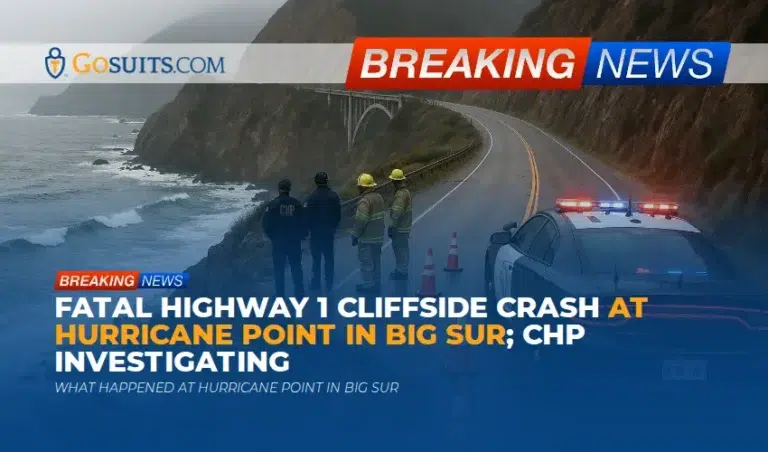
Late afternoon on February 10, multiple 911 calls reported a vehicle leaving the roadway near the Hurricane Point scenic overlook along Highway 1 in Big Sur. According to public statements reported from the scene, Big Sur Fire and the Monterey County Sheriff’s Office conducted a joint search and rescue effort. The vehicle was located more than 500 feet below on the rocks just above the waterline, and one occupant was pronounced deceased at the scene. Recovery took approximately four hours in gusty, rainy conditions. The California Highway Patrol has opened an investigation into the circumstances surrounding the crash.
Hurricane Point sits along one of the state’s most photographed and challenging coastal corridors, a place where the road carves along steep cliffs and winds funnel around headlands. Locals know that sudden wind gusts, slick pavement during winter rains, and constant changes in visibility can converge quickly on this stretch. Visitors may not anticipate how a scenic pullout can transition to tight curves and sheer drop-offs within moments. While investigators have not released findings or fault determinations, the terrain and weather on this segment of Highway 1 present unique hazards that agencies evaluate in the aftermath of an incident.
Local context on Highway 1, Hurricane Point, and seasonal hazards
Hurricane Point and the surrounding coast
Hurricane Point lies just south of Garrapata State Park and north of the famed Bixby Creek Bridge, a run many Monterey County residents drive to clear their heads at sunset. The scenery is epic and so are the exposures. Pullouts can be narrow, shoulders are unforgiving, and the cliff faces are steep. Even experienced drivers sometimes feel crosswinds push against their vehicles as the road crests open saddles.
Winter months typically bring rain, strong coastal winds, and intermittent rockfall. This part of the coast has a long history of roadway disruptions tied to slides and slope instability, which is why crews regularly monitor and maintain Highway 1. Public research has documented that the Big Sur coastline is highly susceptible to landslides, especially during or after heavy rainfall events that saturate slopes and undercut roadbed support [1]. Caltrans District 5, which includes Monterey County, communicates ongoing work and safety notices for the region as conditions change through the season [2].
Seasonal weather and driving dynamics
When rain returns after dry spells, California roads can become slick as oils lift to the surface. On elevated, exposed points like Hurricane Point, even a modest squall can produce sudden gusts or reduce visibility with mist. National highway and safety agencies regularly caution drivers to slow down and increase following distance in wet or winter conditions, and to account for longer stopping distances and reduced tire traction [3]. The federal roadway safety program also emphasizes that many severe crashes involve roadway departure on rural, curving segments, particularly where barriers or recovery areas are limited [4].
California’s basic speed law requires motorists to never drive faster than is safe for current conditions, regardless of the posted limit. That includes slowing for rain, wind, fog, or night-time darkness on winding coastal routes [5]. This does not imply fault in any individual case. It is part of the broader safety context that investigators consider alongside roadway design, signage placement, vehicle condition, and other contributing factors.
How investigations unfold after a cliffside crash on Highway 1
Which agencies are typically involved
On state highways outside city limits, the California Highway Patrol (CHP) ordinarily leads the traffic collision investigation. Local agencies such as the Monterey County Sheriff’s Office may coordinate on rescue, recovery, and coroner responsibilities. Caltrans may assess any infrastructure or slope-related considerations relevant to roadway safety management.

Evidence investigators may review
Traffic crash investigations commonly assemble multiple pieces of evidence, such as:
- Scene documentation: measurements, photographs, roadway markings, gouges, debris fields, and guardrail or shoulder impacts.
- Vehicle inspection: brakes, tires, steering, lighting, on-board diagnostics or event data recorder downloads when available.
- Environmental conditions: rainfall, wind speed or gusts, visibility, and roadway friction at or near the time of the crash [3].
- Roadway features: curve radii, signage, advisory speeds, barrier types, and clear zone characteristics relevant to roadway departure risks [4].
- Witness information: 911 calls and any witness statements that help pinpoint how the vehicle left the roadway, subject to public records rules [6].
Because of the difficult terrain below Hurricane Point, rescuer safety guides the timing and method of recovery. The technical challenges can delay access to the vehicle’s interior and undercarriage, which sometimes postpones mechanical inspections or retrieval of devices.
Records families may need and where to call
Traffic collision report
The California Highway Patrol’s collision report is a central document that summarizes the investigation’s observations and conclusions. Families can request a copy directly from CHP using the agency’s process and forms once the report becomes available. CHP provides public guidance on requesting traffic collision reports, including eligibility and identification requirements [7]. In many Highway 1 cases near Big Sur, the Monterey Area or nearby CHP office is responsible. Confirm the investigating office noted on the incident number before submitting a request.
Coroner’s records and identification
In California, the county coroner has a statutory duty to investigate certain types of deaths, including those sudden or accidental in nature [8]. For coastal incidents in this region, the Monterey County Sheriff’s Coroner Unit handles identification and related records. Families commonly seek:
- Final identification confirmation: once next of kin are notified.
- Autopsy and coroner investigative reports: typically released to authorized parties after internal review, subject to state law.
- Personal effects recovery: coordinated through the coroner unit after documentation.
While county-specific contact details are typically listed on the sheriff-coroner’s official website, general California law clarifies the coroner’s investigative role and helps families understand what to expect during next steps [8].
Death certificate
Certified death certificates are issued through California’s vital records system. Families may request certificates from the county vital records office or through the California Department of Public Health’s Vital Records program, which outlines how to order certified copies, identification requirements, and processing times [9].
911 calls and public records
Audio of 911 calls and certain public safety records may be available through public records requests, with exceptions for privacy or active investigations. The California Public Records Act provides an overview of what agencies can disclose and how requests are processed [6]. For highway incidents, a request may be directed to the county dispatch authority or CHP, depending on how the call was routed.
Roadway or slope information
Caltrans District 5 covers Highway 1 in Monterey County and maintains project pages, travel advisories, and contacts for the public. If a family or their representative needs general information about historical closures, maintenance, or slope stabilization activities near a crash site, Caltrans’ regional pages provide a starting point for understanding how the state monitors and manages this corridor [2]. Technical context about Big Sur’s landslide-prone geology is also publicly available from federal researchers [1].
Civil liability considerations after a fatal single-vehicle crash
Even when a crash appears to involve only one vehicle, the civil law analysis can be complex. From a personal injury perspective, several categories are typically examined. None of the following assigns blame in this specific incident. Rather, they reflect the questions that are often asked in coastal roadway tragedies.
Potential contributing factors
- Roadway conditions and warnings: Were advisory speed signs, curve warning signs, and any chevrons or barrier systems present, visible, and reasonably maintained for a driver approaching the point of departure?
- Weather and surface friction: Did rain reduce traction or visibility beyond what an attentive driver could handle at a prudent speed? What was the condition of the pavement and striping at the time?
- Vehicle condition: Were tires, brakes, steering, or stability control systems functioning properly? Some vehicles capture limited crash-related data that may help clarify a sequence of events.
- Third-party involvement: Did a phantom vehicle, unsafe pass, or sudden encroachment lead the driver to steer away from the lane? Were there obstacles in the roadway?
When public entities may be implicated
If roadway design, signage, or maintenance is alleged to have contributed, California law governs claims against public entities. The Government Claims Act sets strict procedures and deadlines for presenting claims to public entities like Caltrans before any lawsuit can be filed [10]. Families considering whether a roadway condition played a role should consult counsel promptly because claim windows are short and evidence can change with weather and repairs.
Wrongful death timelines
California’s statute of limitations for wrongful death is generally two years from the date of death [11]. Some claims against public entities have additional earlier deadlines under the Government Claims Act [10]. These timelines are provided for general awareness only. Case-specific facts, identities of potential defendants, and exceptions can alter how deadlines apply.
Insurance issues families commonly face
In the wake of a fatal crash, multiple insurance policies may be implicated, including the decedent’s auto policy, any underinsured or uninsured motorist coverage, and potentially liability policies of third parties if they are later identified as contributing to the crash. When a crash occurs on a state highway near a scenic overlook, questions about roadway conditions sometimes lead insurers to point fingers or delay while they await agency findings. Families often confront requests for recorded statements or early document signatures they do not yet understand.
It is common to see insurance carriers leverage knowledge gaps by requesting broad medical authorizations, suggesting quick resolutions before all facts are known, or highlighting preliminary conclusions in a traffic report that may later be clarified. That is one reason many families choose to speak with a seasoned attorney before engaging with any insurer on a fatal crash claim.
For additional background on how families navigate the immediate aftermath of a fatal roadway incident, this resource explains key steps and decision points: what happens if someone is killed in a car accident.
Key steps before speaking with any insurance company
- Pause before recorded statements: Politely decline to give any recorded statement until you have spoken with counsel. What is said early can be cited later out of context.
- Preserve documents: Keep the incident number, tow and recovery information, and any personal photos or communications related to the day’s travel.
- Request official records in sequence: Start with the CHP collision report request process once available [7], then track the coroner’s records timeline [8].
- Document expenses: Funeral and memorial costs, travel expenses for family, and time missed from work are common outlays that should be tracked early.
Families often turn to car accident lawyers to coordinate these tasks and protect communications. This article cannot cover every nuance of claims handling, but understanding the order of operations helps keep the process from becoming overwhelming.
In a statewide context, California car accident lawyers regularly emphasize that statements to insurance adjusters may be used later to limit or contest coverage. Waiting until the essential records are in hand is a prudent first step in many cases.
Community notes, remembrance, and roadway safety
Residents from Carmel-by-the-Sea to Big Sur Village know Hurricane Point as both a breathtaking stop and a place where the wind whips hard. On winter afternoons, mist can hang below the ridge before giving way to clear sun just a mile down the road. Today, many neighbors will drive past the overlook and glance south toward the surf line where rescuers worked for hours. It is a sobering reminder of how quickly a coastal drive can change.
Highway safety officials and federal researchers continue to invest in roadway departure countermeasures on curving, rural roads, such as enhanced signage, high-friction surface treatments, and barrier improvements where feasible [4]. Public agencies also push seasonal safety reminders about slowing in rain and giving extra time and space to navigate winding corridors [3]. Locally, patience during winter travel and respect for advisory speed signs near overlooks can help prevent another family’s loss.
Why timely action matters now
What to do
- Identify the investigating office: Confirm which CHP area office is handling the report and note the incident number.
- Track coroner notifications: Monitor official communications for identification, next-of-kin instructions, and records access steps.
- Preserve evidence: Save any photos, dashcam files, phone location data, and receipts from the travel day. Ask the tow or storage facility to hold the vehicle without alterations until an inspection can be arranged.
- Organize benefits paperwork: Locate auto insurance policies, any life or accidental death coverage, and employment benefits that may include death or bereavement provisions.
- Seek a free consultation: Before speaking with insurers, consult with a qualified attorney to understand rights, timelines, and potential third-party issues, including any public entity questions under the Government Claims Act [10].

Why act now
- Short administrative windows: Some claims require notices within months, not years, especially when public entities are involved [10].
- Evidence changes quickly: Coastal weather, tides, and slope stabilization work can alter or erase physical evidence near the scene.
- Insurance positioning begins early: Carriers often set internal reserves and theories of causation based on the earliest documents and statements.
- Family logistics: Timely requests for reports and certificates help with estate, benefits, and memorial planning [9].
Commentary from Gosuits Big Sur, California Personal Injury Attorney
Our hearts are with the family and loved ones affected by this tragedy near Hurricane Point. This note is offered for educational purposes and general information so the community can better understand the process that follows a fatal crash on Highway 1.
From what has been publicly shared, recovery required a complex, high-risk operation in rough terrain. Weather was challenging and the vehicle came to rest more than 500 feet below the roadway. In civil injury cases, an analysis typically considers roadway features, signage, slope and barrier context, vehicle condition, and the impact of wind and rain on traction and visibility. None of that minimizes the human loss. It simply reflects how facts are gathered when families want answers.
Insurance companies and corporate stakeholders often move fast in the early days after a fatal incident. They may ask for statements before key records are available, or highlight preliminary findings in a way that narrows options later. The imbalance of information is real. A free consultation allows families to understand the process, timelines, and how to avoid missteps that could affect coverage or liability determinations.
Before engaging with any insurer, get clear on the path ahead. Learn what records will matter most, how the Government Claims Act can affect timing when public entities are potentially involved, and how communications can be managed to protect the family’s interests.
References
- Landslide hazards along California’s Big Sur coast – USGS
- Caltrans District 5: Monterey, San Luis Obispo, Santa Barbara, San Benito, Santa Cruz – Caltrans
- Winter Driving Tips – NHTSA
- Roadway Departure Safety – Federal Highway Administration
- California Vehicle Code section 22350 Basic Speed Law – California Legislature
- The California Public Records Act: A Guide – California Attorney General
- Traffic Collision Reporting Procedures – California Highway Patrol
- California Government Code section 27491 Coroner’s duties – California Legislature
- Vital Records: Birth, Death, Fetal Death, Still Birth – California Department of Public Health
- Government Claims Act, Division 3.6 – California Government Code
- Code of Civil Procedure section 335.1 Statute of limitations for wrongful death – California Legislature