- What happened on I-35W at the U.S. 287 ramp
- Traffic impacts and location context
- What remains unknown
- Why rear impacts with semitrailers are so dangerous
- Investigation steps and evidence families should know about
- How to get official records in Tarrant County and Fort Worth
- Texas legal context: wrongful death and potential civil liability
- Insurance and corporate responsibility in truck crashes
- Practical first steps families can consider in the first two weeks
- Community safety notes for Fort Worth drivers on I-35W
- Why acting promptly matters after a serious truck crash
- Commentary from Gosuits Fort Worth, Texas Personal Injury Attorney
What happened on I-35W at the U.S. 287 ramp
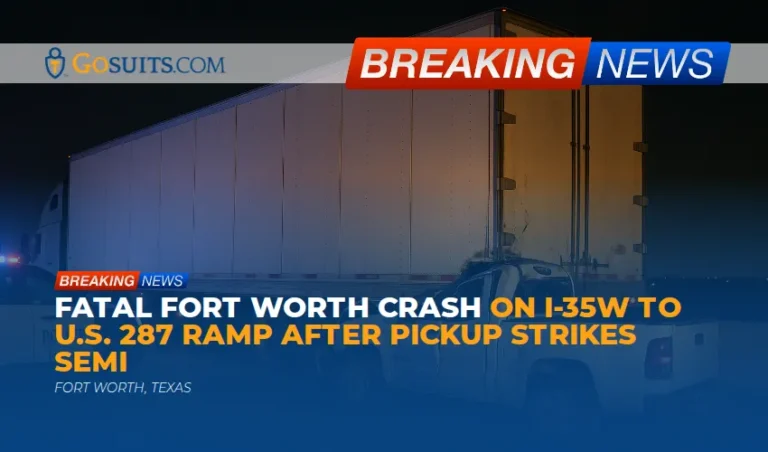
Late Monday night, just after 9 p.m., Fort Worth Police responded to a major collision on the northbound I-35W ramp transitioning to U.S. Highway 287. Investigators reported that a pickup truck struck the rear of a tractor-trailer and then lost control. The pickup’s driver was pronounced deceased at the scene. Authorities closed all northbound lanes of I-35W for several hours overnight while the scene was investigated and cleared. The roadway has since reopened, according to police information shared publicly.
At the time of writing, the Tarrant County Medical Examiner has not released the identity of the deceased driver, and authorities have not indicated whether the semitrailer driver suffered injuries.
Traffic impacts and location context
Northbound I-35W feeding onto U.S. 287 is a busy freight and commuter corridor connecting downtown Fort Worth to the Northside, Saginaw, and further to the Alliance area. Nighttime activity often includes a mix of long-haul tractor-trailers and regional delivery trucks along with local traffic returning from downtown events, the Medical District, and Stockyards-area restaurants. A closure at that ramp can ripple traffic back toward downtown and the interchange with I-30.
When major lanes close on I-35W, regional updates typically appear on state traffic resources; drivers can monitor official statewide roadway condition platforms for lane status and detours [11]. This helps families and investigators access the crash area safely once authorities reopen the scene.
What remains unknown
Fort Worth Police have stated that the underlying cause is still under investigation. Key unanswered questions usually include: vehicle speeds, visibility and lighting conditions, whether any vehicle was stopped or moving slowly before impact, the presence and performance of trailer lighting and reflectors, and whether braking or evasive maneuvers occurred. Toxicology results, mechanical inspections, and downloads of electronic data recorders may inform those findings.
Under Texas law, the official crash report and certain records are released only to specific parties and with required information, which is discussed below [3].
Why rear impacts with semitrailers are so dangerous
Rear-end collisions with semitrailers are uniquely hazardous because the trailer’s height can allow a smaller vehicle’s front end to travel under the rear structure, a scenario widely known as an underride. Even when underride does not occur, the mismatch in mass and stopping characteristics makes outcomes severe. Federal safety agencies have long highlighted underride protection and conspicuity requirements for trailers to help reduce these risks [5].
On high-speed connectors like the I-35W to U.S. 287 ramp, short sight distances, nighttime glare, and a mix of traffic speeds can amplify danger. Trailers must carry reflective tape, lamps, and a rear guard that meets federal performance standards designed to help following drivers detect and avoid the back of a trailer at night or in low-contrast conditions [5]. If any of those safety features are missing, defective, or obstructed, a trailing motorist may have less time to recognize and react to a slow or stopped trailer.
For a deeper look at how rear underride happens and why proof can be technical, see our practical overview in Underride Crashes in Texas: Dangers & Legal Options.
Investigation steps and evidence families should know about
When a pickup strikes the rear of a semitrailer, investigators will typically examine both vehicles and the scene for a range of evidence. Families often find it helpful to understand what may be collected and why it matters.
Scene documentation
Authorities usually note gouge marks, debris scatter, tire friction marks, fluid trails, and resting positions. They measure distances, photograph the scene, and may use total station mapping or 3D scanning if reconstruction is expected. Those details can help estimate speed, reaction time, braking, and impact orientation.

Vehicle inspections
On the tractor-trailer side, investigators may document the rear underride guard condition, conspicuity tape and lamp functionality, brake system performance, tires, and any cargo securement issues. On the pickup, attention often focuses on headlights, brakes, tires, steering, and structural crush. Mechanical defects are rare but can be critical if present.
Electronic data
Light-duty vehicles commonly store crash-related data in an event data recorder that may capture pre-impact speed, braking, and throttle position. Heavy trucks typically have distinct electronic control module data and, if compliant, an electronic logging device that records driver duty status and driving time [9]. While ELDs are not designed to store crash telemetry, they can help verify hours-of-service compliance around the time of the collision.
Carrier and driver records
In a commercial trucking context, relevant documents can include driver qualification file materials, hours-of-service logs, bills of lading, dispatch records, maintenance and inspection records, and prior repair reports. These records can be time-sensitive. It is common in civil cases for a family’s legal team to issue a preservation letter early to help ensure critical evidence is not overwritten or lost.
Video and 911 audio
Dash cameras are increasingly common in both commercial and personal vehicles. Nearby businesses along access roads or interchanges may also have surveillance. Additionally, 911 audio can shed light on immediate witness observations. Each data source typically has its own retention window, so early identification and request procedures are important.
How to get official records in Tarrant County and Fort Worth
Several official records can help families piece together what happened. Below are the primary sources and how access typically works under Texas law and agency policy.
Fort Worth Police Department report
FWPD crash reports and related records are requested through the department’s Records and Reports channels. The City of Fort Worth maintains a public portal detailing how to request reports, what identifiers you need, and processing timelines [1]. Texas law limits who can receive a full crash report and what identifying information is needed to verify eligibility [3].
State of Texas crash report via TxDOT
Families and authorized parties may also obtain the CR-3 crash report through the Texas Department of Transportation’s Crash Records system. TxDOT explains eligibility, required information, and the online purchase process on its crash records pages [2]. Access usually requires specific details such as date, location, and at least one party’s name or driver’s license information.
Tarrant County Medical Examiner
The Medical Examiner’s Office handles the forensic investigation, autopsy, and identification in fatal incidents within its jurisdiction. Families can find information on identification release, autopsy reports, and next-of-kin procedures through the Tarrant County Medical Examiner’s Office website [4]. The office outlines who may request records, what documentation is needed, and any associated fees. Release timing can depend on toxicology and other testing.
Public information requests
Beyond the crash report, some materials may be requested under Texas open records law. However, crash reports themselves are governed by Texas Transportation Code 550.065, which requires specific identifying information and restricts access to particular recipients [3]. Audio, video, and certain communications may be subject to statutory exceptions or redactions based on ongoing investigations and privacy protections. Always review the specific agency’s guidance to understand what is available and when.
Roadway closure and traffic status
For those coordinating with investigators or funeral homes and needing to travel through the area, official statewide roadway updates are available through the state’s traveler information platform [11].
Texas legal context: wrongful death and potential civil liability
Every collision is different, and investigators will determine the factual sequence. In general, rear-end crashes often raise questions about following distance, attentiveness, conspicuity, and whether a forward vehicle created an unreasonable hazard. In a heavy-truck context, federal and state safety rules add important layers related to vehicle equipment, lighting, maintenance, and driver operations.
In fatal incidents, Texas law allows certain surviving family members to bring a civil wrongful death claim. Under the Texas Civil Practice and Remedies Code, a decedent’s spouse, children, and parents may have standing to file, and a related survival claim may be brought on behalf of the estate for damages the decedent could have sought if they had lived [7]. Allocation of responsibility, if disputed, is handled under Texas’ proportionate responsibility rules, which limit recovery if a claimant is found more than 50 percent responsible [8].
Because trucking collisions can involve multiple corporate entities, identifying all potentially responsible parties is a careful process. Legal teams often examine whether the motor carrier, owner of the tractor or trailer, shipper, broker, maintenance providers, or others played a role, based on the operational records and contracts.
If a family decides to speak with truck accident lawyers, that team can explain how time-sensitive evidence is preserved, what insurance may apply, and whether experts in accident reconstruction, human factors, or vehicle engineering are useful under the case facts. Careful analysis is especially important where visibility, lighting, vehicle conspicuity, or sudden stops might be contested.
Insurance and corporate responsibility in truck crashes
Interstate motor carriers must maintain minimum levels of financial responsibility under federal regulations. For most motor carriers transporting non-hazardous property, the minimum combined single limit is 750,000 dollars, with higher requirements for certain hazardous materials [6]. Some carriers voluntarily carry more.
Claims often involve multiple policies. The trucking company may have a primary auto liability policy, potentially an excess or umbrella policy, and sometimes separate coverage for the trailer owner. The at-issue pickup may have its own policy and, in certain circumstances, additional coverages can apply. Sorting out priority of coverage and available policy limits tends to be document driven.
Adjusters and corporate risk managers typically move quickly to protect their interests. It is common for an insurer to request a recorded statement, medical authorizations, or early releases. Before engaging with a trucking company’s insurer, many families choose to consult a lawyer first, because statements given early can be used to shape or dispute liability later.
When a fatality is involved, families sometimes feel pressure to resolve questions quickly. In reality, it can take weeks to obtain the full crash report, toxicology, and vehicle data. Having a clear plan and a measured timeline helps preserve options while key facts are still being gathered. If local support is preferred, Fort Worth truck accident lawyers can help explain these processes and typical timelines in this jurisdiction.
Practical first steps families can consider in the first two weeks
These suggestions are general and meant to help organize information during a difficult time. Every situation is unique.
- Designate a single point of contact for calls from law enforcement, towing/storage yards, and insurers. Centralizing updates reduces repeated conversations during a stressful period.
- Request the FWPD crash report once it is available through the City’s portal or from TxDOT, following eligibility and identification rules [1] [2] [3].
- Coordinate with the Medical Examiner regarding identification, autopsy status, and the process for obtaining records authorized for next of kin [4].
- Preserve documents and devices such as the decedent’s phone, any personal dashcam, navigation devices, or vehicle telematics portals. Do not alter or reset them before consulting with a legal team about preservation.
- Note potential witnesses including anyone who arrived quickly after the crash, tow operators, or nearby motorists who may have seen the semitrailer’s position or lighting just before impact.
- Document expenses related to funeral arrangements, travel, and time away from work. Keep receipts and a simple log. These records can be important later.
- Wait to speak with opposing insurers until after getting a free consultation with a qualified attorney. Statements to an insurer can be used to shape liability arguments later on.
- Identify vehicle locations quickly. If the pickup and the tractor-trailer are in storage, record where they are and notify your legal team so they can address preservation and inspection before repairs or scrapping occur.
It is common for a trucking carrier to begin its own investigation immediately. That is another reason families often seek guidance early, to balance the information flow and ensure critical evidence is preserved.
Community safety notes for Fort Worth drivers on I-35W
Anyone who uses I-35W knows the feel of that corridor at night as trucks climb and descend between interchanges with tight merges. A few reminders for local drivers during evening hours:
- Leave more following distance behind large trucks than you think you need. Heavier vehicles stop more slowly, and your sightline to traffic ahead is reduced when you are close behind a trailer.
- Look for conspicuity cues on trailers: reflective red-white tape, marker lamps, and brake lights. If any lighting appears out or dim, widen your buffer.
- Anticipate varying speeds on connector ramps, especially where grades or lane drops occur.
- Reduce distractions approaching high-freight interchanges. Even a second of inattention can erase your stopping margin at highway speeds.
Texas agencies regularly publish statewide crash statistics and safety messaging to improve driver awareness [2] [10]. Staying attentive and giving trucks extra space helps everyone get home safely.
Why acting promptly matters after a serious truck crash
What is the specific action to take? The immediate priority is to safeguard time-sensitive evidence and obtain the official records. That includes identifying vehicle storage locations, preventing spoliation of onboard data, and securing the police and Medical Examiner documentation when available. It also means declining recorded statements requested by adverse insurers until after speaking with a lawyer who can explain rights and risks.
Why it matters now: Commercial trucking evidence can be overwritten quickly. Electronic logging devices cycle. Company dashcams and telematics often have short retention windows unless a preservation request is made. Trailer lighting and brake issues can be corrected if repairs occur before inspection. Acting within days rather than weeks often makes the difference between a complete and an incomplete record of what happened.
Context and timing: In North Texas, it can take several business days for the full crash report to post through FWPD or TxDOT. Meanwhile, a carrier’s risk team may be interviewing its driver, gathering internal documents, and preparing a liability position. Moving early to preserve neutral, objective data balances that dynamic and supports a fact-driven resolution later.
Benefit of acting: A thorough, timely record clarifies cause, narrows disputes, and reduces surprises. It positions families to make informed choices once the investigation is complete.
Additional insight on rear impacts and underride
Federal safety initiatives emphasize conspicuity and underride guards to reduce the severity of rear impacts into trailers. NHTSA’s underride protection resources explain the purpose of rear impact guards and reflective treatments, as well as ongoing research and rulemaking in this area [5]. While many crashes are multifactorial, questions about whether a trailer was properly equipped, maintained, and visible can be pivotal in civil liability analysis.
Separately, commercial driver scheduling and hours-of-service compliance are tracked through ELDs, which can corroborate timelines and fatigue risk. Although ELDs are not crash-data devices, they are a valuable puzzle piece alongside inspection records and third-party video [9]. Where disputes arise about stopping on the roadway, emergency flashers, or disabled vehicle procedures, agency rules and carrier policies tend to receive close scrutiny.
Experienced civil practitioners sometimes consult human factors experts to understand nighttime visibility, perception-response time, and how glare, grade, and curve geometry might influence hazard detection. Objective measurements, scene lighting surveys, and photogrammetry can link those scientific principles with the physical evidence documented by police.
If a family is weighing next steps, discussing these technical avenues with truck accident lawyers can help set realistic expectations about investigative scope and likely timelines.
Where local families often start
In Fort Worth and greater Tarrant County, these official agencies are typically involved after a fatal highway collision:
- Fort Worth Police Department for the crash report and collision records processes [1].
- Texas Department of Transportation Crash Records for a state-verified copy of the CR-3 crash report [2].
- Tarrant County Medical Examiner’s Office for identification, autopsy status, and next-of-kin record requests [4].
- Texas traveler information for roadway status and lane reopening updates if you need to revisit the area [11].
When contacting any agency, have the date, approximate time, roadway, and any report numbers ready. If you are a qualifying family member requesting restricted records, be prepared to verify your identity and relationship, in line with Texas statutes governing crash report access [3].
Your rights, timelines, and how Texas law frames responsibility
Texas wrongful death and survival statutes outline who may bring claims and what types of damages may be available in a civil action following a fatal crash [7]. Texas also applies proportionate responsibility rules that can reduce or bar recovery depending on allocated fault across the parties involved [8]. Understanding these frameworks early helps set expectations as the facts develop.
Because trucking cases often involve sophisticated insurers and multiple corporate parties, many families choose to meet with a seasoned local attorney to discuss preservation steps, insurance coverage layers, and realistic investigative timelines before interacting with any adverse insurer. What is said to an insurance company can be used against the claimant later on, which is why people often seek a free consultation first to understand their rights and potential risks in plain terms.
If you are comparing options, some look for teams known for handling commercial motor vehicle investigations, evidence preservation, and litigation against corporate defendants. Others focus on location familiarity and courthouse experience. Either approach can be valid. A straightforward first meeting should clarify how evidence will be preserved, how communication with insurers will be handled, and what a measured plan looks like for the first 30 to 60 days.
In many situations, coordination between an attorney and accident reconstruction experts begins early so that vehicle inspections, scene surveys, and document requests are not delayed. This balanced approach often leads to a clearer understanding of cause and responsibility once the official reports and lab results are complete.
Localized support and informed next steps
Fort Worth’s highways are among the busiest in North Texas for heavy truck traffic, especially along I-35W moving between downtown, the Northside, and logistics hubs. That context shapes how investigations unfold and where helpful video or data might be found. Knowing the local road geometry, typical lighting, and likely camera vantage points can improve how quickly and completely critical information is gathered.
If families prefer to speak with a local professional, many start with a short conversation to map out the next two weeks: obtain official records, send preservation requests, identify and secure any vehicle or device data, and determine if third-party video is available. These early steps, while simple in concept, can be pivotal in a case where cause and responsibility are still unsettled.
When the time is right, it can also be useful to discuss broader questions such as employer liability, shipper or broker involvement, and whether additional parties may have contributed to the hazard. Each case turns on its facts, but a structured plan helps ensure nothing is missed while the family focuses on immediate needs.
Finally, if a family wants general reading on how these crashes happen on major highways in North Texas, this practical overview can help frame the common patterns: Dallas Common Truck Crash Causes on Highways. It pairs well with the underride resource shared earlier and can help families ask informed questions as new facts come in.
Commentary from Gosuits Fort Worth, Texas Personal Injury Attorney
Our hearts go out to everyone affected by this tragedy on the I-35W to U.S. 287 connector. Losing a community member on a corridor so many of us travel is heartbreaking. This commentary is offered for general information and educational purposes only, based on what officials have shared so far.
When a pickup collides with the rear of a semitrailer at night, questions naturally arise about speed, following distance, and visibility. Investigators will sort those facts out. In our experience handling heavy-vehicle cases, it is also important to examine trailer lighting and reflective treatments, the condition of the rear impact guard, and whether any unusual traffic pattern or slow-moving condition existed ahead of the ramp. Those pieces, together with data from the vehicles and any scene video, tend to clarify why a driver did not or could not avoid the back of the trailer in time.
Insurance companies and corporate stakeholders often mobilize quickly after a serious truck crash. They collect logs, interview their driver, and seek to lock down narratives early. Families unfamiliar with these processes may feel outmatched or rushed into statements or decisions. That imbalance of information can affect how responsibility is framed before all the facts are in. A simple, no-cost consultation empowers people with a roadmap: what to preserve, what to wait for, and what to avoid saying to adverse insurers while evidence is still being gathered.
If anyone is considering next steps, a private, free consultation can help explain preservation of evidence, the role of official records, and how Texas law approaches responsibility in collisions involving commercial trucks. Speaking with a professional first is especially important because what is shared with an insurance company can be used later to challenge liability or damages.
Base note for readers: truck accident lawyers are often consulted early in cases like this to help balance the process, protect time-sensitive data, and ensure the investigation is full and fair. For those who want locale-specific guidance, Fort Worth truck accident lawyers can explain typical investigative timelines, the agencies involved, and how corporate insurance layers may apply in this jurisdiction.
References and Resources
- Police Reports and Records – City of Fort Worth
- Crash Records and Reports – Texas Department of Transportation
- Texas Transportation Code Sec. 550.065 – Release of Accident Report
- Tarrant County Medical Examiner’s Office – Official Site
- Underride Protection – National Highway Traffic Safety Administration
- 49 CFR 387.9 – Financial Responsibility, Minimum Levels – eCFR
- Texas Civil Practice and Remedies Code Chapter 71 – Wrongful Death and Survival
- Texas Civil Practice and Remedies Code Chapter 33 – Proportionate Responsibility
- 49 CFR Part 395 – Hours of Service and ELDs – eCFR
- Motor Vehicle Crash Statistics – Texas Department of Transportation
- DriveTexas – Official Road Conditions and Closures