- Texas Senate Bill 546: What It Requires and Why It Matters
- East Texas Context: Pine Tree ISD and Our Community’s School Buses
- Timeline to 2029 and What Compliance Looks Like
- Safety Science: Three point seat belts on school buses
- Potential Liability and Rights After a Bus Injury
- Funding Paths Districts Are Exploring in Texas
- If a School Bus Crash Happens: Who to Call and What to Request
- How to Request Official Records in Texas
- Insurance and School District Claims: What to Expect
- Practical Steps Parents Can Take Now
- Action Steps You Can Take Today
- Commentary from Gosuits Longview, Texas Personal Injury Attorney
- Resources and References
Texas Senate Bill 546: What It Requires and Why It Matters
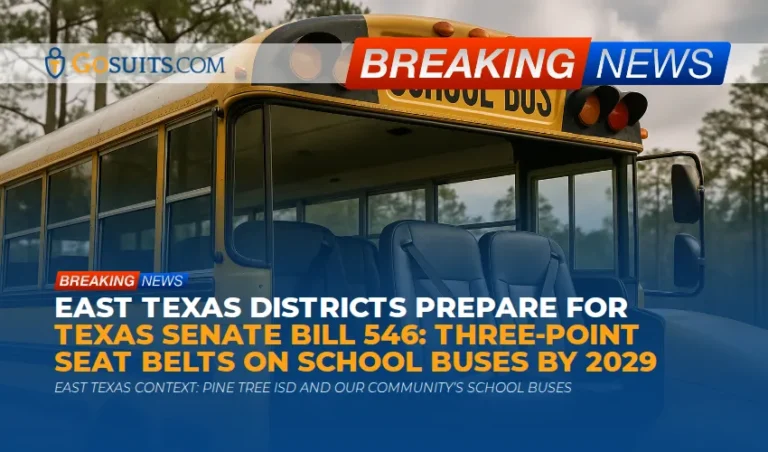
Texas Senate Bill 546 directs that all buses covered by the law be equipped with three point seat belts by September 1, 2029. The bill reflects a statewide shift toward lap shoulder restraints for student passengers, aligning state policy with national safety research and federal standards that recognize the added protection these belts provide compared with compartmentalization alone. The measure builds on prior Texas policy that encouraged or required belts on certain new buses and moves the state toward universal adoption on a defined timeline [1] [2].
Why does this matter for families and districts in East Texas and across the state? Three point restraints can reduce the risk of serious injury in certain crash scenarios, including rollovers and side impacts. National authorities have explained that large school buses have strong safety records due to structural design and compartmentalized seating, yet they also note that properly installed lap shoulder belts add protection against ejection and help keep students in position during a crash [5] [6].
On the operations side, the new requirement raises concrete questions for local school systems. Many districts are assessing fleet ages, retrofit feasibility, and purchase schedules. State agencies provide school transportation guidance and vehicle specifications that will intersect with compliance planning in the coming years [3] [4].
East Texas Context: Pine Tree ISD and Our Community’s School Buses
Here in East Texas, communities like Longview, Pine Tree, White Oak, and Hallsville rely on school buses daily along corridors such as Loop 281, U.S. 80, and the I 20 stretch between Gregg and Harrison counties. Morning fog near the Sabine bottomlands, sudden downpours in spring, and early nightfall during football season all add to the real world conditions that student transportation teams manage.
Local administrators have already begun mapping out what SB 546 will mean in practice. Pine Tree ISD Superintendent Steve Clugston has acknowledged the reality that planning must account for cost and timing, and that the district is working through those questions now. Many East Texas districts are in similar conversations, since the law’s deadline touches fleets of different ages and conditions across our region.
Families often ask what this means for their child’s daily ride to school or to games at Lobo Stadium or out of town events in Tyler, Kilgore, or Marshall. In the near term, districts will continue using existing buses while scoping funding, procurement, and training needed to add or expand three point restraints. Over time, more routes should feature buses with lap shoulder belts as retrofits or replacements move forward.
Timeline to 2029 and What Compliance Looks Like
The headline date is September 1, 2029. Between now and then, several moving parts will shape how districts get there. Factors include the physical feasibility of retrofitting particular bus models, prioritizing older or higher mileage units for replacement, and integrating new belts with seat spacing and anchorage points that meet federal safety standards. The Texas Department of Public Safety publishes the Texas School Bus Specifications that set detailed standards for construction and equipment, and those specifications help guide procurement decisions for districts and vendors [4].
At the same time, the Texas Education Agency’s student transportation program provides statewide guidance and funding mechanisms for eligible transportation costs. While the specifics of how SB 546 will fold into future budget cycles will evolve, TEA’s existing frameworks for student transportation are a baseline for how districts categorize and report eligible expenses [3].
Districts may phase compliance by prioritizing activity or athletic buses that log longer highway miles on I 20 or U.S. 259, then expanding to daily route buses. Others may align belt installations with regular mid life overhauls to minimize down time. The precise plan will vary by fleet makeup.

Safety Science: Three point seat belts on school buses
Large school buses are built on a safety concept called compartmentalization, which uses closely spaced, energy absorbing seats to protect passengers without belts. That approach has worked well, yet it has known limitations in certain types of crashes where occupant movement can exceed the envelope of the seat. In those situations, lap shoulder belts provide important benefits by keeping students properly positioned, which can lower the risk of head and upper body injury and reduce the chance of partial or full ejection [5] [6].
National Highway Traffic Safety Administration materials emphasize that belts must be properly installed to work as intended. On modern buses designed for lap shoulder restraints, seat frames and anchorage systems are engineered for the added loads. For retrofits on existing buses, districts will look for vendor solutions that meet federal motor vehicle safety standards and state specifications, then train drivers and students on proper use.
Texas based research institutions have also examined how lap shoulder belts affect crash dynamics and student behavior. Published studies have found that belts can reduce movement in crashes and may improve bus conduct, which matters on rural highways and during wet weather on roads like Gilmer Road or TX 42. Cost and installation logistics are real considerations, but the injury prevention benefits in specific crash modes remain a core driver of the mandate [11].
Potential Liability and Rights After a Bus Injury
From a civil injury standpoint, the shift to three point restraints does not erase every risk. Claims after bus crashes often involve questions about driver conduct, maintenance, route planning, visibility at stops, and whether safety equipment was installed and used. In Texas, claims involving public school districts may follow unique notice rules and timelines under state law, which is one reason families often seek guidance early if an injury occurs. Many people search for car accident lawyers to better understand their options after a serious transportation incident.
Seat belt availability may intersect with liability analyses in limited ways. For example, if a crash occurs after the mandate is in effect, investigators may review whether required equipment was present and functioning and whether students received reasonable instruction on use. Separate from that, Texas comparative responsibility rules can come into play if insurers try to argue about seat belt use. Each case turns on its facts, and discussions about fault and defenses are highly particularized.
When buses are contracted or chartered, additional layers of responsibility may exist for the transportation company, the driver’s employer, and their insurers. Evidence preservation is critical. That includes driver logs, bus video systems, electronic control module data if present, maintenance records, and route documents.
Funding Paths Districts Are Exploring in Texas
Districts across Texas are evaluating the costs of retrofitting buses with three point restraints or replacing older units. The mix of strategies may include phasing in retrofits on newer buses that are structurally compatible, prioritizing replacement of high mileage units, and aligning purchases with existing bond programs or budget cycles. Some districts also look for grants or safety funds where eligible. TEA program structures for student transportation and DPS specifications will guide what can be purchased and how it must be equipped [3] [4].
For a broader policy view on school safety measures in Texas and how new laws ripple through district operations, see this practical overview: Impact of New School Safety Law on Texas School Districts.
In East Texas, transportation directors also keep an eye on vendor supply timelines. Ordering windows for new buses can stretch many months, especially when specification changes increase demand. That is why early planning and clear board communication matter in Longview, Pine Tree, Kilgore, and other systems that serve both dense neighborhoods and rural routes.

If a School Bus Crash Happens: Who to Call and What to Request
No one wants to think about a school bus crash. If one occurs on Loop 281, U.S. 80, or a county road outside Gladewater, families will want accurate information fast and a clear understanding of what records exist. Consider these contacts and requests, which apply broadly in Texas:
- Local law enforcement. For city streets in Longview or White Oak, that may be the city police department. On county roads, it may be the sheriff’s office or the Department of Public Safety. Ask how to obtain the Texas Peace Officer’s Crash Report (CR 3). Texas crash reports are available to eligible requestors through state systems [7] [8].
- Emergency medical services and hospitals. For transported students, request discharge paperwork and billing records. Retain every document.
- School district transportation department. Ask if the bus had an onboard camera system and how long video is retained. Ask for the route sheet, seating chart if used, and any incident report created after the event. Public school records are generally subject to the Texas Public Information Act, though exceptions and privacy rules apply [9].
- County medical examiner or justice of the peace in fatal incidents. Texas law provides for county medical examiners in some counties and for justices of the peace to serve similar functions elsewhere. Requests for autopsy or inquest records follow state law and local procedures [10].
When making requests, note dates, times, and locations such as I 20 near Estes Parkway, Loop 281 at Gilmer Road, or Eastman Road crossings. Precise details help agencies search quickly.
How to Request Official Records in Texas
Official records requests in Texas typically follow these paths:
- Crash reports. Texas crash reports can be requested online through the state’s Crash Records Information System purchase portal. You will need the crash date, location, and involved party information. Only eligible parties may obtain a full report under state law [7] [8].
- School records. Submit a written request to the district’s public information officer. Identify the records you seek, for example bus video for a defined date and time, bus number, route number, seating and discipline logs, driver training certifications, and maintenance records for the specific unit. The Texas Public Information Act sets timelines for responses and outlines exemptions that may apply to student privacy and security sensitive materials [9].
- Medical examiner or JP records. For fatal incidents, consult the county’s published process for inquest and autopsy records. The Texas Code of Criminal Procedure sets statewide rules for counties with medical examiners. In counties without a medical examiner office, the justice of the peace conducts inquests and will have procedures for records requests [10].
- Video from nearby public sources. If a crash happened near a TxDOT camera or public facility, a public information request may be appropriate. Be specific and act quickly because many systems overwrite footage on short cycles.
Keep copies of all requests and responses. If a severe injury is involved, evidence preservation letters are commonly used to notify parties that records, video, and vehicle data must be retained.
Insurance and School District Claims: What to Expect
Transportation claims can involve a mix of coverage sources. Public school districts typically carry liability coverage through insurers or risk pools. If a crash involves a third party driver, that driver’s liability coverage becomes part of the analysis. Medical bills for injured students may first run through family health insurance, then seek reimbursement through responsible parties later.
Be cautious with early calls from insurance adjusters after a crash. Recorded statements can be used to minimize or dispute a claim. Before speaking with any insurer, it is a good idea to consult an attorney to understand your rights, obligations, and the best way to document injuries. People often turn to Dallas car accident lawyers when a crash involves serious injuries and complex coverage questions, especially if the incident occurred in East Texas but potential defendants or insurers are based in the Metroplex.
If a claim is opened with an insurance company, consider waiting to make any formal statement until after legal consultation. What a person says to an insurer can be used against them later, even if they are trying to be helpful.
Practical Steps Parents Can Take Now
You do not have to wait until 2029 to engage on bus safety or understand how your district is approaching SB 546. Here are practical, community centered steps that align with the realities of East Texas schools and roads:
- Ask about your child’s route bus. Get the bus number and confirm whether it currently has lap shoulder belts. If it does, ask your child’s campus to demonstrate proper belt use during dismissal or at a back to school safety session.
- Request the district’s timeline. Transportation departments often have a replacement and retrofit schedule. Understanding when your route is expected to change can help you plan.
- Talk with your student about bus conduct. Belts work best when students remain seated properly. Remind your child why buckling up is important, especially on rainy mornings or during long drives to away games.
- Prepare an emergency contact card. Put key phone numbers in your child’s backpack. If a route is diverted because of a crash near Loop 281 or delays on I 20, up to date contacts matter.
- Know your records rights. Learn how to request crash reports, district records, and video under the Texas Public Information Act so you can act quickly if needed [7] [9].
Action Steps You Can Take Today
Knowing where to start can make a stressful situation more manageable. These are concrete actions that community members can take to stay ahead of the curve:
- Document your child’s current transportation. Write down bus numbers, stop locations, and driver names if publicly posted. This information is essential if an incident occurs because it allows precise records requests and speeds up communication.
- Attend a school board meeting focused on transportation. Districts will be making budget decisions between now and 2029. Public input helps leaders calibrate timelines and prioritize high mileage or highway heavy routes first.
- Request the written safety plan for SB 546 implementation. A brief, written plan that lists timelines, retrofit vendors, training, and communication protocols brings accountability and clarity.
- Create a family protocol for after a crash. Decide who will request the police report, who will save medical bills, and who will capture photos and notes if your child is able. Early, organized documentation often helps later.
- Consult an attorney before discussing details with insurance companies. Early recorded statements can lock in incomplete facts and make it harder to recover fair compensation later. A free consultation can help map out the right steps and avoid common pitfalls.

Commentary from Gosuits Longview, Texas Personal Injury Attorney
Our hearts are with every family, driver, and educator working to keep students safe on East Texas roads. This overview is for general information and education. It is not case specific guidance.
In our view, SB 546 reflects a careful move by Texas toward the added protection that three point restraints can offer in particular crash scenarios. Compartmentalization remains a proven baseline, but belts help keep students in position during rollovers and side impacts that can happen on highways like I 20 or when a bus is struck at an intersection along Loop 281. For districts like Pine Tree ISD that are planning carefully, the next several years will be about choosing the right mix of retrofits and replacements, training, and clear communication with families.
We have seen how insurance carriers and large organizations sometimes take advantage of a person’s lack of familiarity with the process. Adjusters can look friendly while gathering recorded statements that later get used to dispute how a crash happened or to argue that injuries are minor. Key records such as bus camera video or maintenance logs can also go missing if they are not requested quickly and appropriately.
Early, knowledgeable guidance can make a difference. A free consultation helps people understand which records to request, how to preserve evidence, and what not to say in early calls. It also helps set expectations about timelines, coverage layers, and documentation that supports a claim if one becomes necessary.
Resources and References
- Texas Legislature Online Bill Lookup and Text – capitol.texas.gov
- Texas Education Code Section 34.013 – Statutes – Texas Legislature Online
- Student Transportation – Texas Education Agency
- School Bus Transportation and Specifications – Texas Department of Public Safety
- School Bus Safety Overview – National Highway Traffic Safety Administration
- Federal Motor Vehicle Safety Standards including FMVSS 222 – NHTSA
- Crash Report Purchase System – Texas Department of Transportation
- Crash Reports – Texas Department of Public Safety
- Overview of the Texas Public Information Act – Office of the Texas Attorney General
- Texas Code of Criminal Procedure Article 49.25 – Medical Examiners – Texas Legislature Online
- Texas A&M Transportation Institute Research Portal – tti.tamu.edu