- What we know about the East Los Angeles hit-and-run on Whittier Boulevard
- Community and location context: Whittier Boulevard near Ferris Avenue at night
- Investigation status and how information can be shared with authorities
- How families can obtain official records in Los Angeles County
- Civil law overview after a fatal hit-and-run in California
- Insurance pathways when the at-fault driver is unknown
- Preserving and finding evidence around Whittier Boulevard
- Grief support and practical help in Los Angeles County
- Safety reflections for riders and drivers in East Los Angeles
- Steps to take now
- Commentary from Gosuits East Los Angeles, California Personal Injury Attorney
- References
What we know about the East Los Angeles hit-and-run on Whittier Boulevard
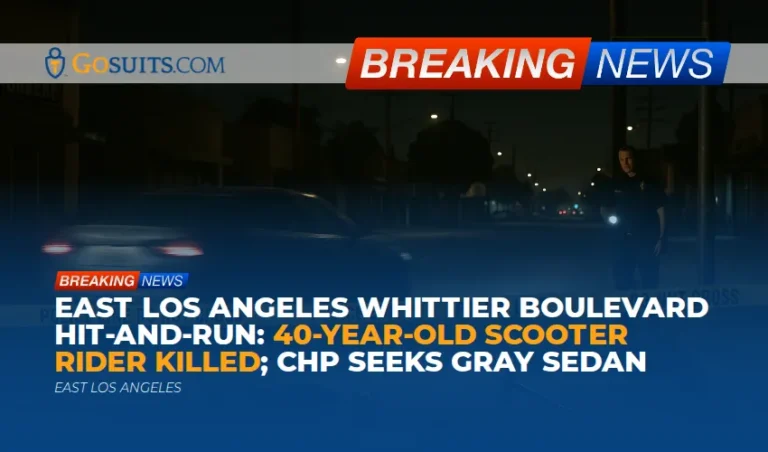
In the early morning hours, about 2:30 a.m. Sunday, a 40-year-old man riding a scooter was struck by a gray sedan and killed near the intersection of Whittier Boulevard and Ferris Avenue in East Los Angeles. According to the initial details publicly shared, the California Highway Patrol is the investigating agency. The driver left the scene and remains at large. Family members have pleaded for the driver to come forward and for anyone with information to contact investigators. Authorities have asked the public to share tips with the California Highway Patrol.
At this stage, only the vehicle color has been publicly described. No driver description has been released. This is common early on, when investigators work to verify witness accounts, secure surveillance footage, and analyze physical evidence gathered at the scene.
Community and location context: Whittier Boulevard near Ferris Avenue at night
Neighbors in East Los Angeles know Whittier Boulevard as a major corridor that stays active well into the night. Even after last call, taquerias, bakeries, and late-night markets can keep foot and vehicle traffic steady. The stretch near Ferris Avenue runs through a blend of small businesses and residential pockets. Street lighting varies by block, and sightlines can be a challenge with frequent driveways and parked cars along the curb.
Anyone who travels this corridor regularly has seen the mix of pedestrians, cyclists, and scooter riders sharing space with motorists. In the overnight hours, speeds can rise and reaction times shrink. That reality is why investigators often cast a wide net for witnesses, especially drivers who might have passed the location around the time of the collision and could have dashcam recordings. If a gray sedan headed east or west on Whittier around 2:20 to 2:40 a.m., even a brief clip could help triangulate the route the car took before or after the crash.
Investigation status and how information can be shared with authorities
The California Highway Patrol leads collision investigations on many county roadways in unincorporated areas like East Los Angeles. Investigators typically start with scene evidence, witness interviews, and any available video from nearby establishments. In fatal hit-and-run cases, the priority is locating the involved vehicle and identifying the driver. Even partial details can matter: body damage patterns, missing trim pieces, or paint transfers can help isolate the year and model range of a suspect vehicle.
If anyone in the community has information, it can be reported to the California Highway Patrol. Tips can be provided by calling a local CHP Area Office or by visiting the statewide office locator to find the East Los Angeles Area Office and confirm the best contact method [3]. If there is an immediate risk to public safety, call 911. For non-emergency tips, refer to the CHP office contact for this area. Providing the exact time window and any media you have, such as dashcam or home security footage, is especially helpful.
How families can obtain official records in Los Angeles County
After a fatal crash, families often need several official records to understand what happened and to handle practical matters. In Los Angeles County, those typically include the CHP collision report and records from the County Medical Examiner. Timing varies, and not all documents are immediately available.
CHP collision report
Collision reports for CHP-investigated crashes are requested using the CHP 190 form, “Application for Release of Information.” The CHP provides guidance on eligibility, documentation required, and where to submit the request. Reports may take time to finalize, especially when a criminal investigation is ongoing. Start with CHP’s public guidance on collision report requests [1] and the CHP 190 form [2]. You will generally need to identify your relationship to the involved person and provide the report number if available. If you do not have the report number, supply the exact date, time, and location so staff can search.
Medical Examiner records
The Los Angeles County Department of Medical Examiner maintains records including autopsy and toxicology reports when a death is under their jurisdiction. Families can review the department’s process for requesting records, typical timelines, and eligibility requirements on the Medical Examiner’s website [4]. Some records may not be releasable while an active law enforcement investigation is underway, but the office can explain what is available and when.
Other records that may be helpful
- CAD logs and 911 recordings: Depending on agency policy and the status of the case, call recordings and dispatch logs may be requested. Requests to state agencies like CHP are typically handled under the California Public Records Act [10]. Response times and exemptions vary.
- Death certificate: Issued through the Los Angeles County Registrar-Recorder/County Clerk. This is often needed for insurance and estate matters.
For a practical, step-by-step checklist that fits Los Angeles families navigating these documents, see our in-depth resource, Los Angeles Wrongful Death Paperwork Checklist for Families.
Civil law overview after a fatal hit-and-run in California
Leaving the scene of a collision that causes injury or death violates California’s duty-to-stop laws and creates serious legal exposure for a driver who flees [5] [6]. On the civil side, when a person is killed by another’s negligence, certain family members can bring a wrongful death claim under California Code of Civil Procedure section 377.60 [7]. This statute outlines who can file and the types of losses that can be claimed, which typically include loss of financial support and the loss of the decedent’s love, companionship, and guidance. A separate but related survival action may be brought under section 377.30 for losses the decedent sustained between injury and death, such as medical expenses [8].
The general statute of limitations for a wrongful death claim in California is two years from the date of death under section 335.1 [9]. If any public entity were potentially implicated, such as for a claim involving roadway maintenance, timing is different and the California Government Claims Act’s shorter deadlines can apply [11]. Those scenarios are fact-specific and should be evaluated carefully.
Families often seek guidance from wrongful death attorneys to understand these timelines and how evidence will be developed. In many cases, early legal steps focus on securing records, preserving video evidence, interviewing witnesses, and coordinating with investigating agencies while avoiding interference with a criminal investigation.
When a case arises in Los Angeles County, many people look for local representation by Los Angeles wrongful death attorneys familiar with area agencies, typical roadway conditions, and jury expectations. Local knowledge can help with practical tasks like identifying which businesses along Whittier Boulevard are most likely to have usable video and when to request it.
Insurance pathways when the at-fault driver is unknown
Hit-and-run cases create a difficult situation because the identity of the at-fault driver is initially unknown. In California, many families turn to Uninsured Motorist coverage, which is designed to respond when an at-fault driver has no insurance or cannot be identified. The California Department of Insurance provides consumer guidance on how automobile coverages work and what UM coverage can address [12].
Several key points often matter in these claims:
- Which policies may apply: Potential sources include the decedent’s own auto policy, a household family member’s auto policy if the decedent was a listed driver or resident relative, and any policy covering the scooter if it was insured. Policy language controls.
- Prompt notice: Policy terms usually require prompt notice of a hit-and-run and a report to law enforcement. Delays can complicate claims. Before contacting any insurer, it is wise to speak with a lawyer so that statements do not limit coverage later.
- Evidence of impact: Many UM policies require evidence that another vehicle caused the collision. Physical evidence, video, and independent witness statements can be critical for meeting this requirement.
- Liability investigation: Even with a hit-and-run, insurers review liability. They may look at lighting, reflectivity, roadway conditions, and travel path. Preserving accurate, objective evidence is essential.
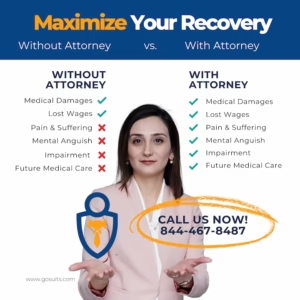
Insurance companies have adjusters, defense counsel, and preferred experts working to minimize what they pay. Families without guidance can feel outmatched. Speaking with wrongful death attorneys before opening any claim can help ensure the process starts on the right terms, including controlling what is shared and setting expectations for what documentation will be needed.
Preserving and finding evidence around Whittier Boulevard
Evidence disappears quickly, especially video. Many private security systems overwrite within days. Along Whittier Boulevard near Ferris Avenue, there are convenience stores, restaurants, auto shops, and apartment buildings that may have cameras. A targeted, block-by-block canvass in the first 24 to 72 hours is often the difference between securing usable footage and missing it entirely.
Consider these time-sensitive steps:
- Identify likely cameras: Look for cameras pointed toward the sidewalk and curb lanes, particularly at business entrances, parking lot exits, and corners that capture cross-streets like Ferris Avenue.
- Request preservation: Ask owners to preserve footage for at least the hour surrounding 2:30 a.m. on the date of the collision. Provide a specific time window so staff can isolate the correct segment.
- Seek multiple angles: A clip that looks unhelpful alone can become powerful when synced with another angle. Video that shows headlights reflecting off parked cars or brake lights in the distance may help reconstruct speed and path.
- Document the scene: Photograph skid marks, debris, broken plastic, or paint chips. Note exact locations relative to fixed landmarks like crosswalks, bus stops, or signposts.
- Public records: Some data may be available through requests under the California Public Records Act, such as traffic signal timing sheets or certain dispatch logs, depending on which public agency holds them [10]. Many freeway or highway traffic cameras are not recorded and are for live monitoring, but it is still worth checking whether any relevant public footage exists.
Evidence preservation letters can be sent to nearby businesses and property managers asking them to save video and relevant records. When served promptly and properly, these requests show diligence and can persuade recipients to cooperate.
Grief support and practical help in Los Angeles County
No one prepares for the sudden loss of a family member in a crash. Los Angeles County has resources to support loved ones emotionally and practically. The County Department of Mental Health offers community-based services and can point residents to grief counseling and crisis response teams [13]. In addition, the Los Angeles County District Attorney’s Office operates a Victim Services Division that assists crime victims and surviving family members with information, referrals, and help navigating the criminal justice process in cases like hit-and-run [14].
For documentation and estate issues, families often need death certificates, identification documents, and employer records for the decedent. Organizing these early helps when dealing with insurance claims and any probate steps. While community fundraisers can ease immediate expenses, official records will be required to address the longer-term tasks.
Safety reflections for riders and drivers in East Los Angeles
Conversations about safety are never about blame. They are about reducing the chances another family will feel this kind of loss.
- For drivers: On corridors like Whittier Boulevard, late-night driving can create a false sense of open road. Maintain speeds that fit lighting and sightlines, scan for people on scooters or bicycles, and be ready for someone stepping off a curb near a parked car.
- For people on scooters: Visibility tools help. Bright clothing, reflectors, and lights make a difference at 2:30 a.m. When available, choose routes with better lighting and fewer driveways. Travel predictably and assume drivers may not anticipate a small profile vehicle.
- For businesses with cameras: Keeping cameras angled toward the sidewalk and curb lane helps deter crime and greatly assists investigations when the unthinkable happens.
Above all, hit-and-run is never the answer. California law requires drivers involved in injury or fatal collisions to stop, render aid, and exchange information [5] [6]. Stopping can save a life. Fleeing compounds the harm.
Steps to take now
When a fatal crash occurs and the driver leaves the scene, there are focused actions that can preserve options for accountability and support.
- Secure official records: Begin the process to obtain the CHP collision report using the state’s guidance and form CHP 190 [1] [2]. Monitor the Los Angeles County Medical Examiner’s portal for record availability and request updates as needed [4].
- Preserve video immediately: Within days, visit businesses and residences along Whittier Boulevard near Ferris Avenue to ask that overnight footage be saved. Prioritize the time window around 2:30 a.m. Save receipts or notes from these visits.
- Collect physical evidence and witness contacts: Photograph any debris field or scuff marks and keep a list of witnesses with preferred contact methods. Back up photos in more than one place.
- Map a vehicle path: Use any dashcam or home camera clips to map possible approach and departure routes for a gray sedan. Share this with CHP to help target additional canvassing.
- Protect insurance options: Before contacting any auto insurer, consult a lawyer so that statements are consistent and complete. What is said to an adjuster can be used later to limit coverage. Confirm whether Uninsured Motorist coverage exists on the decedent’s policy or a resident relative’s policy and keep all policy documents together.
- Track timelines: Note the two-year general deadline for wrongful death actions in California [9]. If a public entity could be involved based on roadway conditions, note the possibility of a six-month administrative claim window under the Government Claims Act [11].
Many families also benefit from a single, organized folder that holds incident numbers, agency contacts, and copies of any letters or emails sent to businesses about video preservation. Keeping information centralized eases coordination with investigators and any legal team that may assist.
Commentary from Gosuits East Los Angeles, California Personal Injury Attorney
Our hearts are with this family and the East Los Angeles community. Losing a loved one on a familiar corridor like Whittier Boulevard is devastating, and it is especially painful when the driver leaves the scene. This article is for education and general information, and it is not a substitute for guidance about any individual situation.
From our perspective, several facts stand out. The report indicates a gray sedan and a narrow overnight window around 2:30 a.m. That combination makes private security footage the most urgent source of leads, particularly from corner businesses and lots along Whittier and Ferris. Even a few seconds of taillights or visible body damage can break a case open. Early, respectful outreach to nearby businesses often yields cooperation, especially when investigators are looped in promptly.
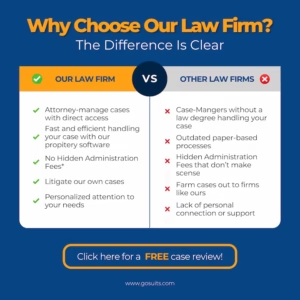
Insurance companies and large corporate actors understand these timelines and know where claims are vulnerable. They may contact families before the family has the full picture and ask seemingly simple questions that become ammunition to dispute liability or minimize coverage. They control policy language and adjuster playbooks. Without seasoned guidance, people can end up signing broad authorizations, giving incomplete statements, or missing critical proof deadlines. A free consultation provides a safe space to learn what information to share and what to hold until the record is complete. It also helps families prioritize evidence tasks that matter most in a hit-and-run investigation, without getting overwhelmed by paperwork too soon.
References
- Request a Collision Report – California Highway Patrol
- CHP 190 Application for Release of Information – California Highway Patrol
- Find an Office – California Highway Patrol
- Family Assistance and Records – Los Angeles County Department of Medical Examiner
- Vehicle Code § 20001 Duty to Stop at Scene of Accident – California Legislative Information
- Vehicle Code § 20003 Duty to Give Information and Render Aid – California Legislative Information
- Code of Civil Procedure § 377.60 Wrongful Death – California Legislative Information
- Code of Civil Procedure § 377.30 Survival Action – California Legislative Information
- Code of Civil Procedure § 335.1 Two-Year Limitation – California Legislative Information
- California Public Records Act Overview – California Department of Justice
- Government Code § 911.2 Claims Presentation Deadline – California Legislative Information
- Automobile Insurance 101 – California Department of Insurance
- Los Angeles County Department of Mental Health
- Victim Services Division – Los Angeles County District Attorney