- What happened near Grant Elementary in Santa Monica
- Why automated vehicle incidents raise unique questions
- School zone safety and California rules that matter
- Who is investigating and what that typically involves
- Practical steps families can take in the first days
- How to obtain official records and documents
- Potential civil liability paths after an AV pedestrian collision
- Insurance issues and how claims usually work in California
- Community context around Pearl Street and local safety efforts
- If a company or insurer contacts you
- What sensible next steps look like within 48 to 72 hours
- Commentary from Gosuits Santa Monica, California Personal Injury Attorney
- References
What happened near Grant Elementary in Santa Monica
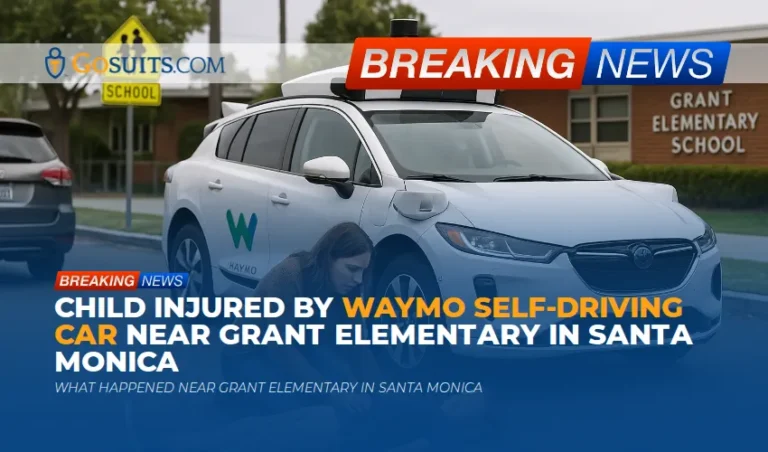
A child was struck and injured by a Waymo self-driving vehicle near Grant Elementary School on Pearl Street in Santa Monica. The incident occurred on January 23. According to a company statement reported in local coverage, the child suddenly entered the roadway from behind an SUV into the path of the automated vehicle, which slowed but still made contact. The child’s injuries were described as minor. The company reportedly notified the National Highway Traffic Safety Administration, and a federal inquiry is underway.
Any crash involving a child steps right to the heart of a neighborhood’s sense of safety. Pearl Street, which runs through a busy residential area not far from Lincoln Boulevard, sees a lot of drop-off and pick-up traffic on school days. In those windows, drivers, cyclists, and automated vehicles alike face the reality of children sometimes moving unpredictably, families loading and unloading, and sightlines broken up by parked or stopping vehicles.
Why automated vehicle incidents raise unique questions
Crashes involving automated driving systems are not just ordinary fender-benders with a twist. They add layers of technical and legal complexity. Federal safety officials collect crash data from companies testing or deploying automated driving systems under a standing general order for crash reporting. That system is designed to help regulators monitor safety performance and spot patterns that might require corrective action or further investigation [1].
At the same time, California has its own framework for autonomous vehicle testing and deployment. The California DMV requires companies that test on public roads to hold appropriate permits and to file collision reports that are made available to the public. Those reports provide a baseline of facts about each crash, such as date, location, and narrative summaries, which can be useful alongside any police report or witness accounts [3]. DMV rules also govern how companies test and what data they must submit, depending on whether the vehicle is supervised by a safety operator or operating without one [4].
Practically speaking, these frameworks mean there are potentially multiple sources of official documentation and oversight. That can help families, schools, and the broader Santa Monica community understand what happened and what, if anything, should change to keep kids safer around campuses.
School zone safety and California rules that matter
It helps to ground the discussion in the rules that already apply in school areas, whether a vehicle is human-driven or automated:
- California’s school-zone speed limits: State law recognizes 25 mph as a prima facie limit near schools under certain conditions. Depending on signage and specific circumstances, drivers are expected to slow to speeds that are reasonable and safe in a school zone [6].
- The basic speed law: Even below the posted limit, drivers must not travel faster than is safe for current conditions. In other words, if visibility is limited by parked SUVs, if it is pickup time, or if children are present near the curb, drivers must reduce speed accordingly [7].
- Pedestrian right-of-way and duty of care: Motorists must yield the right-of-way to pedestrians within marked and unmarked crosswalks at intersections and exercise due care for pedestrian safety. Pedestrians also share responsibility for their own safety, but vehicles must anticipate common behaviors and respond appropriately [5].
The intent behind these rules is straightforward. School areas are dynamic. Kids can be hard to see behind taller vehicles and can step off the curb suddenly. Systems that drive must recognize that and err on the side of caution. So must human drivers, crossing guards, and everyone else sharing those blocks.
Santa Monica families know this firsthand. On Pearl Street during morning drop-off or afternoon pickup, the combination of parked cars, opening doors, and clusters of students with backpacks can test the limits of any vehicle’s perception and braking. Safety comes from layers: slower speeds, extra scanning, clear crosswalks, and predictable traffic behavior.

Who is investigating and what that typically involves
According to the company’s statement referenced in the initial reporting, NHTSA has been contacted and is opening an investigation. In general, NHTSA can request data, review logs, compare the incident to other reported crashes, and decide whether any engineering analysis is warranted. While each case is different, the agency’s process is meant to identify potential defects or systemic safety problems and, if needed, require corrective actions [1].
In California, the DMV maintains a public repository of autonomous vehicle collision reports. If a report is required for this incident, it would typically appear in the DMV database after being filed by the company [3]. Those reports can be read alongside any local police documentation.
Locally, the Santa Monica Police Department would ordinarily take the lead on on-scene response, traffic control, and initial documentation within city limits. Families and schools may be able to coordinate with SMPD for traffic safety reviews around campus based on their findings [9].
Finally, if a crash were to result in fatal injuries, the Los Angeles County Department of Medical Examiner would manage medicolegal death investigation and custodianship of records. That is not the case here, but families often ask who to call for official answers in the most serious scenarios. The county’s office maintains procedures for requesting records [10].
Practical steps families can take in the first days
In the aftermath of any vehicle-pedestrian incident, especially near a school, a few quick and careful actions can make a real difference. Here are focused steps that often help clarify what happened and protect well-being:
- Prioritize medical evaluation: Even when injuries seem minor, pediatric providers may want to check for hidden issues such as concussive symptoms or soft-tissue injuries that do not appear immediately. Keeping a simple symptom journal for the first 48 hours can be useful when following up with a doctor.
- Note time, location, and conditions: Write down the exact time, location on Pearl Street, nearby intersections, any school signs or beacons that were active, and road conditions. These details help when discussing the event with school staff, SMPD, or insurers.
- Preserve photos and video: Capture the scene as soon as it is safe. If the school has cameras, politely ask the principal’s office how to request a copy. City cameras or nearby business cameras may also have useful angles. This is often time-sensitive because many systems overwrite footage quickly.
- Collect witness information: Parents, crossing guards, and neighbors often see something important. Jot down names and contact details while memories are fresh.
- Keep all paperwork: Store medical discharge papers, notes from the school, any incident forms, and any correspondence received from a company representative in one folder.
- Understand the multi-agency landscape: For automated vehicles, there may be additional technical logs and data in play. Knowing that California DMV and NHTSA may be involved helps you track where official information could come from [1] [3].
For a broader look at how responsibility can be analyzed when technology is driving, see this practical explainer: Who Is at Fault for Autopilot Car Crashes?
How to obtain official records and documents
Getting the right documents early prevents information gaps later. Here are the most common records and where they usually come from:
- Santa Monica Police Department report: If officers responded, the SMPD Records Unit is generally the custodian of the collision report. The city’s website provides department contact information and access instructions for police records [9].
- California DMV SR-1 accident report: California requires certain crashes to be reported to DMV within 10 days via form SR-1, regardless of fault, when conditions like injury or property damage above a threshold are met. The DMV hosts the SR-1 form and instructions online [8].
- Autonomous vehicle collision report: If required, the AV company files a collision report with the California DMV’s autonomous vehicle program. These reports are posted in the DMV’s public portal [3].
- NHTSA reporting and complaints: Although NHTSA’s Standing General Order focuses on manufacturer reporting, members of the public can also submit vehicle safety complaints. That portal routes information to federal safety databases [2].
- Medical records: Your child’s pediatrician or urgent care provider can provide encounter summaries and imaging results. Keep requests simple and organized by date of service.
- If a death occurs: In fatal cases, the Los Angeles County Department of Medical Examiner is the custodian of postmortem reports and related records. The department’s site provides the process to request those documents [10].

Potential civil liability paths after an AV pedestrian collision
Every incident has unique facts. Still, there are recurring legal questions when a pedestrian is struck by any vehicle near a school, including an automated one:
- Negligence and duty of care: California law imposes a duty on drivers to use due care for pedestrian safety, particularly in and near crosswalks. The interplay between right-of-way rules and “due care” means responsibility may involve a fact-specific analysis, including speed relative to conditions and visibility constraints in a school zone [5] [6] [7].
- Company responsibility for automated driving systems: In driverless operation, legal responsibility often focuses on the company operating the system. Depending on the facts, analysis may examine perception, prediction, braking response, and whether the system responded reasonably to a foreseeable hazard in a school environment.
- Product-focused theories: In some cases, claims can involve alleged defects in design or warnings related to automated operation in complex pedestrian environments. Whether such a theory is appropriate depends heavily on technical evidence and testing records.
- Comparative fault principles: California uses comparative fault, meaning responsibility can be apportioned among parties based on conduct. This can include pedestrians, motorists, and, where applicable, companies deploying automated vehicles. How that applies turns on detailed facts, not assumptions.
- Damages considerations for minors: When a child is injured, claims typically account for medical expenses, potential future care, and the child’s non-economic harms assessed under California law. Courts and insurers may require safeguards on any funds intended for a minor.
These cases demand thorough fact development, including scene measurements, video from nearby cameras, and in AV cases, system logs and event data recordings where available. Skilled car accident lawyers often focus early on preserving and reviewing that data while it is still accessible.
Insurance issues and how claims usually work in California
California is not a no-fault auto insurance state. Typically, the at-fault party’s liability coverage addresses injury and property damage, while a family’s own Med-Pay coverage, if purchased, can help with immediate medical bills. The California Department of Insurance publishes consumer-oriented guidance that explains common auto coverages and claim practices, which can help people understand what questions to ask when a claim adjuster calls [12].
When a company vehicle using automated driving systems is involved, there can be multiple policies at play, including corporate liability coverage and technology-specific coverages. That can lead to parallel conversations with different claim handlers. It is normal to feel overwhelmed by the number of forms and requests.
Documentation helps. Copies of the SMPD report number, the child’s medical visit summaries, and any correspondence from the company can streamline claim setup. Locally informed advice can also be valuable because school-zone collisions in Santa Monica have context that out-of-area teams might miss. In that sense, having guidance from Los Angeles car accident lawyers who know the traffic patterns around Pearl Street and Grant Elementary can be useful when discussing sightlines, signage, and typical pick-up conditions with an insurer.
Community context around Pearl Street and local safety efforts
Santa Monica residents know the rhythms around Grant Elementary. Morning and afternoon bring clusters of families on foot, bikes with trailers, rolling backpacks, and cars edging into tight parking gaps. Those dynamics can create intermittent visual obstructions, especially near driveway cutouts and parked SUVs.
Santa Monica has an ongoing focus on safe mobility for people walking and biking. Statewide, the Office of Traffic Safety underscores the importance of safe speeds and heightened attention in areas where children travel. That advice applies just as much to modern vehicles with sensors as it does to every parent behind the wheel [11].
In practice, community safety is a combination of engineering, enforcement, and education. Painted curb extensions, active school beacons, and crossing guard placements all contribute. So do driver education campaigns and consistent reinforcement during arrival and dismissal windows. Any incident like this prompts a fresh look at those layers to see where incremental improvements might help.
If a company or insurer contacts you
It is common for a company representative or insurance adjuster to reach out quickly after a crash involving an automated vehicle. They may ask to record a statement, request medical authorizations, or propose an early resolution. It is wise to slow down and consider the long view.
- Recorded statements: What is said early can be misinterpreted later. If the conversation is recorded, it can be used to challenge or narrow a later claim. Clarify that you are still gathering information.
- Medical authorizations: Broad authorizations may allow access to unrelated medical history. It is reasonable to ask that requests be specific to dates of service and providers involved in this incident.
- “Quick” payments: Early offers sometimes arrive before full symptoms are known. Children’s injuries, in particular, can evolve over days or weeks. It is cautious to make decisions after a treating provider has offered a clear outlook.
- Get informed first: Before speaking at length with an insurance company, consider consulting a qualified attorney about your rights and obligations, including how statements can be used and what timelines may apply. An initial consultation is typically free and can help you understand the process.
What sensible next steps look like within 48 to 72 hours
When time is short and emotions run high, a short list of actions can keep things on track without overcommitting to any narrative too soon:
- See a pediatric clinician and follow instructions: Document symptoms and stick to the follow-up schedule. Ask about red-flag symptoms to watch for over the next week.
- Write down a neutral account: Record the who, what, when, and where. Note whether school beacons or crossing guards were present. Keep your notes factual and dated.
- Ask the school about video: If Grant Elementary or nearby businesses have cameras, politely ask about retention periods and the process to request a clip for the time of the incident. Footage can be pivotal and often expires quickly.
- Request the police report number: If SMPD responded, note the incident or report number to make later requests easier [9].
- Check whether an SR-1 is required: Review the DMV’s guidance to see if a report is necessary for your situation and how to submit it if so [8].
- Consider a free legal consultation before speaking to insurers: A brief conversation can clarify what to share, what to hold, and how to preserve your family’s options. Statements given to insurers can be used later, so timing matters.

Commentary from Gosuits Santa Monica, California Personal Injury Attorney
Our hearts go out to the child, the family, and the Grant Elementary community. Incidents like this are unsettling, especially when they happen on the streets where our kids walk every day. What follows is general information meant to help neighbors understand the process and the considerations that typically arise in a situation like this.
From a civil-injury perspective, school-zone pedestrian collisions demand careful attention to speed, sightlines, and human behavior around campus. When an automated driving system is involved, that analysis extends to whether the system perceived, predicted, and responded reasonably given the environment. Public records, including any SMPD report and California DMV autonomous vehicle collision report, will be valuable touchpoints as more information becomes available.
In our experience, insurance companies and large corporations often move quickly after a crash to control the narrative. They may request recorded statements, broad medical authorizations, and early resolutions before all the facts are assembled. That momentum can disadvantage families who are still processing what happened and prioritizing care. It is smart to slow the pace until there is a complete picture.
A free consultation can help people understand their rights, what documents to request, and how to handle insurer contacts without jeopardizing their options. It is not about making promises. It is about helping community members get oriented, ask better questions, and make informed decisions at a stressful time.
References
- Standing General Order on Crash Reporting for Automated Driving Systems – NHTSA
- Report a Vehicle Safety Problem – NHTSA
- Autonomous Vehicle Collision Reports – California DMV
- Autonomous Vehicles Program Overview – California DMV
- California Vehicle Code 21950 Pedestrians’ Right-of-Way – California Legislature
- California Vehicle Code 22352 Prima Facie Speed Limits Including School Zones – California Legislature
- California Vehicle Code 22350 Basic Speed Law – California Legislature
- DMV Accident Report SR-1 – California DMV
- Santa Monica Police Department – City of Santa Monica
- Los Angeles County Department of Medical Examiner – County of Los Angeles
- Pedestrian and Bicycle Safety – California Office of Traffic Safety
- Auto Insurance 101 for Consumers – California Department of Insurance