- Incident overview: bicyclist seriously injured on Country Club Drive near Indio
- What we know so far from CHP
- Local context: Country Club Drive, Adams Street, and Coachella Valley traffic patterns
- Injury implications and immediate medical considerations
- Evidence and documents to secure after a bicycle and vehicle collision
- How to get official records and who to contact
- Key California rules that protect people on bikes
- How investigators evaluate fault in rear-impact bicycle crashes
- Insurance issues that commonly arise in bicycle versus car collisions
- Important California deadlines and notice rules
- Safety reflections for drivers and cyclists in the Coachella Valley
- Recommended steps for families navigating the aftermath
- Why taking action promptly matters
- Commentary from Gosuits Indio, CA Personal Injury Attorney
- References
Incident overview: bicyclist seriously injured on Country Club Drive near Indio
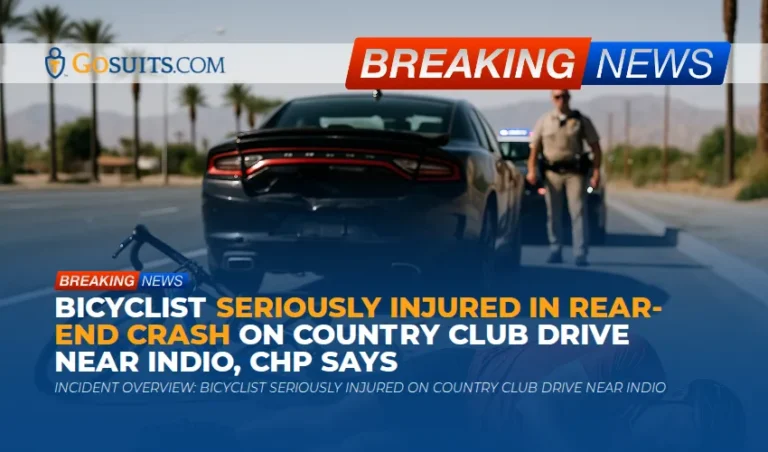
A collision late Monday morning near Indio left a male bicyclist hospitalized with major injuries. According to California Highway Patrol Officer David Torres, a Dodge Charger traveling eastbound on Country Club Drive in the No. 2 lane, east of Adams Street, struck the rear of the bicycle shortly before 10 a.m. The rider, who was wearing a helmet, was ejected and landed on the pavement. He was transported to Desert Regional Medical Center in Palm Springs for treatment. CHP reported that drugs or alcohol are not suspected at this time, and the cause of the crash remains under investigation.
Rear-end collisions involving cyclists are among the most dangerous scenarios on our desert roadways, often occurring in corridors with high traffic volumes, changes in speed, or when visibility or attention lapses. While investigators continue their work, the community’s concern rests first with the rider’s recovery and with ensuring that any evidence relevant to the crash is preserved quickly and properly.
What we know so far from CHP
Time, place, and initial facts
Based on the report described by CHP Officer Torres, the collision occurred:
- Time: Shortly before 10 a.m., a busy hour for local commutes, appointments, and service traffic.
- Location: Eastbound Country Club Drive in the No. 2 lane, east of Adams Street, a stretch used by drivers coming from Palm Desert and Bermuda Dunes toward Indio.
- Mechanism: The Dodge Charger hit the rear of the bicycle, ejecting the cyclist to the roadway.
- Injuries: Major injuries reported; rider taken to Desert Regional Medical Center in Palm Springs.
- Impairment: Drugs or alcohol are not suspected at this stage.
- Status: The cause is under investigation, which typically involves scene documentation, vehicle inspections, and potential witness follow up.
As with many serious bike collisions, crucial facts such as speed, lane positioning, sightlines, and any last-second maneuvers will matter. CHP and collision investigators commonly blend physical evidence, data from vehicle modules when available, and witness statements to answer those questions.
Local context: Country Club Drive, Adams Street, and Coachella Valley traffic patterns
Country Club Drive serves residents and visitors traveling between Palm Desert, Bermuda Dunes, and Indio. Mid-mornings can bring a mix of local residents, resort workers, delivery vehicles, and service trucks. The Adams Street area features multiple driveways and cross traffic, with drivers often transitioning between posted speed zones. In this part of the Coachella Valley, sun angle and glare can vary by season and hour, and agricultural traffic may appear in certain stretches. While we do not speculate about this crash, investigators frequently consider whether visibility, speed selection, or lane positioning affected driver perception and reaction time.
Community members who walk, ride, and drive along Country Club Drive know it connects neighborhoods, schools, golf communities, and shopping corridors that include everyday destinations like grocery stores and medical offices. The mix of roadway users highlights why consistent scanning, safe passing, and space management are essential in these shared spaces.

Injury implications and immediate medical considerations
Major injuries from a rear-impact event can include fractures, head and neck trauma, internal injuries, and soft-tissue damage. Helmets significantly reduce the risk of serious head injury, but they cannot prevent all injuries in a high-energy impact. Early trauma care, follow up imaging, and rehabilitation planning are often needed. Even when initial scans are reassuring, symptoms such as concussion effects, neck and back pain, or nerve complaints can evolve over days or weeks.
Families often keep a simple recovery log with dates, treatments, medications, pain levels, and missed activities. This kind of timeline helps clinicians track progress and adjust care. It can also help later when insurers ask for documentation of how injuries have affected daily life and work.
Evidence and documents to secure after a bicycle and vehicle collision
Preserving information early can make a substantial difference in understanding what happened. Here are practical steps families or trusted helpers often consider:
- Photographs and video: Capture the roadway scene as soon as it is safe to do so, including lane markings, debris fields, scuff marks, vehicle and bicycle damage, lighting conditions, and any nearby construction or roadside obstructions. If nearby businesses or homes have cameras that face the street, politely ask whether footage exists and how long it is retained.
- Witness information: Names, phone numbers, and email addresses for anyone who saw the crash or arrived immediately afterward. Even brief observations can be critical.
- Medical records: Keep discharge summaries, imaging reports, prescriptions, therapy referrals, and bills in one folder. Request copies from each provider as the recovery progresses.
- Police report: CHP collision reports can be requested by involved parties or their representatives. Knowing the process early speeds up insurance communications later.
- Property and gear: Preserve the bicycle and damaged equipment as they are, without repairs. Photograph the condition of the helmet, clothing, lights, and any conspicuity gear.
- Insurance communications: Save emails and letters. If a recorded statement is requested, it is wise to speak with a qualified attorney first because statements can affect later determinations.
California’s Public Records Act may allow requests for certain government-held records in limited circumstances, though availability and retention vary by agency and system. Families often send prompt preservation requests to nearby businesses when street-facing cameras might have captured the incident. Time is crucial because many systems overwrite footage within days.
How to get official records and who to contact
California Highway Patrol collision report
CHP maintains collision reports that can be requested using an official form. Involved parties or their legal representatives typically provide the date, location, and names of those involved. Reports may include diagramming, narrative summaries, and, in some cases, statements or measurements. The CHP website outlines how to request a Traffic Collision Report and includes the standard request form and submission instructions [1].
DMV reporting and SR-1
California requires that traffic crashes resulting in injury or property damage of a certain threshold be reported to the DMV within a specified time window using the SR-1 form, regardless of fault. The DMV provides instructions and the form online, along with information about insurance obligations [2].
Riverside County Coroner information
If a collision involves a fatality or later becomes a fatality, the Riverside County Sheriff’s Office Coroner’s Bureau provides information about decedent identification, autopsy procedures, and how families can request related documents. While this incident was reported as nonfatal, families sometimes need this information if circumstances change. The Coroner’s Bureau explains its services and points of contact on its official site [3].
Key California rules that protect people on bikes
California law treats bicycles as vehicles in most respects. Both drivers and cyclists have duties to operate safely and predictably. Several statutes regularly arise in bike versus vehicle crash evaluations:
- Drivers must pass at a safe distance: The Three Feet for Safety Act requires drivers to provide at least three feet when passing a bicyclist, or to slow and only pass when safe if three feet is not available [4]. For a plain-language explainer written for community members, see our guide on the California three foot law cyclists.
- Basic speed law: Drivers must never travel faster than is reasonable or prudent given traffic, weather, visibility, and roadway conditions, and must control speed to avoid collisions [5].
- Following too closely: Motorists may not follow another vehicle more closely than is reasonable and prudent, considering speed, traffic, and the roadway. This rule reinforces space management to avoid rear-end crashes [6].
- Bicyclists’ rights and duties: Cyclists generally have the same rights and responsibilities as vehicle drivers and must obey traffic signals and signs [7]. The DMV’s driver handbook also emphasizes how drivers should share the road with bicyclists [8].
- Riding position and lane use: California outlines when a bicyclist should ride as close as practicable to the right and when they may take the lane, including when the lane is too narrow for a bike and a vehicle to travel safely side by side [9].
- Helmet requirement for minors: Riders under 18 must wear a bicycle helmet. Adults are encouraged though not required by state law to wear helmets [10].
State and federal agencies also publish safety data and guidance. The California Office of Traffic Safety and the National Highway Traffic Safety Administration provide research, crash data, and practical strategies for drivers and cyclists to reduce collisions [11] [12].
How investigators evaluate fault in rear-impact bicycle crashes
Because this collision involved a motor vehicle striking the rear of a bicycle, investigators typically focus on visibility, perception and reaction time, lane positioning, passing or following behavior, and speed control. Common lines of inquiry include:
- Driver lookout and speed selection: Was the driver traveling at a speed reasonable for the conditions and maintaining enough space to avoid a foreseeable conflict? The basic speed law requires a safe speed selection even below posted limits when conditions warrant [5].
- Passing versus following dynamics: Was the driver attempting to pass the cyclist in the same lane or was the driver following? If passing, did the movement provide the required safe distance, or did the interaction collapse into a following scenario with inadequate space [4] [6]?
- Lane width and cyclist positioning: Was the lane too narrow for side-by-side travel, which would justify the cyclist taking the lane? California law gives cyclists discretion to use more of the lane when needed for safety [9].
- Conspicuity and roadway features: Lighting conditions, signage, shadows, and background clutter can affect how quickly a driver perceives a cyclist. Investigators often examine whether the cyclist had lights or reflective gear and whether the environment created visual confusion. These observations help explain, not excuse, failures to yield or maintain safe following distance.
- Physical evidence: Skid marks, scrape patterns, digital crash data, bicycle and vehicle damage profiles, and final rest positions contribute to speed and trajectory estimates.
Ultimately, responsibility assessments depend on the complete fact set and applicable statutes. Families should be cautious with early assumptions and with comments to insurers before the evidence picture is complete.
Insurance issues that commonly arise in bicycle versus car collisions
In the Coachella Valley, bike versus car crashes often trigger overlapping insurance questions. A few that come up frequently:
- Liability coverage of the driver: The motorist’s bodily injury liability insurance is typically the primary source for injury claims when the driver is at fault. Investigation findings, witness accounts, and statutes inform the liability carrier’s decisions.
- Uninsured or underinsured motorist coverage: Cyclists may access their own auto policy’s UM or UIM coverage if the driver lacks adequate insurance. This can apply even though the injured person was riding a bicycle at the time, depending on policy terms. Insurers often scrutinize these claims carefully.
- Medical payments coverage: Some auto policies include MedPay that can help with immediate medical bills regardless of fault, subject to policy limits and coordination with health insurance.
- Health insurance and liens: Health plans may later assert reimbursement rights from any third-party recovery. Understanding lien obligations early can prevent surprises.
- Recorded statements and releases: Insurers often request recorded statements or early medical authorizations. Families should consult with a qualified attorney before participating. Statements can be used to minimize claims, and broad releases can expose private medical history unrelated to the collision.
Mentioning resources like California car accident lawyers is not about litigation for its own sake. It is about protecting access to medical care, wage support, and long-term needs when injuries are serious and liability is disputed.
If a claim involves a public entity, additional notice rules may apply before a lawsuit can be filed. See the deadlines section below for details [13].
Important California deadlines and notice rules
- Two-year statute of limitations for personal injury: In most California injury cases, the general deadline to file a civil action is two years from the date of injury. The controlling statute is California Code of Civil Procedure section 335.1 [14].
- Six-month claim deadline for government entities: If a public entity is a potential defendant, California’s Government Claims Act typically requires a written claim within six months of the incident, with limited exceptions. See Government Code section 911.2 for the general claim timeline [13].
- DMV accident reporting: Separate from any civil claim, California requires filing the SR-1 form with the DMV within 10 days when a crash results in injury or specified property damage, regardless of fault [2].
Deadlines can be unforgiving. Families who suspect a government entity’s involvement or a roadway condition issue should get timely guidance because the pre-lawsuit claims process is mandatory before any civil action against a public entity can proceed in court.
Safety reflections for drivers and cyclists in the Coachella Valley
Local roads like Country Club Drive carry a mix of residents, workers, and visitors heading to golf courses, medical appointments, and shopping corridors from Palm Desert to Indio. Everyone benefits when drivers and cyclists anticipate one another and respect space. Some reminders drawn from state and federal safety guidance:
- For drivers:
- Slow down when approaching a cyclist and pass only when safe, providing at least three feet or changing lanes when available [4].
- Scan ahead for slower traffic, driveways, and bus stops. The Coachella Valley’s bright sun and heat shimmer can reduce contrast, so take a second look.
- Obey the basic speed law. A few miles per hour less can make a significant difference in stopping distance and reaction time [5].
- For cyclists:
- Use lights day and night and wear high-contrast or reflective gear to enhance conspicuity. Position yourself to be visible and predictable within the lane when conditions warrant [9] [12].
- Make eye contact with drivers when possible at intersections and driveways, and ride defensively given speed differentials on corridors like Country Club Drive.
- Know when you may take the lane for safety. A narrow lane that cannot be shared side by side is a recognized reason under California law [9].
While safety steps help, people on bikes remain vulnerable in a collision with a motor vehicle. That is why California’s laws place clear duties on motorists to control speed, maintain safe following distances, and pass cyclists only when it is safe to do so.
Recommended steps for families navigating the aftermath
Families in Palm Desert, Indio, Bermuda Dunes, and the surrounding Coachella Valley often ask what to do in the first days after a serious crash. A measured, organized approach can help protect health and preserve important rights:
- Prioritize medical follow up: Attend all appointments and report new or worsening symptoms promptly. Ask providers for copies of visit notes and imaging results.
- Gather records: Request the CHP collision report as soon as it is available. Collect hospital records, ambulance run sheets if applicable, and photographs of injuries and the bicycle.
- Preserve the bicycle and gear: Do not repair or discard the bicycle, helmet, or clothing. Store them securely so they can be inspected if needed.
- Document lost time and tasks: Keep track of missed work, household help needs, and activities affected by the injuries.
- Be cautious with insurers: Before giving recorded statements or signing medical releases, consult an attorney. What is said early can be used to dispute claims later.
- Consider legal consultation: A free consultation can help a family understand insurance coverages, medical liens, and the process for resolving claims without making any commitments.
For a deeper dive into road-sharing laws that may apply in collisions like this, our knowledge resource on the state’s three-foot passing rule is a helpful read: California three foot law cyclists.
Why taking action promptly matters
What is the exact thing to do now? Secure the essential records and preserve physical evidence while it still exists. That means requesting the CHP collision report, gathering medical documentation, safeguarding the bicycle and helmet, identifying witnesses, and considering a prompt legal consultation before speaking in detail with any insurance company.
Why act now and not later? Several systems automatically overwrite or dispose of key information. Many businesses keep video only a few days. Skid marks fade, debris gets swept up, and vehicles are repaired or totaled. Insurance carriers move quickly to collect statements and shape liability assessments. Acting early helps ensure the factual record is complete rather than partial or contested.
What benefit comes from timely steps? A complete record supports accurate medical care planning, gives investigators the best chance to reconstruct events, and reduces disputes about fault and damages. It also helps prevent gaps that insurers may use to delay or minimize claims. Prompt action can make a demonstrable difference in both short-term support and long-term recovery paths.

Commentary from Gosuits Indio, CA Personal Injury Attorney
Our hearts are with the injured rider and the family navigating a frightening moment. This update is shared for general information and education for our neighbors in the Coachella Valley. The report describes a rear-impact crash with major injuries, a scenario that often raises questions about safe passing, following distance, and speed selection. While the investigation is ongoing and facts should be respected, rear-end collisions typically prompt careful scrutiny of the driver’s lookout and space management.
In our experience, insurance companies and large corporations capitalize on uncertainty after serious incidents. Adjusters may request recorded statements before all evidence is collected, push for broad medical authorizations, or propose early low settlement numbers while the full scope of injuries is still unfolding. Those tactics rely on the fact that most people are unfamiliar with injury claim timelines, medical lien rules, and the coverage layers available when a bicyclist is hurt by a motor vehicle.
A no-cost consultation can help people understand their options without committing to anything. It allows families to ask questions, learn about deadlines, and decide how to handle insurer communications in a way that protects their interests. Even one conversation can prevent missteps that are hard to undo later, especially in cases involving serious injuries, multiple insurers, or potential public entity issues.
References
- Traffic Collision Reports – California Highway Patrol
- Accident Reporting (SR-1) – California DMV
- Coroner’s Bureau – Riverside County Sheriff’s Office
- Vehicle Code § 21760 Three Feet for Safety – California Legislature
- Vehicle Code § 22350 Basic Speed Law – California Legislature
- Vehicle Code § 21703 Following Too Closely – California Legislature
- Vehicle Code § 21200 Bicycles: Rights and Duties – California Legislature
- Share the Road – California Driver Handbook – California DMV
- Vehicle Code § 21202 Position in the Roadway – California Legislature
- Vehicle Code § 21212 Helmet Requirements for Minors – California Legislature
- Bicycle Safety – California Office of Traffic Safety
- Bicyclist Safety – National Highway Traffic Safety Administration
- Government Code § 911.2 Claims Presentation Deadlines – California Legislature
- Code of Civil Procedure § 335.1 Personal Injury Limitations Period – California Legislature