- What we know about the Barstow I‑40 construction-zone motorcycle crash
- Timeline and location details
- Official statements and the ongoing investigation
- Safety and legal context for California work-zone crashes
- What families can do next: records, reports, and practical steps
- How liability may be evaluated in a construction-zone crash
- Insurance considerations and common pitfalls
- Preserving evidence unique to motorcycle collisions
- Local Barstow resources and practical community guidance
- Support and immediate logistics after an unexpected loss
- Commentary from Gosuits Barstow, California Personal Injury Attorney
- Time-sensitive action steps that protect rights and options
What we know about the Barstow I‑40 construction-zone motorcycle crash
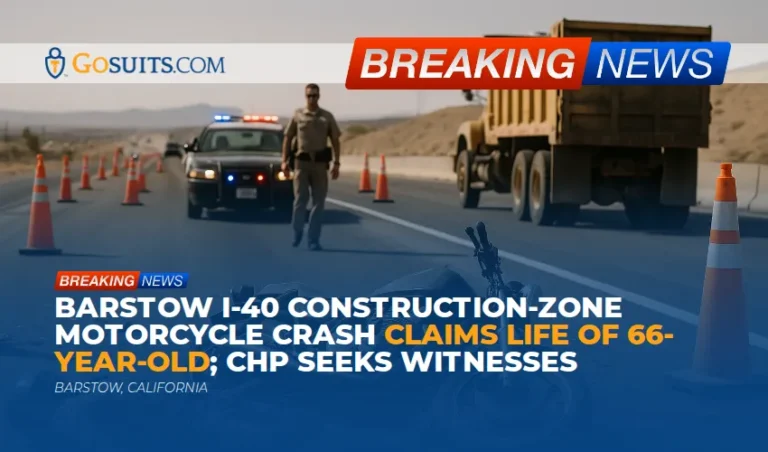
Early Tuesday, December 16, a 66-year-old Barstow resident, Vincent T. Rodriguez, died in a motorcycle collision in an active construction zone on the eastbound 40 Freeway overpassing Iwo Jima Street. According to initial information shared by the California Highway Patrol (CHP) and San Bernardino County coroner’s officials, the crash occurred just after 7 a.m. in Barstow. CHP’s preliminary statement indicates the rider was on a 1992 Honda motorcycle and, for reasons still under investigation, veered to the right, striking orange construction cones. The motorcycle continued toward the right shoulder and collided with a construction vehicle that was parked on the right shoulder. The rider was wearing a helmet and was pronounced deceased at the scene by paramedics. CHP noted that DUI was not initially suspected.
Investigators are asking anyone who witnessed the incident or who has information to contact the CHP Barstow Area Office at (760) 255-5900. CHP leadership emphasized the ongoing need for extra caution in construction zones and urged drivers to follow posted signage and traffic laws while passing through work areas.
Timeline and location details
The incident occurred:
- When: Just after 7 a.m., Tuesday, December 16
- Where: On eastbound I‑40, overpassing Iwo Jima Street in Barstow, within an active construction zone
- Vehicle: 1992 Honda motorcycle
- Sequence described by CHP: Contact with construction cones followed by movement to the right shoulder and impact with a parked construction vehicle
- Safety equipment: The rider was wearing a helmet
- Initial investigative note: DUI not initially suspected
The I‑40 corridor through Barstow is a familiar stretch to local commuters, military families connecting to Fort Irwin, and long-haul travelers heading east across the desert. Morning traffic can be steady, and when construction is active, lane shifts, narrowed shoulders, and cone patterns can change the usual road feel. Anyone driving that segment knows how quickly conditions can change near Iwo Jima Street or as you pass the Barstow Station area toward the I‑15/I‑40 interchange.
Official statements and the ongoing investigation
CHP’s initial statement confirms the construction zone was active and that the construction vehicle struck was parked on the right shoulder. The precise cause remains under investigation. Crash reconstruction in work zones often requires additional steps: identifying traffic control plans, confirming signage placement and timing, and determining whether temporary barriers, cones, and warning devices met applicable standards.
CHP Barstow Area Commander Nicholas King publicly reminded motorists to stay alert in construction zones, adhere to posted signs, and comply with traffic laws. Authorities continue to collect witness statements and any available video. If you drove the area that morning and saw road conditions or the incident sequence, even small details might help investigators build an accurate picture.
Safety and legal context for California work-zone crashes
How work zones are supposed to function
Work zones on California state highways are subject to engineering standards and traffic control rules intended to keep both road users and workers safe. California follows the California Manual on Uniform Traffic Control Devices (CA MUTCD), which adapts national standards to the state’s needs. These standards guide the selection and placement of cones, channelizers, warning signs, tapers, and advance notifications. For reference, see the CA MUTCD information page from Caltrans at dot.ca.gov/programs/traffic-operations/camutcd and the Federal Highway Administration’s MUTCD resources at mutcd.fhwa.dot.gov.
Caltrans emphasizes work-zone safety for the traveling public and crews, urging drivers to slow down, stay alert, and respect traffic control through active sites. Caltrans’ work zone safety hub offers statewide resources at dot.ca.gov/programs/safety-programs/work-zone-safety. District 8, which covers San Bernardino County, provides project and traffic updates specific to our area at dot.ca.gov/caltrans-near-me/district-8.

Motorcycle safety context
Motorcyclists face unique risks due to exposure and roadway dynamics. National Highway Traffic Safety Administration materials explain that helmets substantially reduce the risk of fatal head injuries. NHTSA notes that helmets are effective at reducing deaths and severe injuries for riders and passengers alike. Read more at nhtsa.gov/motorcycle-safety. California law requires motorcycle helmets for all riders and passengers under California Vehicle Code section 27803, which you can review at leginfo.legislature.ca.gov.
Move Over and slow down near highway workers
California’s Move Over law requires drivers, when safe, to move over or slow down for stationary emergency vehicles and certain Caltrans or road service vehicles displaying flashing lights. While each situation is fact-specific, the principle underscores the need to reduce speed and increase caution around work vehicles on shoulders. See California Vehicle Code section 21809 at leginfo.legislature.ca.gov.
Wrongful death timing in California
California generally sets a two-year period from the date of death to bring a wrongful death claim, subject to exceptions. See the Code of Civil Procedure section 335.1 at leginfo.legislature.ca.gov. If a potential defendant is a public entity, California’s Government Claims Act typically requires an administrative claim within six months of the incident in many cases. Review Government Code section 911.2 at leginfo.legislature.ca.gov. Timing questions are sensitive to the facts, so it’s important to understand which deadlines apply before taking steps that might affect rights.
What families can do next: records, reports, and practical steps
In the first days after a crash, paperwork and contacts can feel overwhelming. Here’s a fact-based roadmap for records that often matter in a highway construction-zone fatality investigation.
CHP collision report
- What it is: The official traffic collision report prepared by the investigating agency, typically including diagrams, witness information, and preliminary findings.
- Who holds it: The California Highway Patrol for state highway incidents. The Barstow Area Office is handling this investigation.
- How to request: CHP collision reports are generally requested through a Public Records Act process. CHP provides guidance on public records requests at chp.ca.gov/notify-chp/public-records-act-requests. Requestors commonly use form CHP 190 to seek a collision report; CHP can advise on eligibility, proof of relationship, and availability timelines.
- Local contact: CHP Barstow Area Office, (760) 255-5900.

Coroner’s records and autopsy report
- What it is: The coroner’s case file may include cause and manner of death, autopsy findings, and toxicology when performed. Not all records are immediately available; release rules depend on status and next-of-kin.
- Who holds it: San Bernardino County Sheriff’s Department, Coroner Division.
- Where to learn more: See the Coroner Division page at sheriff.sbcounty.gov/divisions/coroner/ for record request guidance and contact information.
Death certificates
- What it is: An official record of death, usually needed for estate matters, benefits, and certain insurance processes.
- How to obtain: Certified copies are issued through vital records. California’s statewide information is available from the California Department of Public Health at cdph.ca.gov/Programs/CHSI/Pages/Vital-Records.aspx. Families can also obtain certified copies through county vital records.
Caltrans work-zone information
- What can help: Project identification, lane closure schedules, and the traffic control plan applicable on the morning of the crash may be relevant for understanding the work area layout.
- Where to start: Caltrans District 8 maintains updates for San Bernardino County at dot.ca.gov/caltrans-near-me/district-8. Public records requests to Caltrans for project plans or traffic control documents may be made through Caltrans’ Public Records Act process referenced on Caltrans sites.
Public records act basics
California’s Public Records Act promotes access to government records. The Attorney General provides general guidance on the law and public access at oag.ca.gov/consumers/general/public-records-act. Requestors seeking traffic control plans, permit conditions, or project logs from public agencies can use this process.
How liability may be evaluated in a construction-zone crash
Every work-zone crash is fact-specific. Multiple parties may be involved, and responsibility can turn on details like signage, taper length, buffer space, shoulder use, and vehicle placement. Here are common areas analysts review in a collision like the one reported in Barstow.
- Traffic control compliance: Whether cones, signs, and warnings met applicable standards under the CA MUTCD and project-specific traffic control plans. Investigators may examine advance warning sign spacing, taper lengths, and whether any deviations were documented. References: CA MUTCD, FHWA MUTCD.
- Placement of parked work vehicles: Whether a construction vehicle parked on the shoulder had appropriate buffer and protection, and whether additional warning devices or lighting were required under the plan.
- Roadway geometry and environment: Sightlines from the rider’s perspective, presence of lane shifts, narrowed shoulders, temporary barriers, or early-morning glare particular to desert corridors like I‑40. These factors are considered alongside the traffic control plan and standard practices.
- Driver and rider behavior: Speed relative to conditions, following distance, and lane position through the work area. California’s Move Over and helmet laws provide context but each fact pattern stands on its own.
- Maintenance of work zone: Whether any displaced cones or devices changed the intended path of travel, and how quickly any hazards were addressed by the crew.
- Potential public-entity issues: If public entities or their contractors were involved, Government Claims Act procedures and immunities may be implicated. See California Government Code section 911.2 for claim presentation timing at leginfo.legislature.ca.gov.
Evaluations typically require a coordinated review of agency records, photographs, scene measurements, and witness accounts. It’s also common to review whether the work zone changed in the hours or days before the crash and whether that change was documented.
Insurance considerations and common pitfalls
With highway construction-zone crashes, more than one insurer may be involved: a motorcycle policy, potential contractor or subcontractor policies, and sometimes public-entity risk pools. Claims can get complex quickly. A few points to keep front of mind:
- Recorded statements carry risk: What someone says to an insurance adjuster can be used to limit or deny a claim later. It is wise to speak with a qualified attorney first to understand rights and obligations before giving any detailed account to an insurer.
- Medical payments and funeral benefits: Depending on the policy, some coverage may exist for immediate expenses. Policy language and eligibility vary widely.
- Comparative fault assessments: California’s comparative fault rules mean insurers may attempt to assign percentages of responsibility. Early narratives can shape those allocations.
- Public-entity claim deadlines: If a government agency might be involved, there are short administrative deadlines. Missing these windows can foreclose certain claims, even when a separate two-year wrongful death period would otherwise apply. See Gov. Code § 911.2.
If a claim is being considered, it’s strongly recommended to consult an attorney first before contacting any insurer. Adjusters are trained to gather statements rapidly. The timing and content of communications can affect outcomes.
Preserving evidence unique to motorcycle collisions
Motorcycle cases have evidence sources that differ from standard passenger vehicles. Preserving the right items early can make a meaningful difference in understanding what happened.
- Protect the motorcycle: Storage location, chain of custody, and photographs matter. Impact points, scrapes, and damaged components can help reconstruct the path and angle of impact.
- Helmet and gear: Retain the helmet, jacket, gloves, and boots. Damage patterns can provide important clues about the mechanism of injury and impact direction.
- On-bike or wearable cameras: Some riders use mounted cameras. Even if the device seems damaged, the memory card may be recoverable.
- Phone data: Location and movement data can sometimes corroborate speed and position. Secure the device and avoid altering data.
- Maintenance and aftermarket parts: Keep receipts and records for tires, brakes, suspension, and any modifications. These can answer questions fast if equipment is raised by an insurer.
- Scene evidence: Photographs of cone patterns, skid or yaw marks, and the location of the parked work vehicle relative to fixed landmarks help anchor later analysis. In active work zones, layouts can change quickly.
Local Barstow resources and practical community guidance
Barstow is a close-knit community. People who drive I‑40 past Iwo Jima Street, stop at Barstow Station, or head up to Calico in the cooler months know how fast conditions can shift during construction. Here are local steps and contacts that often help after an incident like this.
- CHP Barstow Area Office: For witness statements or follow-up on the collision report process, call (760) 255-5900. Collision report requests are administered under CHP’s public records procedures at chp.ca.gov/notify-chp/public-records-act-requests.
- San Bernardino County Coroner Division: For questions about the coroner’s process, case numbers, and records, visit sheriff.sbcounty.gov/divisions/coroner/.
- California Vital Records: For certified copies of death certificates, see cdph.ca.gov/Programs/CHSI/Pages/Vital-Records.aspx.
- Caltrans District 8: For project context, lane closures, and the district’s work-zone information for our region, see dot.ca.gov/caltrans-near-me/district-8.
Neighbors often ask how they can help while investigations unfold. If someone has dashcam footage from the eastbound I‑40 stretch over Iwo Jima Street on the morning of December 16, it can be valuable to share it with CHP. Even if the incident was not captured, footage of traffic control signs or cone placement minutes before or after may assist investigators.

Support and immediate logistics after an unexpected loss
In Barstow, people rally around families. Still, there are practical steps that can feel heavy in the early days. While each situation is different, these items commonly arise after a highway fatality.
- Personal paperwork: Locate insurance policies, vehicle registration, and any military or employment benefits information if applicable. Many households keep these documents together near a desk or safe.
- Funeral and memorial planning: Local places of worship and community groups can be helpful. Coordinating with a funeral home often requires early access to a death certificate or coroner documentation.
- Employer notice: Employment benefit administrators can provide guidance on any life or accidental death benefits if in place.
- Property and vehicle handling: Confirm where the motorcycle is stored. If it’s in a tow yard, request in writing that it be preserved and not destroyed or sold until all parties have had a chance to inspect.
It’s okay to move at a steady pace and ask for help from trusted people. Friends in Lenwood, Yermo, or along Old Highway 58 often step up with meals and rides. If you need space to process grief, the desert trails and overlooks around the Mojave River can offer quiet moments.
Commentary from Gosuits Barstow, California Personal Injury Attorney
We extend our heartfelt condolences to the family, friends, and neighbors of Vincent T. Rodriguez. Incidents like this shake our community. The following thoughts are offered for educational purposes and general information to help the community understand the civil dimensions often present in construction-zone crashes.
Based on the initial report, the collision sequence involved contact with construction cones and an impact with a parked construction vehicle on the right shoulder within an active work zone. In our experience, questions quickly arise about the configuration and maintenance of the work zone: Were signs, tapers, and buffer areas set and maintained consistently with the traffic control plan? Were parked work vehicles positioned with adequate protection and visibility? These are not conclusions; they are the types of questions that guide a careful review.
Insurance companies and large contractors often marshal resources immediately. Early statements are recorded, and narratives form fast. Without a clear understanding of rights, people can feel pressured into providing statements or accepting interpretations that don’t reflect the full picture. Important details like whether the work zone changed that morning, whether a cone line shifted, or whether a shoulder buffer was reduced can be missed if the only account on record is a quick call with an adjuster.
A free consultation can help clarify timing and process before any statements are given. It’s a chance to discuss the Government Claims Act’s shorter deadlines if a public entity might be involved and to understand the differences between speaking with law enforcement versus speaking with an insurance adjuster. What’s said to an insurer can be used to shape fault allocations later. Taking time to understand these dynamics can protect options while the facts are still developing.
Time-sensitive action steps that protect rights and options
When a crash occurs in an active construction zone, the situation evolves quickly. Temporary lane patterns may change overnight, crews may move equipment, and cones may be reset. Acting promptly can preserve information that becomes harder to recover later.
- Secure core records first: Identify the investigating agency and ask how to request the collision report when it’s available. Note the CHP Barstow Area Office number and the public records request process at chp.ca.gov/notify-chp/public-records-act-requests. Consider that government agencies have processing times.
- Preserve the motorcycle and gear: Request in writing that the motorcycle not be altered or destroyed. Store the helmet and riding gear in a safe, dry place. These items may answer questions later about impact forces and directions.
- Capture the work-zone layout: If it’s safe and lawful to do so, document the location with photos from public vantage points showing signs, taper lengths, and cone patterns. Work zones can look different even a day later.
- Collect and safeguard media: Save any dashcam or phone footage from the morning commute. Ask neighbors or coworkers who regularly drive I‑40 near Iwo Jima Street if they passed through around 7 a.m. and can share what they observed.
- Understand deadlines: Calendar the general two-year period for wrongful death claims in California under CCP § 335.1, and evaluate whether a public-entity claim under Gov. Code § 911.2 could apply, which may require action within six months. Deadlines can be unforgiving.
- Speak with an attorney before insurers: Consulting an attorney first helps ensure statements to insurance companies are informed. Insurers record early calls, and those words can influence how fault is assigned later.
- Request coroner and vital records: Follow the San Bernardino County Coroner guidance at sheriff.sbcounty.gov/divisions/coroner/ and state vital records information at cdph.ca.gov/Programs/CHSI/Pages/Vital-Records.aspx so logistical matters can proceed smoothly.
- Keep a single binder: Centralize contacts, claim numbers, receipts, and notes. A simple binder or shared digital folder reduces stress and makes follow-up easier.
Taking these steps sooner rather than later preserves options and reduces the risk of missing critical deadlines. The benefit is clarity: when records and evidence are gathered methodically, decision-making becomes easier, even amid grief and uncertainty.