- What Happened on I-30 Near Cherry Lane
- What We Know and What Remains Unconfirmed
- Local Impact in West Fort Worth and Travel Delays
- Legal and Safety Context for Stalled 18-Wheelers on Texas Highways
- Evidence and Investigation: What Typically Gets Examined
- Where Families Can Seek Official Information and Records
- Insurance and Rights After a Fort Worth Truck Crash
- Wrongful Death Basics in Texas
- Thoughtful Steps Families Often Take in the First Days
- Safety Reminders for Drivers Approaching Disabled Big Rigs
- What To Do Next and Why Timing Matters
- Commentary from Gosuits Fort Worth, Texas Personal Injury Attorney
- References
What Happened on I-30 Near Cherry Lane
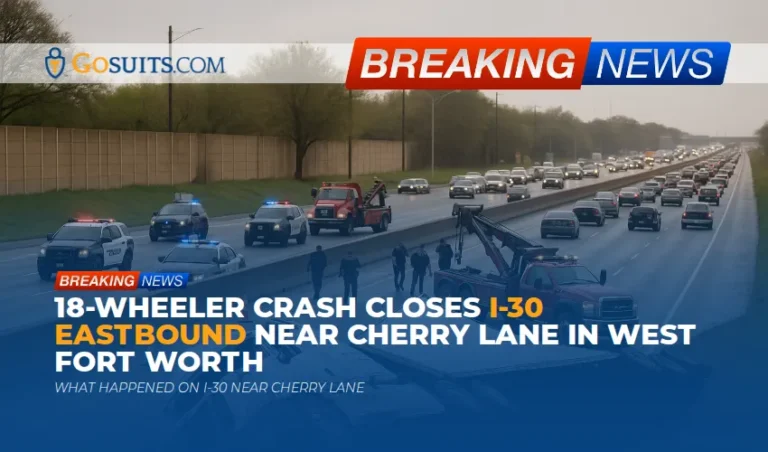
On a Tuesday morning around 8 a.m., emergency crews responded to a major collision on Interstate 30 eastbound near Cherry Lane in West Fort Worth. Early television helicopter images showed an 18-wheeler positioned off to the side of the freeway with multiple police units and wreckers at the scene. All eastbound lanes were closed while investigators worked, which quickly created a long backup for commuters heading toward downtown Fort Worth and Arlington.
Initial on-air reporting suggested the driver of a stalled big rig may have been killed, though authorities had not confirmed that detail at the time of the report. The situation unfolded in a part of I-30 that many West Fort Worth residents use daily, just east of Ridgmar and not far from the Naval Air Station Joint Reserve Base corridor. It is a stretch where traffic can stack in the morning, especially if there is an unexpected lane closure.
What We Know and What Remains Unconfirmed
Verified context
According to early reports and aerial footage, the collision involved at least one 18-wheeler and led to a full shut down of eastbound I-30. Police staged a significant presence to manage traffic, protect investigators, and allow heavy-duty tow operators to address the disabled rig.
Information still pending
At the time of the report, officials had not released key confirmation points, including:
- Whether there was a fatality or how many people were injured.
- How many vehicles were involved beyond the 18-wheeler noted in the footage.
- Whether a suspect was being sought in connection with the incident.
When a crash investigation is active on a high-speed corridor like I-30, it is common for police to withhold details until next-of-kin notifications are completed and basic facts are verified with witness statements, scene measurements, and any available video.

Local Impact in West Fort Worth and Travel Delays
Closing all eastbound lanes of I-30 near Cherry Lane affects a wide slice of the West Fort Worth community. Many drivers coming from White Settlement, Ridgmar, and Chapel Creek funnel into this corridor to access downtown offices, medical appointments, and the University area. Morning closures can ripple into side streets like Las Vegas Trail and Camp Bowie, where motorists seek alternative routes. If you were on the road at that time, you may have noticed traffic re-routing around the frontage roads and across neighborhood arterials that were not built to handle freeway volumes.
TxDOT’s traffic management often coordinates with local police to set up detours and clear debris efficiently. Still, with an 18-wheeler involved, specialized equipment is typically required. That means a longer on-scene timeframe while investigators collect evidence and commercial tow operators safely remove the tractor and trailer. TxDOT provides statewide road condition updates and closure information to the public for planning purposes, which can be helpful on days like this [1], [2].
Legal and Safety Context for Stalled 18-Wheelers on Texas Highways
While we do not yet know the exact cause of this crash, there are well-established safety rules that apply when a commercial motor vehicle becomes disabled on the highway. Federal regulations require drivers of large commercial trucks to activate hazard flashers immediately when stopped and, within a short window, place reflective triangles or flares at specified distances behind and sometimes in front of the vehicle depending on location and roadway conditions [3]. These warnings are intended to alert approaching traffic, especially on fast-moving corridors like I-30 where sight distances can be compromised by curves, weather, or congestion.
Texas law also requires drivers passing emergency scenes to slow down and move over when possible to protect first responders and wreckers who are operating on the shoulder or in a lane [4]. On busy urban interstates, that move-over behavior can be a lifesaver. Speed, following distance, and distraction also play major roles in whether an approaching driver perceives and reacts in time.
Nationally, crashes involving large trucks remain a major public safety concern, and they carry a higher risk of serious injury because of the size and weight of the vehicles. Federal safety agencies publish data and guidance that highlight these risks and promote safer sharing of the road with big rigs [5].
Evidence and Investigation: What Typically Gets Examined
After a serious collision involving an 18-wheeler, investigators often look at several technical layers of evidence to reconstruct what happened:
- Scene documentation: Skid marks, gouges, debris scatter, and vehicle resting positions help determine speed, braking, and impact angles.
- Commercial vehicle compliance: Whether required reflective triangles or flares were placed, hazard lights were used promptly, and the truck was positioned as safely as possible under the circumstances [3].
- Vehicle data: Many trucks maintain electronic control module data similar to an event data recorder, which can show speed, brake application, and fault codes. NHTSA provides information about event data recorders and their role in crash analysis [9].
- Driver factors: Fatigue, distraction, and compliance with hours-of-service rules are evaluated by looking at logs, telematics, and phone records when available.
- Weather and visibility: Morning glare, fog, wet pavement, or low sun angles can affect perception-response time for approaching traffic.
In certain severe collisions, a passenger vehicle can slide under a trailer, a scenario known as an underride. Texas families dealing with these devastating events often need to understand how underride happens and what legal options may exist. For a plain-language overview, see Underride Crashes in Texas: Dangers & Legal Options.
In our experience helping communities across North Texas, it is also common to review any relevant Texas Department of Transportation traffic camera footage or third-party dashcams when available. If an agency-operated camera captured the crash or the immediate aftermath, requesting preservation early can make a difference.
Where Families Can Seek Official Information and Records
Crash reports
In Texas, public crash reports are generally obtained through the Texas Department of Transportation’s Crash Records Information System. If Fort Worth Police Department is the investigating agency, the official report typically flows to the TxDOT system. Members of the public can search for and purchase reports online through TxDOT’s portal [6]. If the Texas Department of Public Safety or another agency handled the scene, DPS also provides information regarding crash reports and processes for obtaining them [7].
For local context, Fort Worth Police Department maintains public-facing information and may publish updates about significant roadway incidents on city channels as cases develop [8]. It can take days, sometimes longer, for crash reports to be finalized, especially when multiple vehicles or commercial carriers are involved.
Medical examiner and autopsy records
When a fatality is suspected in Tarrant County, the Tarrant County Medical Examiner’s Office typically leads the medicolegal death investigation. The office provides guidance on how next of kin can request autopsy and investigative records when they become available [10]. Timing depends on the complexity of the case and lab testing requirements. Families should be prepared for a waiting period before toxicology and final reports are released.
Road condition and closure information
For ongoing or future travel disruptions associated with a serious crash scene, TxDOT’s statewide road conditions pages can be useful to track closures and detours while crews work to reopen lanes safely [1], [2].
Insurance and Rights After a Fort Worth Truck Crash
Serious crashes involving tractor-trailers often trigger complex insurance questions. There might be multiple policies in play: the truck’s liability coverage, the motor carrier’s policy, trailer ownership coverage if different, and potentially commercial general liability depending on the facts. On the other side, injured motorists sometimes have uninsured or underinsured motorist coverage that can apply when the at-fault limits are inadequate.
It is wise to speak with a seasoned attorney before giving any recorded statement to an insurance company. Statements given early can be used to minimize or dispute claims later. In particular, trucking insurers and their rapid response teams may move quickly to collect evidence and shape the narrative. Families benefit from understanding their rights at the start, including how fault is evaluated in Texas and how damages are documented over time.
For cases centered in Tarrant County, Fort Worth 18-wheeler accident lawyers often address medical bills coordination, lost wage documentation, and property damage assessments while parallel investigations continue into the truck’s maintenance, driver’s logs, and compliance with safety rules. Texas civil law applies comparative fault principles, which can reduce recoveries if a claimant is found partially at fault, and bar recovery over a certain threshold. Understanding where fault analysis may land is important for planning and expectations [11].
Wrongful Death Basics in Texas
If a fatality is ultimately confirmed, Texas law outlines who can bring a wrongful death action and who may recover. Generally, the surviving spouse, children, and parents may have standing to bring the claim under state statute [12]. Wrongful death and survival actions are different, and families sometimes pursue both. Wrongful death addresses the losses to the family, while a survival claim focuses on damages the decedent could have pursued had they lived, such as conscious pain and suffering before passing.
Texas also imposes deadlines for filing suit. Most wrongful death and personal injury claims are subject to a two-year statute of limitations, measured from the date of the incident in most circumstances [13]. There are exceptions that can shorten or lengthen the period, so timely evaluation is essential.
Thoughtful Steps Families Often Take in the First Days
Every situation is unique, but after a serious collision with a big rig, families in Fort Worth often consider the following:
- Protect medical care first. Ensure immediate and follow-up treatment is secured. Keep every discharge paper, imaging report, and referral note. These records will matter later.
- Preserve evidence early. Save photos, dashcam clips, and witness contact details. If there is reason to believe business- or agency-owned video captured the event, a preservation request should go out quickly.
- Secure the crash report. Monitor the TxDOT CRIS portal for the official report and any supplements [6].
- Coordinate with the Medical Examiner if a death occurred. Ask about timelines and what documents will be available to next of kin [10].
- Document financial impacts. Track missed work, mileage to medical visits, home care needs, and other out-of-pocket expenses.
- Avoid early recorded statements. Speak with counsel before providing statements to insurers. What is said now can be used later to dispute injury severity or fault allocation.
- Consider the vehicle’s data. If a personal vehicle is a total loss, coordinate to preserve any onboard data and valuable personal items before salvage.
When appropriate, 18-wheeler accident lawyers help families identify responsible parties, which can include the driver, the motor carrier, a shipper or broker in specific circumstances, and maintenance entities depending on the facts. That identification guides the insurance coverage review and the evidence requests.
Safety Reminders for Drivers Approaching Disabled Big Rigs
West Fort Worth drivers know this stretch of I-30 can be unforgiving during the morning rush. If you encounter a stalled truck or an active crash scene:
- Slow down and increase following distance. Rear-end impacts are common when traffic compresses suddenly.
- Move over when safe. Texas requires drivers to move over and reduce speed for emergency and certain roadside workers. Even when the statute does not explicitly apply, moving over gives space and can prevent secondary crashes [4].
- Scan ahead for triangles and flares. Truck drivers are required to deploy warning devices when stopped. Expect to see them on the shoulder or lane edge [3].
- Avoid distraction. Looking at crash scenes can lead to another crash. Keep attention on the flow ahead.
What To Do Next and Why Timing Matters
Immediate steps after a commercial truck crash can shape what information is available later. The exact action to take is to prioritize personal safety and urgent medical care, then quickly secure the official crash report, preserve any photos or videos, and request that all potentially relevant video and vehicle data be retained. Consult an attorney before speaking with insurance carriers. Early statements or releases can limit later options.
Why act now? Evidence on a highway scene is fragile. Tire marks fade, debris is swept, vehicles are moved to storage lots, and onboard electronic data can be overwritten if the truck is placed back in service. The benefit of taking timely steps is straightforward: a stronger factual record for whatever process follows, whether that is an insurance claim or a lawsuit. This also helps ensure all responsible parties are identified early, including carriers and any entities involved in maintenance or loading.
When does it matter most? The first days and weeks. That is when businesses still have routine video footage, when witnesses’ memories are freshest, and when medical documentation can tie symptoms to the crash. Waiting increases the risk that important proof disappears or gets harder to authenticate later.
Commentary from Gosuits Fort Worth, Texas Personal Injury Attorney
Our hearts go out to everyone affected by the crash on I-30 near Cherry Lane. Incidents on busy commuter corridors shake the entire neighborhood. This commentary is shared for educational purposes and general information so the community understands the typical processes and considerations after a serious 18-wheeler crash.
Based on what is publicly known, investigators will likely focus on two broad questions. First, what caused the initial hazard and how was the disabled big rig handled, including whether required warning devices were deployed in a timely way. Second, how approaching traffic reacted and whether reasonable care was used given the warning signs and conditions on the roadway. These are standard lines of inquiry in commercial vehicle cases because they track safety rules that exist to prevent tragedies.
We see insurance carriers and corporate defendants take advantage of unfamiliarity with the process. Adjusters sometimes push for early recorded statements, ask for broad medical authorizations, or suggest fast, low offers before the full extent of injuries or losses is known. In trucking cases, carriers may deploy rapid response teams immediately, which means their framing of the facts starts early. That is why it is important to speak with a knowledgeable advocate first. An initial conversation can help clarify rights, outline what evidence to protect, and explain the realistic timeline. A free consultation allows people to understand options without pressure. Knowing the rules and the road ahead makes a real difference when the stakes are high.
References
- Road Conditions and Closures – Texas Department of Transportation
- Texas Department of Transportation Main Site – TxDOT
- 49 CFR 392.22 Emergency signals for stopped commercial motor vehicles – eCFR
- Texas Transportation Code 545.157 Move Over, Slow Down – Texas Statutes
- Large Trucks Road Safety – NHTSA
- Purchase Texas Crash Reports – TxDOT CRIS
- Crash Reports – Texas Department of Public Safety
- Fort Worth Police Department – City of Fort Worth
- Event Data Recorder Information – NHTSA
- Tarrant County Medical Examiner – Tarrant County
- Proportionate Responsibility Chapter 33 – Texas Civil Practice and Remedies Code
- Wrongful Death Beneficiaries 71.004 – Texas Civil Practice and Remedies Code
- Limitations Period 16.003 – Texas Civil Practice and Remedies Code