
- What is an appeal and how does it differ from a new trial?
- When should you consider an appeal in a personal injury case?
- How do civil appeals work in general?
- What are the notice of appeal deadlines in California, Texas, and Illinois?
- What are common grounds for appeal in personal injury cases?
- What standards of review do appellate courts use?
- What is the “record on appeal” and what must be included?
- What is an appellate brief and what happens at oral argument?
- What can an appellate court do with your case: affirm, reverse, modify, or remand?
- Should you file a motion for new trial or go straight to appeal?
- How do you pause enforcement of a judgment during an appeal?
- What is the civil appeal process in California, Texas, and Illinois?
- How long do appeals take and what do they cost?
- What should plaintiffs know before appealing?
- How can GoSuits help me on my personal injury appeal?
- Sources and further reading
What is an appeal and how does it differ from a new trial?
An appeal is a formal request asking a higher court to review a final judgment or order to determine whether the trial court made legal errors that affected the result. Appeals are not do-overs and do not involve new witnesses or new evidence. Appellate courts review the written record from the trial court and the legal arguments in the briefs to decide if the outcome should be affirmed, changed, or sent back to the trial court for further proceedings. The federal judiciary explains that appellate courts typically sit in three-judge panels, do not hold new trials, and ordinarily decide cases based on the record and written submissions, sometimes with oral argument (U.S. Courts).
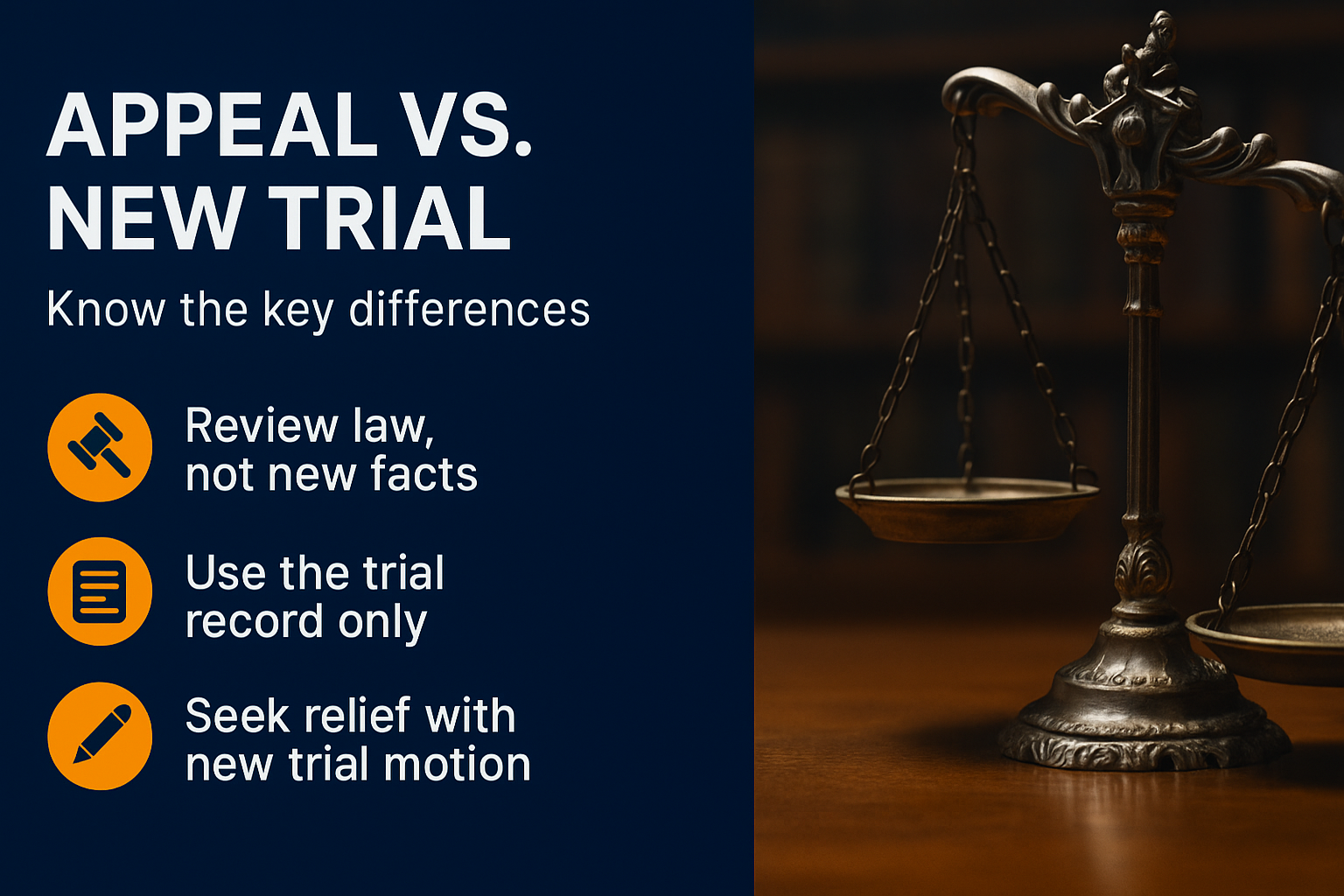
A motion for new trial, by contrast, is filed in the same trial court asking the judge to set aside the verdict or judgment for reasons such as procedural error, evidentiary error, or a verdict contrary to the law. In some states, filing certain post-trial motions can extend the deadline to appeal, which is a crucial strategic consideration.
When should you consider an appeal in a personal injury case?
In personal injury cases, you might consider an appeal when a final judgment is entered and you believe a legal error likely affected the outcome. Examples include incorrect jury instructions on negligence or damages, improper exclusion or admission of key evidence, or a legal ruling that misapplied statutes or case law.
Appeals are time sensitive. Each state has strict deadlines, and missing them usually ends the right to appeal. Because appellate practice focuses on identifying legal errors and preserving them in the record, getting qualified legal help early is important.
How does an appellate court review a case?
Appellate courts review questions of law, not new facts. They look for prejudicial errors in the proceedings below. If an error is deemed harmless, meaning it did not affect the outcome, it will be disregarded under harmless error rules in civil cases (see Fed. R. Civ. P. 61 for the general concept, which many states mirror).
What are the basic steps in a civil appeal?
- File a notice of appeal within the deadline.
- Designate the record and transcripts for the appellate court.
- Prepare and file briefs laying out legal arguments and authorities.
- Participate in oral argument if granted or requested.
- Receive a decision that may affirm, reverse, modify, or remand.
What are the notice of appeal deadlines in California, Texas, and Illinois?
What is the notice of appeal deadline in California civil cases?
In California, the deadline is generally the earlier of:
- 60 days after the clerk or a party serves a document titled “Notice of Entry” of judgment or a filed-endorsed copy of the judgment, or
- 180 days after entry of judgment, if no Notice of Entry was served.
See Cal. Rules of Court, rule 8.104. Certain timely post-trial motions can extend the deadline (rule 8.108).
What is the notice of appeal deadline in Texas civil cases?
In Texas, the notice of appeal is generally due:
- 30 days after the judgment is signed, or
- 90 days after the judgment is signed if a timely motion for new trial, motion to modify, or certain other post-judgment motions are filed.
See Texas Rules of Appellate Procedure 26.1 (Texas State Law Library guide to rules).
What is the notice of appeal deadline in Illinois civil cases?
In Illinois, the notice of appeal must be filed:
- Within 30 days after entry of the final judgment, or
- Within 30 days after entry of the order disposing of a timely post-judgment motion directed at that judgment.
See Illinois Supreme Court Rule 303.
What are common grounds for appeal in personal injury cases?
- Erroneous jury instructions on liability or damages that misstate the law.
- Evidentiary rulings that admit or exclude key evidence contrary to the rules of evidence.
- Legal rulings on dispositive motions, such as summary judgment or judgment as a matter of law, that misapply statutes or precedent.
- Improper comments by counsel that were objected to and preserved, if prejudicial.
- Damages issues, including remittitur or additur orders, or incorrect application of statutory caps where applicable.
Grounds must be preserved at trial through timely objections in most instances. For example, Texas requires a complaint to be preserved by a timely request, objection, or motion that states the grounds with sufficient specificity (Tex. R. App. P. 33.1). In Illinois jury cases, most claimed errors must be raised in a post-trial motion to be reviewed on appeal (735 ILCS 5/2-1202). California recognizes that some issues may be raised on appeal without a new trial motion, but post-trial motions can create a fuller record and extend the appellate deadline (Cal. Rules of Court, rule 8.108).
What standards of review do appellate courts use?
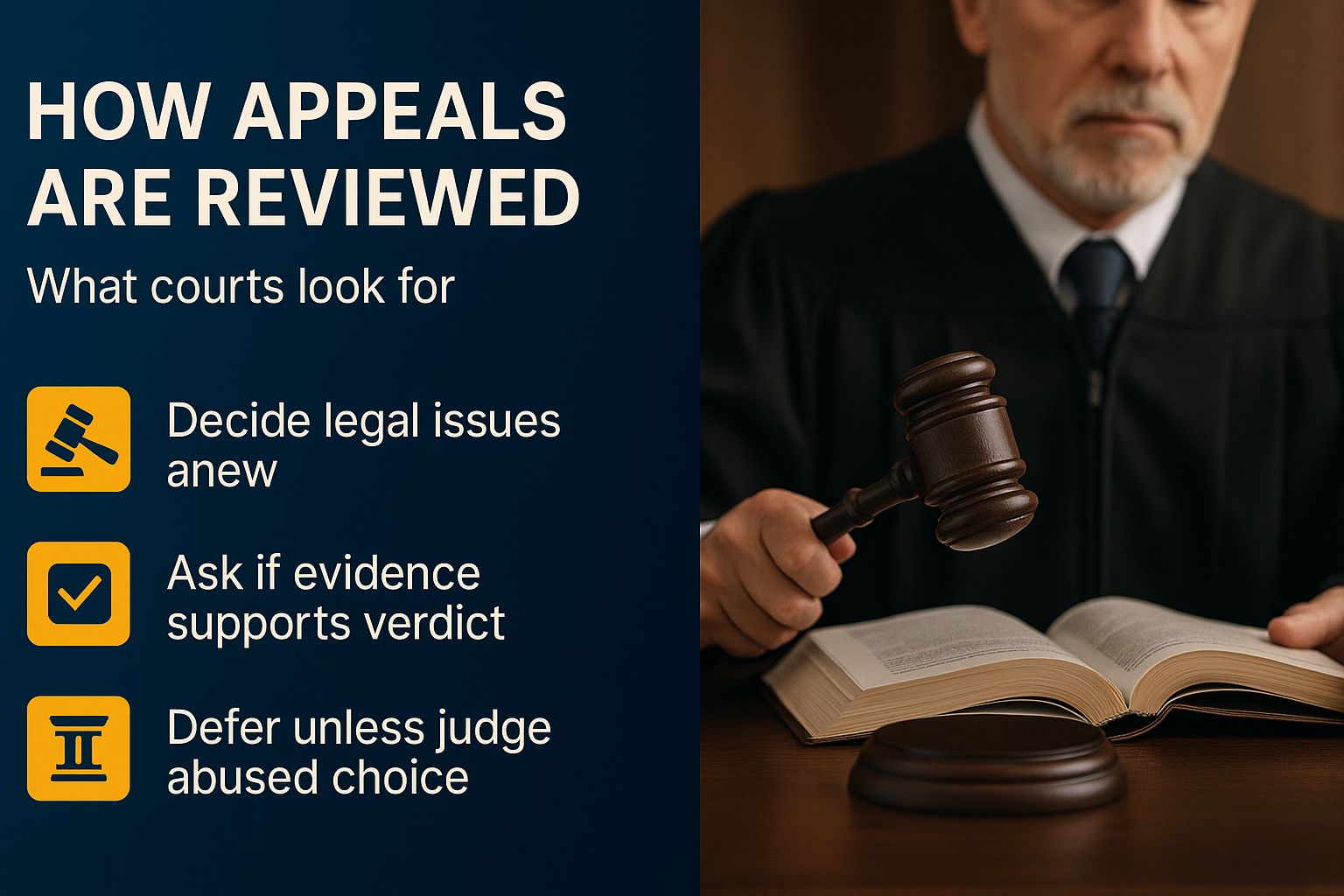
Standards of review define the level of deference given to the trial court. They often determine the likelihood of success because some standards are more deferential than others. Cornell Law School provides a helpful overview of common standards (LII: Standard of Review).
What are the main standards of review in civil appeals?
- De novo review applies to pure legal questions, such as statutory interpretation or summary judgment rulings. The appellate court gives no deference to the trial court’s legal conclusions.
- Substantial evidence or sufficiency-of-the-evidence review asks whether a reasonable factfinder could reach the verdict based on the evidence, viewed in the light most favorable to the verdict.
- Abuse of discretion review applies to discretionary decisions, like many evidentiary rulings, discovery sanctions, and new trial rulings. The question is whether the decision was arbitrary, unreasonable, or without reference to guiding rules.
- Harmless error doctrine means even if error occurred, reversal is not required unless the error affected substantial rights or probably led to an improper judgment (see FRCP 61; see also Tex. R. App. P. 44.1 for Texas civil harmless error).

What is the “record on appeal” and what must be included?
The record generally includes the pleadings, motions, orders, exhibits, and the transcript of proceedings. You must designate the items for inclusion.
- California: The record consists of a clerk’s transcript or appendix and a reporter’s transcript, if oral proceedings are relevant (Rule 8.120; Rule 8.122).
- Texas: The record includes the clerk’s record and the reporter’s record, as designated by the parties (Tex. R. App. P. 34).
- Illinois: The record on appeal includes the common law record and the report of proceedings, as well as any agreed statement or bystander’s report if no transcript is available (Ill. S. Ct. R. 321, 323).
Why is the record so critical?
Appellate courts decide cases based on what is in the record. Materials not in the record cannot be considered. If a key issue turns on something never filed or transcribed, it will be difficult to prevail on appeal. This is why timely objections and complete transcripts matter.
What is an appellate brief?
- California: Appellate briefs require a statement of issues, statement of facts with record citations, argument with legal authorities, and a conclusion (Rule 8.204).
- Texas: Briefs must include issues presented, statement of facts, summary of the argument, argument with citations to authorities and the record, and a prayer (Tex. R. App. P. 38).
- Illinois: Briefs must include points relied on for reversal, statement of jurisdiction, statement of facts, argument with citations, and other components set by (Ill. S. Ct. R. 341).
Will there be oral argument?
Oral argument may be requested and is scheduled at the court’s discretion. The rules describe how oral argument works and when it may be limited:
- California: See Rule 8.256.
- Texas: See Tex. R. App. P. 39.
- Illinois: See Ill. S. Ct. R. 352.
Even when oral argument is granted, most appeals are decided based on the briefs and the record. The U.S. Courts note that appellate panels decide cases primarily on written submissions, sometimes without oral argument (U.S. Courts).
What can an appellate court do with your case: affirm, reverse, modify, or remand?
- Affirm: The trial court’s judgment stands.
- Reverse: The appellate court overturns the judgment.
- Modify: The appellate court changes part of the judgment.
- Remand: The case is sent back to the trial court for further proceedings consistent with the appellate opinion.
State rules and statutes expressly authorize these outcomes, such as California Code of Civil Procedure section 43 (Cal. CCP § 43), Texas Rule of Appellate Procedure 43 (Tex. R. App. P. 43), and Illinois Supreme Court Rule 366 (Ill. S. Ct. R. 366).
Should you file a motion for new trial or go straight to appeal?
- California: A timely motion for new trial or to vacate judgment can extend the time to appeal. See Rule 8.108. Substantive grounds for new trial appear in CCP § 657.
- Texas: A timely motion for new trial generally extends the notice of appeal deadline from 30 to 90 days (Tex. R. App. P. 26.1), and many issues must be preserved by objection or motion (Tex. R. App. P. 33.1).
- Illinois: In jury cases, a post-trial motion is generally required to preserve issues for appeal, and filing a timely post-judgment motion affects the timeline for appeal (735 ILCS 5/2-1202; Ill. S. Ct. R. 303).
Choosing whether to move for a new trial or proceed straight to an appeal depends on your objectives, the type of error, and the local rules. Post-trial motions can give the trial judge an opportunity to correct errors and can sharpen appellate issues, but they add time and cost.
How do you pause enforcement of a judgment during an appeal?
- California: Money judgments are not automatically stayed by appealing. To stay enforcement, the appellant usually must file an undertaking (bond) under CCP § 917.1.
- Texas: Supersedeas is governed by Tex. R. App. P. 24, which provides methods to suspend enforcement, including bonds and deposits.
- Illinois: A stay pending appeal usually requires a bond under Ill. S. Ct. R. 305.
The specifics vary by jurisdiction and judgment type. Missing a stay can expose you to collection while the appeal is pending.
What is the civil appeal process in California, Texas, and Illinois?
How do appeals work in California state courts?
- Which court hears the appeal? The California Courts of Appeal, organized into districts, hear most civil appeals from the Superior Courts (California Courts of Appeal).
- Starting the appeal: File a notice of appeal within the deadlines in rule 8.104 and consider extensions under rule 8.108.
- Selecting the record: Choose a clerk’s transcript or appendix and designate the reporter’s transcript if needed (rule 8.120).
- Briefing: Follow rule 8.204 for content and format.
- Oral argument: Governed by rule 8.256.
- Decision: The court may affirm, reverse, modify, or remand as authorized by CCP § 43.
- Self-help overview: The California Courts provide a user-friendly appeals guide for civil cases (California Courts Self-Help).
How do appeals work in Texas state courts?
- Which court hears the appeal? One of the intermediate Texas Courts of Appeals hears most civil appeals from district and county courts (Texas Courts of Appeals).
- Starting the appeal: File the notice of appeal per Tex. R. App. P. 25, 26.1.
- Record: The clerk’s record and reporter’s record are governed by Tex. R. App. P. 34.
- Briefing: See Tex. R. App. P. 38.
- Oral argument: See Tex. R. App. P. 39.
- Disposition: See Tex. R. App. P. 43, 44.1 for reversal standards and harmless error.
- Rules access: The Texas State Law Library maintains current links to appellate rules (SLL Court Rules Guide).
How do appeals work in Illinois state courts?
- Which court hears the appeal? The Illinois Appellate Court, organized into five districts, hears civil appeals from the Circuit Courts (Illinois Appellate Court).
- Starting the appeal: File the notice of appeal under Rule 303.
- Record: See Rule 321 and Rule 323.
- Briefing: See Rule 341.
- Oral argument: See Rule 352.
- Disposition: See Rule 366 for the powers of the reviewing court, including affirming, reversing, modifying, or remanding.

How long do appeals take and what do they cost?
Timelines vary with court caseload and the complexity of the record and issues. As a general reference, appellate courts often take many months from the notice of appeal to a decision after briefing and argument. The U.S. Courts explain that appeals are decided primarily on written records and briefs, which are handled in a sequence that can take substantial time to complete (U.S. Courts). In California, Texas, and Illinois, briefing schedules and record preparation commonly place total durations in the range of several months to over a year. The exact timing depends on factors like transcript length, extensions, and whether oral argument is granted.
What costs should you anticipate?
- Filing fees for the notice of appeal and for record preparation.
- Transcript costs, which can be significant for multi-day trials.
- Bond or undertaking costs if staying a money judgment pending appeal.
- Appellate counsel fees for research, briefing, and argument.
Some costs can be reduced through partial records or agreed statements, where permitted by court rules, but these options must still preserve all necessary issues.
When is it worth appealing a plaintiff’s loss or low award?
- Identify reversible legal error: Appeals succeed based on legal error that likely affected the outcome, not simply because you disagree with the verdict.
- Preservation matters: Ensure key issues were preserved by objections or motions. Texas, for example, requires preservation by timely complaint in the trial court (Tex. R. App. P. 33.1).
- Deadlines are strict: Calendar the 60-day California deadline, the 30-day Texas and Illinois deadlines, and any extensions triggered by post-judgment motions.
- Weigh the remedy: A reversal may lead to a new trial rather than a final win. Consider the cost and time of retrying the case.
Can you raise damages issues on appeal?
Yes, legal errors relating to damages can be appealed. For example, improper exclusion of a damages expert or incorrect instructions. But if the issue involves the jury’s weighing of evidence, the standard of review may be deferential, making reversal harder. Some states permit review of remittitur or additur orders under abuse of discretion standards.
Are appeals frequently successful?
What do official sources say about reversal rates?
Most appeals are affirmed. The federal judiciary explains that appellate courts decide cases based on the existing record and legal arguments, with reversals typically limited to prejudicial legal error (U.S. Courts). While reversal rates vary by jurisdiction, case type, and year, the overall pattern is that only a minority of civil appeals result in reversals. This underscores the importance of identifying strong, preserved legal issues and matching them to favorable standards of review.
Which appellate courts handle civil appeals in California, Texas, and Illinois?
Where will your appeal be heard?
- California: The Courts of Appeal in six appellate districts review civil cases from the Superior Courts (California Courts of Appeal). The California Supreme Court exercises discretionary review.
- Texas: Fourteen Courts of Appeals hear civil appeals from the trial courts in their respective regions (Texas Courts of Appeals). The Texas Supreme Court reviews civil cases on petition.
- Illinois: Five appellate districts hear appeals from the Circuit Courts (Illinois Appellate Court). The Illinois Supreme Court reviews cases on petition.
What practical steps improve your odds on appeal?
How can you strengthen an appeal from the start?
- Preserve error: Make timely, specific objections; request rulings; file necessary motions.
- Build a clean record: Order and review transcripts; ensure exhibits and offers of proof are included.
- Pick your issues: Focus on a few strong, outcome-determinative errors.
- Match arguments to standards: Lead with de novo legal issues where possible.
- Mind the clock: Track and document notice deadlines and extensions in your jurisdiction.
How do California, Texas, and Illinois differ on key appeal topics?
What are the most important differences you should know?
- Deadlines: California’s 60-day or 180-day deadlines differ from the 30-day standard in Texas and Illinois, with extensions tied to post-trial motions (Cal. R. Ct. 8.104; Tex. R. App. P. 26.1; Ill. S. Ct. R. 303).
- Preservation: Texas expressly requires preservation of complaints via objection or motion (Tex. R. App. P. 33.1). Illinois jury cases require a post-trial motion for most issues (735 ILCS 5/2-1202). California recognizes preservation rules largely through case law and evidence rules; post-trial motions can extend deadlines (Cal. R. Ct. 8.108).
- Stays: California requires an undertaking to stay money judgments (CCP § 917.1); Texas uses supersedeas mechanisms (Tex. R. App. P. 24); Illinois requires a bond for most stays (Rule 305).
What examples show how standards can affect outcomes?
How might the same issue play out differently depending on the standard?
- Jury instruction error: Reviewed de novo for legal accuracy, but reversal still requires showing harm. Strong record objections and proposed correct instructions help.
- Evidentiary ruling: Often reviewed for abuse of discretion. Even if error, you must show it probably caused an improper judgment under harmless error standards.
- Summary judgment: De novo review favors appellants if the trial court’s legal conclusions were incorrect. Focus on undisputed facts and controlling law.
What questions do courts and search engines expect you to ask about appeals?
Which issues do people ask most about the civil appeal process?
- When to appeal a personal injury judgment or order.
- How appeals work, including briefs, records, and oral argument.
- Standards of review and how they affect success rates.
- Deadlines for notices of appeal in California, Texas, and Illinois.
- Stays and bonds to pause enforcement during appeal.
- Remand vs. affirm vs. reverse and what those outcomes mean.
What are the most common appeal mistakes to avoid?

How can you avoid losing your appeal before it starts?
- Missing the notice deadline by days or even hours. Calendar conservatively.
- Failing to order transcripts of key hearings or trial days. No transcript, no review.
- Overloading issues and diluting strong arguments with weak ones.
- Insufficient citations to the record and controlling authority.
- No stay plan, resulting in collection activity during the appeal.
Where can you find official guidance in California, Texas, and Illinois?
What authoritative resources explain appeals in each state?
- California: Official Civil Appeals self-help portal (selfhelp.courts.ca.gov/appeals) and the California Rules of Court (selected rules linked throughout this page).
- Texas: Texas State Law Library’s rules guide to the Texas Rules of Appellate Procedure (SLL Court Rules Guide) and the Texas Courts of Appeals site.
- Illinois: Illinois Supreme Court Rules page (illinoiscourts.gov) and the Illinois Appellate Court site.
How can GoSuits help me on my personal injury appeal?
If you received an unfavorable judgment or order in a personal injury case in California, Texas, or Illinois, an appeal may be the right next step. Appeals turn on preserved legal issues, strict timelines, and precise written advocacy. A free consultation with a personal injury appellate lawyer can help you evaluate grounds for appeal, deadlines, likelihood of a stay, and the most effective path forward.
- Our footprint: We handle personal injury matters in California, Texas, and Illinois, including post-trial strategy and civil appeals.
- Technology-first: GoSuits uses an exclusive proprietary software platform to accelerate records review, transcript analysis, and brief drafting while maintaining high-quality attorney review at every step.
- Attorney access: Although our technology expedites the case, every client has a designated attorney. We do not use case managers, and clients have direct access to their lawyer.
- Leadership in innovation: Our team integrates litigation analytics, citation validation, and automated record indexing to move faster and reduce errors.
- Experience: With 30 years of combined trial and appellate experience, we understand how trial strategy affects appellate outcomes, and how to frame issues for reviewing courts.
- Trial readiness: When appeals lead to remand, our trial experience helps position the case for a stronger result the second time.
- Past results: See representative outcomes across injury litigation and appeals on our prior cases page. Past results do not guarantee a similar outcome, but they show our approach and persistence in complex matters.
Explore more:
Sources and further reading
- U.S. Courts, Court Role and Structure: uscourts.gov
- Cornell Law School Legal Information Institute, Appeal: law.cornell.edu/wex/appeal
- Cornell Law School Legal Information Institute, Standard of Review: law.cornell.edu/wex/standard_of_review
- Cornell Law School Legal Information Institute, FRCP 61 Harmless Error: law.cornell.edu/rules/frcp/rule_61
- California Courts Self-Help, Civil Appeals: selfhelp.courts.ca.gov/appeals
- California Rules of Court 8.104, Time to Appeal: courts.ca.gov
- California Rules of Court 8.108, Extending Time to Appeal: courts.ca.gov
- California Rules of Court 8.120, 8.122, Record on Appeal: courts.ca.gov and courts.ca.gov
- California Rules of Court 8.204, Briefs: courts.ca.gov
- California Rules of Court 8.256, Oral Argument: courts.ca.gov
- California Code of Civil Procedure § 43, Appellate Powers: leginfo.legislature.ca.gov
- California Code of Civil Procedure § 657, New Trial: leginfo.legislature.ca.gov
- California Code of Civil Procedure § 917.1, Stay of Enforcement: leginfo.legislature.ca.gov
- Texas State Law Library, Texas Rules of Appellate Procedure: guides.sll.texas.gov
- Texas Courts of Appeals: txcourts.gov
- Illinois Appellate Court: illinoiscourts.gov
- Illinois Supreme Court Rules, Civil Appeals: illinoiscourts.gov
- 735 ILCS 5/2-1202, Post-trial motions in jury cases: ilga.gov