- What happens during a personal injury civil trial?
- How often do personal injury cases settle instead of going to trial?
- What happens before trial in the personal injury lawsuit process?
- What occurs at the final pretrial conference and with pretrial motions?
- How does jury selection work in California, Texas, and Illinois?
- What is the burden of proof at a personal injury civil trial?
- What are opening statements and why do they matter?
- How is evidence presented, and how does expert testimony work?
- How do cross-examination and objections work during trial?
- What defenses and comparative negligence issues arise at trial?
- What happens during closing arguments and jury instructions?
- How do jury deliberations and verdicts work across jurisdictions?
- What damages can be awarded in a personal injury civil trial?
- What happens after the verdict with judgment and post-trial motions?
- How do appeals work in federal court, California, Texas, and Illinois?
- How long does a personal injury trial take, and what is the trial timeline?
- How should you weigh settlement vs trial?
- What practical tips help you prepare for your day in court?
- What are some local snapshots for California, Texas, and Illinois personal injury trials?
- How can GoSuits support you if your case goes to trial?
- References and resources
What happens during a personal injury civil trial?
A personal injury civil trial is the courtroom phase of a lawsuit where a judge or jury decides who is legally responsible for an injury and, if appropriate, how much compensation to award. While many cases settle, trials are where the facts, the law, and the credibility of witnesses are tested in public. Understanding the personal injury trial process helps you know what to expect, how a case moves from start to finish, and where key decisions are made.
Trials follow a structured sequence: jury selection, opening statements, witness testimony and exhibits, cross-examination, motions, closing arguments, jury instructions, deliberations, and a verdict. After a verdict, the court enters judgment, and either side can file post-trial motions or an appeal. Throughout, both plaintiffs and defendants make strategic choices about evidence and law that can shape the outcome.
How often do personal injury cases settle instead of going to trial?
Most civil cases do not go to trial. State court data from the Bureau of Justice Statistics show trials represent a small percentage of civil case dispositions. In a nationwide analysis, plaintiffs prevailed in about 56 percent of civil trials, with a median award of roughly $31,000, and punitive damages appeared in a small fraction of plaintiff wins. These findings come from the Civil Justice Survey of State Courts, which remains a key benchmark for understanding civil trial patterns (BJS, Civil Bench and Jury Trials in State Courts, 2005).
Federal courts similarly resolve most civil cases without trial through motion practice and settlement. The Administrative Office of the U.S. Courts describes how civil cases move through pleading, discovery, motions, and a final pretrial order, with only a small share reaching trial (U.S. Courts, Civil Cases). Your individual likelihood of trial depends on the facts, legal issues, the damages at stake, the quality of evidence, and the willingness of both sides to compromise. Even on the courthouse steps, cases frequently settle.
What happens before trial in the personal injury lawsuit process?
Before a personal injury civil trial, the case typically proceeds through these phases:
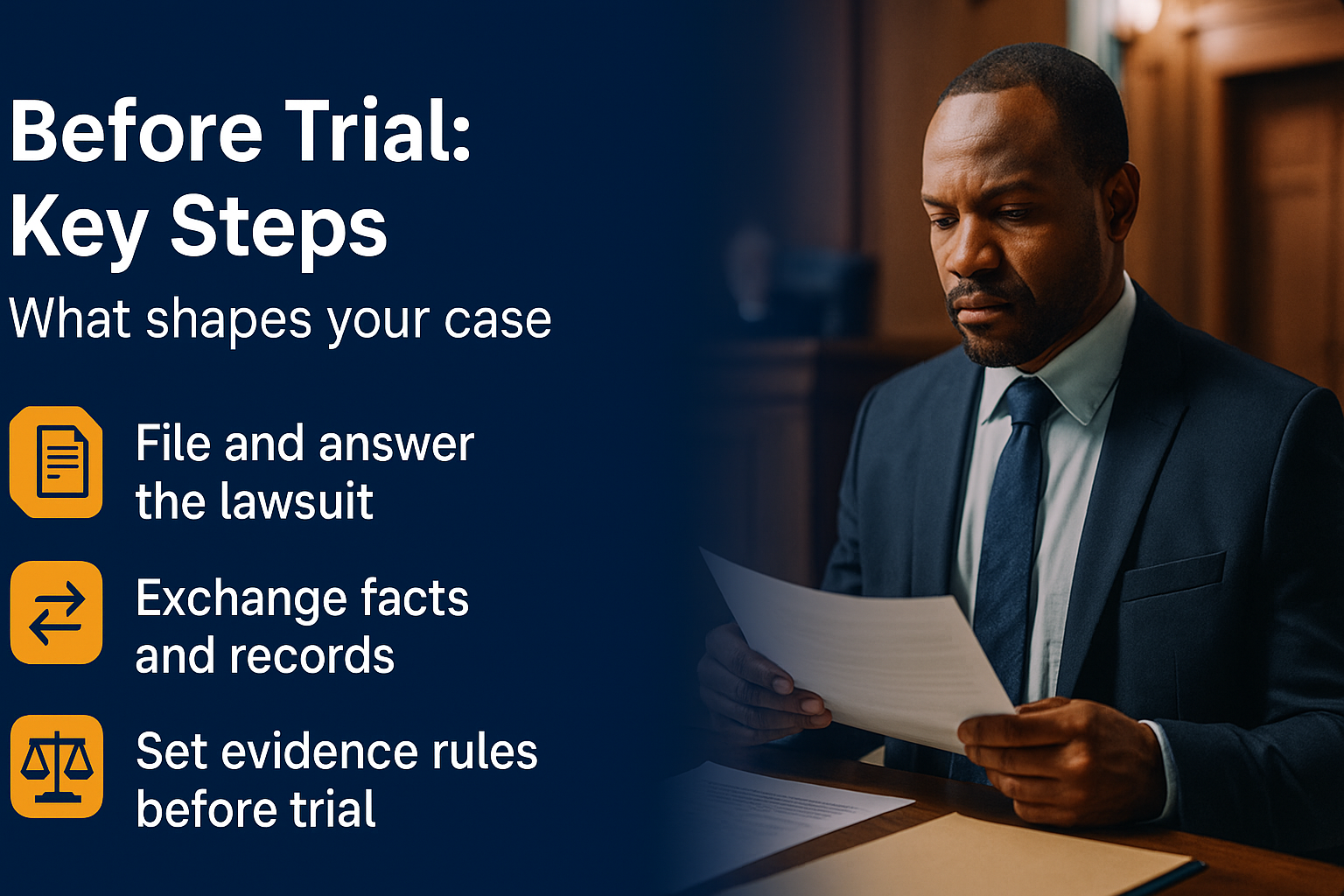
- Pleadings: Your complaint is filed and served, the defense answers, and any counterclaims are raised.
- Discovery phase: Both sides exchange information through interrogatories, requests for production, requests for admission, and depositions. This is where the facts and expert opinions are developed. Discovery sets the stage for the trial, and failures to disclose can lead to evidence being excluded.
- Pretrial motions: Common motions include motions to compel discovery, motions for protective orders, and dispositive motions. A motion for summary judgment asks the court to enter judgment as a matter of law if there is no genuine dispute of material fact under Federal Rule of Civil Procedure 56 (FRCP 56), and most states have similar rules.
- Motions in limine: These pretrial requests ask the judge to exclude or admit specific evidence before trial starts, often under Rules 401, 402, and 403 of the Rules of Evidence regarding relevance and unfair prejudice (LII, Motion in limine; FRE 401; FRE 402; FRE 403).
- Final pretrial order: The court may require a joint pretrial order listing witnesses, exhibits, stipulations, and contested issues to streamline the personal injury trial process.
At every step, legal counsel for both plaintiffs and defendants is important. Discovery and pretrial motions can shape what the jury sees and hears, which often influences settlement discussions as well.
What occurs at the final pretrial conference and with pretrial motions?
Courts use final pretrial conferences to resolve issues so the trial proceeds smoothly. Expect the judge to address:
- Exhibit lists and objections: The judge rules on evidence disputes, often following earlier motions in limine.
- Witness scheduling: The court confirms witness order, time limits, and any accommodation needs.
- Jury instructions and verdict form: The court works from proposed instructions and crafts a verdict form tailored to the claims, defenses, and comparative negligence questions.
- Remaining motions: The court may hear pending motions to exclude experts, bifurcate issues, or adjust the trial timeline.
These conferences can be decisive because they define the boundaries of the evidence and legal standards the jury will apply.
How does jury selection work in California, Texas, and Illinois?
Jury selection, called voir dire, is where lawyers and the judge question prospective jurors for bias or inability to be fair. It protects the right to an impartial jury in civil cases and follows both general principles and state-specific procedures (LII, Voir dire).
- California: California Code of Civil Procedure section 222.5 sets parameters for attorney-conducted voir dire and good-cause examination of bias (Cal. CCP 222.5). Civil juries are rooted in Article I, section 16 of the California Constitution, which includes provisions about jury size and verdicts (Cal. Const., art. I, § 16).
- Texas: Texas uses the Rules of Civil Procedure and case law to guide voir dire, with pattern instructions and rules addressing challenges for cause and peremptory challenges. See the Texas Rules of Civil Procedure resource page for the current rules (Texas Rules).
- Illinois: Illinois Supreme Court Rule 431 governs voir dire and the scope of attorney questioning to uncover potential bias (Illinois Supreme Court Rules).
In all three states, lawyers can challenge jurors for cause, and each side has a limited number of peremptory challenges. The goal is a fair and impartial civil jury capable of applying the law to the facts.
What is the burden of proof at a personal injury civil trial?
In civil cases like personal injury, the standard is typically preponderance of the evidence. This means the jury decides whether it is more likely than not that the defendant is legally responsible. It is a lower standard than in criminal cases (LII, Preponderance of the evidence). States codify related concepts through evidence codes. For example, California Evidence Code section 115 describes the use of preponderance and other standards in civil proceedings (Cal. Evid. Code § 115).

What are opening statements and why do they matter?
Opening statements are each side’s roadmap of the case. They are not arguments but a preview of what the evidence will show. The plaintiff typically goes first, because the plaintiff bears the burden of proof. Then the defense outlines its position, such as disputing causation, challenging the claimed damages, or asserting comparative negligence. A clear opening helps jurors organize what they are about to hear.
How is evidence presented, and how does expert testimony work?
Evidence comes through witness testimony and exhibits. The rules emphasize relevance and reliability, with judges acting as gatekeepers.
- Relevance and exclusion Evidence must be relevant to be admissible, and relevant evidence can still be excluded if its probative value is substantially outweighed by unfair prejudice or confusion (FRE 401; FRE 403).
- Lay and expert witnesses Lay witnesses testify about what they saw or experienced. Expert testimony is allowed when specialized knowledge will help the jury understand evidence or determine a fact in issue. Federal Rule of Evidence 702 and the U.S. Supreme Court’s decision in Daubert v. Merrell Dow Pharmaceuticals guide courts in assessing whether expert testimony is based on reliable principles and methods (FRE 702; Daubert, 509 U.S. 579). Many states apply similar reliability standards through their own evidence rules and case law.
- Foundations and exhibits Documents, photos, medical bills, and demonstratives require proper foundation to authenticate them and show relevance. Parties often stipulate routine foundations to save time.
In a personal injury trial, common expert topics include accident reconstruction, biomechanics, human factors, life-care planning, and economic loss calculations. Both sides may present competing opinions, and the jury decides which is more persuasive.
How do cross-examination and objections work during trial?
After a witness testifies on direct examination, the opposing party may cross-examine to challenge credibility, bias, or the basis of opinions. Cross-examination often highlights gaps, inconsistencies, or assumptions. Objections enforce the rules of evidence in real time and can be raised for reasons such as hearsay, lack of foundation, speculation, or unfair prejudice under rules like FRE 403. The judge rules on objections, and sustained objections keep improper questions or answers from the record. Jurors are instructed to disregard testimony the court strikes.
What defenses and comparative negligence issues arise at trial?
Defense themes vary, but common ones include disputing liability, contesting causation, reducing damages, and arguing comparative negligence. Comparative negligence affects how fault is allocated and how damages are adjusted by state:
- California: California follows pure comparative negligence, meaning a plaintiff’s recovery is reduced by their percentage of fault, but they are not barred unless their fault is 100 percent. The doctrine originated with Li v. Yellow Cab Co. of California, a landmark California Supreme Court case (Li v. Yellow Cab, 13 Cal.3d 804).
- Texas: Texas applies proportionate responsibility. A plaintiff cannot recover if they are more than 50 percent responsible. Otherwise, damages are reduced by the plaintiff’s percentage of responsibility under Texas Civil Practice and Remedies Code Chapter 33 (Tex. Civ. Prac. & Rem. Code ch. 33).
- Illinois: Illinois uses modified comparative negligence. Recovery is barred if the plaintiff’s fault is more than 50 percent, and otherwise reduced by their share of fault, as set out in 735 ILCS 5/2-1116 (735 ILCS 5/2-1116).
The jury’s verdict form typically requires the jurors to assign percentages of fault among all parties and nonparties as permitted in the jurisdiction.
What happens during closing arguments and jury instructions?
Closing arguments let each side connect the evidence to the law. The plaintiff argues why the elements of the claims were proven by a preponderance of the evidence; the defense emphasizes doubts, alternative explanations, and contributory fault. After closings, the judge reads jury instructions that explain the law, define key terms like preponderance, causation, and damages, and outline how to complete the verdict form. The instructions come from statutes, case law, and pattern jury instructions where available.
How do jury deliberations and verdicts work across jurisdictions?
Jurors deliberate in private to reach a verdict. In civil cases, unanimity requirements and jury size can vary by jurisdiction:
- California: California’s Constitution governs civil juries and allows non-unanimous verdicts in certain civil cases, often requiring agreement by three-fourths of jurors, depending on the court’s rules and the parties’ stipulations (Cal. Const., art. I, § 16).
- Texas: Texas procedure addresses civil jury size and verdict requirements, including provisions that allow a verdict when a specified number of jurors agree, often 10 of 12 in district court or 5 of 6 in county court, under the Texas Rules of Civil Procedure (Texas Rules).
- Illinois: Illinois statutes speak to civil jury size and verdicts. As a general rule, civil juries may consist of up to 12 jurors unless the parties agree otherwise, and verdict rules are addressed in 735 ILCS 5/2-1105 (735 ILCS 5/2-1105).
Once the jury reaches a verdict, the court reads it in open court and may poll the jury. The verdict is not the end of the process, because judgment and post-trial motions can follow.

What damages can be awarded in a personal injury civil trial?
A personal injury verdict may include several categories of damages, depending on the claims and jurisdiction:

- Economic damages: Past and future medical expenses, rehabilitation costs, lost wages, lost earning capacity, household services, and other quantifiable financial losses.
- Non-economic damages: Pain, suffering, inconvenience, emotional distress, loss of enjoyment of life, and loss of companionship, as allowed by state law.
- Punitive damages: In limited cases, a jury may award punitive damages to punish and deter particularly wrongful conduct. The U.S. Supreme Court has held that due process places limits on punitive damages, and that single-digit ratios between punitive and compensatory damages are more likely to comport with due process considerations, depending on the case’s facts (State Farm v. Campbell, 538 U.S. 408).
Courts carefully instruct juries on damages to prevent double counting and to tie any award to evidence presented at trial. The court may adjust or set aside a damages award if legal standards were not met.
What happens after the verdict with judgment and post-trial motions?
After the verdict, the court enters judgment. Either side can file post-trial motions within set deadlines:
- Judgment as a matter of law: A party can renew a motion arguing that no reasonable jury could have found as it did under Rule 50 in federal court (FRCP 50).
- New trial or altered judgment: Parties may move for a new trial or to alter or amend the judgment under Rule 59, often within 28 days of entry of judgment in federal court (FRCP 59).
- Relief from judgment: Under Rule 60, a party may seek relief for reasons like mistake, newly discovered evidence, or fraud (FRCP 60).
States have analogous mechanisms and deadlines. Timely post-trial motions can preserve issues for appeal and sometimes narrow or resolve disputes without an appellate proceeding.
How do appeals work in federal court, California, Texas, and Illinois?
An appeal reviews alleged legal errors, not fact disputes the jury resolved. The appellant must file a notice of appeal within the applicable deadline and follow the appellate rules for records, briefing, and standards of review.
- Federal appeals: In most civil cases, the notice of appeal must be filed within 30 days after entry of judgment, with some exceptions, under Federal Rule of Appellate Procedure 4(a) (FRAP 4(a)).
- California appeals: California Rules of Court generally require a notice of appeal to be filed within 60 days after service of notice of entry of judgment, or a different limit if no notice is served, under rule 8.104 (Cal. Rule of Court 8.104).
- Texas appeals: The Texas Rules of Appellate Procedure set deadlines that are often 30 days after the judgment is signed for a notice of appeal in civil cases, subject to extensions and specific circumstances (Texas Appellate Rules).
- Illinois appeals: Illinois Supreme Court Rule 303 generally requires a notice of appeal to be filed within 30 days after entry of the final judgment, with provisions for certain post-judgment motions (Ill. S. Ct. R. 303).
Because appeals are time-sensitive, it is important to act promptly after judgment if you are considering appellate review.
How long does a personal injury trial take, and what is the trial timeline?
Timelines vary by court and case complexity, but a typical sequence looks like this:
- Day 1 Jury selection (voir dire) and swearing-in of the jury.
- Day 2 Opening statements from both sides.
- Days 3–5+ Plaintiff’s case-in-chief with fact witnesses and expert testimony, cross-examination, and evidence admissions.
- Days 5–7+ Defense case-in-chief, including defenses and possible comparative negligence evidence.
- Last day Rebuttal, if any, followed by closing arguments, jury instructions, and deliberations.
Shorter trials can conclude in a few days, while complex injury cases may take several weeks. Local civil trial management rules, witness availability, court calendars, and evidentiary issues all affect timing.
How should you weigh settlement vs trial?
Settlement can offer certainty, speed, privacy, and reduced cost. Trial offers the opportunity for a fact finder to resolve disputed liability and damages but carries risk and public exposure. National data reflect that only a small portion of civil cases reach trial, and plaintiffs win only a share of those that do, with median awards that vary widely by case type and venue (BJS Civil Trials).
Effective evaluation requires careful review of liability evidence, causation, comparative negligence, the quality of expert testimony, the likely jury pool in California, Texas, or Illinois, and the enforceability of a judgment. Consider the time value of money, appellate risks, and the potential for post-trial motion practice to alter or delay a verdict.
What practical tips help you prepare for your day in court?
- Work closely with your attorney: Preparing testimony, understanding exhibits, and anticipating cross-examination are vital.
- Keep documents organized: Medical records, wage proof, and other economic loss documentation should be consistent and accessible.
- Arrive early and dress respectfully: First impressions with the jury matter.
- Follow courtroom rules: Listen to the judge, avoid reactions during testimony, and refrain from discussing the case in public areas.
- Be truthful and concise: Jurors assess credibility carefully. Answer the question asked and avoid guessing.
What are some local snapshots for California, Texas, and Illinois personal injury trials?
California: What California-specific rules commonly affect personal injury trials?
- Voir dire and juror bias: California permits meaningful attorney-conducted voir dire to uncover potential bias in civil cases (CCP 222.5).
- Burden standard: California Evidence Code section 115 recognizes preponderance and other standards depending on the issue (Evid. Code § 115).
- Comparative negligence: California applies pure comparative negligence as set by California Supreme Court authority (Li v. Yellow Cab).
- Appeal deadlines: Notice of appeal deadlines are governed by California Rules of Court rule 8.104, commonly 60 days after notice of entry of judgment (Rule 8.104).
Texas: What Texas-specific rules commonly affect personal injury trials?
- Jury selection and verdicts: Texas Rules of Civil Procedure address voir dire, challenges, and verdict requirements, including consensus thresholds that can permit a non-unanimous verdict in civil cases (Texas Rules).
- Proportionate responsibility: A plaintiff barred from recovery if greater than 50 percent responsible. Fault apportionment is central to Texas personal injury trial strategy (Tex. CPRC ch. 33).
- Appeal timing: The Texas Rules of Appellate Procedure provide civil deadlines often 30 days after judgment, with possible extensions (Texas Appellate Rules).

Illinois: What Illinois-specific rules commonly affect personal injury trials?
- Voir dire scope: Illinois Supreme Court Rule 431 controls juror questioning and bias inquiries (Ill. S. Ct. R. 431).
- Modified comparative negligence: Recovery is barred if plaintiff’s fault exceeds 50 percent, and otherwise reduced proportionately (735 ILCS 5/2-1116).
- Civil jury size and verdicts: Jury size and verdict procedures are set by statute (735 ILCS 5/2-1105).
- Appeal timing: Illinois Supreme Court Rule 303 typically requires filing a notice of appeal within 30 days after final judgment (Ill. S. Ct. R. 303).
How can GoSuits support you if your case goes to trial?
If you are facing a personal injury civil trial in California, Texas, or Illinois, we understand the stakes. A free consultation with an injury attorney helps you understand the personal injury trial process, the strength of your evidence, and realistic outcomes grounded in law and facts. We handle civil injury cases across California, Texas, and Illinois, and we invest in the courtroom preparation that a jury expects.
- Technology-driven approach: GoSuits uses exclusive proprietary software to organize discovery, analyze timelines, and surface key exhibits faster, so your trial team can focus on strategy and storytelling.
- Leadership in innovation: We bring modern tools to traditional advocacy to move cases forward efficiently while maintaining rigorous quality control.
- Direct attorney access: Although technology expedites the case, every client has a designated attorney. We do not use case managers. You have unfettered access to your lawyer.
- Trial experience: Our attorneys try cases and prepare each matter as if it will be heard by a jury, which often improves positioning for settlement and readiness for a verdict.
- Past results: We are proud of the outcomes secured for clients across our practice areas. See representative matters at Prior Cases.
- Team and practice areas: Learn more about our attorneys at Our Attorneys, our firm at About Us, and the full range of matters we handle at Practice Areas.
- Experience GoSuits brings 30 years of combined experience to civil injury litigation, from investigation and discovery through verdict and appeals.
Whether your case resolves at mediation or goes to a jury, we focus on preparation, clarity, and communication to pursue the best path for you.
References and resources
- Bureau of Justice Statistics, Civil Bench and Jury Trials in State Courts, 2005 (trial rates, plaintiff win rates, and median awards)
- U.S. Courts, Civil Cases (civil case process overview)
- FRCP 56; FRCP 50; FRCP 59; FRCP 60 (summary judgment, judgment as a matter of law, new trial, relief from judgment)
- LII, Motion in limine (pretrial evidence motions)
- FRE 401; FRE 402; FRE 403 (relevance and exclusion)
- FRE 702 and Daubert v. Merrell Dow Pharmaceuticals, 509 U.S. 579 (expert testimony standards)
- LII, Preponderance of the evidence (civil burden of proof)
- Cal. Evid. Code § 115 (burden of proof standards)
- Cal. Code Civ. Proc. § 222.5 (voir dire)
- Cal. Const., art. I, § 16 (civil juries and verdicts)
- Tex. Civ. Prac. & Rem. Code ch. 33 (proportionate responsibility)
- Texas Rules of Civil and Appellate Procedure (jury selection, verdicts, appellate deadlines)
- Illinois Supreme Court Rules and Rule 303 (voir dire and appeals)
- 735 ILCS 5/2-1116 and 735 ILCS 5/2-1105 (comparative negligence and civil juries)
- Li v. Yellow Cab Co. of California, 13 Cal.3d 804 (California pure comparative negligence)
- State Farm Mut. Auto. Ins. Co. v. Campbell, 538 U.S. 408 (punitive damages due process)
- FRAP 4(a) (federal appeal timing)