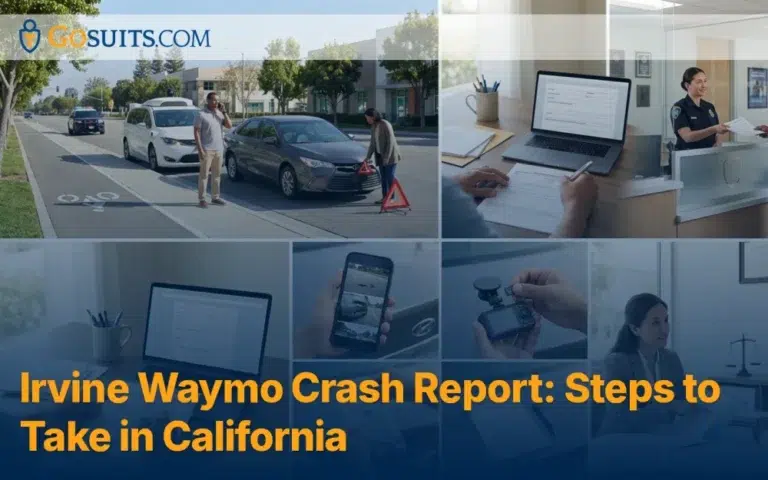
- What should you do first after a Waymo or rideshare crash in Irvine CA?
- When should you call 911 and what should you say?
- How do you document the scene and exchange information under California law?
- Do you need to file an Irvine police report or contact CHP, and how do you get the report?
- What is the California DMV SR-1 and when must you submit it?
- How are autonomous vehicle crashes reported in California and does Waymo have extra obligations?
- What insurance applies after a rideshare or Waymo crash in Irvine?
- How does comparative fault work in California crash cases?
- What deadlines apply to injury and property damage claims in California?
- How do you preserve vehicle and electronic data after an AV or rideshare crash?
- Should you talk to insurers or sign releases soon after the crash?
- How do you get medical care and track damages for a civil claim?
- What mistakes should you avoid after an Irvine rideshare or AV crash?
- How can legal representation help with an Irvine Waymo or rideshare crash claim?
- Why choose GoSuits for help after an Irvine rideshare or Waymo crash?
- References and resources
What should you do first after a Waymo or rideshare crash in Irvine CA?
If you are involved in an Irvine Waymo accident or any rideshare collision in Irvine CA, prioritize safety and health. Move to a safe location if you can do so without risk, turn on hazard lights, and check for injuries. Call 911 for any suspected injury or if there is traffic danger. California drivers also have legal duties after a crash that include stopping, aiding the injured when reasonable, and exchanging information. State law requires drivers to provide identifying and insurance information to others involved and to any peace officer at the scene [3].
If you are a passenger in an autonomous vehicle, treat the situation like any motor vehicle crash. Use the vehicle’s emergency features if available, and follow instructions from dispatch or the human operator if one is reachable. Secure the scene by warning approaching traffic if it is safe, especially on high speed roads, and avoid standing in traffic lanes.
As soon as immediate safety is under control, begin documenting. Take photos of the vehicles, the intersection or roadway, any damage and debris, skid marks, traffic signals or signs, weather conditions, and visible injuries. Capture time and date on your photos or video. If there were passengers or pedestrians, note their names and contact information. This documentation often becomes crucial as you navigate insurance claims and potential civil litigation.
When should you call 911 and what should you say?
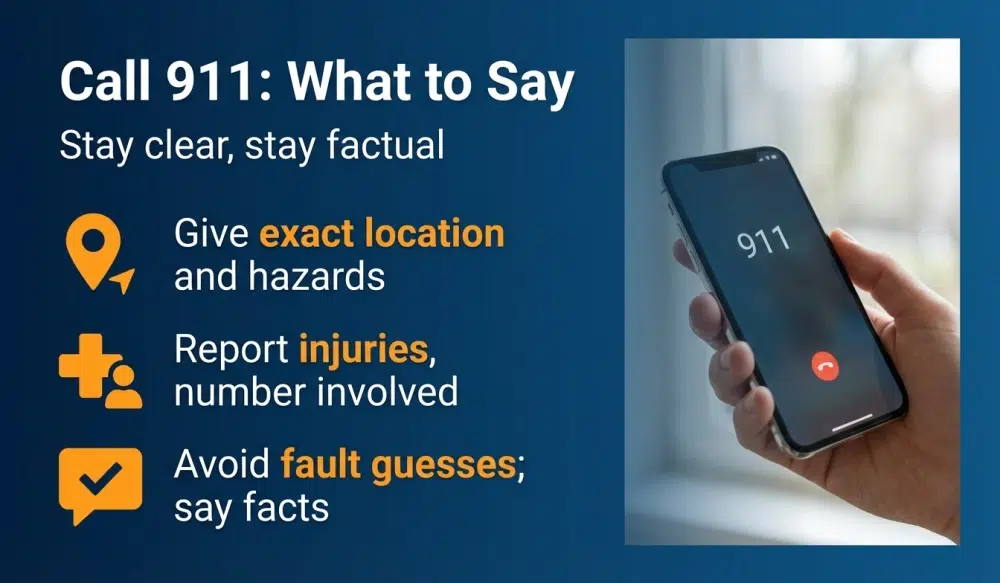
Call 911 promptly if anyone is injured or if you suspect injury. California law requires reporting collisions involving injury or death to local police or the California Highway Patrol within 24 hours [2]. Calling 911 meets that requirement in most cases because an officer will respond and create a report. If the incident only involves property damage and is minor, you can still request an officer if there is a traffic hazard, impaired driver suspicion, or a dispute about fault. For non-emergencies after the fact, you may contact local law enforcement for reporting guidance.
When speaking with the dispatcher, provide your exact location, the number of people and vehicles involved, whether there are hazards like leaking fluids, and whether anyone needs urgent medical attention. Do not speculate about fault. Keep your statements factual and concise. If the crash involves a Waymo or other autonomous vehicle, mention that detail so responders can prepare for unique vehicle systems and data preservation.
How do you document the scene and exchange information under California law?
California Vehicle Code section 16025 requires drivers to exchange specific information after a collision, including name and current residence address, vehicle registration number, name and address of the owner, and proof of financial responsibility or insurance information [3]. Ask to see the other driver’s license and insurance card and take clear photos. Verify the license plate and VIN if possible and photograph any rideshare or fleet identification on the vehicle.
For rideshare collisions, also capture the rideshare app screen showing the trip status and driver identity. If an autonomous vehicle is involved, note any visible external sensors, vehicle number, or operator information posted inside the vehicle cabin. Take photos of damage from multiple angles and the wider roadway context. Note surveillance cameras on nearby buildings or buses that may have recorded the incident. If anyone admits a violation, record their words precisely and identify any witnesses willing to provide statements later.
When you exchange information, remain calm and respectful. Avoid arguments. You can tell the other party that California law requires the exchange and that both sides will cooperate with law enforcement and insurers [3].
Do you need to file an Irvine police report or contact CHP, and how do you get the report?
For collisions with injury or death, California law requires reporting to police or the California Highway Patrol within 24 hours [2]. If the crash occurs within Irvine city limits, Irvine Police Department typically responds, and you can later request a copy of the report through the department’s records unit. If the crash is on a freeway or state route, CHP usually responds and maintains the collision report. CHP provides instructions for requesting a Traffic Collision Report for involved parties or their representatives [12]. If you are unsure whether Irvine PD or CHP has the report, call either agency’s records office, provide the date, time, and location, and ask which agency holds the file.
City resources can help you locate the correct unit and procedures for requests. The Irvine Police Department webpage provides contact information for records and public services [11]. When you request a report, have your incident number or the date and location ready. You may need to verify your identity and relationship to the incident under state confidentiality rules for collision reports. Plan for a processing period, as reports are usually reviewed and approved before release.
What is the California DMV SR-1 and when must you submit it?
California requires an SR-1 Report of Traffic Accident to the DMV within 10 days if a crash results in injury, death, or property damage of more than a specified amount. The threshold for filing is property damage greater than 1000 dollars, any injury no matter how minor, or a fatality. The DMV provides the SR-1 form and instructions, and filing is required even if law enforcement takes a report [1]. This is separate from the police report and serves the state’s financial responsibility system. Failure to file can lead to license or registration consequences.
Information you will need for the SR-1 includes names and addresses of all drivers and property owners, insurance information, vehicle descriptions, and a brief description of the collision. Keep copies of what you submit and note the date of filing. If you do not have all details immediately, submit the form with what you have and follow up with missing details promptly if the DMV requests them.
How are autonomous vehicle crashes reported in California and does Waymo have extra obligations?
California’s DMV oversees autonomous vehicle testing and deployment programs. Companies operating autonomous vehicles under DMV authorization must file collision reports with the DMV for any crash involving a vehicle operating in autonomous mode or when the collision arises while the autonomous technology is engaged. These reports must be filed within 10 business days, and the DMV publishes them on its website [4]. The reports help regulators, researchers, and the public understand the nature of AV collisions in the state.
Separately, if the AV is providing passenger service under a program overseen by the California Public Utilities Commission, the company must also follow CPUC requirements for passenger safety programs and reporting. CPUC regulates transportation network companies providing rideshare or passenger service, including pilot programs related to autonomous passenger service [5]. For you as an involved individual, these company reporting duties do not replace your obligations to call 911 when needed, exchange information, and file the DMV SR-1 if required [1].
If you were riding in an AV and suffered injuries, ask the responding officer to note that the vehicle was operating with autonomous technology. Preserve your trip receipt or app record. You can later check whether a DMV AV collision report appears for the incident once posted online, which can help confirm technical details noted by the company [4].
What insurance applies after a rideshare or Waymo crash in Irvine?
Insurance coverage depends on the vehicle status and who was at fault. For rideshare vehicles, California law sets minimum insurance amounts tied to three periods of the rideshare driver’s app status. When the app is on and the driver is available but has not accepted a ride, the required liability coverage is at least 50,000 dollars for death or bodily injury per person, 100,000 dollars per incident, and 30,000 dollars for property damage, plus uninsured and underinsured motorist coverage in certain amounts. When a ride is accepted and during passenger trips, the law requires at least 1,000,000 dollars in primary commercial liability coverage, with additional first party and uninsured motorist coverage as required by statute [6]. CPUC oversight confirms these coverage structures for transportation network companies operating in California [5].
For an autonomous vehicle operated by a company such as Waymo, coverage usually comes from the company’s commercial policy. The specifics depend on the program authorization and whether the vehicle was in commercial passenger service or was being tested without passengers. In all cases, exchange insurance information at the scene and request the carrier name and policy number. If the other vehicle is a private motorist, standard auto liability coverage applies, subject to California minimums and any additional coverage the driver purchased.
If you were a passenger, your personal auto policy’s medical payments or uninsured motorist coverage may provide benefits depending on your policy terms, even when you were not driving. Do not assume coverage without checking the policy language. Document all insurance details and follow the claim instructions from the applicable carriers.

How does comparative fault work in California crash cases?
California follows a system of pure comparative fault in civil negligence cases, which allows a plaintiff to recover damages reduced by their percentage of fault. Juries are instructed on allocating responsibility among all who contributed to harm. The Judicial Council’s civil jury instructions explain how jurors should measure and assign percentages of responsibility when more than one person’s negligence contributed to an injury [7]. The practical effect is that both plaintiffs and defendants should gather thorough evidence on how the crash occurred, what behaviors contributed, and whether reasonable care was used under the circumstances.
Comparative fault often arises in rideshare scenarios where multiple factors coexist, such as a rideshare driver’s speed, a merging driver’s lane change, and an AV’s behavior in autonomous mode. Evidence like traffic signal timing, dash camera footage, event data recorder information, and pedestrian or passenger testimony help clarify apportionment. Because California applies this system strictly, even a severely injured person may see a reduction in compensation if they are found partially at fault. Conversely, a defendant can still be liable for their share of damages even if another party bore most of the responsibility [7].
What deadlines apply to injury and property damage claims in California?
California sets strict filing deadlines for civil claims. Most personal injury claims arising from vehicle crashes must be filed within two years from the date of injury under Code of Civil Procedure section 335.1 [8]. Claims for damage to property, such as vehicle repair or replacement, generally must be filed within three years under Code of Civil Procedure section 338 [9]. There are exceptions and tolling rules, but you should not rely on an exception without careful analysis.
When a public entity is involved, different rules apply. A claim under the Government Claims Act must be presented to the appropriate government entity within six months for claims relating to death or injury to person or to personal property in many cases, with specific statutory guidance for content and delivery. Government Code section 911.2 covers this presentation deadline and the consequences of late claims [10]. If a collision involved a government vehicle or a roadway condition claim against a city, county, or the state, these shorter deadlines may control your case. Missing a deadline can bar the claim completely.
How do you preserve vehicle and electronic data after an AV or rideshare crash?
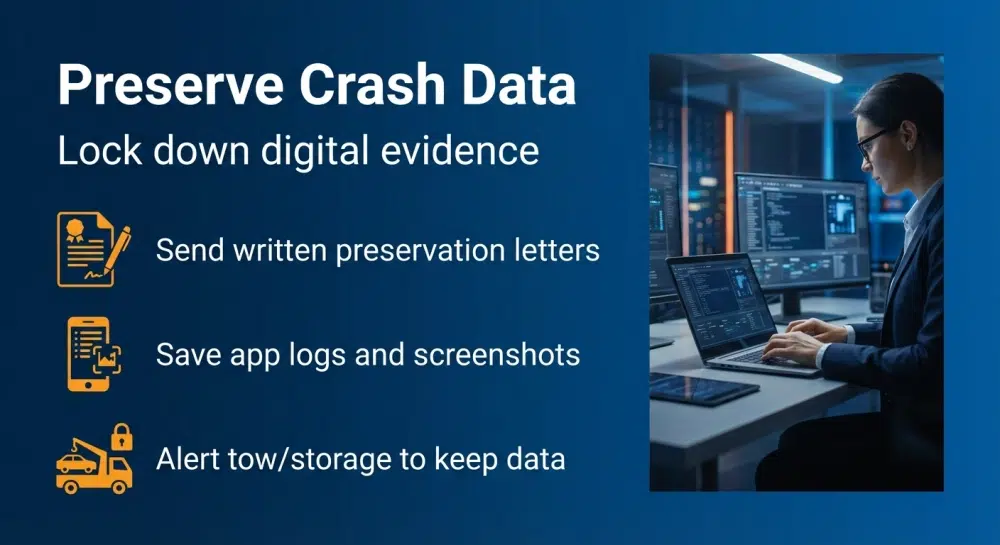
Modern vehicles, including autonomous vehicles and rideshare fleets, may store valuable electronic data. Sources include event data recorders, telematics, vehicular cameras, smartphones, and company back end trip logs. Prompt preservation is critical. Send a written data preservation request to the responsible parties and their insurers, asking that they preserve all collision related data and hardware. Note the date and time of the crash, vehicle identification number if available, precise location, and the types of data you expect exist, such as lidar logs, radar data, disengagement records, and app based GPS traces. Courts can allow juries to consider whether a party willfully suppressed evidence, so timely notices can help support later motions if data goes missing [7].
For rideshare incidents, capture screenshots of your app ride history, driver name and photo, time stamps, route maps, and any communications with the driver. For AV incidents, save any receipts or notifications from the service that confirm ride start and end times and vehicle identification numbers. If law enforcement tows a vehicle, contact the storage facility promptly to identify the custodian of the vehicle and to request that no data be altered or erased.
Should you talk to insurers or sign releases soon after the crash?
Insurers may contact you quickly after a crash seeking recorded statements or medical authorizations. You can provide basic facts such as identity, contact information, and the location and date of the incident. Avoid providing recorded statements until you understand the scope of the request and how your words could be used. Do not sign broad medical releases early in the process. It is common for adjusters to ask for access to complete medical histories, which may not be necessary to evaluate the claim at the initial stage.
Rideshare and AV company insurers may ask for app screenshots or trip receipts to confirm coverage. Provide accurate materials but keep copies. If you are uncertain about a document or release, ask questions and verify the purpose. California’s financial responsibility and reporting rules exist to help align claims with insurance coverage, but they do not require claimants to waive important privacy protections to start the process [1].
How do you get medical care and track damages for a civil claim?
Get evaluated as soon as possible, even if you feel fine at the scene. Some injuries appear days later. Early documentation connects symptoms to the crash and helps you follow a consistent treatment plan. Keep every medical bill, prescription receipt, and therapy invoice. Maintain a symptom and activity journal that notes pain levels, missed work, and daily limitations. For property damage, keep repair estimates, rental car receipts, and any out of pocket costs for towing or storage. This record becomes the foundation of your damages proof in a civil claim.
California’s comparative fault system means accurate documentation helps both in proving the other side’s negligence and in defending against claims that you contributed to your harm [7]. Communicate with your healthcare providers about billing options, including using health insurance, medical payments coverage, or letters of protection where appropriate. Each option has pros and cons, and some involve reimbursement rights for insurers. Tracking these moving parts early can reduce disputes later.
What mistakes should you avoid after an Irvine rideshare or AV crash?
Common errors can reduce the value of your claim or complicate fault findings. Consider avoiding the following:
- Leaving without exchanging information. California law requires sharing identity, vehicle registration, and insurance information [3].
- Skipping the SR-1 filing. Even when police respond, the DMV still requires an SR-1 within 10 days when there is injury or sufficient property damage [1].
- Assuming coverage without verification. Rideshare coverage varies by period status and can be substantial during trips but more limited between rides [6].
- Not preserving electronic evidence. AV and rideshare data can be critical to proving the sequence of events [4].
- Delaying medical evaluation. Early care supports both health and documentation.
- Providing sweeping recorded statements. Premature statements can be used to dispute fault or causation later.
- Missing short government deadlines. Claims involving government entities may require action within six months [10].
How can legal representation help with an Irvine Waymo or rideshare crash claim?
Civil cases after rideshare and autonomous vehicle collisions can involve multiple insurance carriers, complex data sources, and questions about human and machine decision making. Attorneys can help identify proper defendants, preserve and analyze technical evidence, and present claims within California’s legal framework. A skilled legal team can also coordinate law enforcement records, DMV filings, and government claim procedures when public entities are involved [1] [2] [10].
If you are comparing options for guidance, many people seek out car accident lawyers who regularly handle collisions with commercial fleets and rideshare vehicles. This is especially helpful when navigating CPUC rules, Insurance Code requirements for TNCs, and discovery issues for AV telemetry and sensor data [5] [6]. In more complex situations where injuries are significant, Irvine car accident lawyers can coordinate crash reconstruction and work with experts in vehicle dynamics and human factors while remaining focused on the specific needs of the case.
Because California applies pure comparative fault, careful evidence gathering can change outcomes. Legal support can help you identify all sources of recovery, including rideshare commercial policies, applicable uninsured or underinsured motorist coverage, and any third party liability such as roadway maintenance or defective equipment where warranted [7] [8].

What step by step checklist should you follow right after the crash?
Use this practical checklist tailored to Irvine CA crashes involving rideshare or AVs:
- Check safety. Move to a safe location, check for injuries, and call 911 if anyone is hurt [2].
- Exchange information. Share and collect identities, registration, and insurance details as required by state law [3].
- Document thoroughly. Photograph damage, lanes, signals, and injuries. Save rideshare app screens and trip receipts.
- Identify the agency. Ask if Irvine PD or CHP is handling the report. Get the incident number for your records [11] [12].
- File the SR-1. Submit the DMV SR-1 within 10 days if there is injury, a fatality, or sufficient property damage [1].
- Notify insurers. Report the crash to your insurer promptly, especially if you might need uninsured or underinsured motorist benefits.
- Preserve data. Send preservation notices for AV telemetry and rideshare logs [4].
- Track care and costs. Keep medical records and expense logs from day one.
- Note deadlines. Calendar the two year personal injury and three year property damage deadlines, and any six month government claims deadlines where applicable [8] [9] [10].
How do California’s reporting rules apply if you were a passenger in a rideshare or AV?
If you were a passenger, you still may have information the DMV requires for an SR-1 filing if you are an owner or if the driver fails to submit the report. Passengers should gather the same evidence and retain trip records. Your civil claim can be against one or more responsible parties, including a rideshare driver, another motorist, an AV operator, or a party responsible for roadway conditions. Although passengers typically do not have reporting duties under Vehicle Code section 20008, cooperating with law enforcement at the scene can assist the investigation and later claims [2].
What if the other driver refuses to share insurance information or leaves the scene?
Record what you can, including the license plate and vehicle description. Call 911 and report the behavior. California law requires drivers to exchange information, and leaving an injury scene is a serious offense [3]. If the driver leaves before exchanging information, your uninsured motorist coverage may apply. Document the refusal or flight in your own notes and alert the responding officer to this fact. Provide any witness contact information to the officer.
How do Irvine collision reports help your civil case?
Police reports provide a narrative, diagram, and sometimes preliminary fault assessments. While not conclusive in civil court, they can guide insurers and help identify witnesses. The Irvine Police Department page provides direction to contact the records unit for report copies [11], and CHP outlines steps to obtain freeway or state route collision reports [12]. Request the report quickly and review it for accuracy. If there is an error, prepare a written clarification with supporting documents for your insurer or legal representative to consider in negotiations.
How do you handle an SR-1 if you are unsure about the property damage amount?
Many people are unsure at the scene whether property damage exceeds the statutory threshold. When in doubt, filing the SR-1 within 10 days is prudent if any injury occurred or if damage appears potentially significant. The DMV’s instructions emphasize that the SR-1 requirement is independent from a police report and applies even if the other driver was at fault [1]. Filing protects your driving privileges and provides the state with necessary information for its financial responsibility system.
How do rideshare coverage periods affect your claim value?
The app status at the time of the collision can change available coverage. During an active trip or after a ride is accepted, California law requires at least one million dollars in primary liability coverage. Between rides when the app is on, state law sets lower minimums of 50,000 and 100,000 for bodily injury and 30,000 for property damage per incident. These thresholds, codified in Insurance Code section 5433, form the baseline and some companies maintain higher limits by policy [6]. Ask the insurer to confirm the period classification and policy limits in writing.
What role do negligence definitions and jury instructions play in settlement?
Understanding how California defines negligence helps frame negotiations. Negligence refers to the failure to use reasonable care under the circumstances. The Wex legal dictionary and California’s civil jury instructions provide accessible overviews of negligence concepts that juries apply in reaching verdicts [13] [7]. Settlements often reflect what a jury might do with the evidence. When evidence clearly supports a violation of a traffic duty or a failure to act with reasonable care, negotiations tend to move faster and closer to the documented losses.
When should you consider consulting a lawyer for an Irvine rideshare or AV crash?
Consider reaching out for legal help early if you suffered injuries, if liability is disputed, if multiple insurers are involved, or if you suspect a government entity may be a responsible party. Early guidance can coordinate SR-1 filing, police report requests, preservation letters, and communications with rideshare or AV company insurers. Many people find it valuable to have a single point of contact handling the flow of documents and timelines so medical recovery remains the focus.
In collisions with substantial injuries or complex evidence issues, car accident lawyers can help shape the claim strategy, including whether to pursue mediation, file suit, or engage technical experts in crash reconstruction or human factors. Legal support can also assist with negotiation of medical liens and coordination of benefits where multiple payers are involved.
How do local Irvine considerations affect your claim?
Local conditions matter. Intersections with high traffic volume, construction zones, school areas, and freeway interchanges can influence visibility, sight lines, and collision dynamics. When a crash occurs near these areas, consider whether local traffic studies, signal timing records, or prior collision histories are available. While you focus on care and documentation, a legal team can request public records or consult traffic engineering resources to understand whether road design or temporary controls contributed to the incident.
What if you were partly at fault in an Irvine rideshare or AV crash?
Do not assume you have no claim. California’s pure comparative fault allows injured people to recover damages reduced by their own percentage of fault. Even if you made an error in judgment, document your injuries, costs, and the sequence of events. Provide your materials to the insurer or your legal representative, who can evaluate how comparative fault may apply under the state’s jury instructions [7].
Where do you get help for the administrative steps while you recover?
Administrative steps such as SR-1 filing, police report requests, and insurance notifications can feel overwhelming while you are healing. Friends and family can help gather documents. Some healthcare providers will supply narrative summaries and itemized bills if you ask. If you seek professional help, choose a team that explains each step, responds to questions, and provides regular updates while you focus on treatment and daily life.

Which professional keywords matter for searching help in Irvine?
People often search for terms like Irvine rideshare accident Waymo crash report California, Irvine Waymo accident, Waymo crash reporting California, rideshare accident steps, Irvine police report, California DMV SR-1, autonomous vehicle crash reporting, report a Waymo crash Irvine, Irvine rideshare accident lawyer, and Orange County crash report. If your situation involves a different vehicle type, you may also look for car accident legal help. When evaluating options, weigh experience with California reporting rules, rideshare insurance structures, and the technical aspects of AV data and safety programs.
If you want to compare support options across providers, some people look for car accident lawyers to help organize police reports, SR-1 filings, and claims handling. Keeping your evaluation focused on specific needs and responsiveness can make the process more manageable.
Why choose GoSuits for help after an Irvine rideshare or Waymo crash?
If your situation involves injuries from a rideshare or autonomous vehicle incident in Irvine CA, a free consultation with a personal injury attorney can help you understand the process, timelines, and how evidence will be developed for a civil claim. GoSuits handles personal injury matters throughout California and related civil litigation across the state. Learn more about about us, meet our attorneys, and review representative outcomes on our prior cases page.
- Technology driven approach. GoSuits uses exclusive proprietary software to streamline intakes, evidence tracking, and litigation milestones. This helps reduce delays while maintaining accuracy and accountability.
- Designated attorneys. Every client works directly with a dedicated attorney. We do not route cases through case managers, and clients have direct access to their lawyer for updates and strategy discussions.
- Leadership in innovation. Our platform integrates records requests, SR-1 reminders, police report tracking, and discovery workflows into a single dashboard, improving speed and consistency across case stages.
- Past results. Our team has achieved favorable resolutions for clients in complex vehicle collision claims, including cases involving commercial fleets and roadway condition disputes. Results vary with the facts of each case. See examples of outcomes at prior cases.
- Experience and trial readiness. With more than 30 years of combined experience, our trial attorneys prepare each case with courtroom presentation in mind, which can strengthen negotiation posture and help position your claim for a better result when settlement is appropriate.
- Practice areas. We handle personal injury, vehicle collision claims including rideshare and fleet cases, product liability, premises liability, and related civil matters. Explore our practice areas to see how we can help.
From the first call through resolution, we combine personalized attention with efficient legal technology so your case moves forward while you focus on recovery. If you have questions about SR-1 filings, Irvine PD or CHP reports, or how to preserve rideshare and AV data, reach out to discuss next steps with our team.
References and resources
- Report of Traffic Accident SR-1 and Accident Reporting Requirements – California DMV
- Vehicle Code section 20008 Reporting of Accidents – California Legislature
- Vehicle Code section 16025 Exchange of Information – California Legislature
- Autonomous Vehicle Collision Reports – California DMV
- Transportation Network Companies Requirements – California Public Utilities Commission
- Insurance Code section 5433 TNC Insurance Requirements – California Legislature
- California Civil Jury Instructions CACI, Negligence and Comparative Fault – Judicial Council of California
- Code of Civil Procedure section 335.1 Two-Year Personal Injury Limitations – California Legislature
- Code of Civil Procedure section 338 Three-Year Property Damage Limitations – California Legislature
- Government Code section 911.2 Government Claims Deadline – California Legislature
- Irvine Police Department Contact and Services – City of Irvine
- Traffic Collision Reports for Involved Parties – California Highway Patrol
- Negligence Overview – Cornell Law School Legal Information Institute