- What makes Los Angeles highways especially risky for large truck traffic?
- What are the most common truck crash causes on I 5, I 10, and I 405 in Los Angeles?
- How do investigators and lawyers prove fault in a Los Angeles semi truck crash?
- How do California and federal rules shape liability in commercial vehicle accidents?
- What should you do after a freeway truck collision in Los Angeles?
- How long do you have to file a claim in California?
- What damages can you seek and what defenses do trucking companies raise?
- Which Los Angeles corridors see heavy truck traffic and unique risks?
- How can GoSuits help after a truck crash in Los Angeles?
- Where can you find the sources cited in this guide?
What makes Los Angeles highways especially risky for large truck traffic?
Los Angeles sits at the center of one of the busiest freight hubs in the United States. The twin Ports of Los Angeles and Long Beach feed a steady flow of container trucks onto the region’s interstates and state routes, including I 5, I 10, I 405, US 101, SR 60, SR 91, and the I 710 corridor. Congested multilane freeways, frequent merges, short on ramps, and steep grades in surrounding passes combine with high volumes of commuters and tourists. Caltrans freight planning materials note the central role of these corridors for goods movement, highlighting high truck volumes and the need for safety-focused planning [5]. The California Highway Patrol’s Commercial Vehicle Section enforces safety standards and runs inspection programs to monitor vehicle condition and driver compliance [11].
Nationally, crashes involving large trucks remain a significant share of roadway fatalities. NHTSA’s Traffic Safety Facts reports a multiyear rise in fatalities involving large trucks, underscoring how size, weight, and stopping distances create outsized risks when errors occur [4]. In metro Los Angeles, the combination of high speeds, stop and go congestion, work zones, and complex interchanges can magnify those risks, particularly where lane changes and sudden slowdowns are common.
What are the most common truck crash causes on I 5, I 10, and I 405 in Los Angeles?
Every collision is unique, but patterns emerge when investigators study freeway truck crashes. Below are frequent causes discussed in federal and state guidance, paired with practical context for Los Angeles freeways.
Why does driver fatigue lead to truck crashes in Los Angeles, and what rules apply?
Fatigue degrades reaction time and decision making, especially in dense, fast moving traffic. Hours of Service rules limit driving time and require off duty rest to reduce fatigue risks [1]. Electronic logging devices record duty status data that can confirm compliance or reveal violations [15]. When fatigue collides with the frequent braking and lane changes on I 5, I 10, or I 405, even a brief lapse can result in a rear end or lane departure crash.
- Risk signal: Extended overnight runs into early morning commutes compress rest and heighten fatigue near downtown and port approaches [1].
- Evidence: Duty status logs, ELD records, dispatch schedules, fuel receipts, and toll data show whether a driver complied with Hours of Service [1][15].
How does distracted driving contribute to freeway truck collisions?
Distraction includes device use, in cab systems, or even paperwork. Heavy traffic and complex interchanges amplify the danger. National safety data show distraction remains a major crash factor across vehicle types, and for trucks the consequences are compounded by longer stopping distances and larger blind spots [4].
- Risk signal: Sudden braking chains on I 405 near interchanges, where a moment of inattention leads to underride or multi vehicle rear end impacts [4].
- Evidence: Phone records, telematics events, and cab camera video often clarify driver attention in the seconds before impact [4].

Where do speeding and inadequate following distance cause rear end collisions?
California law sets a lower maximum speed for certain trucks and vehicles towing trailers, commonly 55 miles per hour, which is intended to manage stopping distances and stability [6]. On downhill stretches and during light traffic overnight, trucks that exceed these limits or tailgate can overrun traffic that slows suddenly near bottlenecks.
- Risk signal: Evening and early morning runs on I 10 and SR 60 where posted speeds rise but congestion can appear suddenly ahead [6].
- Evidence: Event data recorder braking traces, dashcam footage, and witness accounts establish speed and headway before the collision.
How does impairment affect crash risk for commercial drivers?
Federal rules prohibit operating a commercial motor vehicle with alcohol or controlled substances in the body and require drug and alcohol testing programs for motor carriers and drivers [9]. Even lawful prescription or over the counter medications can affect alertness. In a corridor with dense merges and short on ramps, small impairments can have major effects.
- Risk signal: Late night port departures meeting early rush hour traffic on I 710 and I 405 increase exposure if impairment is present [9].
- Evidence: Post crash testing results, carrier testing policies, and driver qualification files help establish compliance and potential violations [9].
Can improper loading and unsecured cargo trigger jackknife and rollover accidents?
Yes. Cargo securement rules specify performance standards and methods for tie downs, blocking, and bracing to prevent shifting loads and spills [2]. Unbalanced or high center of gravity loads increase rollover risk during sudden evasive maneuvers on curved ramps and connectors. Palletized freight that is not locked out can surge forward in hard braking, contributing to jackknife events.
- Risk signal: Curved freeway connectors and short ramps near downtown interchanges elevate rollover risk when cargo is top heavy [2].
- Evidence: Bills of lading, weight tickets, load plans, photos of securement, and inspection reports document compliance with cargo rules [2].
How do brake problems and poor maintenance lead to loss of control?
Commercial vehicles must be systematically inspected, repaired, and maintained, and they must not be operated in a defective condition [3]. Brake imbalance, worn tires, lighting failures, and steering defects lengthen stopping distance and increase the chance of loss of control. In heavy Los Angeles traffic, a few extra feet can be decisive.
- Risk signal: Long downgrades and heat can degrade braking performance if maintenance or pre trip inspections are inadequate [3].
- Evidence: Maintenance logs, daily inspection reports, and post crash inspections show defect patterns or missed repairs [3].
Why are tire blowouts hazardous on crowded freeways?
Blowouts can send tire fragments into oncoming traffic and force abrupt steering corrections by the truck. Heat, underinflation, overloading, or tread separation increase blowout risk. Maintenance and pre trip inspections are critical to identifying wear and damage before a run [3].
- Risk signal: Summer heat on concrete segments of I 5 and I 405 combined with heavy loads increases stress on tires [3].
- Evidence: Tread depth records, inflation checks, and inspection notes can connect maintenance history to a blowout event [3].

How do blind spots and unsafe lane changes cause side swipe or underride crashes?
Large trucks have no zones that limit visibility on both sides and directly behind the trailer. In Los Angeles, frequent weaving and short on ramps mean drivers must monitor mirrors continuously. Failure to signal or check mirrors during a lane change can sweep a smaller vehicle into a barrier or under the trailer.
- Risk signal: Weaving near interchanges on I 405 and US 101 where lane drops and merges are frequent.
- Evidence: Cab camera angles, mirror positioning, and turn signal data help reconstruct a lane change sequence.
Do work zones and weather change the risk profile for truck crashes?
Yes. Work zones narrow lanes, add barriers, and alter traffic patterns. Caltrans emphasizes specific work zone safety practices because speed variation and unexpected lane shifts can surprise drivers unfamiliar with the area [12]. Light rain after dry spells can also reduce traction, and glare can hinder visibility at dawn and dusk.
- Risk signal: Night work on I 10 or SR 60 with lane closures and abrupt merges increases the chance of rear end or side swipe impacts [12].
- Evidence: Lane closure logs, construction traffic control plans, and CHP incident logs help frame conditions at the time of the crash [11].
How do investigators and lawyers prove fault in a Los Angeles semi truck crash?
Fault analysis depends on timely collection of evidence, careful reconstruction, and understanding of federal and California rules. Many crucial records are held by the motor carrier. Early preservation can be decisive.
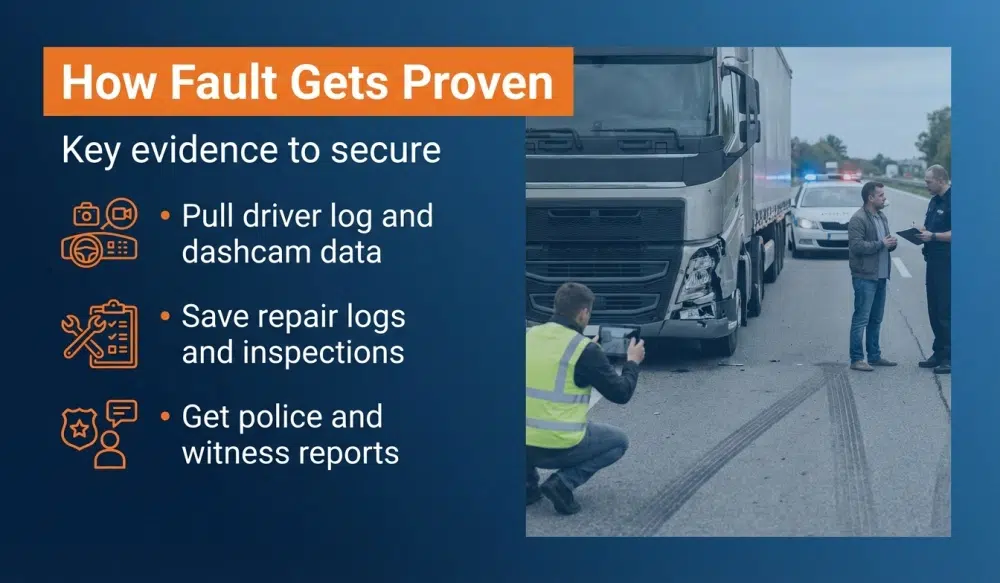
- Police and CHP reports: Initial scene documentation, diagrams, and witness statements create a foundational timeline [11].
- Electronic evidence: ELD duty status, engine control module data, speed and brake application traces, and dashcam video often resolve disputed seconds before impact [15].
- Driver records: Qualification file, prior violations, training records, and drug and alcohol testing records show whether the carrier vetted and monitored the driver as required [9].
- Vehicle and cargo documentation: Pre trip inspection reports, repair orders, load plans, weight tickets, and bills of lading establish maintenance and securement compliance [2][3].
- Work zone and roadway context: Caltrans lane closure schedules, traffic control plans, and maintenance of traffic details add context for speed and lane positioning [12].
- Public crash data: SWITRS and related tools provide historical patterns, which can be helpful for understanding collision types at particular interchanges or stretches of freeway [14].
Prompt preservation letters help prevent evidence loss. California law authorizes courts to impose sanctions for misuse of discovery, and juries may draw adverse inferences when evidence is willfully suppressed [13][8]. Documenting chain of custody and maintaining original media can avoid later disputes over authenticity.
How do California and federal rules shape liability in commercial vehicle accidents?
Liability in a civil truck crash case often turns on whether a party violated a safety duty and whether that violation caused harm. Federal rules set baselines for commercial motor vehicle operation in interstate commerce. California law supplies additional roadway rules and civil liability principles.
- Negligence per se: When a statute or regulation sets a safety standard and a violation causes the type of harm the rule was meant to prevent, a jury may treat the violation as evidence of negligence under the negligence per se doctrine [12]. Examples include Hours of Service violations, inadequate cargo securement, or operating with known brake defects [1][2][3].
- Comparative fault: California follows comparative fault principles, which allow a jury to assign percentages of responsibility among all parties and adjust damages accordingly [8]. A trucking company can argue that a plaintiff’s sudden lane change or unsafe following distance contributed to the crash, while a plaintiff can point to regulatory violations by the carrier.
- Speed and lane rules for trucks: California Vehicle Code provisions impose speed limits and lane restrictions on certain trucks, which can be relevant to fault allocations if violated [6].
- Federal preemption questions: Federal law can preempt state rules that directly conflict with federal motor carrier safety regulation, but many state tort claims proceed because they align with federal safety objectives rather than conflict with them [10].
What should you do after a freeway truck collision in Los Angeles?
After a crash, safety and medical care come first. Once immediate dangers are controlled, steps you take in the first days can help protect your rights and clarify the record.
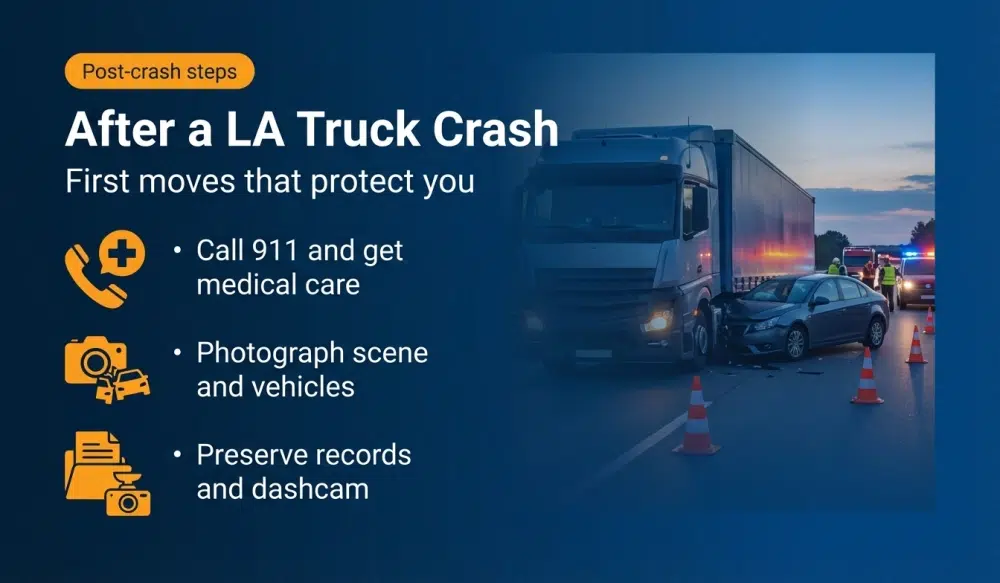
- Call 911 and cooperate with responders: Obtain medical evaluation even if injuries seem minor. Some injuries emerge over time.
- Document the scene: If safe, collect photos or video of vehicle positions, skid marks, debris, lane closures, and nearby cameras. Note responding agencies.
- Exchange information: Get the driver’s DOT number, carrier name, trailer number, and insurance details.
- Preserve your records: Keep medical records, repair estimates, and time off work documentation. Save dashcam footage and photos.
- Notify your insurer carefully: Provide facts without speculation. Do not sign releases or recorded statements without understanding the implications.
- Seek legal help promptly: Complex regulations, multiple defendants, and fast moving evidence timelines make early guidance important. Speaking with truck accident lawyers early can help you understand potential claims and defenses while key records are preserved.
The weeks after a collision can bring calls from multiple insurers and adjusters. You do not have to navigate that alone. If you prefer to keep communication organized and focused on recovery, you can ask a representative to handle those inquiries while you focus on medical care and family responsibilities. In many cases, truck accident lawyers in Los Angeles help coordinate evidence preservation, expert inspections, and medical documentation so nothing critical is overlooked.
How long do you have to file a claim in California?
For most personal injury claims arising from a motor vehicle collision in California, the statute of limitations is two years from the date of injury [7]. If a public entity is involved, a government claim often must be filed much sooner, generally within six months, before a lawsuit may proceed [16]. There are exceptions that can shorten or extend these timelines in specific circumstances. Because trucking collisions may involve out of state defendants and federal regulations, identifying all potential parties and claim requirements early is important.
What damages can you seek and what defenses do trucking companies raise?
Damages in civil truck crash cases are designed to compensate for losses caused by the collision. Available damages depend on the facts and applicable law.
- Medical costs: Emergency care, hospitalization, surgeries, rehabilitation, future treatment, and necessary medical equipment.
- Lost income and earning capacity: Time away from work and changes in future earning potential tied to lasting limitations.
- Property losses: Vehicle repair or total loss value and personal property damage.
- Non economic harms: Physical pain, limitations in daily activities, emotional distress, and loss of enjoyment of life as allowed by California law.
Defendants often raise defenses tailored to the freeway context:
- Comparative fault: Allegations that a plaintiff made unsafe maneuvers, followed too closely, or failed to use signals [8].
- Sudden emergency: Claims that a third party cut off the truck or a sudden obstruction left no time to react.
- Mechanical failure not reasonably preventable: Arguments that a hidden defect caused a part to fail despite reasonable maintenance. Maintenance records and inspection logs are key to evaluating this defense [3].
- Unavoidable work zone hazard: Contentions that traffic control complied with plans and the crash resulted from unpredictable driver behavior in the queue [12].
Which Los Angeles corridors see heavy truck traffic and unique risks?
While heavy commercial vehicle traffic is widespread in Los Angeles County, certain corridors are particularly freight intensive. Understanding their features can help identify risk factors and common crash patterns.
- I 710 and port connectors: Primary routes for containers moving between the Ports of Los Angeles and Long Beach and inland distribution hubs. High truck percentages and frequent lane changes near intermodal connections require heightened attention [5].
- I 5 and SR 60 east west freight flow: Long grades and sustained speeds increase stress on braking systems and tires, especially in heat. Congestion can appear suddenly near interchanges and work zones [3][12].
- I 405 and US 101 urban interchanges: Short merges, lane drops, and intense commuter volumes create frequent opportunities for side swipe and rear end collisions when visibility is limited by large truck blind spots.
Public mapping and data tools based on the California Statewide Integrated Traffic Records System allow users to explore collision patterns by corridor and collision type. While they do not decide fault in an individual case, they can illuminate where rear end, jackknife, and rollover events have concentrated over time [14].

How can GoSuits help after a truck crash in Los Angeles?
Truck crash cases involve multiple companies, layers of insurance, and time sensitive electronic data. A free consultation with a personal injury attorney can help you understand how the facts and rules in your situation fit together, what evidence should be preserved, and how timelines may apply in California. At GoSuits, we help people across California, including Los Angeles, navigate these steps with clarity and care.
- Technology driven advocacy: Our proprietary software streamlines evidence intake, tracks medical documentation, and accelerates case workflows so you get timely updates and faster decisions without sacrificing accuracy.
- Attorney access: Although we leverage technology to move cases forward, every client has a designated attorney and unfettered access to that attorney. We do not replace attorney communication with case managers.
- Trial ready approach: We prepare each case as if it could be tried, which can strengthen negotiation posture and keep your options open when accountability is contested.
- Proven outcomes: We are proud of the results we have achieved for clients over the years. You can see examples on our page for prior cases. Past results do not guarantee future outcomes because every case is different.
- Experienced team: With more than 30 years of combined experience, our attorneys handle complex injury matters that often arise from semi truck and commercial vehicle crashes, multi vehicle freeway collisions, and serious injury claims.
- Focused practice areas: We represent people in personal injury matters including commercial vehicle and trucking collisions, car and motorcycle crashes, premises injuries, product liability, catastrophic injuries, and wrongful death. Explore our practice areas.
- Leadership and transparency: Learn more about our team on our attorneys and firm background on about us.
If you want guidance on preserving ELD data, inspection records, and scene evidence, Los Angeles truck accident lawyers at our firm can coordinate rapid steps that fit your situation while you focus on recovery.
Where can you find the sources cited in this guide?
- Summary of Hours of Service Regulations – FMCSA
- Cargo Securement Rules – FMCSA
- Inspection, Repair, and Maintenance Requirements – FMCSA
- Traffic Safety Facts 2022 Data: Large Trucks – NHTSA
- California Freight Mobility Plan – Caltrans
- California Vehicle Code Section 22406 Truck Speed Limits – California Legislature
- Code of Civil Procedure Section 335.1 Statute of Limitations – California Legislature
- Civil Jury Instructions CACI Overview – Judicial Council of California
- Overview of Drug and Alcohol Testing – FMCSA
- 49 U.S.C. Section 31141 Preemption of State Laws – Cornell Law School LII
- Commercial Vehicle Section – California Highway Patrol
- Work Zone Safety Program – Caltrans
- Code of Civil Procedure Section 2023.010 Discovery Misuses – California Legislature
- Transportation Injury Mapping System SWITRS Tools – UC Berkeley SafeTREC
- Electronic Logging Devices ELDs – FMCSA
- Government Code Section 911.2 Claims Presentation – California Legislature