- What makes truck crashes at Ocean Blvd and Navy Way unique at the Port of Los Angeles?
- Who can be liable in a Port of Los Angeles truck accident near Ocean Blvd and Navy Way?
- What laws and regulations shape liability in California truck collisions?
- What evidence should you secure after a truck crash at the Port of LA?
- What immediate steps should you take after a truck accident at Ocean Blvd and Navy Way?
- How do insurers and defendants defend these claims and how can plaintiffs respond?
- How do damages work in California truck accident cases?
- How do wrongful death claims work after a fatal truck crash?
- How can a free consultation help you move forward?
- Why choose GoSuits for LA Port truck accidents?
- References and Resources
What makes truck crashes at Ocean Blvd and Navy Way unique at the Port of Los Angeles?
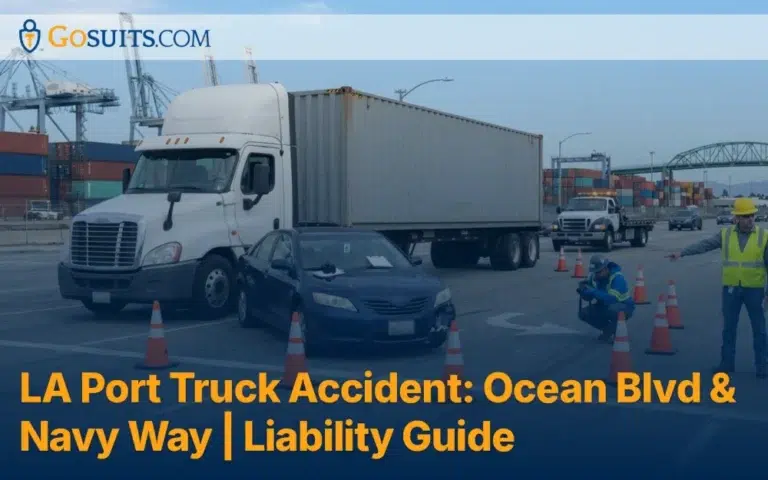
The intersection of Ocean Blvd and Navy Way sits at a gateway to marine terminals in San Pedro, where container trucks, port shuttles, and commuters converge on tight timelines. Traffic surges align with vessel arrivals and terminal gate hours, and multiple lanes funnel into ramps and flyovers that connect to the Vincent Thomas Bridge and the Alameda Corridor. These conditions can amplify risk factors that already exist in heavy vehicle operations, including wide turning paths, long stopping distances, blind spots, complex merges, and load securement issues. Add to this the presence of pedestrians, cyclists, and port workers, and a momentary mistake can have severe consequences.
Tractor trailers are governed by federal and state safety rules for driver hours, equipment, and cargo. A fully loaded combination vehicle on Interstate routes may weigh up to eighty thousand pounds under federal weight limits, which significantly increases stopping distance and crash energy compared with passenger vehicles [2]. At a complex port interchange like Ocean Blvd and Navy Way, any breach of safe speed, adequate following distance, or lane-change signaling can influence fault in a civil claim under California law [5] [6] [7].
National safety data shows that crashes involving large trucks cause thousands of fatalities across the country each year, reflecting the stakes when heavy vehicles interact with other road users [1]. While every collision is unique, investigations at this location often focus on a mix of federal motor carrier rules, California Vehicle Code compliance, roadway design, and on scene evidence such as skid marks, dashcam footage, and electronic logging data.
Who can be liable in a Port of Los Angeles truck accident near Ocean Blvd and Navy Way?
Liability at this intersection depends on a careful reconstruction of events, applicable regulations, and the conduct of each party. California applies pure comparative negligence, so each person or entity can bear a percentage of fault that matches their contribution to the crash [10].
Can the truck driver be held responsible?
Yes. A driver may be found negligent for unsafe speed, following too closely, failing to signal or yield during lane changes, or driving while fatigued or distracted. Violations of California’s basic speed law or following distance rule are powerful evidence of breach of duty in a civil case [5] [6]. If fatigue or hours of service violations are suspected, electronic logging device records and duty status logs are central to the investigation [3] [15].
Are motor carriers responsible for their drivers’ actions?
Often. A motor carrier can be liable under respondeat superior for the negligent acts of its employee drivers. Separate from vicarious liability, a carrier may face direct claims for negligent hiring, training, supervision, dispatch, or maintenance. Evidence of systemic hours of service violations, poor cargo securement practices, or noncompliance with drug and alcohol testing rules can support direct negligence theories [3] [4] [15].
Can shippers, loaders, or brokers be responsible?
Possibly. Cargo shippers and loaders may be liable if they improperly loaded or secured freight that shifted, spilled, or increased rollover risk, causing or contributing to the crash. Federal cargo securement regulations are a common benchmark in evaluating these claims [4]. Brokers can face claims in limited scenarios tied to negligent selection, depending on the facts and applicable case law.

Could a public entity be liable for dangerous road conditions?
In some cases. If a hazardous roadway design, missing or obscured signage, sight line obstruction, or inadequate signal timing created a substantial risk of injury and the government entity had notice and failed to correct it, a claim may be available under California’s Government Code for a dangerous condition of public property [13]. These claims involve strict notice deadlines, including a six month government claim requirement before filing suit [14].
How does comparative negligence apply at this intersection?
California’s pure comparative negligence system means a jury can allocate fault among multiple parties, including the plaintiff. For example, a juror could find a truck driver failed to maintain a safe following distance while a motorist made an unsafe lane change. Each party’s percentage of fault would reduce or increase their recovery or responsibility accordingly [10]. This framework encourages thorough evidence gathering to accurately assign responsibility.
What laws and regulations shape liability in California truck collisions?
What federal trucking rules matter most in these claims?
Key federal rules enforced by the Federal Motor Carrier Safety Administration often drive liability analysis:
- Hours of Service: Limits on driving and on duty time help prevent fatigue related crashes, with 11 hour driving and 14 hour duty limits, rest breaks, and weekly caps for most property carrying drivers [3].
- Electronic Logging Devices: ELDs automatically record driving time and support hours of service compliance. ELD and back up records can corroborate or refute fatigue allegations [15].
- Cargo Securement: Rules for tie downs, working load limits, and securement methods vary by commodity and are often central when loads shift, spill, or cause rollovers [4].
- Drug and Alcohol Testing: Pre employment, random, post crash, and reasonable suspicion testing requirements can be pivotal after serious collisions [4].
- Accident Recordkeeping: Carriers must maintain an accident register and related records, which can provide vital details for litigation [15].
- Vehicle Weight: Federal weight limits on Interstate highways cap typical combination vehicles at eighty thousand pounds gross weight, affecting stopping distances and crash severity [2].
Which California Vehicle Code rules most often influence fault?
California traffic laws frequently cited in civil cases include:
- Basic Speed Law: Drivers must never drive at a speed greater than is reasonable or prudent for conditions, even if not exceeding a posted limit [5].
- Following Distance: Drivers must not follow another vehicle more closely than is reasonable and prudent given speed, traffic, and roadway conditions [6].
- Turning and Lane Changes: No turn or lane movement may be made until it is safe to do so, and proper signaling is required [7].
Violating a safety statute can support negligence per se arguments when the statute is designed to protect against the type of harm experienced.
What filing deadlines and notice requirements apply in California?
- Injury and Wrongful Death: Most California personal injury claims must be filed within two years of the injury date [8].
- Public Entity Claims: If your claim targets a public entity for a dangerous condition or a public employee’s negligence, you generally must present a written claim to the entity within six months [14].
There are exceptions and tolling rules, but missing these deadlines can bar recovery.
What evidence should you secure after a truck crash at the Port of LA?
Winning or defending a claim at Ocean Blvd and Navy Way often depends on timely, thorough evidence preservation. Time sensitive data can be overwritten by routine operations, and surveillance footage can be erased quickly.
How do you obtain the CHP collision report for a Port area crash?
Serious collisions near the Port of Los Angeles are often handled by the California Highway Patrol or the Los Angeles Police Department. The CHP report typically contains crash diagrams, party statements, citations, and witness information. Requesting a copy involves submitting the appropriate form and fee, along with proof of involvement or interest, to the investigating office or CHP’s records unit [12]. If injuries or property damage meet statutory thresholds, you may also need to submit an SR 1 report to the California DMV within ten days, regardless of fault [11].
How can black box ELD or ECM data strengthen a truck accident claim?
Most modern heavy trucks store electronic control module information such as speed, brake application, throttle, diagnostics, and sometimes event data around a sudden deceleration. In addition, federal ELD rules require electronic logging of driving time. Together, these sources can address critical issues, including:
- Speed and Braking: Pre impact speed and braking can show whether the driver adjusted for traffic near Ocean Blvd ramps and merges.
- Hours of Service: Duty status records may corroborate fatigue allegations [3] [15].
- Maintenance Faults: Diagnostic codes may indicate brake, tire, or lighting issues predating the crash.
A preservation letter sent early to the motor carrier can help prevent overwriting of this data. Plaintiffs and defendants both benefit from a transparent approach to data, since it can confirm or refute contested accounts.
Why do witness statements, photos, and surveillance footage matter at this intersection?
At Ocean Blvd and Navy Way, rapid traffic flow, queueing trucks, and multiple conflict points create complex crash dynamics that are often best understood through visuals. Useful sources include:
- Scene Photos: Vehicle rest positions, skid or yaw marks, and debris fields help reconstruct paths and angles.
- Dashcam Footage: Many trucks and private vehicles now record continuously. Quick outreach can secure copies before data loops overwrite older segments.
- Terminal and Street Cameras: Nearby businesses, terminal gates, and public cameras sometimes capture crucial moments. Requests should be made immediately.
What medical treatment documentation should you keep to support your claim?
Medical records connect the crash to your injuries, document the treatment plan, and measure damages. You should preserve ambulance reports, emergency department records, diagnostic imaging, physician notes, prescriptions, therapy notes, and out of pocket expense receipts. Keep a symptom journal that tracks pain, limitations, and missed work. Thorough documentation supports settlement negotiations and, if needed, trial presentation.
What immediate steps should you take after a truck accident at Ocean Blvd and Navy Way?
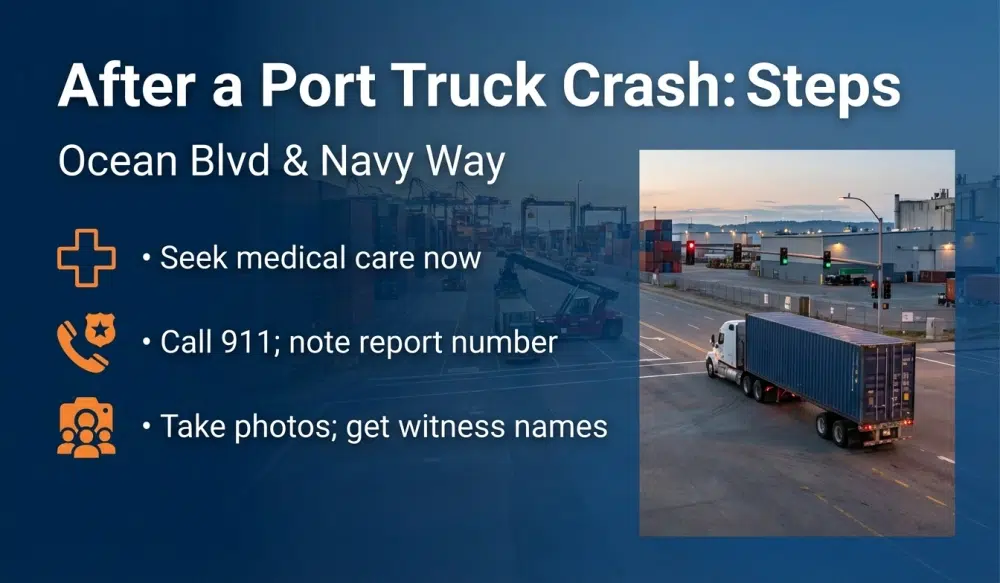
- Get medical care: Seek evaluation right away, even if pain seems minor. Some injuries surface gradually.
- Call 911 and cooperate: Provide factual statements to law enforcement and obtain the incident number for the CHP or LAPD report [12].
- Exchange information: Gather the truck’s DOT number, license plates, insurance details, and the motor carrier’s legal name and address.
- Document the scene: Take photos and video of vehicle damage, road markings, signals, signage, and any visible injuries.
- Identify witnesses: Request names and contact details; record short statements if they are willing.
- Preserve evidence: Save dashcam files and send written preservation requests to the carrier for ELD, ECM, and telematics data [15].
- Notify your insurer: Report the crash promptly while avoiding speculative statements about fault.
- Mind the deadlines: Calendar the two year California filing limit, and if a public entity may be involved, the six month government claim deadline [8] [14].
- Seek qualified legal help: Complex trucking cases at the Port benefit from counsel that understands federal rules, local traffic patterns, and high stakes negotiations.
If you are evaluating representation options, remember that truck accident lawyers can coordinate early investigation, expert analysis, and insurance communications so you can focus on treatment and recovery.
How do insurers and defendants defend these claims and how can plaintiffs respond?
Insurance carriers and defense counsel often pursue strategic defenses to minimize or apportion liability. Understanding these tactics helps you gather counter evidence early.
- Blame shifting through comparative fault: Defendants may argue you made an unsafe lane change, were speeding, or failed to keep a proper lookout, seeking a fault split under California’s pure comparative negligence standard [10]. Response strategy includes securing independent witness statements, objective scene measurements, and video evidence.
- Disputes about injury causation: Carriers may claim injuries are preexisting or unrelated. Response strategy includes prompt, consistent medical documentation and treating provider opinions linking the crash to your condition.
- Questioning regulatory violations: Defendants may assert full compliance with hours of service, cargo securement, and maintenance rules. Response strategy includes targeted discovery of ELD files, dispatch records, training materials, load sheets, and maintenance logs [3] [4] [15].
- Challenging roadway condition claims: Public entities may contest notice, causation, or design immunity for alleged dangerous conditions. Response strategy includes engineering analysis, collision history, and compliance with Government Claims Act procedures [13] [14].
- Low early settlement offers: Adjusters sometimes anchor negotiations with modest opening numbers. Response strategy includes comprehensive damages documentation, clear liability narratives, and readiness to mediate or try the case if needed.
Many injured people choose contingency fee arrangements so they do not pay fees upfront. A contingency fee lawyer advances case costs and receives a percentage only if there is a recovery. Fee agreements should be in writing and fully explained.
For orientation while you consider your options, truck accident lawyers can walk you through insurance communications, the CHP report process, and preservation of ELD and ECM evidence.
This page focuses on civil claims at and around the Port of Los Angeles. Within that context, truck accident lawyers can help align federal motor carrier rules with California traffic and evidence law to pursue fair outcomes at Ocean Blvd and Navy Way.
In high traffic areas like this, truck accident lawyers in Los Angeles are often called upon to coordinate rapid evidence preservation that includes requests to terminal operators and local businesses to retain video before it is overwritten.
How do damages work in California truck accident cases?
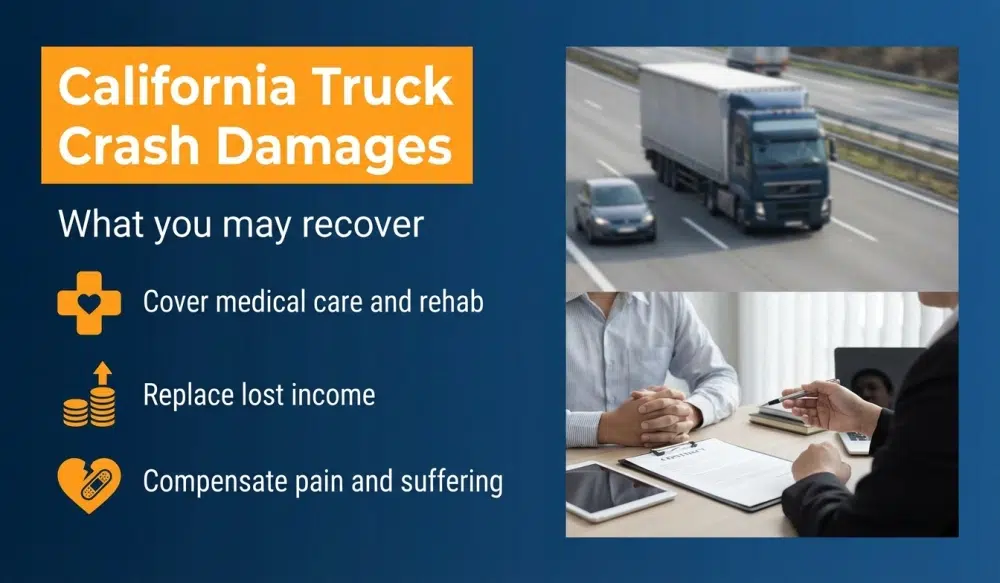
California law permits recovery of economic and non economic damages caused by another’s negligence, subject to comparative fault reductions. Typical categories include:
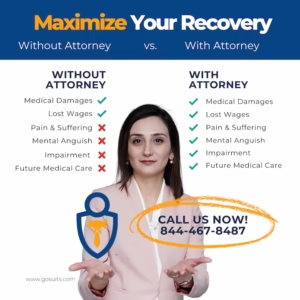
- Medical costs: Emergency care, hospitalization, surgeries, follow up visits, physical therapy, prescriptions, medical devices, and projected future care.
- Lost income: Past wages, future earning capacity, and employment benefits affected by injury limitations.
- Property losses: Vehicle repair or replacement and personal property damage.
- Pain and suffering: Physical pain, emotional distress, loss of enjoyment, and inconvenience.
- Household and transportation services: Out of pocket help for tasks you cannot perform during recovery.
In egregious cases involving despicable conduct with malice or conscious disregard, punitive damages may be considered under California standards, though these are not available in ordinary negligence cases. Evidence such as chronic hours of service violations, falsified logs, or intoxication can influence a jury’s view, but every claim is fact specific and governed by applicable law [3] [4].
How do wrongful death claims work after a fatal truck crash?
When a Port of Los Angeles collision at Ocean Blvd and Navy Way results in tragedy, qualifying family members may bring wrongful death and survival claims. Wrongful death seeks losses to the family such as financial support, companionship, and funeral expenses, while a survival action can recover claims the decedent could have brought if they had lived. The general filing limit is two years from the date of death, with a six month government claim requirement if a public entity is involved [8] [14]. Catastrophic crashes can also draw interest from the National Transportation Safety Board, which conducts independent safety investigations that may yield useful factual findings [9].
Families often benefit from early legal guidance to coordinate probate issues, preserve evidence, and navigate overlapping investigations by law enforcement, insurers, and possibly federal agencies.
How can a free consultation help you move forward?
A no cost consultation can help you make informed decisions after a collision at Ocean Blvd and Navy Way. You can discuss how California’s comparative negligence rule applies to your scenario, what evidence to preserve in the first thirty to sixty days, and how to approach recorded statements and medical billing. You can also review whether public entity notice rules could apply if a road defect or traffic control issue played a role.
During an initial meeting, you can expect a practical roadmap for:
- Evidence preservation: Letters to secure ELD and ECM data, CHP and DMV submissions, and outreach to potential video sources [11] [12] [15].
- Medical coordination: Strategies for documenting care and handling liens so treatment is integrated into the case valuation.
- Insurance communication: A plan for protecting your statements, coverage claims, and negotiation posture.
- Timeline and deadlines: A schedule keyed to California’s two year limit and any government claim milestones [8] [14].
If you choose to retain counsel, you will typically sign a contingency fee agreement that explains the fee percentage and how case costs are handled. The goal is to reduce your burden while building a strong liability and damages presentation.
When you are ready to speak with someone who handles serious crashes, truck accident lawyers can offer a grounded view of both strengths and challenges in your claim.
In this context, many injured people look for truck accident lawyers who combine federal motor carrier rule knowledge with local familiarity with the Port of Los Angeles road network.
Why choose GoSuits for LA Port truck accidents?
Truck and commercial vehicle collisions near Ocean Blvd and Navy Way fall squarely within personal injury work. A free consultation with a personal injury attorney can help you understand your rights, assess the likely sources of insurance coverage, and prioritize the evidence that matters most in a Port of Los Angeles case. At GoSuits, we represent clients across California and Illinois, and we regularly handle cases involving heavy vehicles, complex evidence, and serious injuries.
- Technology driven approach: We use exclusive proprietary software to ingest, organize, and analyze high volume evidence sets such as ELD logs, ECM downloads, telematics feeds, and surveillance video. This reduces delay and helps surface key liability and damages insights earlier.
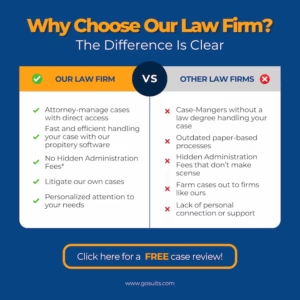
- Designated attorney model: Although we leverage technology to accelerate the path from intake to resolution, every client works directly with a designated attorney. We do not assign case managers in place of lawyers. You have unfettered access to your attorney for strategy, updates, and questions.
- Proven results: Our team has secured significant recoveries for clients injured in serious crashes and other negligence cases. You can review a sample of outcomes on our page for prior cases.
- Leadership in innovation: We actively refine litigation workflows that integrate data analysis with narrative case building. This commitment supports faster, better informed negotiation and trial preparation.
- Experience and trial readiness: With 30 years of combined experience, our attorneys prepare every case as if it will be tried. A trial ready file improves leverage in settlement discussions and positions your case for the courtroom when needed.
- Full service personal injury practice: We handle truck and commercial vehicle crashes, car and motorcycle collisions, premises liability, product liability, construction injuries, and wrongful death. Explore our practice areas, meet our attorneys, and learn more about us.
If you were hurt in a Port of Los Angeles truck crash at or near Ocean Blvd and Navy Way, we are ready to listen and help you plan next steps. Speaking with truck accident lawyers who understand both federal motor carrier rules and California civil procedure can make a meaningful difference in how your claim is presented.
For those comparing representation, Los Angeles truck accident lawyers can help align the local facts at this intersection with the broader standards that govern commercial trucking, and can move quickly to secure evidence from carriers and public agencies.
References and Resources
- Large Truck and Bus Crash Facts 2021 – FMCSA
- 23 U.S.C. 127 Vehicle weight limitations Interstate System – LII Cornell Law School
- Summary of Hours of Service Regulations – FMCSA
- Cargo Securement Rules – FMCSA
- California Vehicle Code section 22350 Basic Speed Law – California Legislature
- California Vehicle Code section 21703 Following Too Closely – California Legislature
- California Vehicle Code section 22107 Turning and Lane Changes – California Legislature
- California Code of Civil Procedure section 335.1 Two Year Limit – California Legislature
- Highway Investigations – National Transportation Safety Board
- Li v. Yellow Cab Co. of California, 13 Cal.3d 804 – CourtListener
- Accident Reporting Requirements SR 1 – California DMV
- Request for Collision Report FAQ – California Highway Patrol
- California Government Code section 835 Dangerous Condition – California Legislature
- California Government Code section 911.2 Government Claims Act Deadline – California Legislature
- 49 C.F.R. section 390.15 Assistance in Investigations and Accident Records – eCFR