- What does traffic camera footage retention look like in California?
- What types of traffic cameras exist in California and do they record video?
- How long do Caltrans freeway and city traffic management cameras keep video?
- How long is red light camera footage kept in California, and who controls it?
- How long do police dash cam and body cam recordings last in California car accident cases?
- Does the California Public Records Act let you get traffic camera footage after a crash?
- How fast must you act, and what is the statute of limitations for a California car accident claim?
- How do you preserve video evidence and avoid spoliation issues in California civil cases?
- How do you subpoena traffic camera footage in a California car accident lawsuit?
- How can plaintiffs and defendants use traffic video in settlement or at trial?
- What if the traffic camera footage is gone, and what alternatives can you use?
- How do local policies differ in Los Angeles, San Diego, San Jose, San Francisco, Sacramento, and Orange County?
- FAQs at a glance
- How GoSuits supports injured Californians with technology and trial readiness
- References and Resources
What does traffic camera footage retention look like in California?
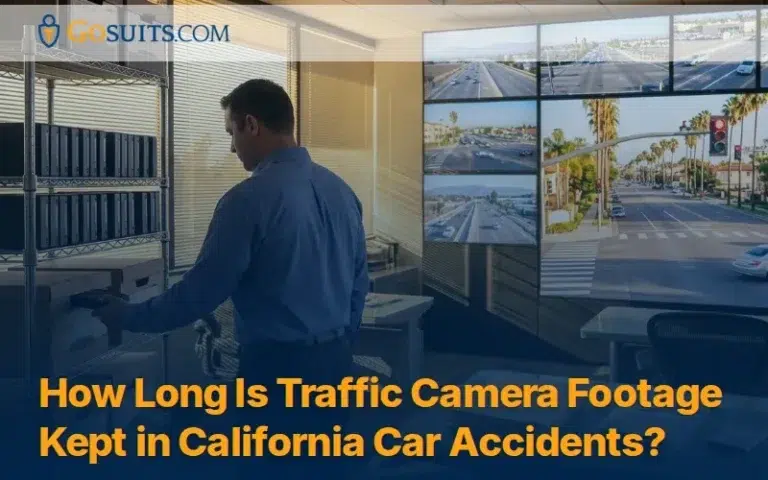
You are not alone if you are asking how long traffic camera footage is kept in California after a car accident. Many people find out too late that traffic video can be overwritten quickly or may not be recorded at all. California does not have one universal retention period for all cameras. Instead, the answer depends on the type of system and who operates it. For example, freeway traffic management cameras maintained by transportation agencies are often designed for live monitoring and may not be archived. Red light enforcement systems capture still images and short video clips for violations, and those records are kept long enough to process citations under the California Vehicle Code. Police body camera and dash cam recordings follow separate rules that require agencies to have written policies, including retention schedules. Public record access is governed by the California Public Records Act, which was reorganized into Government Code sections 7920.000 and following in 2023, without substantive change [1].
Because crashes can be serious and life-changing, acting quickly matters. National data shows the scale of the problem. The National Highway Traffic Safety Administration reported 42,514 traffic fatalities in 2022 across the United States [15]. Video evidence can help clarify fault in a car accident, a motorcycle accident, a collision involving a semi or 18-wheeler, or a wrongful death case. Below, we explain the practical retention realities, how to request and preserve footage, and what to do if it is not available.
What types of traffic cameras exist in California and do they record video?
Video systems around California roadways fall into several categories. Understanding the category is the key to predicting retention.
- Freeway and arterial traffic management cameras. Operated by Caltrans and city or county transportation departments. These are usually part of an Intelligent Transportation System that lets operators watch traffic flow, incidents, and signal operation. Many agencies state these are live feeds and not recorded, or are recorded only briefly for incident review [13].
- Red light automated enforcement cameras. Authorized by California Vehicle Code section 21455.5, these systems record still images and short videos to document alleged violations at intersections with photographic enforcement. The images are evidence for citations and are used only for that purpose [4].
- Police dash cams and body-worn cameras. Governed by Penal Code section 832.18, agencies that choose to use body cameras must adopt policies on activation, storage, and retention, with minimum retention expectations and longer retention for critical events and complaints [5]. Separate public disclosure timelines apply to certain recordings of critical incidents [6].
- Automated license plate readers. Not traffic cameras in the traditional sense, but they collect plate scans near roads. California law requires an ALPR usage and privacy policy, including retention terms, and sets security and access rules [7].
- Private CCTV near the roadway. Stores, homes, parking structures, transit hubs, and commercial buildings often have cameras aimed at curbs, driveways, and intersections. Retention varies by owner and system capacity. Many systems overwrite on a short loop. You generally need owner cooperation, a subpoena, or both.
Each category has a different retention logic and a different access path. That is why a precise strategy is critical when you try to obtain traffic camera video after an accident in Los Angeles, San Diego, San Jose, San Francisco, Sacramento, or Orange County.
How long do Caltrans freeway and city traffic management cameras keep video?
There is no single statewide rule that sets a time limit for the retention of freeway or city traffic management camera video. In practice, two realities control.
- Many traffic management cameras are not recorded. Several California cities explain on their public websites that operational traffic camera feeds are used for real-time traffic management, not for recording or public archiving. For example, the City of San Jose states that its traffic cameras are not recorded and are for traffic operations only [13].
- Routine monitoring video may be destroyed after one year under state law. California Government Code section 34090.6 authorizes cities, counties, and certain districts to destroy recordings of routine video monitoring within one year, provided they are not required for pending litigation or claims and certain procedural steps are followed [3]. This is a maximum allowance and does not require retention for a full year. Agencies can overwrite much sooner.
Caltrans freeway cameras serve operational purposes similar to city traffic cameras. While individual Caltrans districts may publish camera FAQs, the common theme is operational use for live monitoring. Many feeds are public in real time, but they are not archived for later retrieval.
What this means for you. If your crash was on a freeway or a major arterial, you should assume that footage either does not exist or will be overwritten quickly. Rapid outreach to the agency and a written preservation letter may help if an incident review recording exists, but you should be prepared to pursue other sources as well.

How long is red light camera footage kept in California, and who controls it?
Red light camera systems operate under California Vehicle Code section 21455.5, which allows automated enforcement at signalized intersections and limits the use of images to enforcement purposes. The statute does not set a fixed number of days for retention. Instead, it confines use to violation enforcement and allows destruction when the images are no longer needed for that purpose [4].
Key points for red light footage.
- Custodian of records. The city running the program is the custodian of records. Vendors that operate the equipment act for the city, so responsive records in the control of the vendor are generally still public records when sought through the city under the California Public Records Act [1].
- Retention tied to enforcement. Images that document a potential violation are normally kept while the citation is processed, contested, or on appeal. Non violation sequences are typically not retained because the law restricts their use and agencies do not keep irrelevant images indefinitely [4].
- Access path. If a citation was issued, the person cited can often view images or video through the agency’s online portal. For a civil car accident dispute with no citation, access is through a California Public Records Act request to the city, or through a subpoena if a lawsuit is filed.
Practical tip. If your California car accident occurred at a red light camera intersection, move quickly. Ask the city program for clarification on whether any incident clip or stills exist. If there is an open citation or investigation, the records may be temporarily exempt from disclosure under the investigative or adjudicative records provisions of the CPRA, but they can still be sought by subpoena in civil discovery.
How long do police dash cam and body cam recordings last in California car accident cases?
Police video is governed by a different framework than traffic management video. Penal Code section 832.18 requires agencies that use body-worn cameras to adopt written policies that address the duration of storage and methods for handling complaints and public access. The statute sets minimum standards for retention and mandates longer retention when a recording documents a use of force, a critical incident, or a complaint [5]. Separate Government Code provisions govern public release timelines for certain categories of officer involved critical incidents and deadly force [6].
Practical takeaways for car accident cases.
- Dash cam and body cam are often retained long enough to be requested. While local policy controls the exact period, it is common for agencies to keep traffic stop and collision response recordings for a period that allows a CPRA request or a discovery subpoena in a civil case.
- Act before overwriting. If your crash involved a police response, request the incident report number immediately. Submit a CPRA request for related video and dispatch audio, and if litigation is anticipated, send a preservation letter to the agency. If a civil lawsuit is filed, use a subpoena or party discovery as appropriate.
Does the California Public Records Act let you get traffic camera footage after a crash?
Yes, in many situations, but with important limits. California’s Public Records Act, reorganized at Government Code section 7920.000 and following, gives you the right to inspect or get copies of public records from state and local agencies, subject to exemptions [1]. Agencies must make a determination within 10 days of receiving your request and may extend by 14 days in unusual circumstances [2].

Key CPRA points for traffic video.
- Make your request precise and time-bound. Identify the intersection, direction of travel, date, and time window. Ask for any archived segment, incident review clip, or snapshot if the full video is not archived.
- Expect exemptions for security or investigations. Records that reveal security systems and their operation can be exempt, and active law enforcement investigations often have exemptions as well. Automated enforcement images are restricted to enforcement use. Even if exempt from public disclosure, some records are discoverable through civil subpoenas.
- Watch for third-party custody. If a vendor stores records for a city program, those records can still be public records if the city has constructive possession or the right to access them [1].
- Fees and formats. Agencies can charge for duplication costs. For electronic records, costs are typically limited to the direct cost of duplication unless special programming is required.
How fast must you act, and what is the statute of limitations for a California car accident claim?
Two clocks matter. The first is how long traffic camera footage is kept. As explained above, many systems either do not record or overwrite quickly. The second is the legal deadline to file a claim or lawsuit.
- General personal injury deadline. Most California car accident claims for bodily injury must be filed within two years under Code of Civil Procedure section 335.1 [8].
- Property damage deadline. Certain property damage claims may have different deadlines. If you are proceeding against a public entity, the Government Claims Act applies.
- Claims against public entities. If a California public entity might be at fault, you generally must present a written government claim within six months for death, personal injury, or damage to personal property, under Government Code section 911.2 [9]. Missing this administrative claim can bar your lawsuit. This step is separate from a CPRA request for video.
Even when you still have time to sue, camera footage may disappear long before your filing deadline. Send requests and preservation letters immediately after the crash.

How do you preserve video evidence and avoid spoliation issues in California civil cases?
California does not recognize a separate tort claim for spoliation of evidence. The California Supreme Court explained in Cedars Sinai Medical Center v. Superior Court that discovery sanctions and trial remedies are the proper way to address lost or destroyed evidence [12]. Juries can receive an instruction that allows them to infer that missing evidence would have been unfavorable to the party who willfully suppressed it, under CACI No. 204 [11].
Practical steps to preserve video evidence.
- Send a preservation letter quickly. Write to the agency or business that controls the camera. Identify the location, camera, date, and time. Ask them to preserve any recordings, incident clips, or still images. For public entities, reference that a claim is reasonably anticipated. For private businesses, follow up with a subpoena if a lawsuit is filed.
- Document your efforts. Keep copies of emails, portal submissions, and certified mail receipts. If you later seek an evidentiary inference or sanctions, the paper trail helps show diligence.
- Use discovery tools. Once litigation begins, propound requests for production and serve nonparty subpoenas. Courts can impose discovery sanctions for misuse of the discovery process, including destruction of evidence, under the Code of Civil Procedure.
- Be even handed. Plaintiffs and defendants should both act to preserve video. A defendant trucking company in a big rig collision should preserve dash cam, telematics, and any yard surveillance. A plaintiff in a pedestrian accident should send preservation requests to nearby storefronts and apartment complexes.
How do you subpoena traffic camera footage in a California car accident lawsuit?
When a video is not publicly released or when you need authenticated copies for court, use a subpoena.
- Choose the correct subpoena. In California civil cases, a nonparty deposition subpoena for production of business records is used to compel records from a nonparty under Code of Civil Procedure section 2020.410 and related provisions [10].
- Serve the custodian of records. Identify the correct agency or vendor and its custodian of records. For a city program, serve the city clerk or designated recipient and any vendor identified in the city’s public contract.
- Describe with particularity. Specify the intersection, camera identifier if known, date, time window, and format requested. Ask for any logs, still images, and incident clips if full motion video is unavailable.
- Handle objections and privacy. Be prepared to address claims of privilege, investigative exemptions, or security sensitivities. Courts can fashion protective orders that allow limited disclosure when appropriate.
- Authenticate for trial. Request a custodian declaration that satisfies the business records exception to hearsay, or be ready to call a witness. For public agencies, Evidence Code procedures for certified records and custodian declarations streamline admission.
How can plaintiffs and defendants use traffic video in a settlement or at trial?
Video can benefit either side, depending on what it shows.
- For plaintiffs. A clear lane encroachment, a red light violation, or a speeding pattern can make liability straightforward in a California car accident case. In a motorcycle accident or a pedestrian accident, video often clarifies visibility, timing, and yielding. In severe crashes with brain injury allegations, synchronized video and event data recorder downloads can help explain the mechanism of injury.
- For defendants. Video can refute exaggerated claims, show evasive action, or reveal comparative fault. A trucking company facing a claim from a collision with a tractor-trailer can use dash cam telematics and driver facing footage to show compliance with posted speeds and attentive driving. A commercial property owner involved because of a private lot impact may use CCTV video to show a safe condition on the premises.
- For insurers and mediators. Early exchange of clips can narrow disputes and drive resolution. If the footage is conclusive, it often saves the cost of accident reconstruction.
What if the traffic camera footage is gone, and what alternatives can you use?
When traffic camera footage is unavailable, other evidence steps in.

- Private CCTV. Walk the block and canvass nearby businesses, garages, and residences. Many storefronts keep at least a few days of footage. Act quickly and ask politely. If litigation has started, issue a subpoena.
- Transit and school buses. Buses often carry cameras that capture surrounding traffic during stops. Submit a CPRA request to the transit agency for the bus number, route, date, and time window.
- Police records. Collision reports, supplemental reports, dispatch audio, and photos help fill gaps. Body cam snippets may show the scene layout moments after impact.
- Event data recorders and telematics. Passenger cars and commercial trucks often store speed and braking data. In a truck accident with a big rig or 18-wheeler, preserving ECM data is vital.
- Witnesses and scene forensics. Independent witnesses, skid marks, debris fields, and photogrammetry from smartphone photos can support speed and angle calculations.
- ALPR hits. Automated license plate reader scans sometimes place a vehicle near the scene around the time of a crash. ALPR access and use are regulated and require legal process and appropriate purpose [7].
How do local policies differ in Los Angeles, San Diego, San Jose, San Francisco, Sacramento, and Orange County?
Local agencies control their own traffic management systems and may publish retention practices on their websites. A sampling illustrates the variety.
- San Jose. The City of San Jose explains that traffic camera feeds are for operations and are not recorded for public release [13].
- San Diego. The City of San Diego describes its traffic management center cameras as operational and not a public recording program. Practical experience shows clips may exist temporarily for incident review, but overwriting is routine. Always request promptly [14].
- Los Angeles, San Francisco, Sacramento, Orange County. Large agencies operate extensive signal and freeway networks. Many publish traveler information pages that show live images but do not archive video. Because policies change, check the current city or county transportation department website and submit a targeted CPRA request.
Across California, a common denominator applies. Operational traffic cameras are not a reliable long term recording source. Courts and claimants therefore rely heavily on red light enforcement records, police video, private CCTV, and reconstruction evidence to resolve liability in a California car accident or a truck accident.

How GoSuits supports injured Californians with technology and trial readiness
If you were injured in a California car accident, a traffic video can be decisive. GoSuits is a California personal injury firm that integrates litigation craftsmanship with technology from day one. We serve communities throughout California, including Los Angeles, San Diego, San Jose, San Francisco, Sacramento, and Orange County. Our team uses exclusive proprietary software to identify likely camera sources, automate timely California Public Records Act requests, and track subpoena compliance so critical footage is not lost. Even though we move fast with technology, every client has a designated attorney and unfettered access to that attorney. We do not use case managers to shield you from counsel.
We bring over 30 years of combined experience and a record of significant results for clients in cases ranging from a car accident to a truck accident involving a semi or 18-wheeler, to a motorcycle accident, to wrongful death. When needed, we prepare for trial, which helps position cases for full value negotiation. You can review our outcomes and philosophy here.
- See past results. Visit prior cases.
- Meet the team. Read about our attorneys and about us.
- Explore what we handle. Review our practice areas, including California car accident and related injury litigation.
Whether your case involves a pedestrian accident in downtown Los Angeles, a multi-vehicle collision on I-5 near San Diego, or a serious crash with a big rig on Highway 99 near Sacramento, early action on video can shape the outcome. A focused, tech-forward approach paired with hands-on lawyering helps protect your rights while you recover.
References and Resources
- California Public Records Act, Government Code 7920.000 et seq. – California Legislative Information
- Government Code 7922.535 CPRA response timelines – California Legislative Information
- Government Code 34090.6 routine video monitoring retention authorization – California Legislative Information
- Vehicle Code 21455.5 automated traffic enforcement systems – California Legislative Information
- Penal Code 832.18 body-worn camera policies and retention – California Legislative Information
- Government Code 7923.625 disclosure of recordings of critical incidents – California Legislative Information
- Civil Code 1798.90.51 ALPR program requirements including retention policy – California Legislative Information
- Code of Civil Procedure 335.1 two year personal injury limitation – California Legislative Information
- Government Code 911.2 public entity claim presentation deadlines – California Legislative Information
- Code of Civil Procedure 2020.410 deposition subpoena for business records – California Legislative Information
- CACI No. 204 Willful Suppression of Evidence jury instruction – Judicial Council of California
- Cedars Sinai Medical Center v. Superior Court, 18 Cal.4th 1
- City of San Jose Traffic Cameras information page – City of San Jose
- City of San Diego Intelligent Transportation Systems overview – City of San Diego
- 2022 Traffic Crash Data Final Figures – National Highway Traffic Safety Administration