- What is a T-bone intersection crash and why are side-impact collisions so dangerous?
- How do investigators determine fault in a broadside collision at an intersection?
- What evidence helps prove a right-of-way or failure-to-yield crash?
- What are common injuries in side-impact collisions and how do they affect damages?
- Which traffic laws govern intersection right-of-way in California, Texas, and Illinois?
- How do comparative negligence and defenses work in intersection accident lawsuits?
- What insurance issues arise after a T-bone crash, including UM/UIM claims?
- How do statutes of limitations affect T-bone car accident lawsuits in CA, TX, and IL?
- What is the role of experts and accident reconstruction in litigation?
- How do you document medical bills and lost wages to support a claim?
- What happens in wrongful death cases after a fatal intersection crash?
- How do federal and state evidence rules impact your case strategy?
- How can a side-impact collision lawyer help and what does contingency fee mean?
- Why choose GoSuits for a T-bone intersection crash case?
- References and resources
What is a T-bone intersection crash and why are side-impact collisions so dangerous?
A T-bone crash, also called a broadside or side-impact collision, occurs when the front of one vehicle strikes the side of another, forming a T shape. These impacts frequently happen in intersections during left turns, red light violations, or failure-to-yield situations. Intersections are complex environments with multiple conflict points, signal phases, and competing right-of-way rules. According to national safety data, roughly one quarter of all traffic fatalities and about half of all traffic injuries occur at intersections [1]. Side impacts are especially hazardous because there is less structural distance between the occupant and the striking vehicle, leading to higher risks of head, chest, abdominal, and pelvic injuries. Recent fatality statistics show that side impacts account for a significant share of passenger vehicle occupant deaths in the United States [2].
Beyond the physics of lateral intrusion, intersection crashes often involve multi-vehicle dynamics, turning paths, obstructed sightlines, and timing issues with signals. Determining fault typically requires a careful analysis of traffic controls, vehicle movements, and video or data evidence. National transportation authorities track collision trends to inform vehicle design and roadway engineering. In 2021 and subsequent years, federal crash overviews highlighted the ongoing severity of urban and intersection-related fatalities, underscoring the importance of robust legal and technical investigations in these cases [3].
How do investigators determine fault in a broadside collision at an intersection?
Fault analysis in a T-bone collision starts with reconstructing how and why the vehicles entered the conflict point at the same time. Investigators evaluate right-of-way rules, signal phasing, driver actions, and environmental factors. A common scenario involves a left-turning vehicle that must yield to oncoming traffic; another involves a driver running a red light or stop sign. Rarely is fault determined from a single witness statement. Instead, multiple data points are synthesized into a coherent timeline of events.
Important evidence includes:
- Signal timing and phasing records to determine whether a light permitted movement or required a stop, which directly informs right-of-way responsibilities in the seconds leading up to impact.
- Physical evidence at the scene such as skid marks, yaw marks, point-of-impact debris, and final rest positions of vehicles that help reconstruct speed, direction, and evasive maneuvers.
- Telematics and onboard data from event data recorders where available, correlating throttle, brake, and speed profiles with collision timing.
- Video evidence from traffic cameras, nearby businesses, buses, or dashcams; obtaining this quickly is essential due to overwrite cycles or retention limits.
- Witness interviews captured promptly while memories are fresh and before statements are influenced by subsequent events or discussions.
In litigation, only relevant evidence is admissible, which turns on whether a fact has any tendency to make a material issue more or less probable [4]. When technical analysis is needed, courts may allow expert testimony if it is grounded in reliable principles and methods applied to the facts of the case [5]. Early case planning often includes discovery processes designed to exchange key documents, data, and expert disclosures that shape fault determinations [6].
What evidence helps prove a right-of-way or failure-to-yield crash?
Building a persuasive intersection crash case usually requires robust, corroborated proof. Both plaintiffs and defendants benefit from a careful evidence plan that anticipates questions of relevance, authenticity, and reliability.
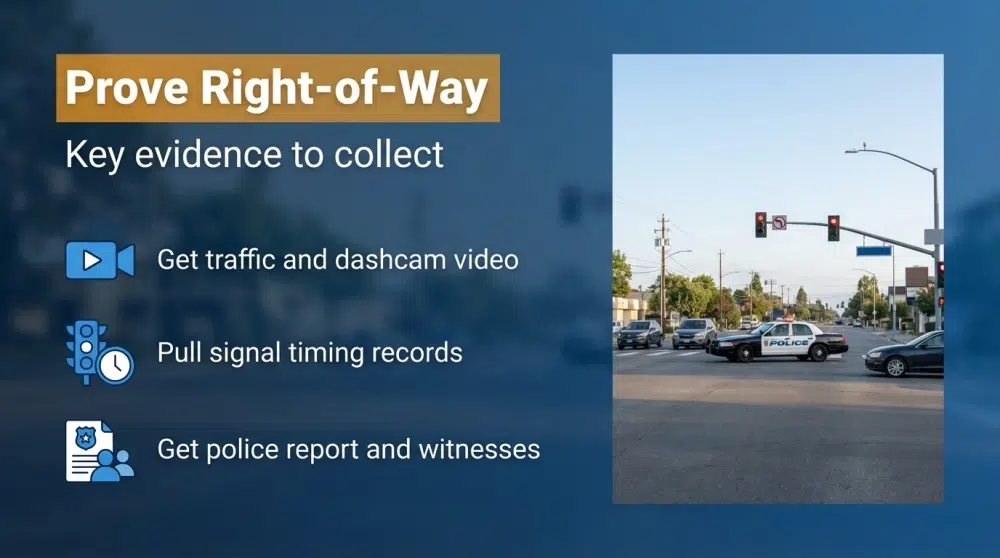
- Police report evidence: Officers document statements, diagram the scene, note traffic control devices, and may list preliminary fault assessments. While not dispositive, reports guide follow-up investigation and witness outreach.
- Traffic camera footage: Intersections often have public cameras, and nearby private businesses may also capture the approach or impact. Records requests should be made quickly. Public records access can be guided by federal transparency principles, although state and local retention policies vary [15].
- Accident reconstruction: For serious injury litigation, reconstructionists analyze crush profiles, vehicle dynamics, and timing to determine whether a driver had the right-of-way or violated a traffic control.
- Vehicle data and downloads: Event data recorders can align pre-impact speed and braking with signal cycles and sight distance assessments.
- Medical records and imaging: Correlating injury patterns with impact direction and severity helps validate crash mechanics and claimed damages.
- Discovery compliance: Structured discovery requests under civil rules, including disclosures and expert reports, are key to obtaining technical proof while avoiding spoliation concerns [6][7].
Because right-of-way and failure-to-yield rules vary by state and situation, pinpointing the controlling statute or ordinance at a specific intersection can be the difference between liability and defense verdicts. Cross-referencing statutory text with objective timing evidence is often decisive.
What are common injuries in side-impact collisions and how do they affect damages?
Side-impact collisions can cause severe injuries due to lateral intrusion and abrupt rotational forces. While modern vehicles incorporate side airbags and improved structures, occupants remain vulnerable when struck at doors or pillars. Common injuries include:
- Traumatic brain injuries such as concussions and diffuse axonal injury from lateral acceleration and head contact.
- Neck and spine trauma including cervical sprain, disc herniation, and in more severe cases, fractures or spinal cord involvement.
- Chest and abdominal injuries ranging from rib fractures and pulmonary contusions to injuries to the liver or spleen.
- Pelvic and hip fractures from direct lateral force to the door side.
- Orthopedic injuries including shoulder, knee, and clavicle injuries when the body rotates or contacts interior components.
Damages in civil cases are driven by evidence. Plaintiffs typically present medical records, physician narratives, imaging reports, treatment plans, and life care assessments. Economic losses may include medical bills and lost wages supported by bills, explanation of benefits, employer wage verification, and tax records. Non-economic losses are documented through testimony about pain, functional limitations, and the impact on daily activities. Defendants may challenge causation, necessity of treatment, or argue that preexisting conditions influenced outcomes. Side-impact injury patterns frequently align with the physics of the crash, and credible medical documentation helps bridge that pathway from collision mechanics to clinical findings [2].
Which traffic laws govern intersection right-of-way in California, Texas, and Illinois?
Right-of-way rules are state-specific, but they share common elements designed to avoid conflicts at intersections. Knowing the statute for left turns, stop-controlled approaches, and signal compliance is vital when reconstructing a T-bone crash.
- California: A driver turning left must yield to vehicles approaching from the opposite direction that are close enough to constitute a hazard, including through traffic and lawful overtaking vehicles [9]. Alleged violations often arise when a left-turning driver misjudges oncoming speed or gaps.
- Texas: A driver intending to turn left must yield the right-of-way to a vehicle approaching from the opposite direction that is in the intersection or so close as to be an immediate hazard [10]. Evidence about distance, timing, and approach speed can be decisive.
- Illinois: A left-turning driver must yield to any vehicle approaching from the opposite direction which is within the intersection or so close as to constitute an immediate hazard [11]. T-bone collisions at protected-permissive signal phases may involve both statutory interpretation and signal timing analysis.
In any jurisdiction, a red signal or stop sign typically requires a complete stop and yielding to cross traffic until safe movement is possible. Proof that one vehicle entered against a red or failed to yield can establish negligence, though comparative fault may still apply if both drivers made errors. If you are evaluating options for representation, many people look to car accident lawyers who regularly handle intersection disputes and understand how to match statutory text with real-world traffic operations.
Because we discuss multiple states and local laws, strategic guidance from an intersection crash attorney can help you identify which statutes and municipal codes apply at a specific location, and how those rules interact with evidence like traffic camera timestamps and event data downloads.
How do comparative negligence and defenses work in intersection accident lawsuits?
Comparative negligence allocates fault between drivers when more than one party contributed to the crash. Many states reduce the plaintiff’s recovery by their percentage of fault, while some bar recovery if the plaintiff’s share reaches a threshold. The details differ by jurisdiction, but the core concept allows jurors to apportion responsibility based on the evidence [8].
Common defense arguments in T-bone intersection cases include:
- Speeding or late yellow entry: The through driver allegedly entered on a stale yellow at excessive speed or failed to slow anticipating a change.
- Line-of-sight or obstruction: View restrictions from parked vehicles, large trucks, or vegetation made it unsafe for either driver to proceed without heightened caution.
- Signal confusion: The intersection had complex phasing or limited signal visibility, creating misunderstandings about protected or permissive turns.
- Sudden hazard: The opposing vehicle allegedly created a sudden hazard, cutting down available reaction time.
- Seat belt and mitigation: Some jurisdictions allow consideration of seat belt nonuse or failure to mitigate damages, subject to evidentiary rules and specific statutes.
Plaintiffs emphasize clear statutory violations, credible timing analysis, and consistent physical evidence. Defendants focus on reasonableness under the circumstances, uncertainties in timing or speed calculations, and sharing of responsibility. Comparative negligence frameworks give jurors a mechanism to reflect those competing narratives [8].
What insurance issues arise after a T-bone crash, including UM/UIM claims?
Insurance disputes after side-impact collisions often turn on liability fault splits, medical necessity, and policy language. Key issues include:
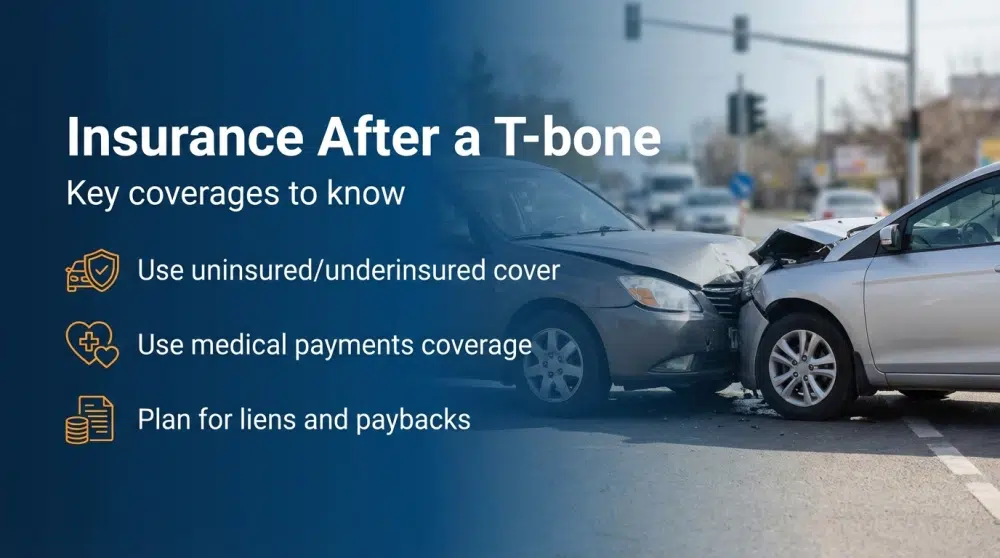
- Bodily injury liability coverage of the at-fault driver, which compensates for injury and loss up to policy limits if negligence is proven.
- Uninsured and underinsured motorist coverage when the other driver has no insurance or inadequate limits. UM/UIM claims require proving the underlying liability of the uninsured or underinsured motorist and compliance with policy conditions.
- Medical payments or personal injury protection where applicable, which may pay certain medical bills regardless of fault, subject to caps and coordination of benefits.
- Property damage coverage for vehicle repairs or total loss, diminished value claims where permitted, and rental reimbursement.
- Subrogation and liens including health insurer reimbursement rights and hospital liens, which can affect net recovery and settlement strategy.
Documentation is critical. Clear communications, prompt notice of claims, and preservation of relevant evidence keep the claim on track. Early case assessment with a T-bone accident attorney can help align fault proof with coverage triggers, especially when UM/UIM is involved.

How do statutes of limitations affect T-bone car accident lawsuits in CA, TX, and IL?
Statutes of limitations impose strict deadlines to file civil injury claims. If you miss the deadline, courts can dismiss the case regardless of its merits. Because rules vary by state and facts, confirm the exact timeline for your claim as soon as possible.
- California: Generally two years for personal injury actions arising from negligence [12].
- Texas: Generally two years for personal injury claims [13].
- Illinois: Generally two years for actions for damages for an injury to the person [14].
Deadlines can be shorter in claims involving government entities or special circumstances, and exceptions can apply. To protect your rights, it is prudent to take action promptly and consult counsel well before any potential expiration date. People seeking focused representation sometimes search for car accident lawyers in Texas when a crash occurs there, because local rules, venue, and limitations periods can significantly affect strategy and timing [13].
What is the role of experts and accident reconstruction in litigation?
When fault or causation is disputed, accident reconstruction and medical experts can provide opinions grounded in data and accepted methods. Courts require that expert testimony meet standards for relevance and reliability, which guide how opinions are formed and presented to a jury [5].
- Accident reconstructionists analyze physical evidence, vehicle damage, roadway geometry, time-distance relationships, and signal timing to determine how the collision occurred.
- Human factors specialists evaluate perception-reaction time, conspicuity, decision making, and expectancy at complex intersections.
- Biomechanical and medical experts link forces and injury mechanisms, interpret imaging, and assess causation and future medical needs.
- Economists and vocational experts quantify lost earning capacity and future care costs using accepted economic methodologies.
Under civil procedure rules, expert disclosures and reports are carefully regulated, and failure to timely disclose or preserve relevant information can lead to sanctions or exclusion of evidence [6][7]. For serious injury litigation, coordinating the testing, simulations, and discovery timeline is often pivotal.
How do you document medical bills and lost wages to support a claim?
Strong documentation transforms a general claim into a credible, verifiable damages presentation. Both plaintiffs and defendants benefit from a clear paper trail.
- Medical bills: Obtain itemized statements with CPT codes, explanations of benefits, and proof of payments. Clarify any adjustments or write-offs to avoid double counting.
- Medical records: Maintain emergency department notes, diagnostic reports, imaging, operative notes, physical therapy, and specialist evaluations that establish causation, treatment, and prognosis.
- Wage loss proof: Secure employer verification of missed time, pay stubs, W-2s, or 1099s. For self-employed individuals, compile profit and loss statements and tax returns.
- Future losses: Consider vocational assessments and economic projections when injuries affect long-term earning capacity.
- Out-of-pocket costs: Keep receipts for medications, travel to appointments, medical equipment, and home modifications where applicable.
Clarity and consistency matter. Your documentation should align with the injury narrative and objective crash evidence. If an insurance dispute arises, contemporaneous records can accelerate resolution or strengthen your position at mediation or trial.
What happens in wrongful death cases after a fatal intersection crash?
When a T-bone crash results in a fatality, surviving family members may bring a civil wrongful death claim where state law permits. These cases focus on the economic and non-economic harms suffered by beneficiaries and the estate. Typical elements include funeral expenses, loss of financial support, and the loss of companionship and guidance. Liability proof still turns on right-of-way and signal compliance, and damages require careful financial and familial documentation.
Defendants may challenge causation, argue comparative negligence, or contest damages. Evidence often includes crash reconstruction, witness accounts, and medical examiner findings. Because deadlines and beneficiary rules vary by state, families often seek prompt legal help to preserve claims and evidence while navigating grief with care and support.
How do federal and state evidence rules impact your case strategy?
Evidence is the backbone of any intersection accident lawsuit. Understanding what is admissible and how to obtain it will influence both settlement posture and trial outcomes.
- Relevance and materiality: Evidence must have a tendency to make a consequential fact more or less probable [4].
- Expert testimony: Opinions must be based on sufficient facts, reliable principles, and a reliable application to the facts of the case [5].
- Discovery obligations: Parties must disclose certain information and supplement as needed during litigation, including expert reports and data, under civil procedure rules [6].
- Preservation and spoliation: Loss of electronically stored information, such as video, when preservation was reasonable and foreseeable, can result in sanctions or adverse inference instructions [7].
- Public records and video requests: Government-held records, including certain video, may be requested under transparency frameworks, though availability and timelines differ by agency and locality [15].
Strategic planning should align claim needs with the governing rules of evidence and procedure, which may vary between federal and state courts. Early, lawful preservation efforts often make the difference in capturing critical intersection footage before it is overwritten.
How can a side-impact collision lawyer help and what does contingency fee mean?
A side-impact collision lawyer coordinates the many moving parts of a T-bone claim so you can focus on healing. Responsibilities typically include investigating fault, preserving video and vehicle data, working with reconstruction and medical experts, organizing medical and wage documentation, navigating insurance coverage, and, when needed, filing a lawsuit and trying the case. Many attorneys work on a contingency fee, meaning legal fees are paid as a percentage of the recovery. Costs and terms vary by firm and jurisdiction, and fee agreements explain how expenses are handled and what happens if there is no recovery.
Legal help is especially important in intersection cases because right-of-way disputes and comparative negligence are common. A seasoned intersection crash attorney understands how to build a timeline using traffic signal data, telematics, and camera footage while applying the correct statutes and evidence rules. If you are uncertain about next steps, a free consultation can help you understand timelines, documentation priorities, and available insurance paths without immediate financial pressure.
People in many communities search for a T-bone accident lawyer, side-impact collision lawyer, intersection crash attorney, broadside collision attorney, or T-bone car accident lawyer when facing these challenges. Nationwide T-bone accident lawyers routinely collaborate with local counsel where needed to address venue-specific rules.

Why choose GoSuits for a T-bone intersection crash case?
We built our practice around helping people after serious crashes at intersections across the United States. If your case involves a side-impact collision, our team offers a free consultation to outline practical next steps, highlight time-sensitive evidence, and discuss how we approach insurance disputes and litigation. We practice nationwide and coordinate matters in federal and state courts where appropriate, with designated attorneys for every client and no case managers. You have direct, unfettered access to your attorney throughout the life of your case.
GoSuits uses an exclusive proprietary software platform to move cases faster while maintaining quality, helping us surface crucial facts like traffic camera locations, retention schedules, and signal timing records earlier. Our technology-driven approach supports, rather than replaces, hands-on lawyering, and our trial-focused mindset means we prepare every case as if it may be presented to a jury.
- Leadership in innovation: We continually refine our workflows to streamline evidence capture and expert coordination, accelerating timelines without sacrificing detail.
- Dedicated attorney contact: Every client works directly with a designated attorney who manages strategy, communication, and key decisions.
- Past results: We have obtained meaningful outcomes in complex crash cases. See our prior cases for examples of past recoveries.
- Trial experience: Courtroom experience benefits clients in negotiations and at trial by shaping a clear, evidence-driven narrative.
- Comprehensive practice areas: Our practice areas include car collisions, trucking, motorcycle, serious injury litigation, product liability, premises claims, and more. Explore our attorneys and learn about us.
- 30 years of combined experience: Our team brings decades of collective courtroom and negotiation experience to complex intersection disputes.
If you are comparing options for representation after a T-bone crash, we can discuss investigation steps, litigation strategy, and fee structure during a free consultation so you understand how we would approach your case from day one.
References and resources
- Intersection Safety Facts and Strategies – Federal Highway Administration
- Crashes by vehicle type and degree of impact – Insurance Institute for Highway Safety
- Traffic Safety Facts and Data Tools – National Highway Traffic Safety Administration
- Rule 401 Relevance – Legal Information Institute
- Rule 702 Testimony by Expert Witnesses – Legal Information Institute
- Rule 26 Duty to Disclose and Discovery – Legal Information Institute
- Rule 37 Failure to Make Disclosures or to Cooperate; Sanctions – Legal Information Institute
- Comparative Negligence – Legal Information Institute
- California Vehicle Code 21801 Left Turns and U-turns – California Legislative Information
- Texas Transportation Code 545.152 Turning Left – Texas Statutes
- 625 ILCS 5/11-902 Vehicle Turning Left – Illinois Compiled Statutes
- California Code of Civil Procedure 335.1 Two-year Limitations – California Legislative Information
- Texas Civil Practice and Remedies Code 16.003 Two-year Limitations – Texas Statutes
- 735 ILCS 5/13-202 Two-year Personal Injury Limitations – Illinois Compiled Statutes
- DOJ Guide to the Freedom of Information Act – U.S. Department of Justice