- What does Caltrans do and when might we have a claim?
- What California laws control a lawsuit against Caltrans?
- Can you sue Caltrans for pothole or road hazard damage?
- What is a dangerous condition of public property in California?
- How do you prove Caltrans had notice of the problem?
- What deadlines apply, including the six month claim deadline?
- How do you file a California Government Claims Act claim?
- What evidence strengthens a Caltrans road defect claim?
- What defenses do public entities raise and how do courts analyze them?
- What compensation is allowed and what is not allowed against a public entity?
- How are property damage only pothole claims handled in California?
- Should you use your insurance if a road defect caused the crash?
- Who is liable if the road is a city street instead of a state highway?
- What should you do immediately after a road hazard incident?
- Frequently asked questions about Caltrans claims
- About GoSuits
- References and resources
What does Caltrans do and when might we have a claim?
Caltrans is the California Department of Transportation. It plans, builds, operates, and maintains the California State Highway System, including many freeways and state routes that run through Los Angeles, San Diego, San Jose, San Francisco, Sacramento, Orange County, Riverside, San Bernardino, Fresno, and Oakland. If a dangerous condition on a state highway, ramp, bridge, or construction zone injures you or damages your vehicle, you may have a civil claim against Caltrans under the California Government Claims Act and the statutes governing public entity liability for a dangerous condition of public property [1] [2].
Common scenarios include pothole damage claim California requests after storms, loose or missing manhole covers, abrupt edge drops, failed guardrails, poor signage during lane closures, flooding from blocked culverts, debris in travel lanes, or defective traffic signal timing. Crashes can involve many vehicle types. Car drivers, motorcyclists, and commercial drivers might all be affected. We regularly see issues intersect with practice areas like car accident, motorcycle accident, and truck accident. If a crash involves a tractor trailer or delivery vehicle on a state route, the analysis often overlaps with topics that matter to truck accident lawyers and commercial vehicle accident lawyers, especially when heavy traffic and work zones are involved.
What California laws control a lawsuit against Caltrans?
Claims against public entities in California are governed by the Government Claims Act. Before you can file a lawsuit against Caltrans, you must first present a timely claim to the state under Government Code sections 905 to 912.8. The dangerous condition rules are found in Government Code sections 830 through 835.4. The most frequently cited provisions include the definition of dangerous condition [2], the trivial defect principle [3], design immunity [4], the elements of liability [1], and the rules for proving notice [5] and reasonableness of corrective efforts [6]. The claims presentation deadline is typically six months for injury or property damage claims [7], and there is a process for seeking permission to file a late claim within one year [8]. After you present a claim, the state normally has 45 days to act on it [9]. If the state rejects the claim, you usually have six months from the rejection notice to file a court lawsuit [11]. You generally cannot file in court until you first present a claim [10].
Court decisions give additional guidance on how these statutes work. Design immunity, notice, and causation have been addressed by the California Supreme Court, including in Cameron v. State of California, Cornette v. Department of Transportation, Bonanno v. Central Contra Costa Transit Authority, and Cordova v. City of Los Angeles [13] [14] [15] [12].
Can you sue Caltrans for pothole or road hazard damage?
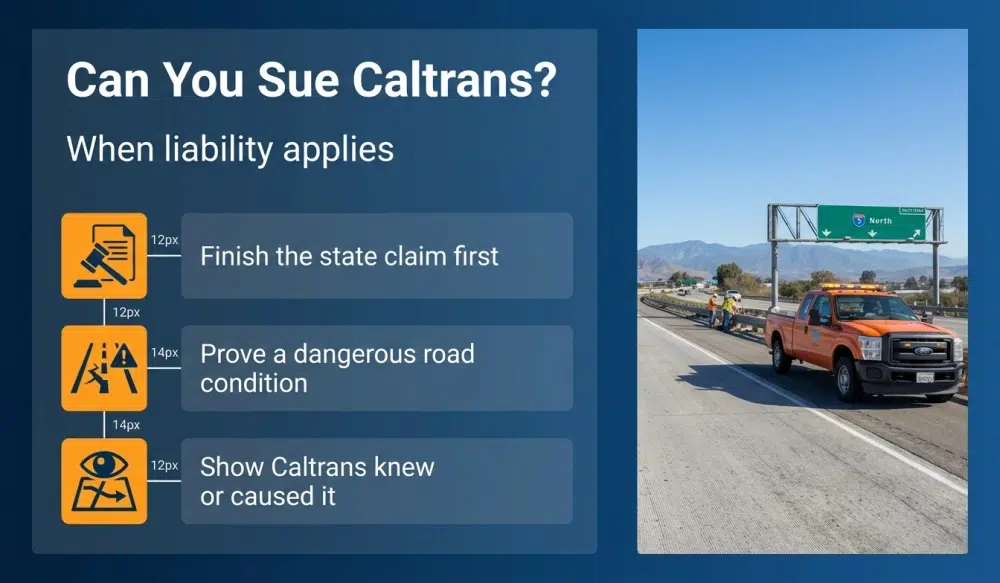
Yes, but only in specific circumstances and only after you complete the California Government Claims Act process. Caltrans can be liable if a dangerous condition of public property substantially caused the injury or damage and the legal elements of Government Code section 835 are met [1]. A dangerous condition means the property created a substantial risk of injury to users exercising due care [2]. For a pothole damage claim California drivers often ask whether the state can be responsible for tire, wheel, or suspension losses. The answer depends on whether the pothole presented a substantial risk and whether Caltrans had actual or constructive notice with enough time to fix it or warn the public [5]. Caltrans may also be liable for negligently created hazards in maintenance or construction zones.
On the other hand, Caltrans is not an automatic insurer of the road system. There are important immunities and defenses. Design immunity can apply where an approved plan or design is the alleged cause [4] and immunity can exist for certain failures to provide signs or signals under different sections not discussed here. Even without an immunity, an entity can avoid liability if it proves its inspection, maintenance, and warning measures were reasonable under all circumstances [6].
What is a dangerous condition of public property in California?
California law defines a dangerous condition as a condition of property that creates a substantial risk of injury to members of the public exercising due care in a foreseeable manner [2]. Not every irregularity or minor defect qualifies. The trivial defect principle states that a condition that is minor, trivial, or insignificant is not a dangerous condition unless the surrounding circumstances transform it into a substantial risk [3]. For example, a shallow pavement depression might be trivial in isolation, but its location in a high speed merge area, poor nighttime visibility, or water accumulation could change the analysis.
Courts examine the totality of circumstances. In Bonanno, the court explained that the dangerous condition analysis considers whether the property posed a substantial risk when used with due care in a reasonably foreseeable manner, including the property’s location and the way the entity planned for pedestrian access [15]. In Cordova, the court clarified that a public entity’s liability can exist when a public property feature, like a tree or fixed object near the roadway, is a substantial concurrent cause of harm even if a negligent driver initiated the crash [12]. For state highways through Los Angeles or San Diego with complex interchanges, factors like speed, traffic density, lighting, signage, and drainage frequently matter.
How do you prove Caltrans had notice of the problem?
Liability under section 835 generally requires proof that Caltrans either created the dangerous condition through an act or omission by an employee or had actual or constructive notice of the condition with enough time to protect against it [1]. Section 835.2 explains the notice standards. Actual notice exists when the entity has direct knowledge of the condition. Constructive notice exists if the condition existed for a long enough time and was so obvious that the entity, in the exercise of due care, should have discovered it [5]. Evidence that can prove notice includes:
- Prior complaints or service requests to Caltrans about the same pothole or hazard, especially in the weeks or months before the incident.
- Maintenance logs and work orders showing inspections, patching, or planned repairs in the area.
- Photographs, videos, and dashcam footage indicating the size, depth, and obviousness of the defect over time.
- CHP collision reports referencing earlier crashes linked to the same condition.
- Weather and drainage records demonstrating repeated water buildup and roadway breakup on a specific grade or curve.
Even if Caltrans lacked prior notice, liability may exist if a maintenance crew actually created the hazard, for example by leaving debris or an unsafe edge during a lane closure.

What deadlines apply, including the six month claim deadline?
For most injury and property damage claims against the State of California, you must present a written claim to the Government Claims Program within six months of the date of injury under Government Code section 911.2 [7]. This six month claim deadline is strict. If you miss it, you can apply for permission to present a late claim within one year of the incident, but you must show excusable reasons such as mistake, inadvertence, surprise, or excusable neglect [8] [12].
After you submit the claim, the state usually has 45 days to allow or reject it [9]. If the claim is rejected in writing, you generally have six months from the date the rejection notice is personally delivered or deposited in the mail to file a civil lawsuit in Superior Court [11]. If the state does not act within 45 days, the claim may be deemed rejected by operation of law, and longer statutes of limitation may apply under section 945.6, but consult the statute text carefully because timing can depend on whether a written notice was given [11].
Importantly, you cannot file a Caltrans lawsuit until you have first presented a timely Government Claims Act claim, subject to limited exceptions [10]. For road hazard injury California cases in San Francisco, Sacramento, or Riverside, the same timeline applies unless a special statute controls the specific claim.
How do you file a California Government Claims Act claim?
Caltrans claims are submitted through the State of California’s Government Claims Program, administered by the Department of General Services Office of Risk and Insurance Management. The state publishes filing instructions and a portal for the state of California claim for damages [13]. Typical steps include:
- Identify the correct entity. Confirm the location is a state highway or facility maintained by Caltrans. City or county streets use different claim processes.
- Prepare the Caltrans damage claim form content. The claim must include your name and address, date and location of loss, a description of what happened, a description of the injury or damage, and the total amount claimed if known at the time [7].
- File within six months. The claim presentation Gov. Code 911.2 deadline is generally six months for injury or property damage [7].
- Attach evidence. Photographs, repair estimates, medical records, tow bills, and witness statements help the Government Claims Program evaluate your claim.
- Wait for a written response or 45 days. The Government Claims Program may approve, settle, or reject the claim. If rejected, keep the notice because it triggers the court filing deadline [9] [11].
- File a lawsuit if necessary. If the claim is denied or not resolved, you can file a civil action in Superior Court, subject to the deadlines in section 945.6 [11]. If your claim was late but within one year, you may need to petition for relief from late claim under section 946.6 after the state denies permission to present a late claim [12].
California Courts Self Help provides general guidance about claims against government entities, which can be a helpful checklist as you prepare [14].
What evidence strengthens a Caltrans road defect claim?
Evidence is crucial. To meet the section 835 elements [1] and overcome defenses, consider collecting:
- Scene documentation. Clear photos and video of the defect, skid marks, debris, signage, cones, and lane closures. Include a reference object and measurements where safe to do so.
- Condition timeline. Proof of how long the condition existed, such as prior photographs from mapping apps, prior work orders, or neighborhood reports.
- Repair and medical records. Tire and wheel invoices, suspension repairs, body shop estimates, medical evaluations, and therapy notes related to the crash.
- Police or CHP reports. These often document road conditions, statements, and diagrams. They are frequently used to corroborate causation.
- Witness testimony. Statements from other drivers, construction workers, or nearby residents about recurring hazards or insufficient warnings.
- Design and maintenance records. For design immunity disputes, plan sheets, as-built drawings, and approval histories can be decisive [4] [13].
If a collision involves a motorcyclist, the physics of two wheel stability and surface irregularities often matter. That is why topics discussed by motorcycle accident lawyers and motorcycle injury claims can be relevant in evaluating defect severity in San Bernardino mountain roads or coastal routes in Orange County.
What defenses do public entities raise and how do courts analyze them?
Public entities raise several recurring defenses. Understanding these can help plaintiffs and defendants evaluate strengths and risks.
What is design immunity and when does it apply?
Design immunity protects a public entity from liability for injuries caused by a plan or design of public improvement where the design was approved by an authorized body or employee, and there is substantial evidence supporting the reasonableness of the design [4]. Cameron and Cornette are landmark cases. Cameron recognized the immunity but also noted it is not unlimited, and Cornette explained there is a way a plaintiff can defeat design immunity where changed physical conditions have made the design dangerous and the entity has had sufficient notice and time to warn or fix the problem [13] [14]. In practical terms, a design that was reasonable in 1975 might be unsafe under present traffic volumes in San Jose or Fresno, and if the change is substantial and known, the immunity can be reevaluated.

How do notice and reasonableness defenses work?
Even without an immunity, an entity can avoid liability if it did not have notice in time to protect the public, or if its inspection, maintenance, and warning measures were reasonable in light of budget, practicality, and risk [5] [6]. For example, if a pothole formed hours after a major storm and a crew had already been dispatched with temporary warnings, a court could find the entity acted reasonably even if damage occurred before repair.
How is causation evaluated when another driver is at fault?
Defendants often argue that a third party driver or the claimant’s own negligence was the sole cause. In Cordova, the California Supreme Court held that a public entity can be liable if a dangerous condition of its property is a substantial factor in causing injury, even if another driver’s negligence contributed. The focus is on whether the property condition caused or increased the risk of the kind of injury that occurred [12]. Comparative fault principles may reduce recovery when a plaintiff’s negligence contributed, but do not bar recovery altogether under California law [16].
What about trivial defects and sign or signal immunities?
Entities may argue that a defect was trivial under section 830.2 [3]. They may also raise statutory immunities for certain traffic control decisions not addressed in depth here. The outcome typically depends on context, including lighting, traffic speed, and whether reasonable warnings were provided in advance of the hazard.
What compensation is allowed and what is not allowed against a public entity?
California allows compensation for economic losses like medical bills and property damage and for noneconomic harm like pain and suffering when the legal elements are proven. However, punitive damages are not recoverable against a public entity like Caltrans [17]. There is generally no special cap on compensatory damages in dangerous condition cases, but plaintiffs must prove causation and the amount of loss with competent evidence. For claimants facing serious injuries such as traumatic brain injury or complex orthopedic trauma, considerations that often arise in brain injury compensation lawyers and serious car accident lawyers discussions can be relevant to show medical needs and future care, especially in high speed freeway crashes in Oakland or Sacramento.
How are property damage only pothole claims handled in California?
Many drivers present claims solely for tire, wheel, or suspension damage from a pothole. The process is the same. You must present your state of California claim for damages to the Government Claims Program within six months of the incident [7] [13]. Attach photographs of the pothole, measurements if available, your repair invoice, and proof of payment. The program may approve or deny the Caltrans claim or propose a partial settlement. If denied, you can evaluate filing in court within the time limits of section 945.6 [11]. Because immunities and defenses still apply, property damage only claims can be contested if the defect was trivial, newly formed, or if notice cannot be shown.
Should you use your insurance if a road defect caused the crash?
Many drivers in Los Angeles or San Diego turn to their own collision coverage for immediate repairs and then pursue subrogation or reimbursement. Using your insurance does not prevent you from presenting a Caltrans damage claim. Keep in mind that your insurer may assert a lien on any recovery. For motorcycle crash injuries, you might also work with motorcycle accident legal help to coordinate medical payment coverage and health insurance subrogation. For crashes involving a commercial vehicle, trucking injury claims and truck negligence attorneys can help integrate bills of lading, driver logs, and compliance records into the causation analysis when a road defect combines with driver error.
Who is liable if the road is a city street instead of a state highway?
Caltrans maintains state highways and some related facilities. Cities and counties maintain local streets. If the incident happened on a local road in San Francisco, Oakland, or Fresno city limits, the liable public entity may be that city, not Caltrans. Local entities follow similar Government Claims Act rules with the same six month claim deadline and lawsuit timing, although filing address and forms differ. The same dangerous condition standards and defenses typically apply under sections 830 to 835.4 [2] [1].
What should you do immediately after a road hazard incident?
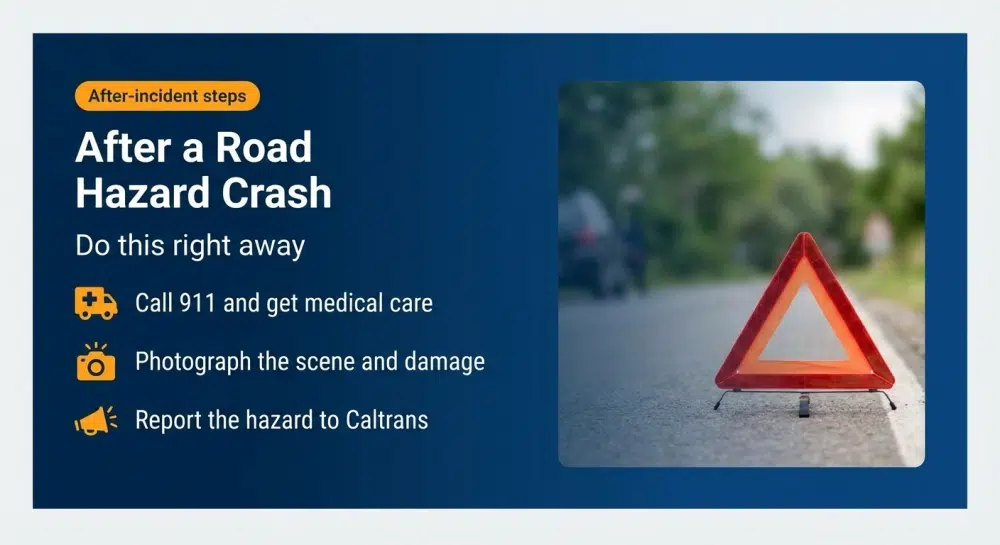
- Call 911 if anyone is hurt. Obtain necessary medical care promptly.
- Document the scene. Photograph the defect, your vehicle, and any warnings or lack of warnings.
- Get witness information. Independent witnesses often help establish notice and causation.
- Preserve the vehicle. Keep damaged parts, tires, and wheels until the claim is resolved.
- Request official reports. Obtain CHP or police reports and any incident numbers.
- Report the hazard. File a maintenance service request with Caltrans as soon as it is safe, and keep a copy of the submission for your claim file.
- Track deadlines. Diary the six month claim deadline under section 911.2 and set reminders for the 45 day response window and the six month lawsuit deadline after rejection [7] [9] [11].

About GoSuits Personal Injury Lawyers
We handle civil injury and property damage claims across California, including complex roadway defect cases that involve the California Government Claims Act, dangerous condition of public property, and the claim presentation Gov. Code 911.2 process. A free consultation with a personal injury attorney can help you understand timelines, evidence needs, and options if a Caltrans claim is rejected. We practice statewide, serving Los Angeles, San Diego, San Jose, San Francisco, Sacramento, Orange County, Riverside, San Bernardino, Fresno, and Oakland.
GoSuits delivers a technology driven approach supported by exclusive proprietary software designed to streamline investigation, claim presentation, litigation scheduling, and trial preparation. Our platform accelerates document collection and analytics while designated trial attorneys lead strategy. We do not use case managers. Each client has direct, unfettered access to their attorney for the life of the case.
Our team has 30 years of combined experience trying and resolving complex injury matters. Past results include significant recoveries in highway defect and major collision cases, as shown in our published summaries at prior cases. Learn more about the people who will work with you at our attorneys, our story at about us, and the range of civil practice areas we cover at practice areas.
Our practice spans car accident, motorcycle accident, truck accident, slip and fall compensation, construction accident, brain injury, product liability, and wrongful death claims arising from roadway incidents and other negligence. We prepare cases for trial, which often leads to better outcomes during settlement negotiations. By combining courtroom experience with proprietary tools, we work to move cases forward efficiently while maintaining personal attorney access for every client.
References and resources
- Gov. Code § 835, Liability for Dangerous Condition of Public Property – California Legislative Information
- Gov. Code § 830, Definitions of Dangerous Condition – California Legislative Information
- Gov. Code § 830.2, Trivial Defect Principle – California Legislative Information
- Gov. Code § 830.6, Design Immunity – California Legislative Information
- Gov. Code § 835.2, Notice of Dangerous Condition – California Legislative Information
- Gov. Code § 835.4, Reasonableness of Protective Measures – California Legislative Information
- Gov. Code § 911.2, Six Month Claim Deadline – California Legislative Information
- Gov. Code § 911.4, Application to Present Late Claim – California Legislative Information
- Gov. Code § 912.4, Time for Action on Claim – California Legislative Information
- Gov. Code § 945.4, Presentation of Claim Prerequisite to Suit – California Legislative Information
- Gov. Code § 945.6, Time to Sue After Rejection – California Legislative Information
- Gov. Code § 946.6, Petition for Relief from Late Claim – California Legislative Information
- File a Government Claim – California Department of General Services, ORIM
- Claims Against the Government – California Courts Self Help
- Bonanno v. Central Contra Costa Transit Authority, 30 Cal.4th 139 – CourtListener
- Li v. Yellow Cab Co., 13 Cal.3d 804 – CourtListener
- Gov. Code § 818, Punitive Damages Not Recoverable Against Public Entity – California Legislative Information
- Cornette v. Dept. of Transportation, 26 Cal.4th 63 – CourtListener
- Cameron v. State of California, 7 Cal.3d 318 – CourtListener
- Cordova v. City of Los Angeles, 5 Cal.5th 989 – CourtListener