- What makes photos decisive evidence after an Irvine rideshare crash?
- What should you photograph first for safety and preservation?
- Which rideshare app screenshots matter and why?
- How do California and federal evidence rules treat photos from your phone?
- How can passengers preserve photo metadata and chain of custody?
- What angles and framing practices help investigators reconstruct the crash?
- What should you avoid photographing or posting online?
- How do insurance periods work for Uber and Lyft in California?
- How do your photos support liability and comparative negligence arguments?
- What if the driver asks you not to take pictures?
- How soon should you request police reports and what information do they include?
- How long do you have to bring a civil claim in California?
- How do defense teams try to challenge your photos and how can you respond?
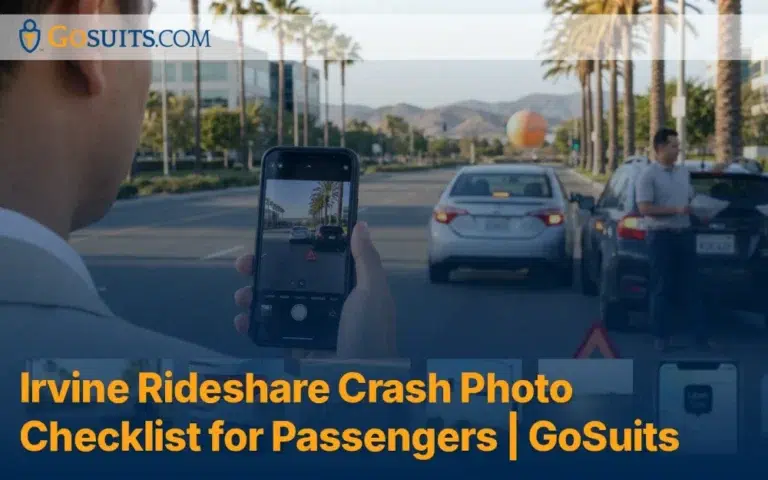
- What is the complete Irvine rideshare crash photo checklist you can follow?
- How can GoSuits support you after an Irvine rideshare crash?
- References and Resources
What makes photos decisive evidence after an Irvine rideshare crash?
As a passenger, you often have the best vantage point to document what happened. Clear photographs can capture vehicle positions, app ride status, traffic signals, skid marks, and injuries. These details can help your legal team and crash reconstruction professionals pinpoint fault, preserve memory, and counter disputes later. Visuals often carry weight because they let judges, juries, and claims adjusters see the scene rather than rely on memory alone. Under the rules of evidence, photos are admissible if a witness can say they fairly and accurately depict what they purport to show [6] [8].
Crash data underscores why careful documentation matters. Nationally, there were 42,514 traffic fatalities in 2022, highlighting the stakes of roadway safety and the volume of investigations following serious collisions [1]. Local assessments, such as the California Office of Traffic Safety city and county ranking reports, track collision patterns that can shape enforcement and prevention efforts in areas like Irvine [2].
Why should passengers focus on evidence even if they believe fault is obvious?
Fault can be contested, and memories fade. Photos taken immediately after the crash can counter later disputes about signal phases, lane positions, speed indicators, and weather or lighting conditions. In California, comparative negligence may reduce recoverable damages based on fault allocation, so thorough documentation helps both plaintiffs and defendants present a precise picture of what occurred [11].
What should you photograph first for safety and preservation?
Your safety comes first. If you can do so without risk, begin documenting. If anyone is seriously hurt, call 911. Do not stand in traffic. If vehicles are in a live lane, move to a safe location and then take photos if possible.
Which shots capture the scene before it changes?
- Overall scene Capture wide shots that include both vehicles, their resting positions, nearby intersections, signals, crosswalks, and lane markings.
- Traffic control Photograph traffic lights, stop signs, speed limit signs, and lane direction signs from the driver’s perspective to show visibility and condition.
- Vehicle damage Get front, rear, and both sides of each vehicle, plus close ups of specific impact points, crumple zones, airbags, and broken glass.
- Skid marks and debris Document skid lengths, yaw marks, fluid trails, and scattered parts to help with speed and direction analysis.
- Weather and lighting Include the sky, sun angle, shadows, streetlights, and any visibility issues like glare or rain on the windshield.
- Road conditions Show potholes, oily surfaces, gravel, standing water, broken curbs, or obstructed signage that might have contributed.
- Injuries If appropriate, photograph visible bruises, cuts, or swelling on yourself to document timing and severity.
If law enforcement responds to an injury or fatal crash in California, drivers are required by law to comply with reporting obligations. Under certain circumstances, they must file the DMV SR 1 form. Passengers typically do not have those statutory reporting duties, but your documentation can still be extremely valuable [13] [3].
Which rideshare app screenshots matter and why?
In California, ridesharing insurance varies based on the driver’s app status. Screenshots can help pinpoint when coverage tiers apply under California law. AB 2293, found in the Insurance Code, established specific minimum coverages for different periods of a rideshare trip [4] [5] .
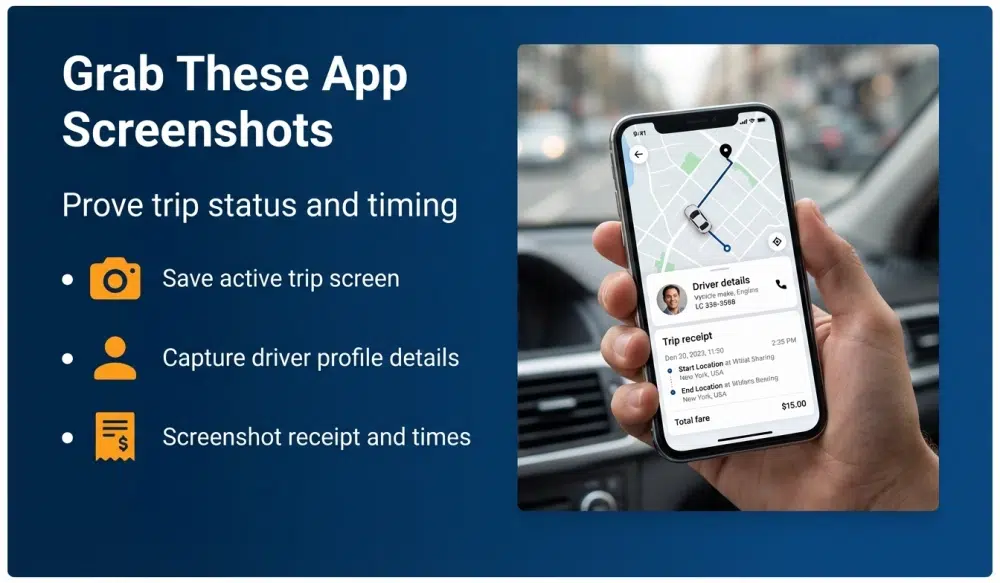
Which app details help show the driver’s status and the trip timeline?
- Take a screenshot of the trip summary on your app, which should include the pick-up and drop-off times, the route taken, and the total cost of your ride. Make sure to capture all these details in a single image.
- Capturing the Driver Profile Screen and Active Trip Status is essential in order to determine which insurance policy was in effect at the time of the accident. This is crucial for ensuring proper coverage and reimbursement for any damages sustained during the incident.
- If possible, please provide a screenshot that includes the map showing your vehicle’s position as well as the current date and time. This will help us verify your location and the exact time when the incident occurred. Thank you!
- In order to ensure effective communication within the app, always make sure you record and share any messages sent by the driver concerning the pickup location, any potential delays, or any requested changes in the planned route. Such information is crucial for seamless coordination between all parties involved.
Combining these screenshots with scene photographs allows us to discern whether coverage was connected during the times when the driver was accessible, on their way to pick someone up, or while they had a passenger under the state TNC framework [4] [5].
How do California and federal evidence rules treat photos from your phone?
Civil courts require that photos be authenticated and relevant. Authentication is not complicated. A witness with knowledge can testify that the photo fairly and accurately portrays what it claims to show. Under both the Federal Rules of Evidence and California Evidence Code, that suffices for authentication and admission if other evidentiary requirements are met [6] [8] [14].
Do you need the original photo file or can you use a copy?
Generally speaking, duplicates are considered acceptable unless there’s a valid concern about the authenticity of the original or it would be unfair to admit the duplicate. In practice, having the original file with all metadata intact is ideal, but high-quality duplicates can suffice if the conditions are met [7].

How do preservation rules apply to your digital photos?
Pictures, videos, and app data are examples of electronically stored information (ESI). Modifying or deleting this info could lead to consequences if a lawsuit is expected. Federal civil procedure guidelines handle missing ESI, while California law allows courts to impose sanctions for improper use of discovery. Adopting good preservation practices will help safeguard your claim and prevent evidence-related difficulties [9] [10] .
How can passengers preserve photo metadata and chain of custody?
In order to bolster credibility, ensure that original files are kept in read-only mode, maintain a straightforward log of their handling, and refrain from making any modifications that could change the visual content of the images.
What practical steps help protect authenticity?
- Save the original pictures by keeping them in their unaltered form on your smartphone. Don’t forget to store these images in a safe, off-device location like a cloud service to avoid accidental loss or damage. This way, you can always revert back to their original state when needed.
- Please take note of the context when recording any data – make sure to jot down the date, time, place or location, as well as any other conditions such as the weather if it plays a part. Most smartphones already capture this information for you in their metadata.
- Do not use filters. Make sure not to crop or alter images in any way. In case you decide to create a copy with annotations later, keep the original, untouched version as well.
- Let’s create a File Map – essentially a list that will maintain details about files in a structured manner. This organized record includes information such as the file name, date it was created (or last modified), and its storage location. By having this readily available information, we can easily monitor changes to files and track their locations more effectively.
- Please share copies instead of original documents. Make certain to provide your legal team with copies while ensuring the originals remain untouched.
- Don’t enable automatic enhancements. Disable them in your camera or gallery settings to prevent any alterations to the picture’s exposure or color after it has been captured.
These practices adhere to fundamental principles of basic authentication and avoidance of repetition, thus guarding against objections to change or correctness. [6] [7] [8].
What angles and framing practices help investigators reconstruct the crash?
Investigators and reconstruction professionals utilize several methods to analyze accidents, such as geometry, damage profiles, and the context of the scene itself. By analyzing these factors, they can better understand the specifics of how a crash occurred. In this process, your photos play a crucial role by providing valuable insights into speeds and vectors during an accident. These details are essential for building accurate models that can help us learn more about what happened in each individual incident.
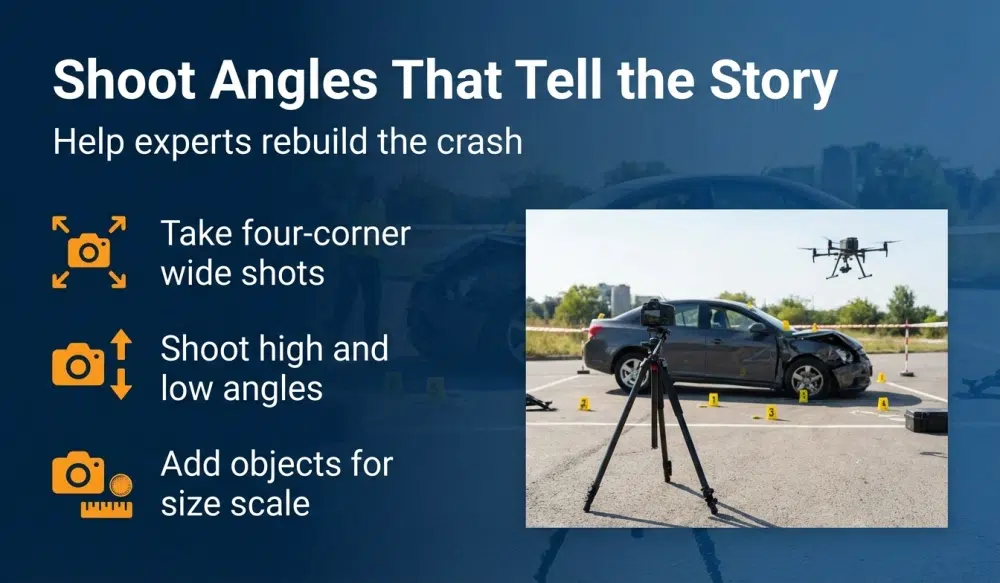
Which compositions are most useful?
- In the four corners method, you should capture a single, wider shot from each corner of the location, effectively capturing all directions within the scene.
- To capture height variety in your shots, try using two different angles: one shot taken while standing at eye level, and another shot taken from a lower angle to reveal details like tire marks and the vehicle’s underbelly damage. This will provide a more dynamic perspective for your images or video footage.
- To give you an idea of scale, I’m including a coin, credit card, or ruler nearby the scratch or dent for comparison purposes. This will help in understanding the size and depth of the damage.
- From the point of view: Take a photo from where the ride-share driver would have been looking while approaching the spot where the incident occurred.
- A progression series involves gradually moving in from wide establishing shots, through medium shots, to closer, more intimate close-ups – without altering the placement of the objects within each shot.
- Include images of license plates, Vehicle Identification Number (VIN) plates, along with any other relevant licenses or documents such as vehicle registrations, license plates themselves, and, if possible, pictures of the VIN plate located in the corner of the windshield.
What should you avoid photographing or posting online?
Respect privacy and avoid confrontation. Do not photograph someone’s personal documents beyond what is necessary for insurance exchange. Avoid filming faces if it escalates tensions. Do not climb into other vehicles or trespass to get photos. Refrain from posting crash photos on social media since defense teams may cite posts out of context, and deletion later can raise spoliation arguments [9] [10]. Focus on the scene, vehicles, and public facing elements like signals and roadway markings.
How do insurance periods work for Uber and Lyft in California?
California law identifies different insurance obligations depending on the driver’s app status. Coverage is structured by periods to protect the public. Documenting the active status at the moment of the crash helps allocate coverages accurately [4] [5].
Which app periods matter?
- App off The rideshare platform is not involved and the driver’s personal auto policy applies.
- App on, waiting for a match Elevated third party liability coverage applies under Insurance Code provisions.
- When traveling to pick up clients and during trips, higher liability limits and in some cases additional coverage will be effective from accepting the ride until you reach your destination.
Taking screenshots of your ride’s status and trip timeline, as well as your scene photographs, can aid in determining the particular time frame that pertains to your experience in Irvine.

How do your photos support liability and comparative negligence arguments?
California applies comparative negligence, which reduces damages in proportion to a party’s share of fault [11]. While passengers are often not at fault for the driving decisions, defense teams may argue that conduct like not wearing a seat belt or distracting a driver contributed. Photos can counter these claims by documenting seat belt use, interior damage patterns, and the dynamics of the crash.
What scenes help when fault is disputed?
- If you look closely at the signal, it may indicate whether your rideshare had a green light or encountered a red one. Pictures of the signal head and its surroundings can provide evidence in case of disputes over the traffic conditions that your ride experienced.
- These images demonstrate right-of-way rules, featuring pedestrian crossings, yield signs, and turn lanes. They illustrate which vehicles have the priority in different scenarios and how to maintain a clear line of sight.
- Obstacles in the form of vegetation, large vehicles, or construction equipment could potentially limit one’s line of sight.
- Long, straight skid marks and impact deformation are useful in providing evidence that can either support or challenge speed estimates made at a crime scene.
- Seat belt evidence can be found in various aspects such as the interior positioning of the belts, locked retractors, or seat impressions, which may provide crucial information regarding usage claims.
As seen from the perspective of a defendant, photographs can also serve as a safeguard against overstated damages or misdirected accusations. By providing visual evidence of pre-existing vehicle conditions or intervening hazards, photos can help achieve a more balanced and fair understanding for both parties involved in the case. This ultimately assists everyone in arriving at the truth more accurately and impartially.
Where in the process do legal teams use your photos?
- Initial negotiations between parties involve assessors confirming responsibility and loss assessment using images as a reference point.
- Experts in Reconstructionism use their knowledge to measure angles and distances, thereby connecting the impact of damage to movement trajectories.
- Depositions and trial Witnesses authenticate photos and use them to explain their account [6] [8].
What if the driver asks you not to take pictures?
Stay calm and stay safe. Remember, there’s no need to put yourself in a dangerous situation by getting involved in confrontations. Instead, if it’s safe to do so, you could step back and discretely take photos of the general scene from a public area. Just make sure you don’t obstruct the view or work of first responders or interfere with law enforcement. If tensions rise, it’s crucial that you remove yourself from harm’s way as quickly and safely as possible. And once things have calmed down, try to recall everything that happened while it’s still fresh in your mind.
If law enforcement arrives at the scene of an accident, it is crucial to cooperate with the officers. In cases involving injury or fatal crashes, drivers have reporting obligations. The police will create a report that can be requested by interested parties in accordance with state laws – links provided here [13] and [15].
How soon should you request police reports and what information do they include?
Please ask for the report as soon as it gets published. Reports generally contain details about the party involved, diagrams, statements, and officer opinions. In California, collision reports are confidential but accessible to interested parties such as those directly involved in the incident or their insurers, usually through the agency that conducted the investigation [15].
How do your photos interact with the police report?
- Cross-check your wide shot footage with the officer’s diagram for consistency.
- The concept discussed here is aligning the timestamp of a camera system (or event) with the reported time of a collision or dispatch operation, to ensure that both are synchronized for effective data analysis and usage. This process involves establishing synchronization between the respective timestamps so that events occurring at different locations can be appropriately correlated and understood. For instance, if there is an incident or accident involving a vehicle at a certain location, we should ideally have the camera timestamps corresponding to the reported time of the collision event. Similarly, if we have an emergency dispatch call from the same location, it would be helpful to know what was happening on the cameras around that time as well. Therefore, this synchronization of timestamps ensures that any correlation or analysis undertaken would be accurate and reliable, providing critical information for investigation, assessment, or decision-making purposes. This alignment process holds significant value particularly in situations where data from multiple sources need to be analyzed together to understand a complete picture of what transpired. In essence, aligning camera timestamps with reported time of collision/dispatch helps make sense of events as they happened while enabling better decision-making and understanding of incidents.
- Testimony and photos can provide supporting evidence for third-party accounts concerning the timing and placement of signals.
How long do you have to bring a civil claim in California?
In California, personal injury claims typically have a two-year statute of limitations according to the Code of Civil Procedure. However, some cases may have shorter deadlines, and claims against public entities often require prompt administrative action. To ensure your rights are appropriately evaluated within the correct timeframes, it is crucial to consult with a qualified attorney [10] .
How do defense teams try to challenge your photos and how can you respond?
Defendants may argue that photos were staged, edited, or taken after the scene changed. They might question whether the angle or cropping misleads or whether metadata is missing. They can also claim that vehicles were moved, traffic control was altered, or lighting was different at the time of the crash. Authenticity and clarity defeat much of this. California courts and the Federal Rules ask only that a witness with knowledge testify that the photo is a fair and accurate depiction of what it shows. Preservation of originals and a simple chain of custody also help. Duplicates are allowed unless there is a genuine authenticity question or unfairness in using a copy [6] [7] [8].
When critical evidence disappears due to deletion or overwriting, courts can impose penalties ranging from extra discovery requests to adverse presumptions and, in rare instances, constraints on asserted claims or defenses. Therefore, backing up your images and not modifying them is so vital [9] [10] [12].
What is the complete Irvine rideshare crash photo checklist you can follow?
Following a rideshare accident in Irvine, CA, utilize the following practical checklist designed specifically for passengers: 1. Prioritize your safety and well-being after the crash. 2. If it’s safe to do so, begin documenting the incident. Gather information such as photos of damage to vehicles involved, witness statements, and any relevant details about the scene. 3. Seek medical attention if needed for you or fellow passengers. 4. Collect personal belongings that were in the vehicle. 5. Reach out to law enforcement to report the incident, obtain a police report number, and file an official claim. 6. Contact your rideshare company (e.g., Uber, Lyft) to inform them of the accident and seek advice on their claims process. Be prepared with relevant details (time, date, location, vehicle description). 7. Keep detailed records of any communications and interactions you have with the rideshare company or insurance provider as they process your claim. 8. In case compensation is offered for damages, engage a legal representative to review the terms before agreeing to them. 9. Cooperate with any investigation or legal proceeding, but avoid discussing the incident with parties outside of authorized personnel. 10. Learn from this experience and consider sharing knowledge on rideshare safety with others in your community.
What should you gather from the vehicles and the roadway?
- Wide scene coverage refers to the diverse range of camera angles and perspectives used within a film that aim to show a broader view of events taking place in a particular area or setting. This often involves utilizing four-corner wide shots, capturing things like vehicles, intersections, lanes, and traffic signals. The idea behind using these kinds of shots is generally to provide a sense of scale and context about the environment where the scene is set, allowing viewers to understand the space better and see how different elements relate to each other in it. It contributes to an immersive viewing experience by enabling us to easily grasp both the size and layout of the scene we are watching.
- When analyzing photographs taken at the site of a traffic accident, it is important to consider the perspective from which each involved vehicle was approaching the collision. This involves examining their line of sight, or the angle and position from which they were able to observe and react to events unfolding on the road. By understanding the perspective of each driver, we can gain insights into the circumstances that may have contributed to the incident.
- Let’s delve into the different forms of damage that can befall a vehicle. We will take a detailed look at various problems that might be found on bumpers, such as minor scratches all the way to significant dents. Fenders are also often seen with damage in the form of small dings or larger dents. Door dings are another common issue; these may not seem like much, but they can cause problems if not addressed properly. Wheels, too, can suffer from various forms of scuffing and scrapes, which could lead to deeper issues in the long run. Chipped or cracked windows are also a possibility, as well as issues with interior airbags that may not deploy properly in an emergency situation. Lastly, broken seat frames might seem like minor problems, but they can also create safety concerns for passengers and drivers alike. Keeping your vehicle well-maintained is crucial to ensure its longevity and reliability on the road.
- Inspecting the underside of a vehicle is essential, as it will reveal valuable information about its condition. Check for any tread marks on the underbelly and wheels. Additionally, examine tires carefully for failures or leaks. It’s also important to look for any fluid leaks or disconnected components beneath the car. Be thorough when performing this inspection, as these are critical areas that can indicate potential issues.
- Skids and debris fields are crucial factors that help give a sense of scale when photographing them one end to another. These measurements or reference objects provide an understanding of the size and extent of each affected area. They offer a clearer image of their aftermath, allowing us to assess the impact and make necessary adjustments if needed. It’s essential in documenting such events for further analysis and learning.
- Traffic control signal heads, stop bars, crosswalks, yield signs, and temporary construction signs are crucial features that help ensure safe travel on our roads. These include traffic signals or stop lights, which direct the flow of vehicles by telling them when to stop or go; stop bars, usually found at intersections, where drivers must come to a full halt before crossing; crosswalks, marked areas specifically designated for pedestrians to safely cross streets; yield signs, used at intersections to indicate that the driver approaching must yield right of way to traffic from other roads; and temporary construction signs, which guide motorists around road work zones. All these elements play a vital role in maintaining smooth traffic flow, preventing accidents, and improving public safety.
- When driving on public roads, there are several environmental factors that can impact safety. These include: 1. Weather Conditions: Rain, snow, fog, or strong winds can all affect visibility and potentially impact the performance of your car’s engine, brakes, and steering. 2. Sunset/Glare Conditions: As the sun sets, it can create glares on the windshield that make driving difficult, while driving into the rising sun can also cause problems with visibility. 3. Puddles and Standing Water: After a heavy rainfall or snowmelt, puddles or standing water can accumulate on roads, which can lead to hydroplaning or skidding hazards. 4. Roadway Defects: Damaged roads, including potholes, uneven surfaces, or loose gravel, can create unexpected dips or obstacles that may cause a vehicle’s suspension to be compromised. 5. Construction Zones: These areas can have a lot of unpredictable traffic patterns and sudden changes in road conditions, such as temporary lane changes or unexpected pavement irregularities due to excavation work or repairs being carried out.
- Recognizing license plates, registration stickers, and vehicle identification numbers (where visible) is essential for verifying information.
Which personal and driver related documentation should you capture?
- In ride-sharing services like Uber and Lyft, the safety and convenience of both drivers and passengers is paramount. To this end, driver information is exchanged prior to each trip. This includes details such as the driver’s name, license plate number, and insurance information, ensuring that all parties are well informed on arrival at their destination. By sharing these particulars upfront, ride-sharing services aim to promote transparency, security, and ultimately a better travel experience for everyone involved.
- When it comes to ridesharing services, having a strong brand identity is absolutely essential. Companies devote significant resources into designing unique logos and visual cues that help differentiate their offerings from those of competitors. These emblems are often prominently displayed on the windshields or dashboards of vehicles to ensure they can be seen from multiple angles at all times. While the exact positioning may vary between companies, what remains constant is the need for immediate recognition – that’s how you build brand awareness and consumer trust.
- If a passenger has been injured during your journey, please take note of any visible bruises, cuts or swelling and ensure to date the photos accordingly. Make sure the images clearly showcase their condition at the time of occurrence for accurate documentation.
- A crucial piece of evidence to gather from witnesses is a clear photograph of their written contact details, provided they give permission or a snapshot of their business card.
Which rideshare app screenshots should you save?
- Active Trip Status: Verification of an ongoing trip, showing time and location details.
- Here’s a copy of your ride receipt: it includes the time and location of your pickup as well as your destination, so you have a clear record of your trip.
- The driver profile will display information such as their name, a photograph, the make and model of their car or vehicle, and the license plate number, all as it appears on our application.
- Messaging Threads: Incorporating pick-up coordination communications, including time stamped commands or directives.

What preservation steps should you take in the hours and days after?
- Make sure you back up your important files by saving them to safe cloud storage and a secondary device for extra security.
- Please, refrain from making changes to the original documents, instead leave them as they are and prepare duplicates for any annotations needed.
- Take note of the date, location, and a brief explanation for each group of photos.
- Keep your receipts! Make sure to save any receipts from medical visits and transportation expenses that match up with your timeline.
How can you use your photos during the claim process?
- Corroborate the police report Attach photo sets that match the diagram and narrative.
- Explain injuries Link your interior photos and seat belt evidence to medical findings, if any.
- Clarify app period Use app screenshots to support which TNC insurance period applied under state law [4] [5].
Many injured riders begin by searching for car accident lawyers. In practice, cases that involve platform coverage, multiple insurers, and potential comparative fault benefit from a legal team that understands both evidence rules and rideshare statutes.
In a busy corridor like Irvine, car accident lawyers analyze photos alongside app logs and police diagrams to build a precise liability picture and move claims toward resolution.
How can GoSuits support you after an Irvine rideshare crash?
If you were a passenger in a rideshare crash in Irvine, CA, your photos and screenshots can make a meaningful difference in any civil claim. A free consultation with a personal injury attorney helps you understand how your documentation fits into California liability rules, discovery obligations, insurance periods, and potential damages. We handle civil cases involving motor vehicle collisions, product cases, construction incidents, premises injuries, and more, always with the goal of presenting clear, admissible evidence supported by the record.
GoSuits represents clients across California. We combine a trial ready mindset with technology that accelerates case work without sacrificing personal attention. Our exclusive proprietary software automates intake, organizes evidence like your photo sets and app data, and surfaces case timelines in real time for faster and better results. Even with advanced tools, we assign a designated attorney to every client, never a case manager, and you have direct access to your lawyer throughout the case. Our track record includes significant outcomes for clients across our practice areas, and you can review selected matters at prior cases.
We believe innovation should serve compassion. That is why our attorneys remain closely involved in strategy, expert coordination, and trial preparation while our platform handles routine tasks. This approach supports earlier, better informed negotiations and positions your case if trial becomes necessary. Meet the team at our attorneys and learn about our values at about us.
Over 30 years of combined experience inform our work in personal injury, including vehicle collisions involving rideshare platforms, as well as truck, motorcycle, premises liability, product liability, construction incidents, and wrongful death claims. We try cases when needed, and trial experience can strengthen your position at every step, from discovery planning to evidence presentation. Explore our practice areas to see how we may assist after a crash in Irvine, CA.
References and Resources
- Traffic Safety Facts 2022 A Compilation of Motor Vehicle Crash Data – NHTSA
- 2021 OTS City County Rankings – California Office of Traffic Safety
- Accident Reporting Requirements SR 1 – California DMV
- Insurance Code section 11580.24 Transportation Network Company Insurance – California Legislature
- Transportation Network Companies TNC Info – California Public Utilities Commission
- Federal Rule of Evidence 901 Authentication – LII Cornell Law
- Federal Rule of Evidence 1003 Admissibility of Duplicates – LII Cornell Law
- Evidence Code section 1401 Authentication of Writings – California Legislature
- Federal Rule of Civil Procedure 37 Sanctions and ESI – LII Cornell Law
- Code of Civil Procedure section 2023.030 Discovery Sanctions – California Legislature
- Li v. Yellow Cab Co. of California 13 Cal.3d 804 – CourtListener
- Cedars Sinai Medical Center v. Superior Court 18 Cal.4th 1 – CourtListener
- Vehicle Code section 20008 Duty to Report Collisions – California Legislature
- Evidence Code section 250 Writing Defined – California Legislature
- Vehicle Code section 20012 Accident Reports Confidentiality – California Legislature