- What counts as a rear-end crash in Los Angeles CA?
- Who is usually at fault in a rear-end collision in California?
- How do you prove fault after a Los Angeles rear-end crash?
- What defenses might insurers raise in rear-end cases, including sudden stop or brake-check arguments?
- How does California comparative negligence change a rear-end case?
- What evidence should you gather in Los Angeles and how do you get it?
- What do police reports and dash cam footage mean for proving fault?
- How do insurance claims and settlements work for a rear-end crash in Los Angeles?
- What injuries and damages are common in rear-end crashes and how are they documented?
- What deadlines apply, including the statute of limitations and public entity claims?
- How is fault handled in multi-vehicle chain reaction rear-end crashes?
- What steps should you take in the days after a rear-end crash?
- What are quick answers to frequently asked questions about Los Angeles rear-end crashes?
- Why choose GoSuits for a Los Angeles rear-end collision case?
- References and resources
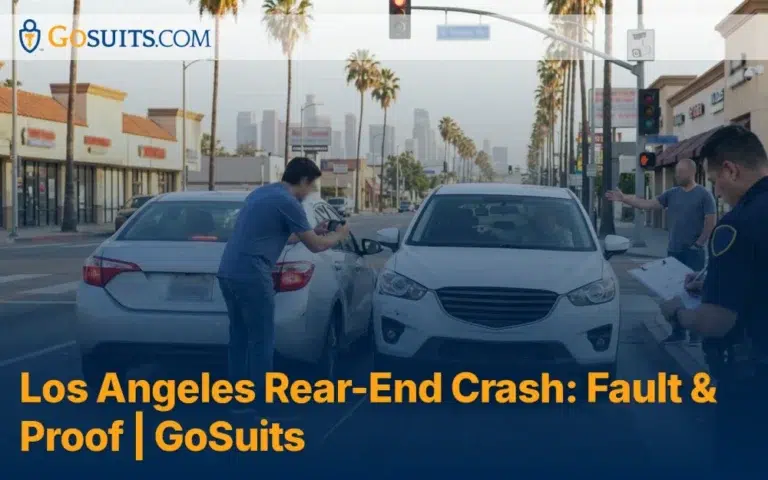
What counts as a rear-end crash in Los Angeles CA?
A rear-end crash happens when one vehicle strikes the back of another. In Los Angeles traffic, this can occur at red lights, at congested freeway merges on the 110, 405, 101, and 10, in lane drops, or during sudden slowdowns on surface streets. California law does not automatically decide fault just because a vehicle was rear-ended, but several California Vehicle Code rules often apply to how drivers must behave in traffic, including following distance and safe speed requirements [1] [3]. Understanding these rules helps both injured people and drivers facing a claim evaluate civil liability in state court.
From a civil law perspective, a rear-end crash is analyzed through negligence. A plaintiff must show duty, breach, causation, and damages. California statutes and jury instructions help define reasonable driving behavior, and courts allow juries to consider violations of safety statutes under negligence per se principles [4]. Because Los Angeles roads are busy, evidence from the scene can disappear quickly. It is helpful to take photos, gather witness names, and seek timely medical evaluation as documentation for a potential civil claim.
Who is usually at fault in a rear-end collision in California?
There is no automatic fault rule in California, but the trailing driver is frequently found negligent because drivers must not follow another vehicle more closely than is reasonable and prudent, considering speed, traffic and roadway conditions [1]. Drivers must also travel at a safe speed for conditions, even if that is below the posted limit, under the basic speed law [3]. If a trailing driver fails to keep a safe following distance or speed and hits a stopped or slowing car, that violation can support a breach of the duty of care.
However, the lead driver can share or bear fault in some situations. For example, California prohibits stopping or suddenly decreasing speed without an appropriate signal when there is an opportunity to signal and doing so could affect another driver [2]. If a lead driver suddenly brakes without proper signaling, cuts in unsafely, or has non-functioning brake lights, a jury can assign comparative fault to the front vehicle. Each case turns on its facts, and the jury weighs what a reasonably careful driver would have done in the same situation using California negligence standards [4].
How do you prove fault after a Los Angeles rear-end crash?
Proving fault typically combines statutes, physical evidence, and witness testimony. Some of the strongest evidence includes:
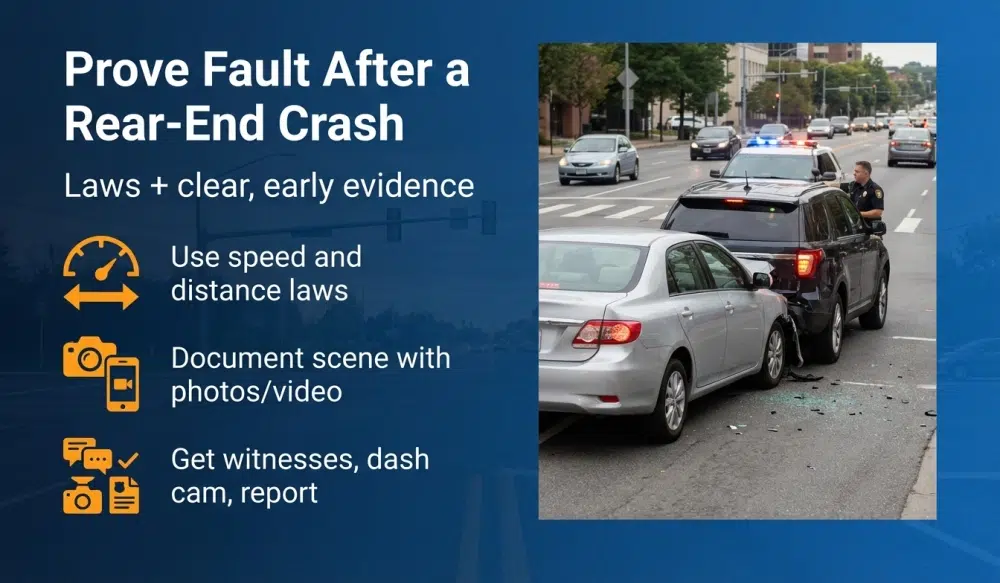
- Traffic laws showing what each driver was required to do. California’s following distance rule, basic speed law, and signaling duties often anchor fault analysis [1] [2] [3].
- Scene photos and video documenting lane positions, impact points, skid marks, debris fields, and traffic controls.
- Vehicle damage profiles showing crush patterns that can be correlated with movement and speed changes.
- Dash cam and surveillance footage, in stores, buses, rideshares, or nearby intersections. Properly authenticated video can be persuasive evidence [10].
- Witness statements providing objective descriptions of following distance, last-second maneuvers, and signaling.
- Police report observations including diagrams and noted violations. In court, police reports are generally hearsay unless an exception applies, such as the official records exception [11].
When a traffic law designed to protect against the type of harm that occurred is violated, California’s negligence per se doctrine allows the jury to use that violation as evidence of negligence if the violation was a substantial factor in causing harm, subject to statutory conditions [4]. For example, violating the following distance rule can support a finding that the trailing driver breached their duty of care if that violation contributed to the collision [1].
If you plan to make a claim, gathering this evidence early matters. Businesses often overwrite surveillance video within days. Request preservation promptly and keep copies of all records. Using car accident lawyers for structured evidence collection can help preserve and present the right proof in negotiation and at trial.
What defenses might insurers raise in rear-end cases, including sudden stop or brake-check arguments?
Defendants and insurers often argue that the lead driver caused or contributed to the crash through one of these theories:
- Sudden emergency: A driver confronted with a sudden and unexpected emergency not of their own making is not negligent if they act as a reasonably careful person would in similar conditions. California juries are instructed on this principle in appropriate cases [13].
- Sudden stop or brake-check: If the front driver stopped or rapidly slowed without proper signaling when there was an opportunity to signal, a jury may allocate fault to the lead driver under California Vehicle Code rules [2].
- Unsafe lane change or cut-in: If a front driver abruptly moved into a lane without space, the trailing driver may have had no reasonable chance to avoid impact, supporting comparative fault.
- Non-functioning brake lights: A vehicle with broken brake lights deprives others of essential warning, which can factor into fault apportionment.
- Chain reaction uncertainty: In multi-vehicle pileups, defendants argue the forces came from a vehicle further back. The jury determines each party’s share of responsibility based on the sequence of impacts and distances.
California’s comparative negligence system means a plaintiff can still recover even if they share fault, with damages reduced by their percentage of responsibility [5]. Because of this, defense strategies often focus on increasing the plaintiff’s percentage of fault to reduce the payout. Careful evidence development and timely investigation can address these arguments.
How does California comparative negligence change a rear-end case?
California follows pure comparative negligence. In a landmark decision, the California Supreme Court held that a plaintiff’s damages are reduced by their own percentage of fault, rather than completely barred [5]. In practice, this means a person injured in a rear-end crash can still recover compensation even if they are partly at fault for following too closely, failing to signal, or making an unsafe maneuver, but the court or jury will assign percentages to each party and reduce the award accordingly.
California law also allocates responsibility between defendants. For noneconomic damages such as pain and suffering, each defendant is liable only for their percentage of fault. For economic damages such as medical expenses and lost wages, different rules may apply under California’s comparative fault and damages statutes [14]. In multi-defendant rear-end cases, this can influence settlement strategy and trial presentation, as parties seek to shift portions of fault among multiple drivers.
What evidence should you gather in Los Angeles and how do you get it?
In Los Angeles, you often have access to multiple forms of evidence to help prove who caused a rear-end collision:
- Photos and video: Use your phone to capture all vehicles, road conditions, skid marks, debris, traffic signals, and nearby businesses with cameras.
- Witnesses: Ask for names, phone numbers, and emails. Independent witnesses can be vital to establish following distance and signaling.
- Vehicle event data: Some vehicles store pre-crash speed and braking data, which can be obtained by subpoena or consent.
- Dash cams: California permits small, properly mounted windscreen cameras that do not obstruct the view. A legally compliant mount location helps avoid equipment violation issues [12].
- Police report: Request the traffic collision report. It can help in insurance negotiations, and portions may be admissible under the official records exception if foundational requirements are met [11].
- Medical records: Document symptoms and treatment. Even low-speed rear-end impacts can cause soft tissue injury. Although the report itself is not proof of fault, it documents causation and damages.
- DMV and legal reporting: California requires reporting certain crashes to the DMV and sets additional rules when collisions involve injury, death, or a public vehicle [9].
Authentication is crucial. Any photo or video must be shown to be what you claim it is before a court can consider it. California Evidence Code provides the foundation standards for authenticating writings and recordings [10]. If you believe a nearby business or bus had cameras pointed at the scene, send a prompt preservation request. Many systems overwrite footage in days.
What do police reports and dash cam footage mean for proving fault?
Police reports can shape settlement negotiations. They may note a Vehicle Code violation, diagram the scene, and include witness statements. In court, the report itself is generally hearsay, but the official records exception can allow admission of certain parts if the requirements are met, including that the record was made by and within the scope of a public employee’s duty and at or near the time of the event [11]. Even if the report is not admitted, the officer or witnesses may testify to their own observations.
Dash cam footage can be highly persuasive. California permits windshield-mounted devices within limited areas if they do not obstruct the driver’s clear view, and devices must be positioned in designated zones to comply with the law [12]. In court, you must authenticate the video by showing it fairly and accurately depicts the scene, often through a witness with knowledge, consistent with the Evidence Code’s authentication standards [10]. Any audio capture should also comply with California recording laws outside the scope of this article. Practically, clear video of following distance, brake lights, turn signals, and impact sequence can make or break a liability dispute.
How do insurance claims and settlements work for a rear-end crash in Los Angeles?
After a rear-end collision, you typically file a claim with the at-fault driver’s liability insurer and, if needed, your own insurer for collision coverage or uninsured or underinsured motorist coverage. California’s fair claims regulations set timelines and standards for insurers to acknowledge, investigate, and make decisions on claims. Insurers must act reasonably and communicate promptly according to state regulations enforced by the Department of Insurance [15].
Expect the insurer to analyze fault using police reports, driver statements, and photos. They may cite the following distance rule and basic speed law against the rear driver [1] [3], or raise sudden stop and cut-in defenses against the lead driver [2]. Because California uses pure comparative negligence, even a partial fault assessment does not end a claim. Rather, it adjusts the negotiation range by the anticipated percentage of responsibility [5].
Documentation drives settlement value. Organize medical records, bills, proof of lost wages, and repair estimates. Keep a diary of pain and daily limitations. If injuries persist, ongoing treatment records and physician notes help establish future care needs. Where a government vehicle or roadway maintenance is involved, additional notice requirements apply and can shape the insurance and litigation timeline [8].
What injuries and damages are common in rear-end crashes and how are they documented?
Common injuries in a rear-end collision include neck and back strain, disc injuries, concussive symptoms, shoulder and knee trauma from bracing, and hand or wrist injuries from steering wheel impact. On the property side, rear bumper, trunk, and quarter panel damage is typical, with potential intrusion into the passenger compartment at higher impact speeds. Documentation generally includes:
- Emergency and primary care records for initial complaints and objective findings.
- Specialist evaluations such as orthopedics or neurology, and imaging results if ordered as part of care.
- Physical therapy or chiropractic notes documenting progress and functional limits.
- Vehicle inspection reports and photographs that correlate with mechanism of injury.
- Work records proving time off and wage loss.
California allows plaintiffs to recover economic damages such as medical bills and lost earnings and noneconomic damages such as pain and suffering when proven. In multi-defendant cases, the allocation of economic and noneconomic damages follows California’s statutory scheme for apportionment among defendants [14]. A thorough record helps accurately capture both short and long-term impacts.
What deadlines apply, including the statute of limitations and public entity claims?
Deadlines in California are strict and missing them can end a case. Key time limits include:
- Personal injury statute of limitations: Generally 2 years from the date of the crash to file a lawsuit for bodily injury [6].
- Property damage statute of limitations: Generally 3 years to bring a property damage claim [7].
- Claims against public entities: If a city, county, or state agency is involved, you usually must file a government claim within 6 months of the incident before suing, with specific statutory procedures and exceptions [8].
- DMV reporting: If the collision meets California’s reporting criteria, a driver must file the required report with the DMV within 10 days in accidents causing injury, death, or property damage of at least the statutory threshold amount [9].
There are exceptions that can pause or extend deadlines in limited circumstances, such as when a minor is injured, but these rules are technical. Prompt action preserves your rights to bring a civil claim in the Los Angeles Superior Court if settlement talks fail.
How is fault handled in multi-vehicle chain reaction rear-end crashes?
Chain-reaction collisions on the 405 or 101 often involve multiple impacts and vehicles. The analysis focuses on who initiated the sequence and whether any driver failed to act reasonably under the circumstances. The first striking vehicle is not automatically 100 percent at fault, and intermediate drivers can be responsible if they followed too closely or failed to maintain a safe speed for conditions [1] [3].
Evidence such as dash cam video, eyewitness accounts, and crash reconstruction can separate the initial impact from subsequent impacts. California’s pure comparative negligence and damages allocation rules allow juries to assign different percentages of fault to multiple drivers and distribute damages accordingly, with noneconomic damages assigned severally to each defendant [14]. In practice, this means each party’s insurer may fund a share of the settlement or judgment consistent with assigned responsibility.

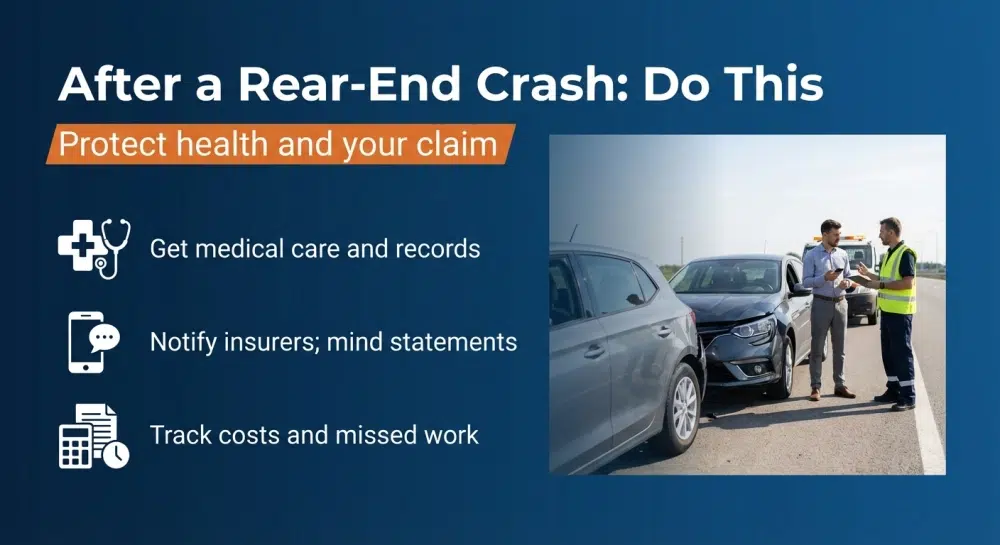
What steps should you take in the days after a rear-end crash?
Here is a practical checklist for the first days and weeks after a rear-end collision in Los Angeles:
- Seek medical evaluation to document injuries and rule out serious conditions. Follow physician guidance and keep all records.
- Report as required to law enforcement and the DMV if statutory thresholds are met, including California’s DMV reporting rule [9].
- Notify insurers promptly to avoid coverage issues, but be mindful when providing recorded statements if fault is disputed.
- Preserve evidence by requesting video from nearby businesses or transit within days, saving dash cam footage, and keeping vehicle parts.
- Track expenses and lost wages with pay stubs, employer letters, and receipts.
- Document pain and limitations in a daily journal to capture the human impact of injuries over time.
- Consider legal representation to coordinate evidence and protect your rights in negotiations and, if needed, in court.
If your crash involved a rideshare, delivery truck, or government vehicle, additional insurance layers and notice rules may apply. In those cases, prompt investigation and tailored strategy can be crucial to preserve claims and meet short deadlines under California’s Government Claims Act [8].
How do local Los Angeles conditions affect rear-end collision liability?
Do congestion and stop-and-go traffic change the standard of care?
Stop-and-go traffic on the 405 or the 110 does not excuse unsafe following distance. The Vehicle Code requires a reasonable and prudent following distance tailored to traffic conditions. In heavy congestion, a reasonable driver anticipates frequent slowdowns and maintains spacing sufficient to stop safely [1].
What about sudden slowdowns near freeway merges and exits?
Near ramps like the 101-110 interchange, sudden slowdowns are common. The basic speed law requires drivers to travel at a speed no greater than is reasonable for conditions, even if that is below the posted limit [3]. Evidence of brake lights ahead and traffic patterns, captured on dash cam or by witnesses, can show the reasonable response time a driver should have allowed.
How do L.A. intersections and bus lanes factor in?
When buses or rideshares stop at curbs, trailing drivers must adjust spacing and speed to accommodate predictable stops. A front vehicle stopping as required by traffic laws is not negligent simply because the stop was abrupt, but signaling and lighting remain relevant to apportioning fault [2]. Photographs and signal timing data can clarify who had the duty to yield or signal.
How can you build a stronger proof package for a rear-end case?
What does a proof package include?
A complete package for settlement usually contains: scene photos and video, vehicle damage estimates, medical records and bills, wage loss proof, expert statements where appropriate, and a liability memo tying the facts to California statutes and case law. Organizing proof with a clear timeline of events and highlighting statutory duties, such as following distance and proper signaling, makes it easier for an adjuster or mediator to evaluate fault [1] [2] [3] [4].
Why do authentication and hearsay rules matter?
Even compelling video or business records must be admissible to carry weight in court. California Evidence Code requires authentication for recordings and sets conditions for the official records exception. Laying the proper foundation means your strongest evidence can support motions and trial presentation [10] [11].
How do you handle conflicting stories?
Conflicting statements are common. Corroboration through physical evidence, time-stamped videos, brake light functionality, and consistent medical documentation helps a fact finder decide which account aligns with objective facts. Where appropriate, accident reconstruction can interpret crush damage and stopping distances consistent with California rules of the road [1] [3].
What role do attorneys play in rear-end liability and proof?
Why consider legal help instead of going it alone?
Civil liability disputes turn on statutes, evidence rules, and procedural deadlines. A negotiation that overlooks comparative negligence or a Government Claims Act deadline can compromise the case value or viability. Beyond gathering proof, attorneys evaluate apportionment under California law and present statutory violations in a clear negligence framework, which can influence both settlement and trial outcomes [5] [8].

What should you ask in an initial consultation?
Ask about the approach to evidence preservation, strategies for disputing sudden stop or cut-in defenses, and experience with multi-defendant apportionment under California’s damages statute. Understanding timelines, communication practices, and trial readiness helps align expectations. Many people find that working with car accident lawyers helps coordinate the legal and factual aspects while they focus on recovery.
How do police reports, DMV rules, and local processes intersect in Los Angeles cases?
Do you need a police report for a civil claim?
While not strictly required, a police report can document key facts and identify witnesses. Portions of a report may be admissible under the official records exception if statutory criteria are established [11]. Reports can also prompt insurers to accept liability faster where clear violations are noted.
What about the DMV accident reporting requirement?
California requires a DMV report within 10 days if the crash involves injury, death, or property damage meeting the threshold amount set by statute. The duty applies regardless of fault and ensures financial responsibility is documented. Failure to report can affect driving privileges and claim handling [9].
Can a dash cam help or hurt my case?
Yes. A properly mounted dash cam can capture following distance, brake lights, and signaling. It can also record a lead driver’s unsafe cut-in or a lack of signaling before a sudden stop. The device must be mounted within legally allowed areas so it does not obstruct the driver’s view [12]. In civil court, the footage must be authenticated to be considered [10].
How do California laws on negligence per se and speed rules affect rear-end liability?
What is negligence per se and how does it apply in rear-end cases?
Negligence per se allows a jury to treat the violation of a statute designed to protect against a particular harm as evidence of negligence if the plaintiff was in the protected class and the violation caused the harm. In rear-end cases, violations of following distance, signaling, or safe speed laws may support negligence per se instructions and findings [1] [2] [3] [4].
How does the basic speed law factor in urban traffic?
The basic speed law requires a speed that is reasonable for conditions, not just at or below the posted limit. In dense Los Angeles traffic, drivers must anticipate frequent changes and maintain control. Failing to adjust speed for tailbacks or merging vehicles can support fault in a rear-end collision [3].
How do settlements account for multiple drivers under California law?
What is the effect of California’s damages apportionment statute?
California’s statute limits a defendant’s liability for noneconomic damages to their percentage of fault. In a chain reaction, this means each at-fault driver pays their share of noneconomic harm. This rule affects settlement dynamics, because defendants assess trial risk based on likely fault percentages and damage categories [14].
How do you present multi-defendant facts to an adjuster or jury?
Present a clear timeline and impact sequence, with diagrams, photos, and any video. Identify the initial impact, subsequent impacts, and any contributing acts like unsafe merges or sudden stops without signals. Tie each act to a specific California statute and explain how it contributed to the harm. This approach aligns with negligence and apportionment principles recognized by California courts [4] [5] [14].
What should defendants and their insurers consider in rear-end disputes?
What evidence helps rebut a presumption of trailing-driver fault?
Defendants often look for lead vehicle conduct that broke the chain of causation, like a sudden stop without signaling where there was an opportunity to signal, a cut-in leaving no reaction time, or non-functioning brake lights. Video and witness statements are key. If a sudden emergency exists not of the defendant’s making, the defense can seek a jury instruction consistent with California law [2] [13].
How should insurers evaluate comparative fault percentages?
Insurers commonly model scenarios to evaluate likely apportionment. For example, if a lead driver signaled late and a trailing driver was following too closely, a split allocation might be argued. The parties will weigh statutes, the sequence of impacts, and objective evidence when estimating how a Los Angeles jury might apportion fault under California comparative negligence [1] [5].
Where do settlement negotiations commonly stall in Los Angeles rear-end cases?
What are typical sticking points on liability?
Disputes frequently center on whether the lead driver signaled appropriately, whether the trailing driver had sufficient time and distance to stop, and the accuracy of the police report summary compared to video or photos. When both sides have credible evidence, comparative fault becomes the central negotiation point, with the parties debating percentages based on statutory duties [1] [2] [3].
What about injuries and treatment duration?
Insurers may contest the severity or duration of soft tissue injuries, especially where imaging is limited. Documented functional limitations, physician notes, and consistent treatment records help establish the relationship between the rear-end mechanism and ongoing symptoms. Wage loss supported by employer letters and pay records rounds out the economic picture.

How do you use legal rules to strengthen negotiations and trial readiness?
Which statutes are most persuasive in a rear-end liability brief?
For liability, California Vehicle Code sections on following distance, signaling before slowing, and the basic speed law provide clear standards [1] [2] [3]. For evidentiary support, cite negligence per se and the official records exception. For video, explain authentication standards. For apportionment and damages, reference comparative negligence and the statute limiting noneconomic damages to each defendant’s share [4] [10] [11] [14].
How can a structured demand letter help?
A structured demand letter that opens with a concise facts section, identifies applicable statutes, explains why each party’s conduct breached those duties, and then presents medical and economic documentation, helps adjusters evaluate risk. Referencing California’s fair claims handling standards also keeps the claim on track procedurally [15].
If your injuries are significant or liability is disputed, you may benefit from discussing your situation with Los Angeles car accident lawyers who can organize evidence and present a clear liability narrative grounded in California statutes and case law.
If you are evaluating options after a crash and want a local perspective on Los Angeles traffic patterns, court expectations, and insurer practices, consulting with car accident lawyers in Los Angeles can help you understand timelines, strategy, and the proof needed to move a case forward.
Why choose GoSuits for a Los Angeles rear-end collision case?
Rear-end collision cases in Los Angeles can turn on seconds of video, a few feet of following distance, and the timing of a signal. We focus on civil claims for injured people and families in California. A free consultation with a personal injury attorney can help you understand next steps, preserve evidence, and map out a strategy aligned with California law and deadlines.
- Where we practice: We serve clients throughout California, including Los Angeles, Orange, Riverside, San Bernardino, Ventura, San Diego, and the Bay Area.
- Technology-driven approach: GoSuits uses exclusive proprietary software to streamline intake, document collection, and case building, helping move claims faster while maintaining quality control.
- Innovation leadership: Our platform integrates medical records, billing, and photo or video evidence into a single secure workspace to support negotiations and trial preparation.
- Dedicated attorney access: Although we leverage technology to expedite cases, every client has a designated attorney and unfettered access to that attorney. We do not use case managers in place of lawyers.
- Trial experience: Trial readiness drives better results. Our attorneys prepare cases as if they will be tried, which helps us identify strengths and address weaknesses early.
- Past results: See a selection of outcomes on our page of prior cases. Past results do not guarantee future outcomes, but they show how preparation and advocacy can make a difference.
- Team and background: Learn more about our attorneys and our story on the about us page.
- Practice areas and experience: We handle motor vehicle crashes, premises liability, product liability, wrongful death, and more. Explore our full list of practice areas. Our team brings 30 years of combined experience to negotiation, litigation, and trial.
If you were rear-ended or face a disputed liability claim in Los Angeles, we can help you gather the right proof, address sudden stop or brake-check defenses, and navigate comparative negligence under California law. We welcome the opportunity to speak with you and map out a plan based on your needs and goals.
References and resources
- Following Too Closely, California Vehicle Code 21703 – California Legislative Information
- Stopping or Suddenly Decreasing Speed, California Vehicle Code 22109 – California Legislative Information
- Basic Speed Law, California Vehicle Code 22350 – California Legislative Information
- Negligence Per Se, California Evidence Code 669 – California Legislative Information
- Li v. Yellow Cab Co. of California, 13 Cal.3d 804 – CourtListener
- Personal Injury Statute of Limitations, Code of Civil Procedure 335.1 – California Legislative Information
- Property Damage Statute of Limitations, Code of Civil Procedure 338 – California Legislative Information
- Government Claims Act Claim Presentation, Government Code 911.2 – California Legislative Information
- DMV Accident Reporting Requirement, California Vehicle Code 16000 – California Legislative Information
- Authentication of Writings and Recordings, Evidence Code 1400 – California Legislative Information
- Official Records Hearsay Exception, Evidence Code 1280 – California Legislative Information
- Obstructed Windshields and Dash Cam Placement, Vehicle Code 26708 – California Legislative Information
- Sudden Emergency Doctrine, CACI 452 – Judicial Council of California
- Apportionment of Noneconomic Damages, Civil Code 1431.2 – California Legislative Information
- Fair Claims Settlement Practices Regulations Overview – California Department of Insurance