- What makes rear-end collision fault different in California?
- How is fault determined in a California rear-end collision?
- Is the rear driver automatically at fault, or is it just a presumption?
- What common exceptions can shift fault away from the rear driver?
- How does pure comparative fault affect rear-end collision cases in California?
- Who is at fault in multi-car chain reaction rear-end crashes?
- What evidence helps prove or defend a rear-end collision case?
- How do insurance claims work after a rear-end collision in California?
- What injuries are common in rear-end collisions, and how do they impact damages?
- How do local California cities approach rear-end collisions?
- What is the statute of limitations for California car accident and property damage claims?
- Do you need a police report for a rear-end collision in California, and is it admissible?
- What defenses do drivers have in rear-end collisions?
- What practical steps should you take after a rear-end collision in California?
- Why choose GoSuits for a California rear-end collision case?
- References and resources
What makes rear-end collision fault different in California?
You may have heard that the driver in the back is always at fault in a rear-end collision. California law does not make it automatic. Instead, California applies rules of negligence, statutory duties in the California Vehicle Code, and a pure comparative fault system that divides responsibility by percentages. Rear-end collisions are common, nationally among the most frequent crash types, and often happen at intersections, in stop-and-go traffic, and in highway congestion. Federal research has long identified rear-end crashes as a leading crash mode, making careful fault analysis essential for fair outcomes [10].
In civil cases, the question is who failed to use reasonable care. The analysis looks at the following: distance, speed, signaling, brake lights, roadway conditions, any sudden or unsafe stops, and each driver’s ability to foresee and avoid the crash. Specific California statutes often come into play, including the rule against following too closely [1], the basic speed law [3], and signaling requirements for sudden decreases in speed or stopping [2].
How is fault determined in a California rear-end collision?
California uses a negligence framework: a driver who fails to use reasonable care and causes harm is liable for damages. Violations of safety statutes can support negligence per se if the violation was a substantial factor in causing the collision. Evidence Code section 669 allows a court or jury to treat a statutory violation as a presumption of negligence when certain conditions are met [5]. In rear-end crashes, the statutes most often involved include:
- Following too closely: A driver must not follow another more closely than is reasonable and prudent, having due regard for speed, traffic, and roadway conditions [1]. This frequently anchors fault when a trailing driver does not keep enough space to stop safely.
- Basic speed law: A driver may not drive at a speed greater than is reasonable or prudent having due regard for weather, visibility, traffic, and surface conditions [3]. Even at or below the posted limit, speed can be unsafe in congestion or poor conditions.
- Sudden stop or speed decrease without signaling: A driver must not stop or suddenly decrease speed without first giving an appropriate signal when there is an opportunity to do so [2]. This can matter in brake checking liability California and in stop-and-go traffic.
- Brake lamp requirements: Vehicles must have operational stoplamps that display a red light visible from a specified distance when brakes are applied [4]. Inoperative or obscured brake lights can shift or share fault.
Courts also look to California Civil Jury Instructions for guidance on duties and presumptions, including the negligence per se framework [7].
Is the rear driver automatically at fault, or is it just a presumption?
It is not an automatic fault, but there is often a practical presumption or inference that the trailing driver was negligent, especially if they violated following too closely or were traveling too fast for conditions [1] [3]. That presumption can be rebutted. The leading driver might have created an unreasonable hazard, violated signaling rules for sudden stops, or had inoperative brake lights [2] [4]. The negligence per se doctrine is rebuttable, meaning the defendant can present evidence of excuse or justification under Evidence Code section 669, such as sudden emergency or equipment failure not due to lack of maintenance [5].
What common exceptions can shift fault away from the rear driver?

These scenarios are regularly litigated in California rear-end cases:
- Brake checking or unsafe sudden stops: If a leading driver abruptly brakes without signaling when there was an opportunity to do so, that may violate CVC 22109 and contribute to fault allocation [2].
- Inoperative or obscured brake lights: Nonfunctioning or obscured brake lamps can deprive the trailing driver of reasonable notice, shifting a percentage of fault [4].
- Cut-in with too little space: A leading vehicle merges or changes lanes leaving insufficient stopping distance, creating an unavoidable hazard.
- Sudden emergency: A driver confronted with a sudden and unexpected emergency not of their own making may not be negligent if their response was reasonable under the circumstances, as reflected in standard jury instructions for the sudden emergency doctrine [7].
- Unavoidable equipment failure: If a sudden mechanical failure occurs without prior notice and despite reasonable maintenance, that can rebut a negligence per se presumption linked to a statutory violation [5].

How does pure comparative fault affect rear-end collision cases in California?
California follows pure comparative fault. Each party is responsible for their percentage of fault, even if one party is 90 or 95 percent at fault. This rule was adopted in Li v. Yellow Cab Co. of California, which replaced older contributory negligence rules with a proportional system [6]. In practice, a jury might allocate fault like 70 percent trailing driver, 30 percent leading driver who brake checked or failed to signal. The plaintiff’s damages are reduced by their percentage of fault. A defendant can still recover if they were also injured, reduced by their share of responsibility.
Who is at fault in multi-car chain reaction rear-end crashes?
In a multi-car chain reaction rear-end, liability is often shared among multiple drivers. The first driver to impact may be primarily responsible, but each driver’s following distance, speed, and reaction can matter. For example, in a three-car stack at a stoplight in Los Angeles, the rear-most driver might strike the middle car, which is pushed into the first car. The rear-most driver may bear most fault if they violated following-distance rules, but the middle driver might also be assessed a small percentage if they were traveling too fast in approach or had defective brake lights. California law allows apportionment among multiple tortfeasors and comparative indemnity among defendants [15]. Plaintiffs sometimes pursue each driver that contributed to the impact, and defendants may seek contribution or indemnity based on comparative fault principles [6] [15].
What evidence helps prove or defend a rear-end collision case?
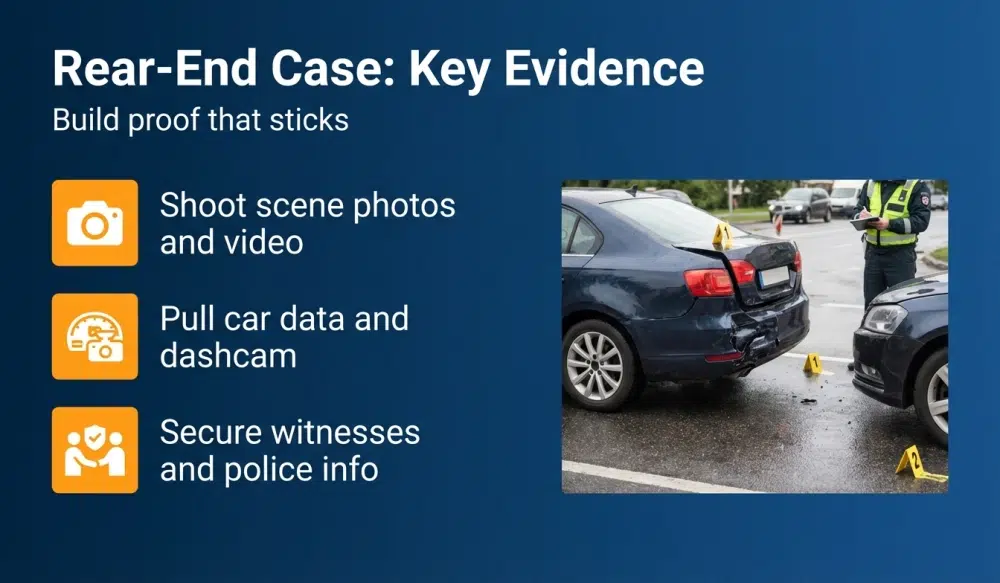
Whether you are the plaintiff or the defendant, a strong civil case is built on detailed, reliable evidence:
- Scene photographs and video: Vehicle positions, skid marks, debris fields, and damage patterns help reconstruct speed and direction. In San Francisco, bus or business cameras near intersections often capture signal phases and approach speeds.
- Vehicle data: Modern vehicles may store event data, including speed, braking, and throttle just before impact.
- Witness testimony: Independent witnesses can confirm whether a leading vehicle signaled, whether brake checking occurred, or whether the trailing driver had time to stop.
- Police records: Police reports, diagrams, and officer observations can be influential in settlement talks. In court, reports may be subject to the official records exception to hearsay under Evidence Code section 1280, but they can include multiple layers of hearsay that courts evaluate carefully [11].
- Statutory compliance: Proof that the trailing driver violated following too closely, or that the leading driver violated, can support negligence per se arguments [1] [2] [5].
- Vehicle condition: Records showing brake light maintenance or prior issues can matter. Photos of unlit or obstructed brake lamps may shift fault [4].
- Traffic signal timing data: In Sacramento or San Jose, municipal agencies can provide signal phase and timing logs that clarify yellow and red intervals and queue lengths.
- Medical documentation: Prompt medical evaluation creates a consistent record of injuries like whiplash for a rear-end collision at a stoplight in California, connecting symptoms to the collision.
How do insurance claims work after a rear-end collision in California?
Most cases start with a liability claim against the at-fault driver’s insurer. If you are in Los Angeles or San Diego and rear-ended at a stoplight, you might open a bodily injury and property damage claim. If hit by someone with inadequate coverage, you may use your uninsured or underinsured motorist coverage for losses. Early steps include:
- Notify your insurer promptly: Provide basic facts, not fault admissions. Insurers often request a recorded statement, but you can wait until you have guidance from car accident lawyers focused on California rear-end accident liability.
- Vehicle inspection: Insurers will assess repair costs or total loss value for a property damage claim in California.
- Medical evaluation: Document whiplash rear-end accident symptoms and follow recommendations.
- Preserve evidence: Keep dashcam video, photos, and repair invoices.
In settlement negotiations, insurers consider fault split under comparative negligence, medical records, wage loss documents, and repair estimates. Written demands often cite statutes, police report information, and independent witnesses. For multi-car chain reaction rear-end cases, insurers may coordinate apportionment among carriers using the same comparative principles recognized by California courts [6] [15].

What injuries are common in rear-end collisions, and how do they impact damages?
Injuries vary from minor soft-tissue strain to serious trauma. Common patterns include:
- Whiplash and soft-tissue injuries: These are frequently reported in a rear-end collision, including tenderness, stiffness, and headaches. Timely documentation supports claims for medical expenses and pain and suffering.
- Concussion or mild traumatic brain injury: Even low-speed impacts can transmit forces that affect the brain. A brain injury can complicate return-to-work timelines and raise long-term care needs for some clients, which is why careful evaluation matters for damages.
- Back injuries: Lumbar strain, disc herniations, or aggravation of preexisting conditions can occur, especially in higher-speed or heavy-vehicle impacts involving commercial vehicle accident lawyers in disputes about load, braking capability, and stopping distance.
How do local California cities approach rear-end collisions?
While state law governs liability, local context matters:
- Los Angeles: High congestion and frequent lane changes complicate determining who is at fault for a rear-end collision in California. Dashcams, traffic cameras, and Caltrans data can clarify lane merges, speed variance, and queue lengths.
- San Diego: Military and tourist corridors see mixed vehicle types. If a crash involves a large truck, the legal analysis can involve federal motor carrier regulations alongside the California Vehicle Code, which is why many people consult truck collision lawyers or commercial truck accident attorneys when serious injuries are involved.
- San Jose: Tech campuses and arterials create predictable peak-hour queues where following distance disputes are common under California rear-end collision laws.
- San Francisco: Hills and sight-line limitations affect stopping distance. Intersection geometry and signal timing are critical for rear-end crashes on grades.
- Sacramento: State routes and interchanges can produce multi-car chain reaction rear-end cases requiring comprehensive comparative fault analysis.
What is the statute of limitations for California car accident and property damage claims?
For personal injury, most California car accident claims must be filed within two years from the date of the collision, under Code of Civil Procedure section 335.1 [8]. For property damage, such as vehicle repair or replacement, the statute of limitations is generally three years, under Code of Civil Procedure section 338 [9]. Shorter administrative deadlines can apply when a public entity is involved, so prompt action is important.
Do you need a police report for a rear-end collision in California, and is it admissible?
California law requires reporting certain collisions:
- Police notification after injury or death: The driver must report the collision to the police or CHP within 24 hours when someone is injured or killed, per Vehicle Code section 20008 [13].
- DMV report requirement: Any collision with injury, death, or property damage above the statutory threshold must be reported to the DMV within 10 days using the SR-1 form, under Vehicle Code section 16000 [12].
- Admissibility limits: Accident reports required by statute, including the SR-1, are generally not admissible as evidence in civil trials under Vehicle Code section 20013 [14]. Police reports may be considered under the official records exception in Evidence Code section 1280, but courts scrutinize hearsay layers [11].
Practically, you should still obtain the police report for claim evaluation. It helps insurers assess liability and can guide further investigation, even if portions might not be admissible at trial.
What defenses do drivers have in rear-end collisions?
Both leading and trailing drivers may assert defenses:
- Comparative negligence: Argue the other driver was partially at fault, reducing exposure under pure comparative fault rules [6].
- No statutory breach or causation: Deny any violation of CVC 21703, 22109, or 22350, or argue that any technical violation did not cause the crash [1] [2] [3].
- Sudden emergency: Present evidence that an unexpected hazard forced immediate braking or evasive action consistent with reasonable care [7].
- Equipment failure without negligence: Show a sudden, unforeseeable brake or component failure unrelated to maintenance lapses, rebutting negligence per se [5].
- Third-party fault: Identify a cut-in driver or phantom vehicle whose actions triggered the collision, supporting fault apportionment [15].
What practical steps should you take after a rear-end collision in California?
- Get to safety and check for injuries: Call 911 if needed. Follow the requirements for reporting to police and the DMV when applicable [13] [12].
- Exchange information: Get names, license numbers, plates, insurance information, and contact info for witnesses.
- Photograph and document: Capture vehicle positions, damage, skid marks, traffic signals, and visibility. Note whether brake lights worked and if any sudden stop occurred.
- Seek medical care: Timely evaluation documents injuries and supports recovery planning.
- Notify insurers: Start your insurance claim rear-end accident California process without making admissions.
- Consult legal help: Rear-ended fault California issues can be complex, especially with multiple vehicles, disputed signaling, or contested injuries. Speaking with car accident lawyers or rear-end accident attorneys can help protect your rights and guide next steps.

Why choose GoSuits for a California rear-end collision case?
Rear-end collisions raise focused legal questions about following distance, signaling, and comparative negligence under California law. If you are navigating a claim in Los Angeles, San Diego, San Jose, San Francisco, Sacramento, or anywhere in California, a dedicated attorney can evaluate evidence, statutes, and jury instruction strategy in both settlement and trial.
- Free consultation with a California personal injury attorney: You can discuss the facts, timelines, and strategy in confidence. We focus on civil cases that include car accident, motorcycle accident, truck accident, brain injury, product liability, wrongful death, and more. See our full practice areas.
- Statewide practice with a client-first approach: We handle cases across California, from freeway chain reaction rear-end collisions in the Bay Area to intersection crashes in Southern California, and we adapt to local rules and court practices.
- Technology-driven, faster case movement: GoSuits uses exclusive proprietary software to streamline investigation, records collection, and case analysis, helping you move from claim to resolution efficiently while keeping accuracy at the forefront.
- Attorney access, not case managers: Although we use advanced technology to expedite your case, every client has a designated attorney and unfettered access for questions and strategy. We do not assign case managers in place of lawyers.
- Leadership in innovation and litigation: Our team brings 30 years of combined experience, significant trial experience, and a record of results for clients in complex rear-end and multi-vehicle collision matters. Review representative outcomes in our prior cases.
- Strategic focus on California law: We build cases on statutes like the California Vehicle Code rear-end provisions, negligence per se principles, and pure comparative fault California case law to position your civil claim for fair evaluation.
- Meet the team: Learn more about our attorneys and approach to client service at our attorneys and about us.
References and resources
- California Vehicle Code section 21703 Following Too Closely – California Legislative Information
- California Vehicle Code section 22109 Stopping or Suddenly Decreasing Speed – California Legislative Information
- California Vehicle Code section 22350 Basic Speed Law – California Legislative Information
- California Vehicle Code section 24603 Stoplamps – California Legislative Information
- Evidence Code section 669 Negligence Per Se – California Legislative Information
- Li v. Yellow Cab Co. of California, 13 Cal.3d 804 – CourtListener
- Judicial Council of California Civil Jury Instructions CACI 2024 Edition – California Courts
- Code of Civil Procedure section 335.1 Two-Year Limit for Injury – California Legislative Information
- Code of Civil Procedure section 338 Three-Year Limit for Property Damage – California Legislative Information
- Rear-End Crash Avoidance Technologies Summary – NHTSA CrashStats
- Evidence Code section 1280 Official Records Exception – California Legislative Information
- California Vehicle Code section 16000 Report of Accident to DMV – California Legislative Information
- California Vehicle Code section 20008 Duty to Report Accident – California Legislative Information
- California Vehicle Code section 20013 Accident Report Confidentiality and Evidence – California Legislative Information
- American Motorcycle Assn. v. Superior Court, 20 Cal.3d 578 – CourtListener