- What does disputed liability mean in a personal injury case?
- How do firms prove fault when each side blames the other?
- Which evidence changes outcomes in contested fault cases?
- How do federal, California, Texas, and Illinois differ on shared fault?
- How do insurers handle an insurance dispute liability claim?
- What happens during an independent medical examination and how should you prepare?
- How are damages valued when liability is shared?
- What timeline should you expect in disputed liability personal injury cases?
- Why work with GoSuits on disputed liability cases?
- References and resources
What does disputed liability mean in a personal injury case?
Disputed liability personal injury cases arise when the parties disagree about who caused the accident and to what extent. You might hear terms like shared fault personal injury, comparative negligence, or liability apportionment. In many states, your recovery can be reduced by your percentage of fault, and in some places you can be barred from recovery if your share of fault exceeds a statutory threshold [2][3][4][5]. Understanding which rules apply is critical because the governing system determines negotiation posture, trial strategy, and how a jury receives instructions on apportioning responsibility [6].
Disputed liability can occur in nearly any claim category, including motor vehicle collisions, premises incidents, construction site injuries, product defect claims, and wrongful death. The stakes are high. National data show traffic deaths remained at over forty two thousand in 2022, a level that keeps fault disputes in focus for families and insurers [11]. Crashes involving large trucks are particularly complex due to multiple potential defendants and federal regulations, with thousands of fatalities annually documented in federal reports [12].
Because contested fault cases turn on details and proof rules, working with personal injury law firms for disputed liability can be decisive. Strategic planning begins immediately with preservation of evidence and a clear theory of liability that aligns with the jurisdiction’s comparative negligence framework [2].
How do firms prove fault when each side blames the other?
Proving fault in disputed liability cases requires a structured approach that matches evidence to the legal elements and the governing standard in the jurisdiction. The core steps are consistent across case types.
What is the first move in a contested fault investigation?
Preserve evidence on day one. Firms send a spoliation letter that instructs opposing parties to preserve electronically stored information and physical evidence. Courts can impose sanctions when relevant electronically stored information is lost if reasonable preservation steps were not taken [8]. Early preservation supports later discovery requests for vehicle event data, surveillance footage, telematics, and maintenance records under Rules 26 and 34 of the Federal Rules of Civil Procedure or comparable state rules [7][8].
Why does comparative negligence change the proof plan?
Under comparative negligence, the goal is not only to prove the defendant’s negligence but also to limit any percentage attributed to you. In California, the Li v. Yellow Cab decision adopted pure comparative negligence, allowing a plaintiff to recover even if mostly at fault, with the award reduced accordingly [1]. In modified comparative negligence states, recovery may be barred if you are more at fault than the defendant or reach a 50 percent threshold, making the allocation battle essential [2][3][4].
How do teams unify facts with the law at trial?
Trial teams map the facts to pattern jury instructions that explain to jurors how to assign percentages of fault. In California, a standard civil instruction tells jurors to consider all negligence that contributed to harm, then reduce damages by the plaintiff’s share [6]. Comparable instructions exist in other states and often reference the state statute on comparative fault or proportionate responsibility [3][4].
When motor vehicle crashes are involved, car accident lawyers often build demonstrative exhibits that synchronize eyewitness accounts, vehicle crush damage, roadway evidence, and vehicle data. Those exhibits help jurors visualize how and why a particular driver’s choices were the primary legal cause of the crash, even if the other driver made mistakes too [9][10].
Which evidence changes outcomes in contested fault cases?
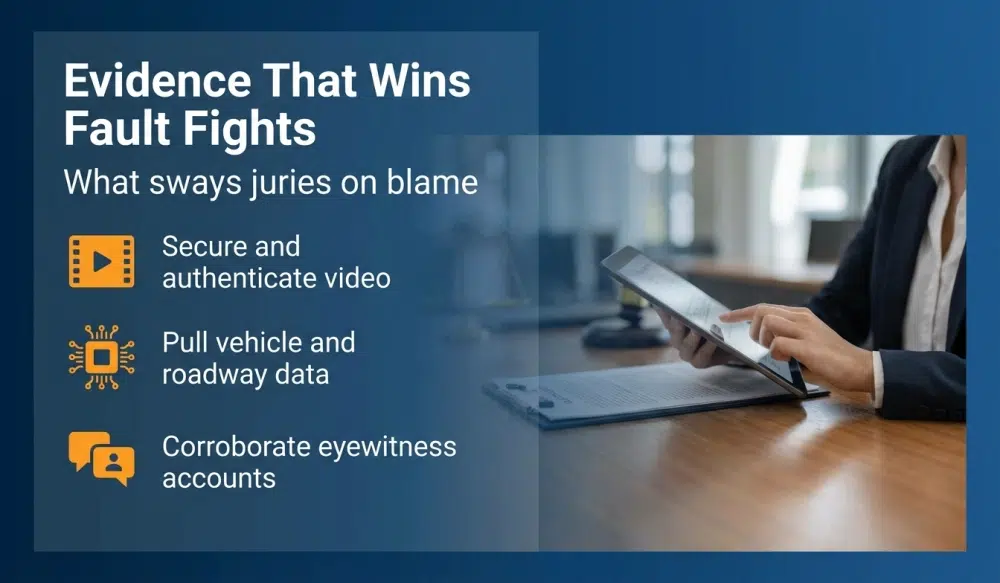
Evidence wins or loses disputed liability cases. Rules of evidence define which proof gets in front of the jury and how it must be authenticated, so a solid plan ties each exhibit to an admissibility pathway [9][10].
How valuable is dashcam and surveillance evidence?
Video can be central to apportioning fault. Relevance requires that the footage make a consequential fact more or less probable, and it must be properly authenticated as what it purports to be [9][10]. Chain of custody logs, device metadata, and witness testimony support authentication. In premises cases, closed circuit footage can clarify who created a hazard and when it appeared, which is vital for addressing notice and comparative fault analysis [15].
When tackling store slip and fall cases, slip and fall lawyers look for timestamped video to test whether inspection policies were actually followed. That evidence counters arguments that a hazard had just appeared before the incident, which defense teams frequently assert [10].
What vehicle and roadway data sway juries?
Modern vehicles often record speed, throttle, braking, and seat belt status in event data recorders. This data, combined with braking marks, point of impact, and crush measurements, can support a professional reconstruction that shows the principal cause of the crash. Reconstruction analyses should be paired with admissibility strategies and lay witnesses to satisfy the rules of evidence without relying on prohibited opinions [9][10].
Because heavy vehicle collisions often involve multiple defendants, trucking logs, dispatch data, and maintenance records can be pivotal. Truck accident lawyers evaluate hours of service compliance and mechanical condition to connect regulatory breaches to causation [12].
How do eyewitness statements fit into a fault fight?
Eyewitness recollections can vary, but they help fill chronology gaps. Corroboration through physical evidence and video is key. Guidance from justice system resources highlights well documented methods for collecting reliable eyewitness evidence, which can reduce later disputes at trial [15].
Do prior remedial measures or settlement talks come into evidence?
Courts generally exclude evidence of subsequent remedial measures to prove negligence or product defect, and exclude settlement discussions when offered to prove liability or amount. These evidence rules shape how policy limits demand letter negotiations intersect with eventual trial proof [9].

What makes a preservation plan effective?
Successful plans specify the categories to retain, set reasonable retention steps, and follow up with discovery tailored to those categories. If electronically stored information is lost, courts look at prejudice and intent to decide on sanctions under the federal rules, so specificity and prompt action matter [8].
How do federal, California, Texas, and Illinois differ on shared fault?
Comparative negligence rules vary. Your rights and negotiation leverage depend on where the injury happened or which law applies.
What is the federal law baseline?
In diversity cases, federal courts apply state substantive law, so the applicable comparative negligence rule is state specific. Federal procedural rules govern discovery, including medical exams and electronic evidence sanctions, which can strongly influence disputed liability litigation [7][8].
How does California handle comparative negligence?
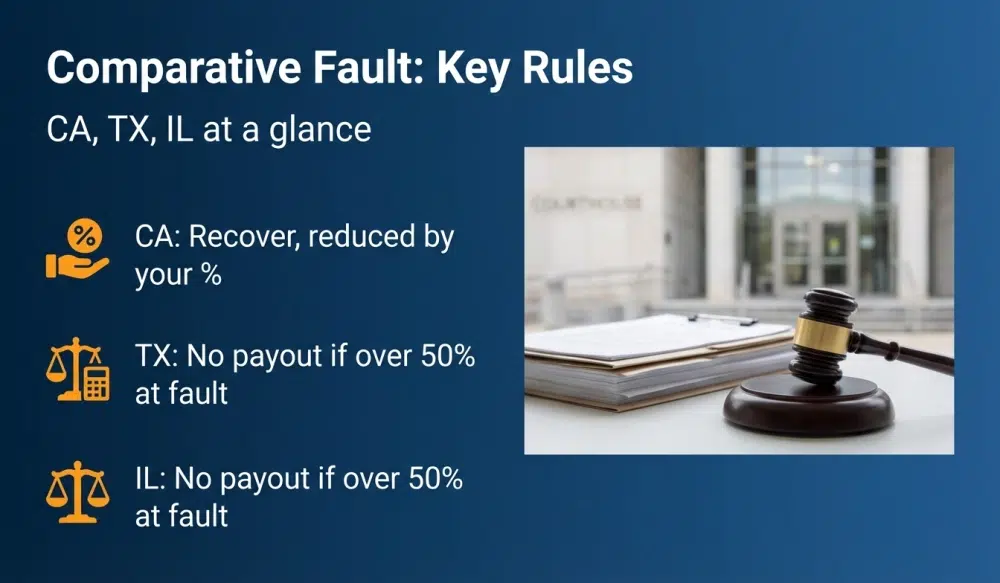
California follows pure comparative negligence. In Li v. Yellow Cab, the Supreme Court of California replaced contributory negligence with comparative fault, and civil cases now apportion responsibility between all negligent actors. California Civil Code section 1714 provides the general duty framework applied in negligence cases [1][5]. Jurors receive standardized instructions on reducing damages by the plaintiff’s percentage of fault [6].
For a traffic collision near an intersection, car accident lawyers in United States evaluate speed, lookout, and right of way as separate comparative factors so jurors can fairly weigh each driver’s conduct [6].
How does Texas apportion responsibility?
Texas uses proportionate responsibility. If a claimant’s responsibility exceeds 50 percent, the claimant cannot recover. Otherwise, damages are reduced by the claimant’s percentage of responsibility. This structure drives early case valuation and settlement tactics in contested fault scenarios [3]. Because timing and content of preservation efforts can affect electronic evidence availability, Texas cases often integrate federal or state analogs concerning spoliation when appropriate [8].
Given the complexity in crash litigation under this standard, truck accident lawyers in United States often work from the first week to secure logs and telematics that help anchor fault below the threshold bar [12].
How does Illinois apply modified comparative negligence?
Illinois follows a modified comparative negligence system. A plaintiff may not recover if more than 50 percent at fault. If 50 percent or less, damages are reduced by the plaintiff’s percentage of fault. The Illinois statute also addresses multiple defendants and several liability in certain contexts, which affects how defense teams allocate fault among co defendants and nonparties [4].
In a multi vehicle collision, motorcycle accident lawyers present lane position, conspicuity, speed, and gap acceptance evidence to keep plaintiff’s negating factors at or below the statutory limit while highlighting the primary negligence of the other driver [4].
How do insurers handle an insurance dispute liability claim?
When liability is contested, insurers examine statements, police data, recorded scene evidence, and medical records to model exposure under the governing comparative negligence regime. Settlement dynamics differ by state. In pure comparative systems, negotiation can continue even if significant fault is assigned to you. In modified systems, insurers may push harder if they believe your share exceeds the threshold, which would bar recovery [2][3][4].
What role does a policy limits demand letter play?
Policy limits demands set a clear settlement opportunity tied to known damages and liability proof. Communications intended to compromise a claim are typically not admissible to prove liability or damages if the matter proceeds to trial, so parties can negotiate without having those specific offers used as liability proof later [9].
How do commercial defendants defend disputed liability?
Commercial defendants focus on causation and apportionment. For example, in a premises case, a business may assert that the hazard was open and obvious or that a reasonable inspection occurred shortly before the incident. Slip and fall lawyers counter with inspection logs, audit trails, and video to prove notice, duration, or failure to follow safety policies [10][15].
In a product claim, product liability lawyers emphasize defect type and feasible alternative designs while preparing to rebut arguments that misuse or alteration was the predominant cause. Technical documentation and testing history often shape the apportionment analysis [9].
What happens during an independent medical examination and how should you prepare?
In civil litigation, a defense medical exam can be requested when your physical or mental condition is in controversy. The rules require good cause and reasonable notice, and orders can specify time, place, manner, conditions, and the scope of the examination. Preparation focuses on accuracy, completeness, and consistency with prior records [7].
What records are usually at issue during the exam?
Typical records include pre accident medical histories, imaging, therapy notes, and prior injuries that could affect causation or apportionment. Consistent documentation lines up your symptoms and limitations with mechanism of injury evidence, which supports credibility when fault is contested and damages are disputed.
When head injuries are claimed, brain injury lawyers coordinate neuroimaging, neuropsychological testing, and treating clinician narratives. These materials connect symptoms to trauma mechanisms, particularly in crashes and falls where defendants argue that other factors are responsible [13].
How are damages valued when liability is shared?
Damages are calculated in full and then reduced by your percentage of fault under comparative negligence systems. The full value includes economic and noneconomic components where allowed, with state specific limitations. In some states, joint and several liability rules for economic damages can affect collection strategy against multiple defendants, which matters when insurers dispute primary responsibility.
Do juries often split fault in civil cases?
National civil trial data show that plaintiffs do not win every trial, and awards vary widely by claim type. In state courts, plaintiff win rates in civil trials were in the mid range historically, and verdict amounts differed by case category. These statistics emphasize the importance of evidence development and jurisdiction specific strategy in disputed liability matters [14].
Because valuation must incorporate likely fault allocation, personal injury lawyers assess case worth as a range multiplied by a probability adjusted share of liability. This model helps you decide between settlement and trial, and it resonates with how mediators frame comparative negligence disputes.
In serious highway collisions, truck accident lawyers present economic damages tied to medical care, wage loss, and long term support needs, then demonstrate why defendant conduct was the predominant cause. Clear apportionment arguments strengthen settlement positions even before trial [12].
When a fatal incident is at issue, wrongful death lawyers align statutory beneficiaries, prove pecuniary losses, and address consortium or companionship damages as permitted by state law. The defense often contests causation and pre existing conditions, so careful medical and economic analysis is central to apportionment outcomes [14].
What timeline should you expect in disputed liability personal injury cases?
Timelines vary by venue and complexity, but most follow predictable phases.
How fast should you act after an incident?
Act immediately to preserve evidence. Time sensitive items like dashcam files, retail surveillance, and vehicle event data can be overwritten in days or weeks. Counsel will send preservation notices, secure inspections, and request data before it is lost or altered. This step directly influences later arguments about spoliation and sanctions in the event of missing materials [8][10].
What happens during claim investigation and negotiation?
During the pre suit phase, insurance adjusters examine statements, records, and liability arguments. If liability remains contested, counsel may issue a policy limits demand letter with supporting evidence packages. Although settlement communications are generally protected from use to prove liability, factual materials attached to demands can be independently admissible if they meet evidence rules [9].
What does litigation add to the timeline?
Litigation introduces discovery, depositions, and motion practice. Courts will address discovery disputes about the scope of inspection, the conditions of a medical exam, or the production of surveillance and telematics. If electronic data are missing, parties may seek sanctions or remedial measures under the rules [7][8]. Many contested fault cases resolve at mediation after key depositions and expert disclosures, but if trial is necessary, jurors receive instructions that tell them exactly how to apportion fault and reduce any damages accordingly [6].
Throughout, car accident lawyers in United States work to align the evolving evidence with the comparative negligence standard and the most persuasive story for judge or jury.
Which disputed liability scenarios are most common across the United States?
How do auto collisions become contested on fault?
Auto collisions often involve conflicting accounts, partial visibility, or momentary inattention by more than one driver. Firms analyze vehicle dynamics, roadway features, and decision timing to pinpoint primary causation. Car accident lawyers use synchronized timelines and authenticated video to reconcile inconsistencies between statements and physical evidence [9][10].
On national roadways with large commercial traffic, truck accident lawyers develop proof of rule violations and maintenance deficiencies that shift responsibility from a passenger car driver to a carrier when appropriate. Hours of service data, inspection histories, and brake performance evidence can clarify the true source of risk [12].
Do motorcycles change the liability analysis?
Motorcycle cases frequently include visibility defenses or claims of unsafe lane positioning. Skilled teams test those assertions with sightline studies, headlight conspicuity, and gap acceptance research. Motorcycle accident lawyers present a careful picture that protects rider rights under state comparative negligence rules while addressing juror biases with objective proof.
What turns a premises incident into a shared fault battle?
In premises claims, key debates include notice, inspection, and open and obvious hazards. Slip and fall lawyers gather logs, training materials, and video to test whether safety procedures were consistently applied. When defendants claim a hazard appeared moments before the fall, timestamped footage and witness accounts often tell a different story [10][15].
Do construction site injuries follow different rules?
Construction sites add layers of contractors and safety responsibilities. Contract language, site logs, and incident investigations determine who controlled the work and what safety measures were required. Construction accident lawyers examine oversight roles and specific duties to apportion fault among multiple entities.
How do product liability claims handle contributory conduct?
In product cases, defendants may argue misuse, alteration, or failure to follow warnings. Product liability lawyers counter with alternative design evidence, standards compliance analysis, and testing records, then address any plaintiff conduct through clear instruction about how comparative negligence applies to the particular defect theory in the jurisdiction [9].
Does the type of injury affect disputed liability strategy?
In head trauma cases, brain injury lawyers build causation with medical records, neuroimaging, and treating clinician reports. These materials answer common defense themes about pre existing conditions or unrelated causes. When outcomes are catastrophic, damages analysis and life care planning need to integrate apportionment scenarios so settlement and verdict models reflect likely fault splits [13].
When families face a fatal incident, wrongful death lawyers structure the claim to address every element under state law while anticipating comparative negligence defenses. Evidence of corporate safety culture, prior incidents, and post incident changes may face admissibility limits, so teams develop independent proof that satisfies rules on relevance and authentication [9][10].
Which practical steps should you take now if liability is contested?
Should you talk to the insurer before speaking with counsel?
Provide only basic information until you have guidance. Even innocent phrasing can be used later to argue a higher percentage of fault. Remember that early statements often occur before you have seen videos, event data, or incident reports that clarify what happened.
How do you document your injuries and limitations?
Keep a journal, save receipts, and attend all appointments. Consistency between your records and testimony strengthens credibility, which matters when jurors assign fault and damages. Personal injury lawyers will help align documentation with the elements required in your jurisdiction.
What if the other side refuses to share vital footage or data?
Your team can use discovery tools and targeted motions to compel production. If materials were lost or destroyed, courts can impose measures ranging from additional discovery to adverse jury instructions depending on prejudice and intent under the governing rules [8].
In many motor vehicle cases, motorcycle accident lawyers in United States submit prompt preservation notices to prevent loss of perishable camera files or telematics that can prove right of way, speed, or lane position.
Why work with GoSuits on disputed liability cases?
If you are facing a fault dispute after an injury anywhere in the country, you can connect with our team for a free consultation focused on your facts and the law that applies where your case will be filed. We represent clients Nationwide in the United States and handle civil claims that include auto, truck, motorcycle, premises, construction, product defect, brain injury, and wrongful death. You can review our approach and work at about us, learn about our attorneys, and see representative results at prior cases. Our full list of services is available on our practice areas page.
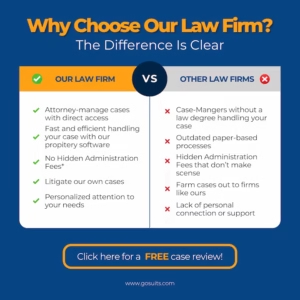
We built GoSuits to move disputed liability cases faster with accuracy. Our exclusive proprietary software organizes evidence, deadlines, and case valuation models for quicker insight and better strategic decisions. Although we use technology to expedite each matter, you will have a designated attorney from start to finish. We do not use case managers. You have direct access to your lawyer for updates, strategy meetings, and preparation for key events.
Over 30 years of combined experience inform our work across investigation, discovery, negotiation, and trial. When fault is contested, courtroom experience matters because jurors need a clear, admissible story that fits the law on apportionment. We have tried and resolved cases across categories, including complex multi vehicle crashes, premises incidents with significant surveillance evidence, and product defect claims with technical proof. You can explore selected matters on our prior cases page.
Our practice covers, among others:
- Motor vehicle collisions cars, trucks, and motorcycles with contested fault and multi defendant issues
- Premises incidents including falls, inadequate maintenance, and safety policy disputes
- Construction site injuries involving overlapping duties and contract based defenses
- Product defect claims focusing on design, manufacturing, and warning theories
- Catastrophic injury and wrongful death where apportionment strategy is central to outcome
Throughout your case, we assemble and authenticate proof, prepare you for depositions and any defense medical exam, and frame settlement options with clear apportionment scenarios. Our technology driven system keeps discovery and deadlines on track, and our attorneys are prepared to try your case when settlement is not appropriate.
References and resources
- Li v. Yellow Cab Co. 13 Cal.3d 804 1975 – CourtListener
- Comparative negligence overview – Cornell LII
- Texas Proportionate Responsibility Chapter 33 – Texas Statutes
- 735 ILCS 5/2-1116 Comparative fault – Illinois General Assembly
- California Civil Code section 1714 – California Legislature
- CACI 405 Comparative Fault Standard Instruction – California Courts
- FRCP 35 Physical and Mental Examinations – Cornell LII
- FRCP 37 Failure to Make Disclosures; Sanctions including ESI – Cornell LII
- FRE 401 Relevance – Cornell LII
- FRE 901 Authenticating or Identifying Evidence – Cornell LII
- Traffic deaths 2022 overview – NHTSA
- Large Truck and Bus Crash Facts 2021 – FMCSA
- TBI data and statistics – CDC
- Civil Bench and Jury Trials in State Courts – Bureau of Justice Statistics
- Eyewitness Evidence Guide – National Institute of Justice