- What should you do right after a truck crash in Los Alamitos?
- How do California and federal trucking laws affect your case?
- What evidence do truck accident lawyers secure and preserve?
- How do lawyers determine who is liable in a California truck collision?
- Which damages can you seek in civil truck accident cases?
- How do insurance claims and policy limits work after a semi truck crash?
- What are the deadlines to file a truck accident lawsuit in California?
- How do wrongful death claims work after a fatal truck crash?
- How do medical bills and liens get handled in truck injury cases?
- What happens if you were partially at fault under California law?
- How do settlement negotiations and mediation typically proceed?
- What litigation steps occur if your case goes to court?
- How do lawyers work with reconstruction and technical testimony?
- What local factors in Los Alamitos and Orange County can impact your case?
- What should commercial drivers and trucking companies know to reduce risk?
- What questions should you ask a Irvine truck accident attorney?
- Why is legal representation important rather than going it alone?
- How do contingency fees and case costs generally work in California injury cases?
- How can digital evidence from trucks and phones change outcomes?
- How GoSuits helps truck accident clients in Los Alamitos
- References and Resources
What should you do right after a truck crash in Los Alamitos?
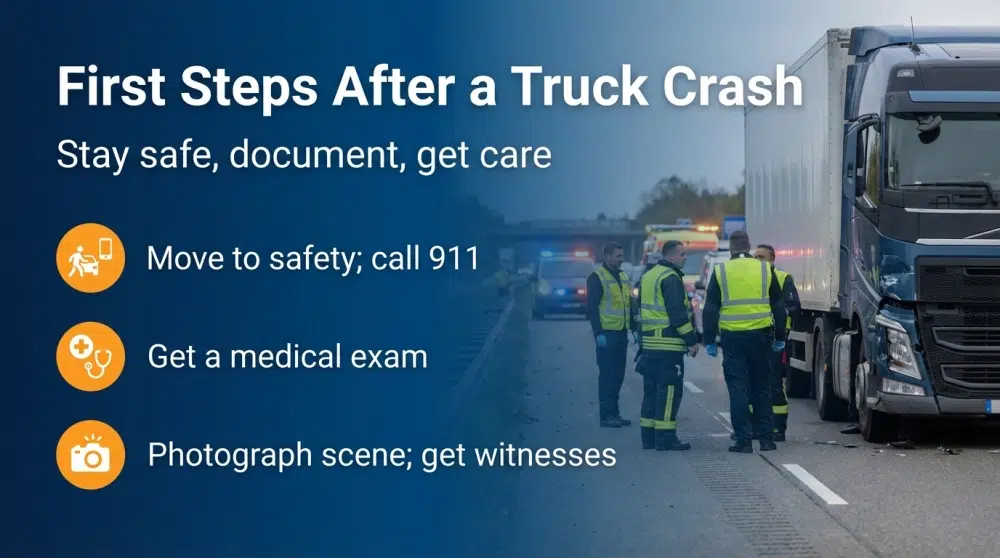
If you or a loved one was involved in a collision with a commercial vehicle in Los Alamitos, your priorities are safety, medical assessment, and preserving information. Move to a safe location if possible, call 911, and request police and medical responders. Even when injuries feel minor, get evaluated, because traumatic injuries can be masked by adrenaline. Photograph vehicle positions, skid marks, cargo spillage, license plates, USDOT and CA numbers on the truck cab, company branding on the trailer, road conditions, and any nearby businesses or traffic cameras. Gather names and contacts for witnesses and first responders.
Ask the responding officer how to obtain the collision report. If you suspect the driver was fatigued, impaired, distracted, or speeding, note those concerns. Avoid discussing fault at the scene. As soon as you can, write down a timeline of events and symptoms. Save damaged clothing and preserve your vehicle for inspection. Many people seek help from truck accident lawyers to coordinate medical care, preserve electronic data from the truck and trailer, and communicate with insurers while you focus on recovery.
How do California and federal trucking laws affect your case?
Commercial trucking is governed by federal safety rules and California state law. Interstate carriers and their drivers must follow hours of service limits designed to reduce fatigue, including maximum driving windows, daily and weekly caps, and mandatory rest breaks [1]. These limits are codified in federal regulation and are paired with required electronic logging devices that automatically record driving time from engine data streams [2]. Compliance and maintenance are also regulated. Carriers must systematically inspect, repair, and maintain their fleets, and document this work [3]. Drivers and carriers are subject to controlled substance and alcohol testing protocols, both random and post crash, under federal rules [4].
Federal law also sets minimum financial responsibility requirements for motor carriers. Depending on vehicle weight and cargo type, interstate carriers typically must carry significant liability insurance, with minimums that increase for hazardous materials [5]. Policies for interstate carriers usually include an MCS 90 endorsement, which is a federally required endorsement tied to financial responsibility that can influence how judgments are satisfied if a policy otherwise would not cover a particular loss [6]. Cargo securement rules specify how loads must be contained and tied down to prevent shifts, spills, or rollovers [7].
On the state side, California’s negligence rules and evidence standards govern most personal injury and wrongful death truck crash lawsuits filed in state court. Understanding both layers matters for proving a safety violation, showing causation, and negotiating with multiple insurers.
As context for the scope of the problem, federal data shows that in 2021 there were thousands of fatalities and many more injuries in crashes involving large trucks nationwide, with multi vehicle crashes constituting the majority of fatal events [8].
What evidence do truck accident lawyers secure and preserve?
Commercial vehicle cases hinge on fast, thorough evidence preservation. Federal rules require drivers to record duty status and carriers to retain supporting documents for set periods. Those sources, combined with vehicle electronics and third party records, can build a comprehensive timeline. A prompt preservation letter instructs the motor carrier and any third parties to retain relevant materials, including electronic data, paper records, and surveillance footage. When electronically stored information is lost after a duty to preserve arises, courts can impose measures under civil procedure rules that govern spoliation of digital evidence [13].
Key evidence sources commonly pursued include:
- Electronic logging device data documenting driving time, engine on off cycles, location pings, and duty status changes [2].
- Truck telematics and engine control module data showing vehicle speed, throttle, brake application, fault codes, and sometimes hard braking events around the time of impact.
- Pre and post trip inspection reports and maintenance logs to identify defects and verify compliance with inspection and repair protocols [3].
- Driver qualification file and drug alcohol testing records, including hiring, training, licensing, and any positive test history [4].
- Dispatch communications and bills of lading that reveal scheduling pressure, route planning, and cargo type.
- Cargo securement documentation and photos to assess whether tie downs and blocking met federal standards for the commodity involved [7].
- Scene data such as event photographs, roadway gouges and yaw marks, skid measurements, vehicle crush profiles, and surveillance or dash camera footage.
- Cell phone records that can corroborate or rule out device use at the time of the collision.
Time is critical because some data auto deletes or is overwritten. For example, certain logging data retention windows are measured in months, not years [1]. Early action helps secure the record before it disappears.
How do lawyers determine who is liable in a California truck collision?
Liability analysis looks at negligent acts or omissions by all entities involved. In a typical Los Alamitos crash, potential defendants might include the truck driver, the motor carrier employer, a trailer owner, a maintenance contractor, a shipper or loader, or a broker depending on the facts. Investigations focus on whether any party breached a duty of reasonable care and whether that breach caused the harm. Examples include driving beyond hours of service limits, falsifying logs, failing to secure a load, inadequate training, negligent retention of an unsafe driver, failure to inspect or repair brakes or tires, speeding, following too closely, or distraction. Evidence of a safety rule violation can support a negligence claim when causally linked to the crash.
From the defense perspective, a thorough evaluation considers compliance records, whether the plaintiff’s conduct contributed to the event, third party fault, sudden emergency, unavoidable mechanical failure despite proper maintenance, or intervening causes. Medical causation is also analyzed to distinguish pre existing conditions from new trauma. The goal on both sides is to understand what happened and why, guided by the documentary record and physical evidence.
Which damages can you seek in civil truck accident cases?
In a personal injury case arising from a truck collision, recoverable damages can include medical expenses, lost income and loss of earning capacity, property loss, and human losses such as pain and suffering. For catastrophic injury, such as spinal cord damage or traumatic brain injury, life care planning accounts for long term needs. When the defendant’s conduct is especially egregious under California law, punitive damages may be considered, though that is fact specific and uncommon in most traffic cases.
In wrongful death, California statutes outline who can bring a claim and the categories of damages available, including loss of financial support and loss of companionship [12]. A related survival action allows the decedent’s personal representative to bring claims the decedent could have brought if they had lived, such as for pre death medical bills and the conscious pain period before death, subject to statutory limits [13].
How do insurance claims and policy limits work after a semi truck crash?
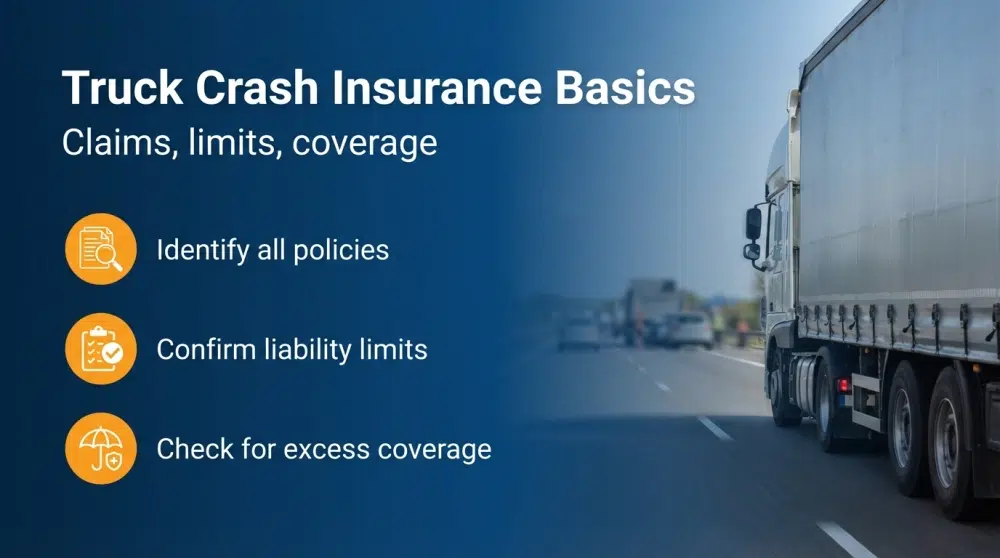
Commercial trucking usually involves larger liability policies than personal auto. Interstate motor carriers must maintain minimum financial responsibility at levels set by federal regulation. For example, the minimum for most freight carriers with vehicles over a threshold weight is higher than typical personal auto limits, and carriers hauling hazardous materials must carry even higher limits [5]. Policies issued to interstate carriers are generally accompanied by an MCS 90 endorsement, a federally required endorsement related to financial responsibility that can affect how injury judgments are paid when coverage defenses might otherwise defeat recovery [6].
There may be multiple policies in play, including the motor carrier’s liability coverage, a separate trailer owner policy, shipper or broker policies, and sometimes umbrella or excess layers. Lawyers map out the insurance stack, request certified policy copies, and analyze endorsements. Settlement negotiations are influenced by documented damages, liability evidence, and the available limits. From the defense side, claims professionals evaluate liability and damages exposure, reserve appropriately, and consider contribution and indemnity among potentially responsible entities.

What are the deadlines to file a truck accident lawsuit in California?
California has strict filing deadlines. For most personal injury and wrongful death claims, the statute of limitations is two years from the date of injury or death [9]. If a public entity is involved, such as a crash with a government vehicle or a dangerous roadway claim, a government claim usually must be presented within six months of the incident date before a civil lawsuit can be filed [10]. There are limited exceptions and tolling rules, but missing these deadlines can bar the claim. Given the complexity of multi defendant trucking cases and the need for early evidence preservation, waiting can create avoidable risk.
How do wrongful death claims work after a fatal truck crash?
In California, certain family members and dependents may bring a wrongful death claim. Recoverable losses can include financial support the decedent would have provided, loss of gifts or benefits, household services, and noneconomic losses such as the loss of love and companionship [12]. Separately, the personal representative can pursue a survival action for the decedent’s own claims that are not extinguished by death, including medical expenses and wage loss between injury and death [13]. Determining the correct plaintiffs, properly allocating damages between wrongful death and survival, and navigating probate or estate issues are important steps that counsel helps organize with sensitivity to family needs.
How do medical bills and liens get handled in truck injury cases?
Medical expenses often become a central issue. Providers, health plans, and government payers may assert liens or reimbursement rights. In California, hospitals can assert a statutory lien for reasonable and necessary emergency and ongoing care provided to an injured person, subject to specific conditions [15]. Health plans and public programs may have contract based or statutory recovery rights. Negotiating medical liens and coordinating benefits can significantly impact the net recovery to the injured person. Lawyers track bills, verify coding and causation, negotiate reductions when allowed, and structure settlements to address outstanding obligations while planning for future care.
What happens if you were partially at fault under California law?
California follows pure comparative negligence, which means your recovery is reduced by your percentage of fault rather than being completely barred. The California Supreme Court adopted this framework, and juries apportion responsibility among all parties, including the plaintiff when supported by the evidence [14]. For example, if a jury found a plaintiff 20 percent at fault and a motor carrier 80 percent at fault, the damages award would be reduced by that 20 percent allocation. This approach underscores the importance of a complete investigation that addresses both plaintiff and defendant conduct at every critical second leading up to impact.
How do settlement negotiations and mediation typically proceed?
After initial treatment stabilizes and the core evidence is preserved, many cases move into a phase focused on documenting damages and liability. Settlement demands often include medical records, bills, diagnostic images, expert opinions where needed, wage loss documentation, tax returns for self employed claimants, and a liability summary with supporting exhibits. Defense evaluations weigh liability challenges, causation disputes, and policy limits. Mediation can be productive when both sides have adequate information. Multi defendant cases require careful coordination of contribution and indemnity claims. Throughout, clear communication about goals, risk, and timing helps align expectations.
What litigation steps occur if your case goes to court?
If settlement is not achievable early, the case proceeds through filing, service, written discovery, depositions, expert discovery, motions, and trial. Discovery targets driver logs, telematics, maintenance histories, corporate policies, training materials, dispatch records, and safety audits. When relevant electronic data is lost after a duty to preserve, courts may consider remedies tailored to the prejudice, including evidence preclusion or instructions under federal rules for electronically stored information in federal cases [13]. Pretrial motions may address admissibility of prior violations, accident history, and specific regulatory materials. Trial presentation relies on clear visuals, demonstratives, and testimony that walk jurors through the timeline, the forces involved, and the human consequences.

How do lawyers work with reconstruction and technical testimony?
Trucking cases frequently involve technical analysis. Reconstruction professionals use scene measurements, vehicle inspections, crush profiles, and electronic data to calculate speeds, timing, and movement. Human factors testimony can address perception response times and visibility. Biomechanics and medical testimony can explain how the forces produced the injuries claimed. On the defense side, the same disciplines are used to challenge causation or show that occupant kinematics are inconsistent with certain alleged injuries. The strongest presentations integrate regulatory compliance analysis with physics and anatomy in a way that is accessible and fair minded.
What local factors in Los Alamitos and Orange County can impact your case?
Los Alamitos sits near busy freight corridors in northwest Orange County. Traffic flow, construction zones, and regional logistics activity can affect risk around connectors and arterials. Nearby distribution centers and port related trucking increase the presence of large vehicles at certain hours. Weather is usually clear, but early morning fog or rain can reduce visibility and traction. Local municipal rules, construction detours, and special events can change traffic patterns. These regional realities matter during investigation, because time of day, route choice, and delivery schedules can illuminate why a particular crash occurred.
Venue and jury pools also vary within the county. Most civil trucking cases connected to Los Alamitos are filed in the Orange County Superior Court. Case management orders, trial preferences, and local rules shape scheduling and motion practice. Knowing the tendencies of the venue helps both sides plan discovery and mediation timing realistically.
What should commercial drivers and trucking companies know to reduce risk?
Safety and compliance are the foundation of risk reduction for fleets and drivers operating in and around Los Alamitos. Practical steps include:
- Plan realistic routes and schedules so drivers remain within hours of service and can rest adequately between shifts [1].
- Use ELD data proactively to monitor patterns of near misses, hard braking, and speeding, and to coach safe driving behaviors [2].
- Invest in preventative maintenance and document inspections and repairs rigorously to meet federal maintenance obligations [3].
- Enforce drug and alcohol policies with compliant testing, prompt removal from safety sensitive duties after violations, and return to duty protocols [4].
- Train on cargo securement specific to commodity and equipment, and audit compliance regularly [7].
- Adopt forward facing and driver facing cameras with clear policies about data retention and privacy, and use the footage to investigate and learn from incidents.
For drivers, a personal commitment to rest, attention, defensive driving, and sober operation protects your license and the public. For carriers, leadership attention to safety culture, realistic dispatching, and technology supported coaching is a powerful combination.
What questions should you ask a Irvine truck accident attorney?
When you speak with a lawyer about a crash in Los Alamitos, consider asking:
- What is your process for preserving ELD, telematics, and camera data immediately?
- How do you evaluate both liability and medical causation fairly?
- What experts are typically involved and when do you retain them?
- How will you identify all applicable insurance policies and endorsements, including any MCS 90 issues? [6]
- How do you approach medical liens and health plan reimbursement claims to protect the client’s net recovery? [15]
- What are realistic timelines for investigation, negotiations, and, if needed, trial in Orange County?
- How will we communicate and make decisions together throughout the case?
These questions help you gauge whether the approach fits your needs and the demands of a complex trucking case.
Why is legal representation important rather than going it alone?
Commercial trucking cases are different from routine car collisions. There are federal regulations, multiple corporate entities, large insurance policies with layered coverage, and time sensitive electronic evidence. Insurers and carriers are sophisticated and act quickly. Handling this on your own creates risk of missing key data or undervaluing long term medical needs. Legal counsel brings organization, experience in dealing with motor carrier records, and the ability to coordinate investigation, medical documentation, and negotiation. Even defendants and insurers benefit from early legal involvement to preserve data, avoid spoliation disputes, and evaluate exposure accurately under the evidence and the law [13].
How do contingency fees and case costs generally work in California injury cases?
In many personal injury cases in California, attorneys work on a contingency basis, which means the attorney’s fee is a percentage of the recovery and is collected at the end if there is a settlement or judgment. Case costs, such as records, depositions, experts, and exhibits, are tracked separately and usually reimbursed from the recovery. Fee structures and percentages should be discussed clearly at the outset, along with how litigation or trial may affect costs and timelines. You should receive a written fee agreement that explains terms in plain language.
How can digital evidence from trucks and phones change outcomes?
Modern trucks generate continuous streams of data through ELDs, telematics, and engine modules. This digital record can verify or contradict driver accounts. Combined with phone records, mapping, and camera footage, the timeline of a crash can be reconstructed with precision. For plaintiffs, this can show excessive speed, improper rest, or missed inspections. For defendants, it can demonstrate compliance, reasonable speed adjustments, and timely evasive actions. When such data is preserved early and interpreted carefully, it often drives case value and resolution strategy [2].
How do lawyers help specifically in Los Alamitos, CA?
A Irvine truck accident lawyer understands the interplay of local road networks, typical freight movements, and local courts. When collisions happen near connectors or busy arterials at peak hours, prompt scene investigation and outreach to nearby businesses for video can be decisive. Relationships with local medical providers and knowledge of Orange County litigation procedures help streamline care coordination and case planning. Coordination with regional crash reconstruction resources and familiarity with area traffic patterns add practical value for both settlement and trial planning.
People searching for help commonly use terms like truck accident lawyer Los Alamitos or Irvine truck accident attorney. While search terms vary, what you need is prompt investigation, preserved electronic data, careful medical documentation, and balanced communication with insurers. That is the core of effective representation in these complex cases.
How do perspectives differ for plaintiffs and defendants in trucking cases?
From the plaintiff side, the focus is on documenting the full human and financial impact, identifying every responsible party, and proving safety rule violations that contributed to the crash. Medical documentation, future care planning for catastrophic injury, and vocational evaluations are central. From the defense side, assessing comparative fault, analyzing pre existing conditions, and auditing compliance help test the claims. Both sides benefit from early, transparent evidence exchanges where possible, because trucking cases are evidence driven. Honest appraisal of strengths and weaknesses leads to realistic negotiations or focused trial presentation.

How should specialized terms and keywords be used in your search for help?
Online searches often include phrases like personal injury lawyer Los Alamitos CA, semi truck accident lawyer, or commercial vehicle accident attorney. Keywords can help you find resources, but your decision should rest on clear communication, prompt action on evidence preservation, and a plan tailored to your injuries and circumstances. Ask each firm how they will preserve logs, download telematics, and document damages within the first days and weeks after the crash.
Many community members ask where to find truck accident lawyers in Irvine. Wherever you look, ask about immediate steps to secure ELD, camera, and phone data, because those records can be lost if not preserved quickly [2].
How GoSuits helps truck accident clients in Los Alamitos
GoSuits represents people in personal injury across California, including those hurt in truck and commercial vehicle collisions in and around Los Alamitos. A free consultation can help you understand timelines, medical documentation, and steps to protect your claim while you focus on healing. Our team uses a technology driven approach anchored by exclusive proprietary software that organizes evidence, accelerates record collection, and surfaces insights from ELD and telematics data for faster, better results without sacrificing accuracy or care.
Despite a strong technology backbone, your case is handled by a designated attorney. We do not assign case managers in place of counsel. Every client has direct and ongoing access to their attorney for strategy, updates, and decisions. The firm brings 30 years of combined experience, including trial experience that prepares cases from day one for the possibility of court. Past results reflect meaningful outcomes for clients across serious injury and wrongful death matters, and you can review a selection of outcomes here: prior cases.
We serve clients statewide in California courts. Learn who will work with you here: our attorneys. Read more about our values and client service here: about us. Explore the full range of our practice areas, including trucking, auto, motorcycle, premises liability, product liability, and more here: practice areas. We combine innovation with careful legal work, so evidence is preserved, damages are documented, and your case moves forward efficiently and confidently.
References and Resources
- Summary of Hours of Service Regulations – FMCSA
- Electronic Logging Devices Rule – FMCSA
- 49 CFR Part 396 Inspection, Repair, and Maintenance – eCFR
- 49 CFR Part 382 Controlled Substances and Alcohol Testing – eCFR
- 49 CFR 387.9 Financial Responsibility Minimum Levels – eCFR
- Insurance Requirements and MCS 90 Endorsement – FMCSA
- 49 CFR Part 393 Subpart I Cargo Securement – eCFR
- Large Truck and Bus Crash Facts 2021 – FMCSA
- California Code of Civil Procedure 335.1 Statute of Limitations – California Legislature
- California Government Code 911.2 Government Claims Deadline – California Legislature
- California Code of Civil Procedure 377.60 Wrongful Death – California Legislature
- Federal Rule of Civil Procedure 37 Electronically Stored Information – LII Cornell Law
- Li v. Yellow Cab Co. of California, 13 Cal.3d 804 – Google Scholar
- California Civil Code 3045.1 Hospital Lien Act – California Legislature