
- Which qualities should you look for in top personal injury firms for rear-end collision claims?
- How do rear-end collisions happen and what injuries and damages are common?
- What evidence do you need to prove a rear-end collision claim?
- How do negligence and comparative fault work in rear-end crash cases?
- What statutes of limitations apply in California, Texas, and Illinois?
- How do insurance claims for rear-end collisions work, including UM and UIM coverage?
- What damages are available and how are rear-end crash settlements valued?
- What should you ask a rear-end collision lawyer during a consultation?
- How does GoSuits help with rear-end collision claims nationwide?
- Where can you find the sources and references used in this guide?
Which qualities should you look for in top personal injury firms for rear-end collision claims?
If you are comparing firms for a rear-end collision claim, you want a team that can quickly organize evidence, communicate clearly, and litigate when negotiations stall. Because rear-end impacts often look straightforward, insurers sometimes minimize pain complaints or suggest preexisting conditions. The right rear-end accident attorney anticipates these issues, builds the medical record early, and presents liability and damages plainly for adjusters and juries.
What core capabilities matter most for rear-end collision claims?
- Proven trial readiness, so insurers know your case will be prepared for a jury if fair value is not offered.
- Medical literacy for soft tissue and whiplash, including how to document symptoms, imaging, and conservative treatment pathways, with references to reputable sources on mechanism and recovery [2].
- Command of negligence and comparative fault rules, including how partial fault changes payouts in your state [6].
- Insurance coverage fluency, especially navigating UM and UIM stacking, offsets, and tender sequencing [14].
- Efficient evidence collection, including police reports, scene photos, vehicle data, witness statements, and medical records.
- Transparent fee structure with contingency fee lawyers who explain costs, expenses, and net recovery in writing.
Why is experienced legal help important even for “simple” rear-end crashes?
Rear-end collisions can generate delayed-onset pain and functional limitations, especially neck and back injuries. Early documentation, consistent follow up, and organized proof of wage loss can affect both liability evaluations and damages models. Civil claims also follow structured timelines and procedures, and meeting deadlines is critical [4]. Trying to manage a claim on your own while recovering can increase the risk of missed evidence, incomplete medical proof, or compromised settlement positioning.
Many people search for the best personal injury firms, but a better question is which firm demonstrates the capabilities above for your specific situation and jurisdiction. You can narrow options by asking about similar rear-end collision claims they have handled, their approach to early medical proof, and how they prepare a case for negotiation versus trial.
How do rear-end collisions happen and what injuries and damages are common?
Most rear-end collisions stem from following too closely, inattention, unsafe speed for conditions, or a failure to appreciate stopping distances. Rain, congestion, and work zones can amplify risk. Although many rear-end crashes occur at lower speeds, the energy transfer can still cause soft tissue injury. National public health sources describe motor vehicle crashes as a leading cause of injury, with substantial medical and economic impacts across the United States [1]. NHTSA has reported hundreds of billions in crash costs nationally in a single year when accounting for medical bills, lost productivity, property loss, and quality of life impacts [3].
What injuries are often seen after rear-end crashes?
- Neck strain and whiplash, with symptoms such as neck pain and stiffness, headaches, shoulder or back pain, and sometimes cognitive or sleep disturbances. Timely evaluation helps guide treatment and recovery [2].
- Back strain, disc aggravation, or radicular symptoms, which may call for imaging, physical therapy, or pain management based on clinical judgment.
- Concussion and mild traumatic brain injury, particularly where there is head strike or rapid acceleration deceleration.
- Sprains, contusions, and seat belt related injuries, including chest wall pain or bruising.
What categories of loss can a rear-end collision generate?
- Medical bills and future care, including emergency care, diagnostics, therapy, and medications.
- Lost wages and reduced earning capacity when time away from work or work restrictions are necessary.
- Pain and suffering damages for physical pain, inconvenience, and loss of enjoyment of life recognized in civil law [13].
- Property damage claim for vehicle repair or total loss values, plus rental or loss of use where available.
A seasoned rear-end collision lawyer will translate these categories into an organized claim supported by records, itemized bills, and clear narrative summaries.

What evidence do you need to prove a rear-end collision claim?
Insurers and courts evaluate two broad questions, liability and damages. Strong documentation for both can shorten the path to a fair settlement. While liability is often straightforward in rear-end cases, disputes can arise over sudden stops, brake lights, or multi-vehicle chains. Damages require medical proof and credible causation.
Which liability documents help establish fault in a rear-end crash?
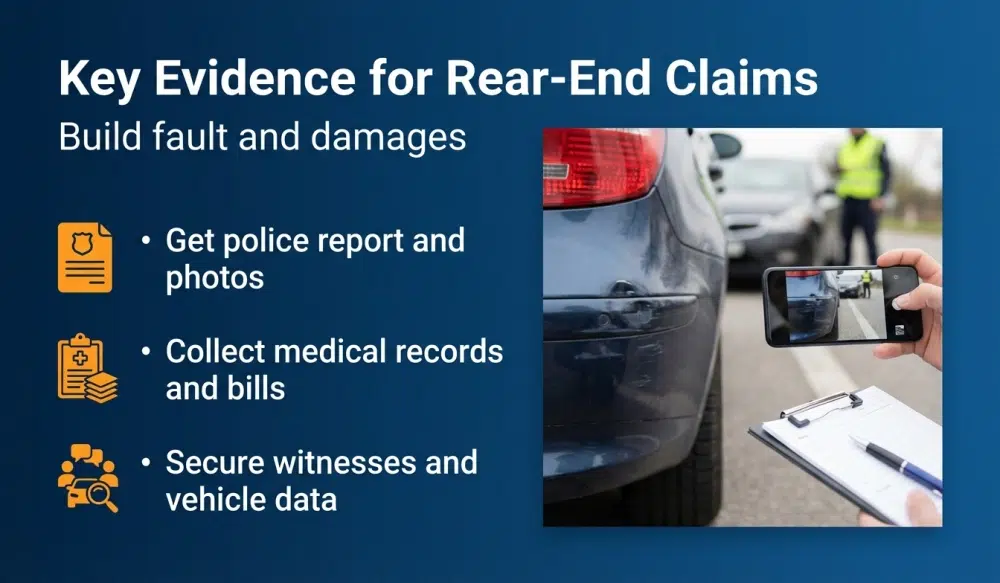
- Police report and evidence, including diagram, narrative, and any citations. In California, crashes meeting reporting thresholds can be documented, and separate DMV reporting can apply for injuries or significant property damage [15].
- Scene photos and videos, showing resting positions, debris, skid marks, and weather or traffic conditions.
- Vehicle damage photos and repair estimates, which can corroborate impact direction and severity.
- Witness statements and contact information, gathered as soon as possible.
- Event data recorder downloads, if impact severity or speed must be quantified.
What medical and economic documents support damages?
- Emergency and primary care records, documenting early symptoms and mechanism of injury.
- Therapy, imaging, and specialist notes, to track response to treatment and ongoing limitations.
- Billing ledgers and explanation of benefits, to establish gross charges, payments, and outstanding balances.
- Employment verification and payroll records, to substantiate wage loss and sick time use.
How does a demand letter package your claim?
A comprehensive demand letter presents liability, medical chronology, itemized losses, and a settlement proposal. It typically includes a concise facts section, statutory or case law highlights as needed, a damages summary with exhibits, and settlement terms. It is common for a rear-end accident attorney to emphasize core negligence elements and any comparative fault defenses that may arise, supported by the evidence discussed below [5] [6].
How do negligence and comparative fault work in rear-end crash cases?
In civil law, negligence generally requires a duty, breach, causation, and damages. Drivers owe a duty to follow at a safe distance and maintain a proper lookout. Breach can be established through traffic laws, witness testimony, or physical evidence. Causation connects the breach to the injuries and losses. These foundational rules are widely recognized in American tort law [5].
How does comparative negligence change outcomes?
Comparative negligence reduces damages by the plaintiff’s percentage of fault. States vary, with some using pure comparative systems and others applying modified rules that bar recovery above a threshold. Understanding your jurisdiction’s rule is crucial for negotiation and trial strategy [6].
What do the California, Texas, and Illinois comparative fault rules say?
- California recognizes comparative fault, and state law apportions noneconomic damages according to each defendant’s percentage of fault, often discussed in the context of Civil Code section 1431.2 [12].
- Texas uses proportionate responsibility. A claimant who is more than 50 percent responsible cannot recover, and any recovery is reduced by the claimant’s percentage of responsibility [10].
- Illinois applies modified comparative negligence. Recovery is barred if the plaintiff’s fault is more than 50 percent. Otherwise, damages are reduced by the percentage of fault [11].
Comparative fault issues can arise in rear-end cases when the lead driver stops suddenly, has nonfunctional brake lights, or reverses. Evidence that clarifies time, distance, and speed helps resolve these disputes.
When you consult car accident lawyers, they should explain how your state’s rules affect settlement ranges and trial risks, and what additional proof would strengthen your position.

What statutes of limitations apply in California, Texas, and Illinois?
Statutes of limitations set the deadline to file suit. Missing the deadline usually means the claim cannot proceed. Always confirm the deadline for your specific claim type and facts.
- California. Most personal injury actions must be filed within two years of the injury date under Code of Civil Procedure section 335.1 [7].
- Texas. Most personal injury actions have a two year limitations period under Civil Practice and Remedies Code section 16.003 [8].
- Illinois. Most personal injury actions must be brought within two years under 735 ILCS 5/13-202 [9].
There are exceptions, such as claims against government entities with shorter notice requirements, minors, or other tolling rules. For a rear-end crash in Texas, discussing timing and any tolling issues with Texas car accident lawyers can help you avoid deadline problems while you focus on treatment.
How do insurance claims for rear-end collisions work, including UM and UIM coverage?
Rear-end collision claims often begin with the at-fault driver’s liability policy. Where available, you may also make a claim for medical payments coverage and, if the at-fault insurance is insufficient, uninsured motorist or underinsured motorist coverage. UM and UIM can be crucial in low limit or hit and run scenarios, and policy terms vary by state and carrier [14].
What steps should you take after a rear-end crash to protect your insurance claim?
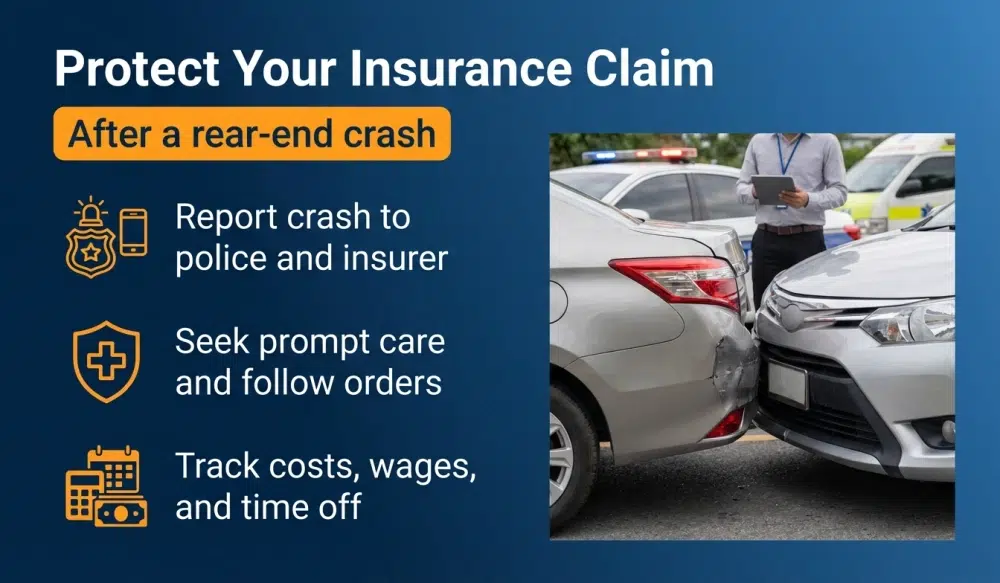
- Report the crash to law enforcement when required, and follow any state specific reporting obligations such as California’s SR 1 reporting for certain losses [15].
- Seek timely medical care and follow recommended treatment so your records reflect symptoms and recovery.
- Notify your insurer promptly to preserve coverage and comply with policy conditions.
- Track all expenses and time off work for inclusion in your damages package.
How do claims adjusters evaluate rear-end collision files?
Adjusters weigh liability clarity, property damage patterns, medical documentation, treatment duration, any gaps, and causation. Some common claims adjuster tactics include disputing the relationship between minor vehicle damage and reported symptoms, emphasizing preexisting conditions, or suggesting overtreatment. A well documented file with a clear medical timeline can reduce friction and improve outcomes.
When do UM or UIM claims come into play?
- Uninsured motorist claims arise when the at-fault driver has no liability coverage or in certain hit and run situations, depending on state law [14].
- Underinsured motorist claims arise when the at-fault driver’s limits are insufficient to cover your damages, and UIM is available under your policy and state law [14].
Your rear-end collision lawyer can sequence tenders, preserve subrogation issues, and coordinate medical liens or reimbursements to maximize net recovery within policy constraints.
What damages are available and how are rear-end crash settlements valued?
Damages typically include economic losses like medical bills and wages, and noneconomic losses like pain and suffering. Civil law recognizes these categories and allows proof through testimony, records, and expert opinions where appropriate [13]. Insurers and juries consider injury severity, treatment reasonableness, prognosis, permanent impairment, and how the injury affects daily activities and work.
What factors often influence settlement value?
- Liability strength, including whether fault is conceded or contested and any comparative negligence exposure.
- Medical proof quality, especially contemporaneous records that reflect mechanism, symptoms, and functional impact.
- Objective findings, such as imaging or neurological assessments, balanced with clinical judgment.
- Duration and consistency of care, showing sustained impact and appropriate treatment progression.
- Economic loss substantiation, with employer letters, payroll records, and vocational evidence if needed.
- Venue considerations, including jury demographics and state law on damages and fault allocation.
What should you ask a rear-end collision lawyer during a consultation?
A productive initial meeting can set the trajectory of your case. Organize your questions and bring key documents, including the police report, photos, your insurance card, and a list of providers. The consultation is also an opportunity to understand fee structures and litigation timelines.
Which questions reveal a firm’s approach to rear-end collisions?
- How will you develop the medical proof for whiplash, back pain, or concussion claims in my file [2]?
- What are the likely liability disputes and how will you address them with evidence or expert testimony?
- How do you handle UM and UIM claims if liability limits are low [14]?
- What is the expected timeline for demand, negotiation, and filing suit if necessary [4]?
- How do you communicate about treatment progress, settlement strategy, and trial preparation?
If you are selecting among nationwide car accident attorneys, also ask about their experience in the states most relevant to your claim, such as California, Texas, or Illinois, since comparative fault and limitation periods differ [7] [8] [9].
People often search for rear-end collision lawyer or rear-end accident attorney when they are in pain and unsure about next steps. A calm, organized consultation can help you regain control, understand the process, and avoid common pitfalls like giving recorded statements before your medical picture is clear.
For perspective on the marketplace, many clients look for car accident lawyers because these cases involve liability disputes, medical documentation, and negotiations that benefit from legal training and courtroom experience.
How does GoSuits help with rear-end collision claims nationwide?
Rear-end collision claims fall squarely within personal injury. If you were hit from behind, a free consultation with a personal injury attorney can clarify your legal options, timelines, and documentation needs, and it can help you avoid mistakes that might weaken your case. GoSuits represents clients nationwide and understands how to navigate differences among states, including filing deadlines and comparative negligence rules that can affect outcomes [6] [7] [8] [11].
What sets GoSuits’ approach apart for rear-end collision claims?
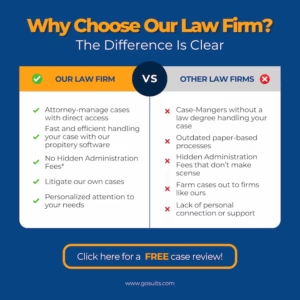
- Technology driven case management. We use exclusive proprietary software to move your case forward faster with cleaner documentation and better organization for settlement and trial.
- Designated attorneys for every client. You will not be routed to case managers. You have unfettered access to your attorney throughout the life of your case.
- Trial experience. Trial readiness benefits settlement positioning. Our litigators prepare cases to present clearly to a jury when necessary, which can encourage fair offers.
- 30 years of combined experience. Our team has decades of combined work across injury law, including rear-end collision claims, soft tissue injuries, and serious loss cases.
- Documented past results. See examples of resolved cases at prior cases, and learn more about the team at our attorneys and about us.
- Full scope personal injury practice. Explore our practice areas for car, truck, motorcycle, premises, product liability, and catastrophic injury matters.
How does GoSuits handle client communication and negotiation?
- Direct attorney access, so your questions about treatment, valuation, and next steps are answered promptly.
- Proactive evidence building, including early medical chronologies, wage loss proof, and demand packages that address typical adjuster arguments.
- Strategic mediation and litigation, calibrated to your goals, with clear updates on offers, risks, and timing.
We are ready to help you bring an organized, persuasive rear-end collision claim from initial investigation through resolution. Our process is built to save time without sacrificing advocacy, with the goal of better outcomes through preparation and efficient execution.
Where can you find the sources and references used in this guide?
- Motor Vehicle Safety, Data and Statistics – Centers for Disease Control and Prevention
- Whiplash Information Page – National Institute of Neurological Disorders and Stroke
- The Economic and Societal Impact of Motor Vehicle Crashes, 2019 – National Highway Traffic Safety Administration
- Civil Cases, Process Overview – United States Courts
- Negligence, Elements and Definition – Legal Information Institute, Cornell Law School
- Comparative Negligence – Legal Information Institute, Cornell Law School
- Cal. Code Civ. Proc. § 335.1 – California Legislative Information
- Tex. Civ. Prac. and Rem. Code § 16.003 – Texas Statutes
- 735 ILCS 5/13-202 – Illinois Compiled Statutes
- Tex. Civ. Prac. and Rem. Code Chapter 33, Proportionate Responsibility – Texas Statutes
- 735 ILCS 5/2-1116, Comparative Negligence – Illinois Compiled Statutes
- Cal. Civ. Code § 1431.2 – California Legislative Information
- Damages, Types and Principles – Legal Information Institute, Cornell Law School
- Uninsured Motorist Coverage – Legal Information Institute, Cornell Law School
- Accident Report SR 1 – California Department of Motor Vehicles